
Verwandte Artikel zu Toxic Parents: Overcoming Their Hurtful Legacy and...
Inhaltsangabe
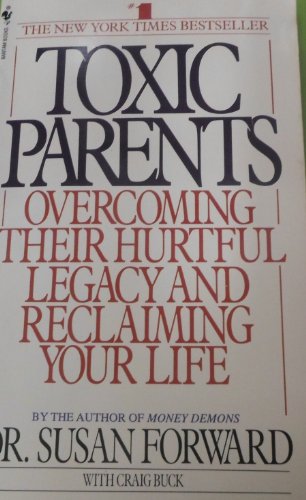
The connection between controlling abusive or alcoholic parents and adult problems with self-esteem, work, or intimacy is examined in a compelling guide to coming to terms with a troubled childhood
Die Inhaltsangabe kann sich auf eine andere Ausgabe dieses Titels beziehen.
Über die Autorin bzw. den Autor
Susan Forward, Ph.D., is an internationally renowned therapist, lecturer, and author of the number one New York Times bestsellers Toxic Parents and Men Who Hate Women and the Women Who Love Them, as well as Betrayal of Innocence: Incest and Its Devastation, Money Demons, Emotional Blackmail, When Your Lover Is a Liar, and Toxic In-Laws.
In addition to her private practice, for five years she hosted a daily ABC talk-radio program. She has also served widely as a group therapist, instructor, and consultant in many southern California medical and psychiatric facilities, and she formed the first private sexual abuse treatment center in California. She lives in Los Angeles and has two grown children.
Dr.
Aus dem Klappentext
e a child...
Did your parents tell you were bad or worthless?
Did your parents use physical pain to discipline you?
Did you have to take care of your parents because of their problems?
Were you frightened of your parents?
Did your parents do anything to you that had to be kept secret?
Now that you are an adult...
Do your parents still treat you as if you were a child?
Do you have intense emotional or physical reactions after spending time with your parents?
Do your parents control you with threats or guilt?
Do they manipulate you with money?
Do you feel that no matter what you do, it's never good enough for your parents?
In this remarkable self-help guide, Dr. Susan Forward drawn on case histories and the real-life voices of adult children of toxic parents to help you free yourself from the frustrating patterns of your relationship with your parent
Auszug. © Genehmigter Nachdruck. Alle Rechte vorbehalten.
Godlike Parents
The Myth of the Perfect Parent
The ancient Greeks had a problem. The gods looked down from their ethereal playground atop Mount Olympus and passed judgment on everything the Greeks were up to. And if the gods weren't pleased, they were swift to punish. They didn't have to be kind; they didn't have to be just; they didn't even have to be right. In fact, they could be downright irrational. At their whim, they could turn you into an echo or make you push a boulder uphill for all eternity. Needless to say, the unpredictability of these powerful gods sowed quite a bit of fear and confusion among their mortal followers.
Not unlike many toxic parent-child relationships. An unpredictable parent is a fearsome god in the eyes of a child.
When we're very young, our godlike parents are everything to us. Without them, we would be unloved, unprotected, unhoused, and unfed, living in a constant state of terror, knowing we were unable to survive alone. They are our all-powerful providers. We need, they supply.
With nothing and no one to judge them against, we assume them to be perfect parents. As our world broadens beyond our crib, we develop a need to maintain this image of perfection as a defense against the great unknowns we increasingly encounter. As long as we believe our parents are perfect, we feel protected.
In our second and third years of life, we begin to assert our independence. We resist toilet training and revel in our "terrible twos." We embrace the word no because it allows us to exercise some control over our lives, whereas yes is simply an acquiescence. We struggle to develop a unique identity, establish our own will.
The process of separating from parents reaches its peak during puberty and adolescence, when we actively confront parental values, tastes, and authority. In a reasonably stable family, parents are able to withstand much of the anxiety that these changes create. For the most part, they will attempt to tolerate, if not exactly encourage, their child's emerging independence. The expression "it's just a phase" becomes a standard assurance for understanding parents, who remember their own teenage years and appreciate rebellion as a normal stage of emotional development.
Toxic parents aren't so understanding. From toilet training through adolescence, they tend to see rebellion or even individual differences as a personal attack. They defend themselves by reinforcing their child's dependence and helplessness. Instead of promoting healthy development, they unconsciously undermine it, often with the belief that they are acting in their child's best interest. They may use phrases such as "it builds character" or "she needs to learn right from wrong," but their arsenals of negativity really harm their child's self-esteem, sabotaging any budding independence. No matter how much these parents believe they're right, such assaults are confusing to a child, bewildering in their animosity, their vehemence, and their suddenness.
Our culture and our religions are almost unanimous in upholding the omnipotence of parental authority. It's acceptable to express anger at our husbands, wives, lovers, siblings, bosses, and friends, but it's almost taboo to assertively confront our parents. How often have we heard the phrases "don't talk back to your mother" or "don't you dare shout at your father"? The Judeo-Christian tradition enshrines the taboo in our collective unconscious by pronouncing "God the Father" and directing us to "honor thy father and mother." The idea finds voices in our schools, our churches, our government ("a return to family values"), even in our corporations. According to the conventional wisdom, our parents are empowered to control us simply because they gave us life.
The child is at the mercy of his godlike parents and, like the ancient Greeks, never knows when the next lightning bolt will strike. But the child of toxic parents knows that the lightning is coming sooner or later. This fear becomes deeply ingrained and grows with the child. At the core of every formerly mistreated adult--even high achievers--is a little child who feels powerless and afraid.
The Cost of Appeasing the Gods
As a child's self-esteem is undermined, his dependence grows, and with it his need to believe that his parents are there to protect and provide. The only way emotional assaults or physical abuse can make sense to a child is if he or she accepts responsibility for the toxic parent's behavior.
No matter how toxic your parents might be, you still have a need to deify them. Even if you understand, on one level, that your father was wrong to beat you, you may still believe he was justified. Intellectual understanding is not enough to convince your emotions that you were not responsible.
As one of my clients put it: "I thought they were perfect, so when they treated me badly, I figured I was bad."
There are two central doctrines in this faith of godlike parents:
1."I am bad and my parents are good."
2."I am weak and my parents are strong."
These are powerful beliefs that can long outlive your physical dependence on your parents. These beliefs keep the faith alive; they allow you to avoid facing the painful truth that your godlike parents actually betrayed you when you were most vulnerable.
Your first step toward controlling your life is to face that truth for yourself. It will take courage, but if you're reading this book, you've already made a commitment to change. That took courage, too.
"They Never Let Me Forget How I Disgraced Them"
Sandy, 28, a striking brunette who seemed to "have it all," was seriously depressed when she first came to see me. She told me that she was unhappy with everything in her life. She had been a floral designer for several years at a prestigious shop. She had always dreamed of opening her own business, but she was convinced that she wasn't smart enough to succeed. She was terrified of failure.
Sandy had also been trying to get pregnant for more than two years, with no success. As we talked, I began to see that her inability to get pregnant was causing her to feel strong resentment toward her husband and inadequate in their relationship, despite the fact that he sounded genuinely understanding and loving. A recent conversation with her mother had aggravated the issue:
This whole pregnancy has become a real obsession with me. When I had lunch with my mom I told her how disappointed I was. She said to me, "I'll bet it's that abortion you had. The Lord works in mysterious ways." I haven't been able to stop crying since. She never lets me forget.
I asked her about the abortion. After some initial hesitancy, she told me the story:
It happened when I was in high school. My parents were very, very strict Catholics, so I went to parochial school. I developed early, and by the time I was twelve, I was five-foot-six, weighed one hundred thirty pounds, and wore a 36-C bra. Boys started paying attention to me, and I really liked it. It drove my dad crazy. The first time he caught me kissing a boy good night, he called me a whore so loud that the whole neighborhood heard. It was downhill from there. Every time I went out with a boy, Dad told me I was going to hell. He never let up. I figured I was damned anyway, so when I was fifteen I slept with this guy. Just my luck, I got pregnant. When my folks found out, they went nuts. Then I told them I wanted an abortion; they totally lost it. They must have screamed at me about "mortal sin" a thousand times. If I wasn't going to hell already, they were sure this would clinch it. The only way I could get them to sign a consent was to threaten to kill...
„Über diesen Titel“ kann sich auf eine andere Ausgabe dieses Titels beziehen.
Suchergebnisse für Toxic Parents: Overcoming Their Hurtful Legacy and...

Beispielbild für diese ISBN
Toxic Parents
Verlag:
Bantam Doubleday Dell Publishing Group Inc, 1989
ISBN 10: 0553284347
ISBN 13: 9780553284348
Gebraucht
Paperback
Anbieter: World of Books (was SecondSale), Montgomery, IL, USA
Verkäuferbewertung 5 von 5 Sternen

Paperback. Zustand: Good. Are you the child of toxic parents? When you were a child. - Did your parents tell you you were bad or worthless?- Did your parents use physical pain to discipline you?- Did you have to take care of your parents because of their problems?- Were you often frightened of your parents?- Did your parents do anything to you that had to be kept secret? Now that you're an adult. - Do your parents still treat you as if you were a child?- Do you have intense emotional or physical reactions after spending time with your parents?- Do your parents control you with threats or guilt? Do they manipulate you with money?- Do you feel that no matter what you do, it's never good enough for your parents? In this remarkable self-help guide, Dr. Susan Forward draws on case histories and the real-life voices of adult children of toxic parents to help you free yourself from the frustrating patterns of your relationship with your parents -- and discover a new world of self-confidence, inner strength, and emotional independence. Artikel-Nr. 00095856435
Gebraucht kaufen
EUR 4,53
Versand gratis
Versand innerhalb von USA
Versand innerhalb von USA
Anzahl: 1 verfügbar
Beispielbild für diese ISBN
Toxic Parents
Verlag:
Bantam Doubleday Dell Publishing Group Inc, 1989
ISBN 10: 0553284347
ISBN 13: 9780553284348
Gebraucht
Paperback
Anbieter: World of Books (was SecondSale), Montgomery, IL, USA
Verkäuferbewertung 5 von 5 Sternen
Paperback. Zustand: Fair. Are you the child of toxic parents? When you were a child. - Did your parents tell you you were bad or worthless?- Did your parents use physical pain to discipline you?- Did you have to take care of your parents because of their problems?- Were you often frightened of your parents?- Did your parents do anything to you that had to be kept secret? Now that you're an adult. - Do your parents still treat you as if you were a child?- Do you have intense emotional or physical reactions after spending time with your parents?- Do your parents control you with threats or guilt? Do they manipulate you with money?- Do you feel that no matter what you do, it's never good enough for your parents? In this remarkable self-help guide, Dr. Susan Forward draws on case histories and the real-life voices of adult children of toxic parents to help you free yourself from the frustrating patterns of your relationship with your parents -- and discover a new world of self-confidence, inner strength, and emotional independence. Artikel-Nr. 00097544172
Gebraucht kaufen
EUR 4,53
Versand gratis
Versand innerhalb von USA
Versand innerhalb von USA
Anzahl: 3 verfügbar
Beispielbild für diese ISBN
Toxic Parents: Overcoming Their Hurtful Legacy and Reclaiming Your Life
Verlag:
Bantam (edition Reissue), 1990
ISBN 10: 0553284347
ISBN 13: 9780553284348
Gebraucht
Paperback
Anbieter: BooksRun, Philadelphia, PA, USA
Verkäuferbewertung 5 von 5 Sternen
Paperback. Zustand: Very Good. Reissue. It's a well-cared-for item that has seen limited use. The item may show minor signs of wear. All the text is legible, with all pages included. It may have slight markings and/or highlighting. Artikel-Nr. 0553284347-11-1
Gebraucht kaufen
EUR 4,54
Versand gratis
Versand innerhalb von USA
Versand innerhalb von USA
Anzahl: 2 verfügbar
Beispielbild für diese ISBN
Toxic Parents: Overcoming Their Hurtful Legacy and Reclaiming Your Life
Anbieter: ThriftBooks-Dallas, Dallas, TX, USA
Verkäuferbewertung 5 von 5 Sternen
Paperback. Zustand: Good. No Jacket. Pages can have notes/highlighting. Spine may show signs of wear. ~ ThriftBooks: Read More, Spend Less. Artikel-Nr. G0553284347I3N00
Gebraucht kaufen
EUR 6,07
Versand gratis
Versand innerhalb von USA
Versand innerhalb von USA
Anzahl: 1 verfügbar
Beispielbild für diese ISBN
Toxic Parents : Overcoming Their Hurtful Legacy and Reclaiming Your Life
Verlag:
Bantam Doubleday Dell Publishing Group, 1990
ISBN 10: 0553284347
ISBN 13: 9780553284348
Gebraucht
Softcover
Anbieter: Better World Books, Mishawaka, IN, USA
Verkäuferbewertung 5 von 5 Sternen
Zustand: Good. Pages intact with minimal writing/highlighting. The binding may be loose and creased. Dust jackets/supplements are not included. Stock photo provided. Product includes identifying sticker. Better World Books: Buy Books. Do Good. Artikel-Nr. GRP76406746
Gebraucht kaufen
EUR 6,47
Versand gratis
Versand innerhalb von USA
Versand innerhalb von USA
Anzahl: 3 verfügbar
Beispielbild für diese ISBN
Toxic Parents : Overcoming Their Hurtful Legacy and Reclaiming Your Life
Verlag:
Bantam Doubleday Dell Publishing Group, 1990
ISBN 10: 0553284347
ISBN 13: 9780553284348
Gebraucht
Softcover
Anbieter: Better World Books: West, Reno, NV, USA
Verkäuferbewertung 5 von 5 Sternen
Zustand: Very Good. Pages intact with possible writing/highlighting. Binding strong with minor wear. Dust jackets/supplements may not be included. Stock photo provided. Product includes identifying sticker. Better World Books: Buy Books. Do Good. Artikel-Nr. 4951212-6
Gebraucht kaufen
EUR 6,47
Versand gratis
Versand innerhalb von USA
Versand innerhalb von USA
Anzahl: 1 verfügbar
Beispielbild für diese ISBN
Toxic Parents : Overcoming Their Hurtful Legacy and Reclaiming Your Life
Verlag:
Bantam Doubleday Dell Publishing Group, 1990
ISBN 10: 0553284347
ISBN 13: 9780553284348
Gebraucht
Softcover
Anbieter: Better World Books: West, Reno, NV, USA
Verkäuferbewertung 5 von 5 Sternen
Zustand: Good. Pages intact with minimal writing/highlighting. The binding may be loose and creased. Dust jackets/supplements are not included. Stock photo provided. Product includes identifying sticker. Better World Books: Buy Books. Do Good. Artikel-Nr. GRP76406746
Gebraucht kaufen
EUR 6,47
Versand gratis
Versand innerhalb von USA
Versand innerhalb von USA
Anzahl: 1 verfügbar
Beispielbild für diese ISBN
Toxic Parents: Overcoming Their Hurtful Legacy and Reclaiming Your Life
Anbieter: WorldofBooks, Goring-By-Sea, WS, Vereinigtes Königreich
Verkäuferbewertung 5 von 5 Sternen
Paperback. Zustand: Good. The book has been read but remains in clean condition. All pages are intact and the cover is intact. Some minor wear to the spine. Artikel-Nr. GOR001573736
Gebraucht kaufen
EUR 3,35
EUR 6,51 Versand
Versand von Vereinigtes Königreich nach USA
Versand von Vereinigtes Königreich nach USA
Anzahl: 2 verfügbar
Beispielbild für diese ISBN
Toxic Parents: Overcoming Their Hurtful Legacy and Reclaiming Your Life
Anbieter: WorldofBooks, Goring-By-Sea, WS, Vereinigtes Königreich
Verkäuferbewertung 5 von 5 Sternen
Paperback. Zustand: Very Good. The book has been read, but is in excellent condition. Pages are intact and not marred by notes or highlighting. The spine remains undamaged. Artikel-Nr. GOR002424371
Gebraucht kaufen
EUR 3,35
EUR 6,51 Versand
Versand von Vereinigtes Königreich nach USA
Versand von Vereinigtes Königreich nach USA
Anzahl: 1 verfügbar
Beispielbild für diese ISBN
Toxic Parents : Overcoming Their Hurtful Legacy and Reclaiming Your Life
Verlag:
Bantam Doubleday Dell Publishing Group, 1990
ISBN 10: 0553284347
ISBN 13: 9780553284348
Gebraucht
Softcover
Anbieter: Better World Books Ltd, Dunfermline, Vereinigtes Königreich
Verkäuferbewertung 5 von 5 Sternen
Zustand: Good. Pages intact with minimal writing/highlighting. The binding may be loose and creased. Dust jackets/supplements are not included. Stock photo provided. Product includes identifying sticker. Better World Books: Buy Books. Do Good. Artikel-Nr. GRP76406746
Gebraucht kaufen
EUR 5,62
EUR 5,81 Versand
Versand von Vereinigtes Königreich nach USA
Versand von Vereinigtes Königreich nach USA
Anzahl: 1 verfügbar