
Verwandte Artikel zu Focusing
Inhaltsangabe
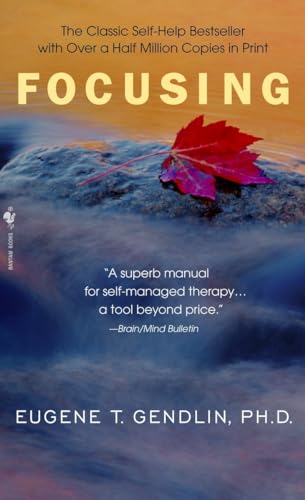
The classic guide to a powerful technique that can increase your mindfulness and lead to personal transformation
Based on groundbreaking research conducted at the University of Chicago, the focusing technique has gained widespread popularity and scholarly acclaim. It consists of six easy-to-master steps that identify and change the way thoughts and emotions are held within the body. Focusing can be done virtually anywhere, at any time, and an entire “session” can take no longer than ten minutes, but its effects can be felt immediately–in the relief of bodily tension and psychological stress, as well as in dramatic shifts in understanding and insight.
In this highly accessible guide, Dr. Eugene Gendlin, the award-winning psychologist who developed the focusing technique, explains the basic principles behind focusing and offers simple step-by-step instructions on how to utilize this powerful tool for tapping into greater self-awareness and inner wisdom. As you learn to develop your natural ability to “focus,” you’ll find yourself more in sync with both mind and body, filled with greater self-assurance, and better equipped to make the positive changes necessary to improve and enhance every aspect of your life.
Die Inhaltsangabe kann sich auf eine andere Ausgabe dieses Titels beziehen.
Über die Autorin bzw. den Autor
Eugene T. Gendlin received his Ph.D. in philosophy from the University of Chicago and taught there from 1963 to 1995. He has been honored three times by the American Psychological Association for his development of experiential psychotherapy. He received the first Distinguished Professional Psychologist of the Year award from the Clinical Division and an award from the Philosophical Psychology Division; he and the Focusing Institute received an award from the Humanistic Division in 2000. He was the founder and editor for many years of the Clinical Division journal Psychotherapy: Theory, Research and Practice. His book Focusing has sold over 500,000 copies and is translated into seventeen languages. His other books include Let Your Body Interpret Your Dreams, Focusing-Oriented Psychotherapy, Experiencing and the Creation of Meaning, Language Beyond Post-Modernism: Saying and Thinking in Gendlin’s Philosophy (edited by David Levin), and A Process Model.
Von der hinteren Coverseite
What is focusing? Based on research at the University of Chicago, focusing is a new technique of self therapy that teaches you to identify and change the way your personal problems concretely exist in your body. "Focusing consists of steps of felt change. Unlike methods that stress "getting in touch with your feelings," there is a built-in test: each focusing step, when done correctly, is marked by a physical relief, a profound release of tension. "Focusing guides you to the deepest level of awareness within your body. It is on this level, unfamiliar to most people, that unresolved problems actually exist, and only on this level can they change.
Auszug. © Genehmigter Nachdruck. Alle Rechte vorbehalten.
Chapter 1
The Inner Act
At the University of Chicago and elsewhere in the past fifteen years, a group of colleagues and I have been studying some questions that most psychotherapists don't like to ask out loud. Why doesn't therapy succeed more often? Why does it so often fail to make a real difference in people's lives? In the rarer cases when it does succeed, what is it that those patients and therapists do? What is it that the majority fail to do?
Seeking answers, we studied many forms of therapy from classical approaches to recent ones. We analyzed literally thousands of therapist-patient sessions recorded on tape. Our series of studies had led to several findings, some very different from what we and most other professional therapists expected.
First, we found that the successful patient—the one who shows real and tangible change on psychological tests and in life—can be picked out fairly easily from recorded therapy sessions. What these rare patients do in their therapy hours is different from the others. The difference is so easy to spot that, once we had defined it, we were able to explain it to inexperienced young undergraduates, and they too were able to sort out the successful patients from the others.
What is this crucial difference? We found that it is not the therapist's technique—differences in methods of therapy seem to mean surprisingly little. Nor does the difference lie in what the patients talk about. The difference is in how they talk. And that is only an outward sign of the real difference: what the successful patients do inside themselves.
The purpose of this book is to tell you what they do and how you can do it. For this uncommon skill, this internal act, not only is useful in a psychotherapist's office, it is a way of approaching any problem or situation.
We have taught this skill to large numbers of people not in therapy in subsequent years. Now that it seems anyone can learn it, I also want this book to be readable by anyone. The book is addressed to professionals, but not only to them. Therefore I am writing it simply and not in the technical manner of my philosophical and scientific publications.
The skill we have observed and defined is not only for problems. Among those who know it, it becomes an internal source that is consulted many times every day. I am using it right now, in the process of writing this book.
The skill I am about to teach you is called focusing.
It will enable you to find and change where your life is stuck, cramped, hemmed in, slowed down. And it will enable you to change—to live from a deeper place than just your thoughts and feelings.
One fact that disturbed us the most in those research studies was that patients who did the crucial thing inside themselves could be picked out in the first two therapy sessions. We found we could predict success or failure right from the start just by analyzing the early interviews. According to a careful statistical analysis, there was less than a thousand-to-one chance of getting the same finding accidentally.
Today we know how to teach focusing. So this finding does not mean that some people cannot learn it. But at the time this was a shocking discovery. Here we had therapists and patients embarking on a year or more of hard effort. Much human need, hope, devotion, and money would be involved, and we already knew they would fail.
The finding means that psychotherapy as usually practiced doesn't show patients how to do psychotherapy. In other words, patients did not improve with practice. If they did not somehow know right from the start how to approach themselves inside in that special way, they did not achieve major changes, no matter what they or their therapists did or how earnestly or for how long.
This finding was contrary to my predictions, and to what had been my own firm subjective conviction. I thought I had experienced the gradual opening and increasing ability of patients to come into touch with their feelings. I had been certain that patients learn to do psychotherapy in themselves over the course of treatment, and do it more effectively in the second half. I had had many experiences of beginning with patients who seemed inept at sensing themselves inwardly, and, by my own skills as a therapist, and with the patients' efforts, I had brought many such patients to a successful resolution of their problems.
One reason why research is so important is precisely that it can surprise you and tell you that your subjective convictions are wrong. If research always found what we expected, there wouldn't be much point in doing research.
With hindsight I realize I was thinking only of the successful patients and not of the many patients with whom I failed. Now we know how to teach these people the crucial skill as well.
The research shows plainly, and repeatedly, that successful patients do indeed improve in this key skill, but the research also shows that they had it to some extent right at the beginning. The others, those who failed, did not have it at all and never achieved it through psychotherapy alone. At that time we did not know how to teach it.
Most therapists don't know what this crucial internal approach is, let alone how to help patients learn it. So I was led to wonder: can it be taught?
My first feeling, stemming from my training as a psychotherapist, was to say no, it can't be taught. I was trained to believe that only a very naive therapist would try to tell the patient in words how therapy works. Someone who hasn't experienced it wouldn't understand the words. Psychotherapy was supposed to be an art, a mystery, not a science. Some groups claim to have developed exact scientific techniques, but this is only a propaganda claim. The omniscient and totally self-assured psychotherapist exists only in the movies. Of course, each school of therapists has its own ideas and techniques, but they all know that they stumble around confusedly when their techniques don't work, which is more often than not. Therefore no serious psychotherapist would claim to be able to put into words exactly what makes therapy work, how to make changes happen inside a person. Only therapy itself was supposed to teach how.
But the research had shown that therapy does not teach how to those who don't already know how. The research had also shown very specifically what the crucial inner act is. Was it naive, now, to think it might be teachable?
Despite my doubts, I set out to see if I could make that all-important inner act teachable. With many people's help, I gradually devised specific directions for doing what those rare successful patients had somehow known how to do. We tried those directions out on large numbers of people and revised them and tried them again many times over a period of years. Those instructions have now become very specific and very teachable. Research conducted in several places has shown that people can be taught effectively in these ways to perform that internal act (see appendix).
Since this crucial internal act can be taught, and is not taught by therapy, people need not be therapy patients to learn it. What follows from this fact is a kind of revolution. No longer need this change process be in the charge of therapists. People can do it for themselves and with each other.
Of course they are not "therapists" or "doctors" or "authorities" with each other, but the authority aspect of the medical doctor never has really fitted the human process of personal change at all. Human problems are by their very nature such that we are each inherently in charge of ourselves. No authority can resolve our problems or tell us how to live. Therefore I...
„Über diesen Titel“ kann sich auf eine andere Ausgabe dieses Titels beziehen.
Suchergebnisse für Focusing

Foto des Verkäufers
Focusing
Anbieter: Dream Books Co., Denver, CO, USA
Verkäuferbewertung 5 von 5 Sternen

Zustand: good. Gently used with minimal wear on the corners and cover. A few pages may contain light highlighting or writing, but the text remains fully legible. Dust jacket may be missing, and supplemental materials like CDs or codes may not be included. May be ex-library with library markings. Ships promptly! Artikel-Nr. DBV.0553278339.G
Gebraucht kaufen
EUR 5,52
Versand gratis
Versand innerhalb von USA
Versand innerhalb von USA
Anzahl: 2 verfügbar
Beispielbild für diese ISBN
Focusing
Anbieter: ThriftBooks-Dallas, Dallas, TX, USA
Verkäuferbewertung 5 von 5 Sternen
Mass Market Paperback. Zustand: Good. No Jacket. Pages can have notes/highlighting. Spine may show signs of wear. ~ ThriftBooks: Read More, Spend Less. Artikel-Nr. G0553278339I3N00
Gebraucht kaufen
EUR 5,86
Versand gratis
Versand innerhalb von USA
Versand innerhalb von USA
Anzahl: 1 verfügbar
Beispielbild für diese ISBN
Focusing
Anbieter: ThriftBooks-Dallas, Dallas, TX, USA
Verkäuferbewertung 5 von 5 Sternen
Mass Market Paperback. Zustand: Fair. No Jacket. Readable copy. Pages may have considerable notes/highlighting. ~ ThriftBooks: Read More, Spend Less. Artikel-Nr. G0553278339I5N00
Gebraucht kaufen
EUR 5,86
Versand gratis
Versand innerhalb von USA
Versand innerhalb von USA
Anzahl: 7 verfügbar
Beispielbild für diese ISBN
Focusing
Anbieter: ThriftBooks-Atlanta, AUSTELL, GA, USA
Verkäuferbewertung 5 von 5 Sternen
Mass Market Paperback. Zustand: Very Good. No Jacket. May have limited writing in cover pages. Pages are unmarked. ~ ThriftBooks: Read More, Spend Less. Artikel-Nr. G0553278339I4N00
Gebraucht kaufen
EUR 5,86
Versand gratis
Versand innerhalb von USA
Versand innerhalb von USA
Anzahl: 1 verfügbar
Beispielbild für diese ISBN
Focusing
Anbieter: ThriftBooks-Dallas, Dallas, TX, USA
Verkäuferbewertung 5 von 5 Sternen
Mass Market Paperback. Zustand: Very Good. No Jacket. May have limited writing in cover pages. Pages are unmarked. ~ ThriftBooks: Read More, Spend Less. Artikel-Nr. G0553278339I4N00
Gebraucht kaufen
EUR 5,86
Versand gratis
Versand innerhalb von USA
Versand innerhalb von USA
Anzahl: 1 verfügbar
Beispielbild für diese ISBN
Focusing
Anbieter: ThriftBooks-Atlanta, AUSTELL, GA, USA
Verkäuferbewertung 5 von 5 Sternen
Mass Market Paperback. Zustand: Good. No Jacket. Pages can have notes/highlighting. Spine may show signs of wear. ~ ThriftBooks: Read More, Spend Less. Artikel-Nr. G0553278339I3N00
Gebraucht kaufen
EUR 5,86
Versand gratis
Versand innerhalb von USA
Versand innerhalb von USA
Anzahl: 1 verfügbar
Beispielbild für diese ISBN
Focusing
Anbieter: ThriftBooks-Reno, Reno, NV, USA
Verkäuferbewertung 5 von 5 Sternen
Mass Market Paperback. Zustand: Fair. No Jacket. Readable copy. Pages may have considerable notes/highlighting. ~ ThriftBooks: Read More, Spend Less. Artikel-Nr. G0553278339I5N00
Gebraucht kaufen
EUR 5,86
Versand gratis
Versand innerhalb von USA
Versand innerhalb von USA
Anzahl: 6 verfügbar
Beispielbild für diese ISBN
Focusing
Anbieter: ThriftBooks-Phoenix, Phoenix, AZ, USA
Verkäuferbewertung 5 von 5 Sternen
Mass Market Paperback. Zustand: Fair. No Jacket. Readable copy. Pages may have considerable notes/highlighting. ~ ThriftBooks: Read More, Spend Less. Artikel-Nr. G0553278339I5N00
Gebraucht kaufen
EUR 5,86
Versand gratis
Versand innerhalb von USA
Versand innerhalb von USA
Anzahl: 6 verfügbar
Beispielbild für diese ISBN
Focusing
Anbieter: ThriftBooks-Atlanta, AUSTELL, GA, USA
Verkäuferbewertung 5 von 5 Sternen
Mass Market Paperback. Zustand: Fair. No Jacket. Readable copy. Pages may have considerable notes/highlighting. ~ ThriftBooks: Read More, Spend Less. Artikel-Nr. G0553278339I5N00
Gebraucht kaufen
EUR 5,86
Versand gratis
Versand innerhalb von USA
Versand innerhalb von USA
Anzahl: 7 verfügbar
Beispielbild für diese ISBN
Focusing
Verlag:
Bantam (edition 2nd (revised)), 1982
ISBN 10: 0553278339
ISBN 13: 9780553278330
Gebraucht
Mass Market Paperback
Anbieter: BooksRun, Philadelphia, PA, USA
Verkäuferbewertung 5 von 5 Sternen
Mass Market Paperback. Zustand: Fair. 2nd (revised). The item might be beaten up but readable. May contain markings or highlighting, as well as stains, bent corners, or any other major defect, but the text is not obscured in any way. Artikel-Nr. 0553278339-7-1
Gebraucht kaufen
EUR 6,06
Versand gratis
Versand innerhalb von USA
Versand innerhalb von USA
Anzahl: 1 verfügbar