
Verwandte Artikel zu The Water Is Wide
Inhaltsangabe
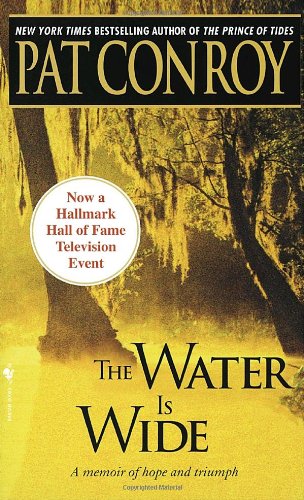
The island is nearly deserted, haunting, beautiful. Across a slip of ocean lies South Carolina. But for the handful of families on Yamacraw island, America is a world away. For years the people here lived proudly from the sea, but now its waters are not safe. Waste from industry threatens their very existence–unless, somehow, they can learn a new life. But they will learn nothing without someone to teach them, and their school has no teacher.
Here is PAT CONROY’S extraordinary drama based on his own experience–the true story of a man who gave a year of his life to an island and the new life its people gave him.
From the Trade Paperback edition.
Die Inhaltsangabe kann sich auf eine andere Ausgabe dieses Titels beziehen.
Über die Autorin bzw. den Autor
Pat Conroy is the bestselling author of The Water is Wide, The Great Santini, The Lords of Discipline, The Prince of Tides, Beach Music, and My Losing Season. He lives in Fripp Island, South Carolina.
Auszug. © Genehmigter Nachdruck. Alle Rechte vorbehalten.
Chapter One
The southern school superintendent is a kind of remote deity who breathes the purer air of Mount Parnassus. The teachers see him only on those august occasions when they need to be reminded of the nobility of their calling. The powers of a superintendent are considerable. He hires and fires, manipulates the board of education, handles a staggering amount of money, and maintains the precarious existence of the status quo. Beaufort, South Carolina's superintendent, Dr. Henry Piedmont, had been in Beaufort for only a year when I went to see him. He had a reputation of being tough, capable, and honest. A friend told me that Piedmont took crap from no man.
I walked into his office, introduced myself, chatted briefly, then told him I wanted to teach on Yamacraw Island. He gave me a hard stare and said, "Son, you are a godsend." I sat in the chair rigidly analyzing my new status. "I have prayed at night," he continued, "for an answer to the problems confronting Yamacraw Island. I have worried myself almost sick. And to think you would walk right into my office and offer to teach those poor colored children on that island. It just goes to show you that God works in mysterious ways."
"I don't know if God had anything to do with it, Doctor. I applied for the Peace Corps and haven't heard. Yamacraw seemed like a viable alternative."
"Son, you can do more good at Yamacraw than you could ever do in the Peace Corps. And you would be helping Americans, Pat. And I, for one, think it's very important to help Americans."
"So do I, Doctor."
We chatted on about the problems of the island. Then he said, "You mentioned that God had nothing to do with your decision to go to Yamacraw, Pat. You remind me of myself when I was your age. Of course, I came up the hard way. My folks worked in a mill. Good people, both of them. Simple people, but God-fearing. My mother was a saint. A saint on earth. I worked in the mill, too. Even after I graduated from college, I went back to the mill in a supervisory capacity. But I wasn't happy, Pat. Something was missing. One night I was working late at the mill. I stepped outside the mill and looked up at the stars. I went toward the edge of the forest and fell to my knees. I prayed to Jesus and asked him what he wanted me to do in my life. And do you know what?"
"No, sir, what?"
Then Dr. Piedmont leaned forward in his seat, his eyes transformed with spiritual intensity.
"He told me what to do that very night. He told me, 'Henry, leave the mill. Go into education and help boys to go to college. Help them to be something. Go back to school, Henry, and get an advanced degree.' So I went to Columbia University, one of the great universities of the world. I emerged with a doctorate. I was the first boy from my town who was ever called Doctor."
I added wittily, "That's nice, Doctor."
"You remind me of that boy I was, Pat. Do you know why you came to me today?"
"Yes, sir, I want to teach at Yamacraw."
"No, son. Do you know the real reason?"
"No, sir, I guess I don't."
"Jesus," he said, as if he just found out the stone had been rolled back from the tomb. "You're too young to realize it now, but Jesus made you come to me today."
I left his office soon afterward. He had been impressive. He was a powerful figure, very controlled, almost arrogantly confident in his abilities. He stared at me during our entire conversation. From experience I knew his breed. The mill-town kid who scratched his way to the top. Horatio Alger, who knew how to floor a man with a quick chop to the gonads. He was a product of the upcountry of South Carolina, the Bible Belt, sand-lot baseball, knife fights under the bleachers. His pride in his doctorate was almost religious. It was the badge that told the world that he was no longer a common man. Intellectually, he was a thoroughbred. Financially, he was secure. And Jesus was his backer. Jesus, with the grits-and-gravy voice, the shortstop on the mill team, liked ol' Henry Piedmont.
Yamacraw is an island off the South Carolina mainland not far from Savannah, Georgia. The island is fringed with the green, undulating marshes of the southern coast; shrimp boats ply the waters around her and fishermen cast their lines along her bountiful shores. Deer cut through her forests in small silent herds. The great southern oaks stand broodingly on her banks. The island and the waters around her teem with life. There is something eternal and indestructible about the tide-eroded shores and the dark, threatening silences of the swamps in the heart of the island. Yamacraw is beautiful because man has not yet had time to destroy this beauty.
The twentieth century has basically ignored the presence of Yamacraw. The island is populated with black people who depend on the sea and their small farms for a living. Several white families live on the island in a paternalistic, but in many ways symbiotic, relationship with their neighbors. Only one white family actively participates in island life to any perceptible degree. The other three couples have come to the island to enjoy their retirement in the obscurity of the island's remotest corners. Thus far, no bridge connects the island with the mainland, and anyone who sets foot on the island comes by water. The roads of the island are unpaved and rutted by the passage of ox carts, still a major form of transportation. The hand pump serves up questionable water to the black residents who live in their small familiar houses. Sears, Roebuck catalogues perform their classic function in the crudely built privies, which sit, half-hidden, in the tall grasses behind the shacks. Electricity came to the island several years ago.
There is something unquestionably moving about the line of utility poles coming across the marsh, moving perhaps because electricity is a bringer of miracles and the journey of the faceless utility poles is such a long one--and such a humane one. But there are no telephones (electricity is enough of a miracle for one century). To call the island you must go to the Beaufort Sheriff's Office and talk to the man who works the radio. Otherwise, Yamacraw remains aloof and apart from the world beyond the river.
It is not a large island, nor an important one, but it represents an era and a segment of history that is rapidly dying in America. The people of the island have changed very little since the Emancipation Proclamation. Indeed, many of them have never heard of this proclamation. They love their island with genuine affection but have watched the young people move to the city, to the lands far away and far removed from Yamacraw. The island is dying, and the people know it.
In the parable of Yamacraw there was a time when the black people supported themselves well, worked hard, and lived up to the sacred tenets laid down in the Protestant ethic. Each morning the strong young men would take to their bateaux and search the shores and inlets for the large clusters of oysters, which the women and old men in the factory shucked into large jars. Yamacraw oysters were world famous. An island legend claims that a czar of Russia once ordered Yamacraw oysters for an imperial banquet. The white people propagate this rumor. The blacks, for the most part, would not know a czar from a fiddler crab, but the oysters were good, and the oyster factories operating on the island provided a substantial living for all the people. Everyone worked and everyone made money.
Then a villain appeared. It was an industrial factory situated on a knoll above the Savannah River many miles away from Yamacraw. The villain spewed its excrement into the river, infected the creeks, and as...
„Über diesen Titel“ kann sich auf eine andere Ausgabe dieses Titels beziehen.
Suchergebnisse für The Water Is Wide

Beispielbild für diese ISBN
The Water is Wide
Verlag:
Bantam Doubleday Dell Publishing Group Inc, 1987
ISBN 10: 0553268937
ISBN 13: 9780553268935
Gebraucht
Softcover
Anbieter: World of Books (was SecondSale), Montgomery, IL, USA
Verkäuferbewertung 5 von 5 Sternen

Zustand: Fair. A miraculous (Newsweek) human drama, based on a true story, from the renowned author of The Prince of Tides and The Great Santini The island is nearly deserted, haunting, beautiful. Across a slip of ocean lies South Carolina. But for the handful of families on Yamacraw Island, America is a world away. For years the people here lived proudly from the sea, but now its waters are not safe. Waste from industry threatens their very existence unless, somehow, they can learn a new way. But they will learn nothing without someone to teach them, and their school has no teacher--until one man gives a year of his life to the island and its people. Praise for The Water Is Wide Miraculous . . . an experience of joy.--Newsweek A powerfully moving book . . . You will laugh, you will weep, you will be proud and you will rail . . . and you will learn to love the man.--Charleston News and Courier A hell of a good story.--The New York Times Few novelists write as well, and none as beautifully.--Lexington Herald-Leader Pat] Conroy cuts through his experiences with a sharp edge of irony. . . . He brings emotion, writing talent and anger to his story.--Baltimore Sun. Artikel-Nr. 00102405524
Gebraucht kaufen
EUR 4,20
Versand gratis
Versand innerhalb von USA
Versand innerhalb von USA
Anzahl: 11 verfügbar
Beispielbild für diese ISBN
The Water Is Wide
Verlag:
Bantam (edition Reissue), 1987
ISBN 10: 0553268937
ISBN 13: 9780553268935
Gebraucht
Mass Market Paperback
Anbieter: BooksRun, Philadelphia, PA, USA
Verkäuferbewertung 5 von 5 Sternen
Mass Market Paperback. Zustand: Fair. Reissue. The item might be beaten up but readable. May contain markings or highlighting, as well as stains, bent corners, or any other major defect, but the text is not obscured in any way. Artikel-Nr. 0553268937-7-1
Gebraucht kaufen
EUR 4,21
Versand gratis
Versand innerhalb von USA
Versand innerhalb von USA
Anzahl: 1 verfügbar
Beispielbild für diese ISBN
The Water is Wide
Anbieter: ThriftBooks-Dallas, Dallas, TX, USA
Verkäuferbewertung 5 von 5 Sternen
Hardcover. Zustand: Fair. No Jacket. Former library book; Readable copy. Pages may have considerable notes/highlighting. ~ ThriftBooks: Read More, Spend Less. Artikel-Nr. G0553268937I5N10
Gebraucht kaufen
EUR 5,96
Versand gratis
Versand innerhalb von USA
Versand innerhalb von USA
Anzahl: 1 verfügbar
Beispielbild für diese ISBN
The Water is Wide
Anbieter: ThriftBooks-Atlanta, AUSTELL, GA, USA
Verkäuferbewertung 5 von 5 Sternen
Hardcover. Zustand: Good. No Jacket. Pages can have notes/highlighting. Spine may show signs of wear. ~ ThriftBooks: Read More, Spend Less. Artikel-Nr. G0553268937I3N00
Gebraucht kaufen
EUR 5,96
Versand gratis
Versand innerhalb von USA
Versand innerhalb von USA
Anzahl: 1 verfügbar
Beispielbild für diese ISBN
The Water is Wide
Anbieter: ThriftBooks-Dallas, Dallas, TX, USA
Verkäuferbewertung 5 von 5 Sternen
Hardcover. Zustand: Fair. No Jacket. Readable copy. Pages may have considerable notes/highlighting. ~ ThriftBooks: Read More, Spend Less. Artikel-Nr. G0553268937I5N00
Gebraucht kaufen
EUR 5,96
Versand gratis
Versand innerhalb von USA
Versand innerhalb von USA
Anzahl: 1 verfügbar
Beispielbild für diese ISBN
The Water is Wide
Anbieter: ThriftBooks-Atlanta, AUSTELL, GA, USA
Verkäuferbewertung 5 von 5 Sternen
Hardcover. Zustand: Fair. No Jacket. Readable copy. Pages may have considerable notes/highlighting. ~ ThriftBooks: Read More, Spend Less. Artikel-Nr. G0553268937I5N00
Gebraucht kaufen
EUR 5,96
Versand gratis
Versand innerhalb von USA
Versand innerhalb von USA
Anzahl: 1 verfügbar
Beispielbild für diese ISBN
The Water is Wide
Anbieter: ThriftBooks-Reno, Reno, NV, USA
Verkäuferbewertung 5 von 5 Sternen
Hardcover. Zustand: Fair. No Jacket. Readable copy. Pages may have considerable notes/highlighting. ~ ThriftBooks: Read More, Spend Less. Artikel-Nr. G0553268937I5N00
Gebraucht kaufen
EUR 6,17
Versand gratis
Versand innerhalb von USA
Versand innerhalb von USA
Anzahl: 1 verfügbar
Beispielbild für diese ISBN
The Water Is Wide
Anbieter: Wonder Book, Frederick, MD, USA
Verkäuferbewertung 5 von 5 Sternen
Zustand: Very Good. Very Good condition. A copy that may have a few cosmetic defects. May also contain light spine creasing or a few markings such as an owner's name, short gifter's inscription or light stamp. Artikel-Nr. F04Q-01185
Gebraucht kaufen
EUR 6,43
Versand gratis
Versand innerhalb von USA
Versand innerhalb von USA
Anzahl: 1 verfügbar
Beispielbild für diese ISBN
The Water Is Wide
Anbieter: Eagle Eye Books, Decatur, GA, USA
Verkäuferbewertung 4 von 5 Sternen

Hardcover. Zustand: Used. Artikel-Nr. 891809
Gebraucht kaufen
EUR 3,67
EUR 3,56 Versand
Versand innerhalb von USA
Versand innerhalb von USA
Anzahl: 1 verfügbar
Beispielbild für diese ISBN
The Water Is Wide : A Memoir
Verlag:
Bantam Doubleday Dell Publishing Group, 1988
ISBN 10: 0553268937
ISBN 13: 9780553268935
Gebraucht
Softcover
Anbieter: Better World Books, Mishawaka, IN, USA
Verkäuferbewertung 5 von 5 Sternen
Zustand: Good. Reissue. Pages intact with minimal writing/highlighting. The binding may be loose and creased. Dust jackets/supplements are not included. Stock photo provided. Product includes identifying sticker. Better World Books: Buy Books. Do Good. Artikel-Nr. 3340690-6
Gebraucht kaufen
EUR 8,35
Versand gratis
Versand innerhalb von USA
Versand innerhalb von USA
Anzahl: 7 verfügbar