
Verwandte Artikel zu The First Fast Draw: A Novel
Inhaltsangabe
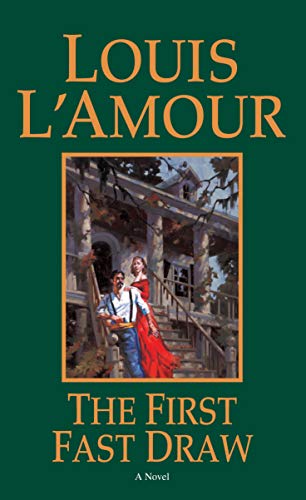
East Texas wasn’t much of a home for Cullen Baker. Few liked him, and some even tried to kill him. Yet after three hard years of wandering, he’s come back to farm the land that’s rightfully his. Only Cullen’s in for an unwelcome homecoming: his neighbors have long memories, the Reconstructionists have greedy hearts, and his worst enemy has teamed up with a vicious outlaw. But Cullen isn’t about to back down. Instead, he’s intent on perfecting a new way of gunfighting: the fast draw. And now, with enemies closing in on three sides and threatening the woman he loves, he’ll have to be faster than lightning—and twice as deadly—just to survive.
Die Inhaltsangabe kann sich auf eine andere Ausgabe dieses Titels beziehen.
Über die Autorin bzw. den Autor
Our foremost storyteller of the American West, Louis L’Amour has thrilled a nation by chronicling the adventures of the brave men and woman who settled the frontier. There are more than three hundred million copies of his books in print around the world.
Von der hinteren Coverseite
You can't go home again....
East Texas wasn't much of a home for Cullen Baker. Few liked him, and some even tried to kill him. Yet after three hard years of wandering, he's come back to farm the land that's rightfully his.
Only Cullen's in for an unwelcome homecoming: his neighbors have long memories, the Reconstructionists have greedy hearts, and his worst enemy has teamed up with a vicious outlaw. But Cullen isn't about to back down. Instead, he's intent on perfecting a new way of gunfighting--the fast draw. And now, with enemies closing in on three sides and threatening the woman he loves, he'll have to be faster than lightning--and twice as deadly--just to survive.
Auszug. © Genehmigter Nachdruck. Alle Rechte vorbehalten.
Chapter One
WHEN THE SHELTER was finished, thatched heavy with pine boughs, I went inside and built myself a hatful of fire. It was a cold, wet, miserable time, and nowhere around any roof for me, although here I was, back in my own country.
Hungry I was, and soaked to the hide from a fall my mule had taken in the swamp, but I kept my fire small, for I'd come home by the back trails, figuring to attract no notice until I could look around and take stock.
They'd given me nothing here in the old days, and I'd given them a sight less, and the only memory they would have of me would be one of violence and anger. Yet hereabouts was all I had ever known of home, or was likely to know.
The woods dripped with rain. Sometimes a big drop would fall from the thatch overhead and hiss in the fire, but other than that and the soft fall of rain in the twilight forest, there was no sound. Not at first.
When a sound did come it was faint. But it was not a sound of the forest, nor of the rain, nor of any wild animal or bird, for these were sounds I knew and had known since childhood.
It was a rider coming, maybe two, and nobody I wanted to see, but that was why I'd put together my lean-to back over the knoll and hid down deep among the rain-wet trees.
This was a rider coming and I could only hope the rain had left no trail they could find, for if trouble was to come to me here, I wanted it to wait, at least until I had walked the old path to the well again, and seen where Pa was buried.
Standing there like that with the rain dripping down, me in my shabby homespun, wore-out clothes, I tried to figure if there was anybody hereabouts beyond a few Caddos whom I could call friend. I couldn't think of anybody.
For a long time then there was no other sound but the rain, a whisper of rain falling among the leaves, and a far-off stirring of wind. And then I heard that sound again.
Behind me the raw-boned mule lifted his head and pricked his ears against the sound, so it wasn't only me heard the sound. No matter, the buckskin mule was ga'nted some and it would be a few days of rest he'd need before I could move on anyway, and maybe I just wasn't feeling right to move at all. Maybe I had come home to stay . . . whether they liked it or not.
Rising, I could just see across the top of the knoll in the forest, and the place I'd chosen to camp commanded a view of the trail at intervals along its course through the swamp woods.
When at last they came in sight there were two riders and they rode as tired men ride, and there was that about them that was somehow familiar. Maybe it was only that they were mighty near as shabby as me, unkempt and lonely as me.
Two riders walking their horses, two riders hunting something. That something could be me.
My Spencer carbine was behind me and so I reached a hand back for it and pulled it close against my side for shelter from the rain. It was a new Spencer, caliber .56 and she carried seven shots-I'd picked it off a dead man up in the Nation. A brand-new, spanking-new, mighty slick piece of shooting iron.
Right there I stood with no notion of moving. Place I stood was a hidden place where a body might pass within six feet and never see it was there. Man like me, in unfriendly country, he can't be too careful. These past years I had seen almost nothing but unfriendly country. Maybe it was my own fault, for I was a man rode careful and who kept a gun to hand.
When I saw them first through the farthest gap in the trees, I'd seen nothing but a couple of men hunched in their saddles, one wearing a ragged poncho, the other a gray Confederate greatcoat.
A moment only, a glimpse, and then they were gone from sight among the trees that lined the trail below, but at the nearest point they would be no more than thirty yards away. So I waited where I was, trusting not to be seen, but keeping the Spencer to hand in case of trouble.
This was a place I knew, an arm of the swamp to protect my right flank, an almost impassable thicket of brush on my left, and the main swamp close in behind me. There was a trail came from the swamp into the trees behind me, but anyone using that trail was likely to be a Caddo or someone as averse to trouble as myself.
The brush on my left could be got through, no question of that, but not without a sight more noise than anybody was likely to make, coming easy to a strange camp.
The people of this northeast corner of Texas had not liked me before, and with times what they were they had no reason to be friendly. The War between the States was just over a few days past, and it was a wary time for strangers.
In the old days when a boy I'd taken nothing from them, nor given them anything they could lay hold on, they disliked me from the start because I wouldn't knuckle under to the town boys, and I'd met dislike with dislike, anger with anger, fist with fist. Despite the war that intervened they would not have forgotten.
Yet it was to this land that I'd come home, for it was as much of a home as I could claim, and despite the hard ways of the people toward me, it was a land I loved. From the deep silences of the forgotten swamp lagoons to the stillness of the fields at evening with the mist of night laying low along the fences, it was a place that belonged to me. There was a feel of things growing here, of a rich, dark soil bursting with eagerness to grow beneath my feet.
Those riders came along . . . there was something seemed familiar about them, but this corner of Texas had been a bloody country filled with black angers and feuding families, and now to the old hatreds there would be added the feeling left by the war just now ended. It was no country for a man to step out and go hailing strangers-least of all for me.
My tiny fire was over the top of the knoll from them and behind a great dead log, the side of the log serving as a reflector to throw heat back into the lean-to. It was snug and tight, and should have been, for I'd lived most of my life like this, and it was most two years since I'd slept beneath a roof of any decent kind. What little smoke the fire gave off lost itself among the leaves overhead, yet a knowing man with a keen nose might catch a whiff if the wind was right.
They drew up in the trail below, in plain sight and an easy shot for my rifle, and they talked there, and one of their voices had an old, familiar ring. So I stepped out of my shelter and strolled down the slope of the knoll toward them, walking soft on the dead wet leaves underfoot. The carbine was in my right hand and in my belt was a Dragoon Colt, within easy grasping.
"Bob Lee," I said aloud, and no louder than needed.
They turned sharp around, but it was to the more slender of the two whom I spoke. He looked at me, measuring me, then making up his mind.
What he was seeing wasn't much. A battered black slouch hat, a shabby buckskin jacket, squaw-made by a Ute west of the big mountains, with cabin-spun shirt and pants, mighty worn. My boots were Army issue, and the man in them a lean, dark young man standing two inches more than six feet in his socks, and weighing nigh two hundred pounds, but with the face of a man who had known much trouble and little of softness or loving-the face of a man born to struggle and the hard ways.
"Cullen, is it? Damn it, man, it's been years!"
"Three."
"I'd have guessed it longer. Bill Longley, meet Cullen Baker, such a man as we need right now in this country."
"I'll take no man's word for that," I said. "They'd no use for me...
„Über diesen Titel“ kann sich auf eine andere Ausgabe dieses Titels beziehen.
Suchergebnisse für The First Fast Draw: A Novel

Beispielbild für diese ISBN
The First Fast Draw: A Novel
Anbieter: World of Books (was SecondSale), Montgomery, IL, USA
Verkäuferbewertung 5 von 5 Sternen

Zustand: Very Good. East Texas wasn't much of a home for Cullen Baker. Few liked him, and some even tried to kill him. Yet after three hard years of wandering, he's come back to farm the land that's rightfully his. Only Cullen's in for an unwelcome homecoming: his neighbors have long memories, the Reconstructionists have greedy hearts, and his worst enemy has teamed up with a vicious outlaw. But Cullen isn't about to back down. Instead, he's intent on perfecting a new way of gunfighting: the fast draw. And now, with enemies closing in on three sides and threatening the woman he loves, he'll have to be faster than lightning-and twice as deadly-just to survive. Artikel-Nr. 00097799754
Gebraucht kaufen
EUR 3,93
Versand gratis
Versand innerhalb von USA
Versand innerhalb von USA
Anzahl: 6 verfügbar
Beispielbild für diese ISBN
The First Fast Draw: A Novel
Anbieter: World of Books (was SecondSale), Montgomery, IL, USA
Verkäuferbewertung 5 von 5 Sternen
Zustand: Good. East Texas wasn't much of a home for Cullen Baker. Few liked him, and some even tried to kill him. Yet after three hard years of wandering, he's come back to farm the land that's rightfully his. Only Cullen's in for an unwelcome homecoming: his neighbors have long memories, the Reconstructionists have greedy hearts, and his worst enemy has teamed up with a vicious outlaw. But Cullen isn't about to back down. Instead, he's intent on perfecting a new way of gunfighting: the fast draw. And now, with enemies closing in on three sides and threatening the woman he loves, he'll have to be faster than lightning-and twice as deadly-just to survive. Artikel-Nr. 00099012187
Gebraucht kaufen
EUR 3,93
Versand gratis
Versand innerhalb von USA
Versand innerhalb von USA
Anzahl: 13 verfügbar
Beispielbild für diese ISBN
The First Fast Draw: A Novel
Anbieter: World of Books (was SecondSale), Montgomery, IL, USA
Verkäuferbewertung 5 von 5 Sternen
Zustand: Fair. East Texas wasn't much of a home for Cullen Baker. Few liked him, and some even tried to kill him. Yet after three hard years of wandering, he's come back to farm the land that's rightfully his. Only Cullen's in for an unwelcome homecoming: his neighbors have long memories, the Reconstructionists have greedy hearts, and his worst enemy has teamed up with a vicious outlaw. But Cullen isn't about to back down. Instead, he's intent on perfecting a new way of gunfighting: the fast draw. And now, with enemies closing in on three sides and threatening the woman he loves, he'll have to be faster than lightning-and twice as deadly-just to survive. Artikel-Nr. 00095063761
Gebraucht kaufen
EUR 3,93
Versand gratis
Versand innerhalb von USA
Versand innerhalb von USA
Anzahl: 3 verfügbar
Beispielbild für diese ISBN
The First Fast Draw: A Novel
Verlag:
Bantam (edition New edition), 1985
ISBN 10: 0553252240
ISBN 13: 9780553252248
Gebraucht
Mass Market Paperback
Anbieter: BooksRun, Philadelphia, PA, USA
Verkäuferbewertung 5 von 5 Sternen
Mass Market Paperback. Zustand: Fair. New edition. The item might be beaten up but readable. May contain markings or highlighting, as well as stains, bent corners, or any other major defect, but the text is not obscured in any way. Artikel-Nr. 0553252240-7-1
Gebraucht kaufen
EUR 4,83
Versand gratis
Versand innerhalb von USA
Versand innerhalb von USA
Anzahl: 1 verfügbar
Beispielbild für diese ISBN
The First Fast Draw: A Novel
Anbieter: Redux Books, Grand Rapids, MI, USA
Verkäuferbewertung 5 von 5 Sternen
Paperback. Zustand: Good. Paperback. Pages are clean and unmarked. Covers show light edge wear. Cover may be different than pictured.; 100% Satisfaction Guaranteed! Ships same or next business day! Artikel-Nr. 132509110097
Gebraucht kaufen
EUR 5,92
Versand gratis
Versand innerhalb von USA
Versand innerhalb von USA
Anzahl: 1 verfügbar
Beispielbild für diese ISBN
The First Fast Draw
Anbieter: ThriftBooks-Dallas, Dallas, TX, USA
Verkäuferbewertung 5 von 5 Sternen
Mass Market Paperback. Zustand: Good. No Jacket. Pages can have notes/highlighting. Spine may show signs of wear. ~ ThriftBooks: Read More, Spend Less. Artikel-Nr. G0553252240I3N00
Gebraucht kaufen
EUR 5,96
Versand gratis
Versand innerhalb von USA
Versand innerhalb von USA
Anzahl: 1 verfügbar
Beispielbild für diese ISBN
The First Fast Draw
Anbieter: ThriftBooks-Atlanta, AUSTELL, GA, USA
Verkäuferbewertung 5 von 5 Sternen
Mass Market Paperback. Zustand: Good. No Jacket. Pages can have notes/highlighting. Spine may show signs of wear. ~ ThriftBooks: Read More, Spend Less. Artikel-Nr. G0553252240I3N00
Gebraucht kaufen
EUR 5,96
Versand gratis
Versand innerhalb von USA
Versand innerhalb von USA
Anzahl: 1 verfügbar
Beispielbild für diese ISBN
The First Fast Draw: A Novel
Anbieter: Wonder Book, Frederick, MD, USA
Verkäuferbewertung 5 von 5 Sternen
Zustand: Very Good. Very Good condition. A copy that may have a few cosmetic defects. May also contain light spine creasing or a few markings such as an owner's name, short gifter's inscription or light stamp. Artikel-Nr. E21K-00019
Gebraucht kaufen
EUR 6,42
Versand gratis
Versand innerhalb von USA
Versand innerhalb von USA
Anzahl: 3 verfügbar
Beispielbild für diese ISBN
The First Fast Draw : A Novel
Verlag:
Random House Publishing Group, 1985
ISBN 10: 0553252240
ISBN 13: 9780553252248
Gebraucht
Softcover
Anbieter: Better World Books: West, Reno, NV, USA
Verkäuferbewertung 5 von 5 Sternen
Zustand: Good. New edition. Pages intact with minimal writing/highlighting. The binding may be loose and creased. Dust jackets/supplements are not included. Stock photo provided. Product includes identifying sticker. Better World Books: Buy Books. Do Good. Artikel-Nr. GRP93032982
Gebraucht kaufen
EUR 6,56
Versand gratis
Versand innerhalb von USA
Versand innerhalb von USA
Anzahl: 1 verfügbar
Beispielbild für diese ISBN
The First Fast Draw : A Novel
Verlag:
Random House Publishing Group, 1985
ISBN 10: 0553252240
ISBN 13: 9780553252248
Gebraucht
Softcover
Anbieter: Better World Books, Mishawaka, IN, USA
Verkäuferbewertung 5 von 5 Sternen
Zustand: Good. New edition. Pages intact with minimal writing/highlighting. The binding may be loose and creased. Dust jackets/supplements are not included. Stock photo provided. Product includes identifying sticker. Better World Books: Buy Books. Do Good. Artikel-Nr. GRP93032982
Gebraucht kaufen
EUR 6,56
Versand gratis
Versand innerhalb von USA
Versand innerhalb von USA
Anzahl: 5 verfügbar