
Verwandte Artikel zu Pygmalion and Major Barbara (Bantam Classics)
Inhaltsangabe
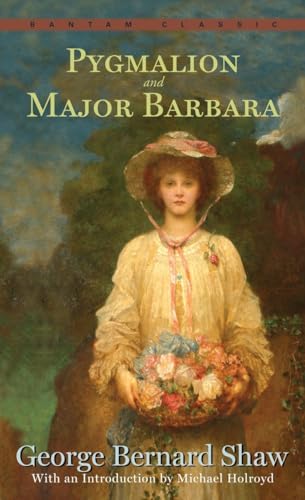
George Bernard Shaw was the greatest British dramatist after Shakespeare, a satirist equal to Jonathan Swift, and a playwright whose most profound gift was his ability to make audiences think by provoking them to laughter.
In one of his best-loved plays, Pygmalion, which later became the basis for the musical My Fair Lady, Shaw compels the audience to see the utter absurdity and hypocrisy of class distinction when Professor Henry Higgins wagers that he can transform a common flower girl into a lady—and then pass her off as a duchess—simply by changing her speech and manners.
In Major Barbara Shaw spins out the drama of an eccentric millionaire, a romantic poet, and a misguided savior of souls, Major Barbara herself, in a topsy-turvy masterpiece of sophisticated banter and urbane humor. His brilliant dialogue, combined with his use of paradox and socialist theory, never fails to tickle, entertain—and challenge.
Die Inhaltsangabe kann sich auf eine andere Ausgabe dieses Titels beziehen.
Über die Autorin bzw. den Autor
George Bernard Shaw (1856-1950) is one of the world’s greatest literary figures. Born in Dublin, Ireland, he left school at fourteen and in 1876 went to London, where he began his literary career with a series of unsuccessful novels. In 1884 he became a founder of the Fabian Society, the famous British socialist organization. After becoming a reviewer and drama critic, he published a study of the Norwegian dramatist Henrik Ibsen in 1891 and became determined to create plays as he felt Ibsen did: to shake audiences out of their moral complacency and to attack social problems. However, Shaw was an irrepressible wit, and his plays are as entertaining as they are socially provocative. Basically shy, Shaw created a public persona for himself: G.B.S., a bearded eccentric, crusading social critic, antivivisectionist, language reformer, strict vegetarian, and renowned public speaker. The author of fifty-three plays, hundreds of essays, reviews, and letters, and several books, Shaw is best known for Widowers’ Houses (1892), Mrs. Warren’s Profession (1893), Arms and the Man (1894), Caesar and Cleopatra (1898), Man and Superman (1903), Major Barbara (1905), Pygmalion (1913), Heartbreak House (1919), and Saint Joan (1923). He was awarded the Nobel Prize for Literature in 1925.
Auszug. © Genehmigter Nachdruck. Alle Rechte vorbehalten.
Major Barbara
ACT I
(It is after dinner on a January night, in the library in LADY BRITOMART UNDERSHAFT's house in Wilton Crescent. A large and comfortable settee is in the middle of the room, upholstered in dark leather. A person sitting on it (it is vacant at present) would have, on his right, LADY BRITOMART's writing-table, with the lady herself busy at it; a smaller writing-table behind him on his left; the door behind him on LADY BRITOMART's side; and a window with a window-seat directly on his left. Near the window is an armchair.
LADY BRITOMART is a woman of fifty or thereabouts, well dressed and yet careless of her dress, well bred and quite reckless of her breeding, well mannered and yet appallingly outspoken and indifferent to the opinion of her interlocutors, amiable and yet peremptory, arbitrary, and high-tempered to the last bearable degree, and withal a very typical managing matron of the upper class, treated as a naughty child until she grew into a scolding mother, and finally settling down with plenty of practical ability and worldly experience, limited in the oddest way with domestic and class limitations, conceiving the universe exactly as if it were a large house in Wilton Crescent, though handling her corner of it very effectively on that assumption, and being quite enlightened and liberal as to the books in the library, the pictures on the walls, the music in the portfolios, and the articles in the papers.
Her son, STEPHEN, comes in. He is a gravely correct young man under 25, taking himself very seriously, but still in some awe of his mother, from childish habit and bachelor shyness rather than from any weakness of character.)
STEPHEN. What's the matter?
LADY BRITOMART. Presently, Stephen.
(STEPHEN submissively walks to the settee and sits down. He takes up The Speaker.)
LADY BRITOMART. Don’t begin to read, Stephen. I shall require all your attention.
STEPHEN. It was only while I was waiting—
LADY BRITOMART. Don’t make excuse, Stephen. (He puts down The Speaker.) Now! (She finishes her writing; rises; and comes to the settee.) I have not kept you waiting very long, I think.
STEPHEN. Not at all, mother.
LADY BRITOMART. Bring me my cushion. (He takes the cushion from the chair at the desk and arranges it for her as she sits down on the settee.) Sit down. (He sits down and fingers his tie nervously.) Don’t fiddle with your tie, Stephen: there is nothing the matter with it.
STEPHEN. I beg your pardon. (He fiddles with his watch chain instead.)
LADY BRITOMART. Now are you attending to me, Stephen?
STEPHEN. Of course, mother.
LADY BRITOMART. No, it's not of course. I want something much more than your everyday matter-of-course attention. I am going to speak to you very seriously, Stephen. I wish you would let that chain alone.
STEPHEN (hastily relinquishing the chain). Have I done anything to annoy you, mother? If so, it was quite unintentional.
LADY BRITOMART (astonished). Nonsense! (With some remorse.) My poor boy, did you think I was angry with you?
STEPHEN. What is it, then, mother? You are making me very uneasy.
LADY BRITOMART (squaring herself at him rather aggressively). Stephen: may I ask how soon you intend to realize that you are a grown-up man, and that I am only a woman?
STEPHEN (amazed). Only a—
LADY BRITOMART. Don’t repeat my words, please: it is a most aggravating habit. You must learn to face life seriously, Stephen. I really cannot bear the whole burden of our family affairs any longer. You must advise me: you must assume the responsibility.
STEPHEN. I!
LADY BRITOMART. Yes, you, of course. You were 24 last June. You’ve been at Harrow and Cambridge. You’ve been to India and Japan. You must know a lot of things, now; unless you have wasted your time most scandalously. Well, advise me.
STEPHEN (much perplexed). You know I have never interfered in the household—
LADY BRITOMART. No: I should think not. I don’t want you to order the dinner.
STEPHEN. I mean in our family affairs.
LADY BRITOMART. Well, you must interfere now; for they are getting quite beyond me.
STEPHEN (troubled). I have thought sometimes that perhaps I ought; but really, mother, I know so little about them; and what I do know is so painful—it is so impossible to mention some things to you— (he stops, ashamed).
LADY BRITOMART. I suppose you mean your father.
STEPHEN (almost inaudibly). Yes.
LADY BRITOMART. My dear: we cant go on all our lives not mentioning him. Of course you were quite right not to open the subject until I asked you to; but you are old enough now to be taken into my confidence, and to help me to deal with him about the girls.
STEPHEN. But the girls are all right. They are engaged.
LADY BRITOMART (complacently). Yes: I have made a very good match for Sarah. Charles Lomax will be a millionaire at 35. But that is ten years ahead; and in the meantime his trustees cannot under the terms of his father's will allow him more than £800 a year.
STEPHEN. But the will says also that if he increases his income by his own exertions, they may double the increase.
LADY BRITOMART. Charles Lomax's exertions are much more likely to decrease his income than to increase it. Sarah will have to find at least another £800 a year for the next ten years; and even then they will be as poor as church mice. And what about Barbara? I thought Barbara was going to make the most brilliant career of all of you. And what does she do? Joins the Salvation Army; discharges her maid; lives on a pound a week; and walks in one evening with a professor of Greek whom she has picked up in the street, and who pretends to be a Salvationist, and actually plays the big drum for her in public because he has fallen head over ears in love with her.
STEPHEN. I was certainly rather taken aback when I heard they were engaged. Cusins is a very nice fellow, certainly: nobody would ever guess that he was born in Australia; but—
LADY BRITOMART. Oh, Adolphus Cusins will make a very good husband. After all, nobody can say a word against Greek: it stamps a man at once as an educated gentleman. And my family, thank Heaven, is not a pig-headed Tory one. We are Whigs, and believe in liberty. Let snobbish people say what they please: Barbara shall marry, not the man they like, but the man I like.
STEPHEN. Of course I was thinking only of his income. However, he is not likely to be extravagant.
LADY BRITOMART. Don’t be too sure of that, Stephen. I know your quiet, simple, refined, poetic people like Adolphus—quite content with the best of everything! They cost more than your extravagant people, who are always as mean as they are second rate. No: Barbara will need at least £2000 a year. You see it means two additional households. Besides, my dear, you must marry soon. I don’t approve of the present fashion of philandering bachelors and late marriages; and I am trying to arrange something for you.
STEPHEN. It's very good of you, mother; but perhaps I had better arrange that for myself.
LADY BRITOMART. Nonsense! you are much too young to begin matchmaking: you would be taken in by some pretty little nobody. Of course I don’t mean that you are not to be consulted: you know that as well as I do. (STEPHEN closes his lips and is silent.) Now don’t sulk, Stephen.
STEPHEN. I am not sulking, mother. What has all this got to do with—with—with my father?
LADY BRITOMART. My dear Stephen: where is the money to come from? It is easy enough for you and the other children to live on my income as long as we are in the same house; but I cant keep four families in four separate...
„Über diesen Titel“ kann sich auf eine andere Ausgabe dieses Titels beziehen.
Suchergebnisse für Pygmalion and Major Barbara (Bantam Classics)

Beispielbild für diese ISBN
Pygmalion and Major Barbara
Anbieter: World of Books (was SecondSale), Montgomery, IL, USA
Verkäuferbewertung 5 von 5 Sternen

Zustand: Very Good. George Bernard Shaw was the greatest British dramatist after Shakespeare, a satirist equal to Jonathan Swift, and a playwright whose most profound gift was his ability to make audiences think by provoking them to laughter. In one of his best-loved plays, Pygmalion, which later became the basis for the musical My Fair Lady, Shaw compels the audience to see the utter absurdity and hypocrisy of class distinction when Professor Henry Higgins wagers that he can transform a common flower girl into a lady--and then pass her off as a duchess--simply by changing her speech and manners. In Major Barbara Shaw spins out the drama of an eccentric millionaire, a romantic poet, and a misguided savior of souls, Major Barbara herself, in a topsy-turvy masterpiece of sophisticated banter and urbane humor. His brilliant dialogue, combined with his use of paradox and socialist theory, never fails to tickle, entertain--and challenge. Artikel-Nr. 00079763007
Gebraucht kaufen
EUR 4,23
Versand gratis
Versand innerhalb von USA
Versand innerhalb von USA
Anzahl: 2 verfügbar
Beispielbild für diese ISBN
Pygmalion and Major Barbara
Anbieter: World of Books (was SecondSale), Montgomery, IL, USA
Verkäuferbewertung 5 von 5 Sternen
Zustand: Fair. George Bernard Shaw was the greatest British dramatist after Shakespeare, a satirist equal to Jonathan Swift, and a playwright whose most profound gift was his ability to make audiences think by provoking them to laughter. In one of his best-loved plays, Pygmalion, which later became the basis for the musical My Fair Lady, Shaw compels the audience to see the utter absurdity and hypocrisy of class distinction when Professor Henry Higgins wagers that he can transform a common flower girl into a lady--and then pass her off as a duchess--simply by changing her speech and manners. In Major Barbara Shaw spins out the drama of an eccentric millionaire, a romantic poet, and a misguided savior of souls, Major Barbara herself, in a topsy-turvy masterpiece of sophisticated banter and urbane humor. His brilliant dialogue, combined with his use of paradox and socialist theory, never fails to tickle, entertain--and challenge. Artikel-Nr. 00106362005
Gebraucht kaufen
EUR 4,23
Versand gratis
Versand innerhalb von USA
Versand innerhalb von USA
Anzahl: 1 verfügbar
Beispielbild für diese ISBN
Pygmalion and Major Barbara (Bantam Classics)
Verlag:
Bantam Classics (edition ), 1992
ISBN 10: 055321408X
ISBN 13: 9780553214086
Gebraucht
Mass Market Paperback
Anbieter: BooksRun, Philadelphia, PA, USA
Verkäuferbewertung 5 von 5 Sternen
Mass Market Paperback. Zustand: Fair. The item might be beaten up but readable. May contain markings or highlighting, as well as stains, bent corners, or any other major defect, but the text is not obscured in any way. Artikel-Nr. 055321408X-7-1
Gebraucht kaufen
EUR 4,54
Versand gratis
Versand innerhalb von USA
Versand innerhalb von USA
Anzahl: 1 verfügbar
Beispielbild für diese ISBN
Pygmalion and Major Barbara
Verlag:
Random House Publishing Group, 1992
ISBN 10: 055321408X
ISBN 13: 9780553214086
Gebraucht
Softcover
Anbieter: Better World Books: West, Reno, NV, USA
Verkäuferbewertung 5 von 5 Sternen
Zustand: Good. Former library copy. Pages intact with minimal writing/highlighting. The binding may be loose and creased. Dust jackets/supplements are not included. Includes library markings. Stock photo provided. Product includes identifying sticker. Better World Books: Buy Books. Do Good. Artikel-Nr. 8034329-6
Gebraucht kaufen
EUR 6,19
Versand gratis
Versand innerhalb von USA
Versand innerhalb von USA
Anzahl: 1 verfügbar
Beispielbild für diese ISBN
Pygmalion and Major Barbara
Verlag:
Random House Publishing Group, 1992
ISBN 10: 055321408X
ISBN 13: 9780553214086
Gebraucht
Softcover
Anbieter: Better World Books, Mishawaka, IN, USA
Verkäuferbewertung 5 von 5 Sternen
Zustand: Good. Former library copy. Pages intact with minimal writing/highlighting. The binding may be loose and creased. Dust jackets/supplements are not included. Includes library markings. Stock photo provided. Product includes identifying sticker. Better World Books: Buy Books. Do Good. Artikel-Nr. 8034329-6
Gebraucht kaufen
EUR 6,19
Versand gratis
Versand innerhalb von USA
Versand innerhalb von USA
Anzahl: 1 verfügbar
Beispielbild für diese ISBN
Pygmalion and Major Barbara
Verlag:
Bantam Classics, 1992
ISBN 10: 055321408X
ISBN 13: 9780553214086
Gebraucht
Mass Market Paperback
Anbieter: ThriftBooks-Atlanta, AUSTELL, GA, USA
Verkäuferbewertung 5 von 5 Sternen
Mass Market Paperback. Zustand: Very Good. No Jacket. May have limited writing in cover pages. Pages are unmarked. ~ ThriftBooks: Read More, Spend Less. Artikel-Nr. G055321408XI4N00
Gebraucht kaufen
EUR 6,38
Versand gratis
Versand innerhalb von USA
Versand innerhalb von USA
Anzahl: 1 verfügbar
Beispielbild für diese ISBN
Pygmalion and Major Barbara (Bantam Classics)
Anbieter: Wonder Book, Frederick, MD, USA
Verkäuferbewertung 5 von 5 Sternen
Zustand: Very Good. Very Good condition. A copy that may have a few cosmetic defects. May also contain light spine creasing or a few markings such as an owner's name, short gifter's inscription or light stamp. Artikel-Nr. I16G-01494
Gebraucht kaufen
EUR 6,43
Versand gratis
Versand innerhalb von USA
Versand innerhalb von USA
Anzahl: 1 verfügbar
Beispielbild für diese ISBN
Pygmalion and Major Barbara
Anbieter: Eagle Eye Books, Decatur, GA, USA
Verkäuferbewertung 4 von 5 Sternen

Paper Back. Zustand: Used. Artikel-Nr. 897399
Gebraucht kaufen
EUR 3,67
EUR 3,56 Versand
Versand innerhalb von USA
Versand innerhalb von USA
Anzahl: 1 verfügbar
Beispielbild für diese ISBN
Pygmalion and Major Barbara (Bantam Classics)
Anbieter: Revaluation Books, Exeter, Vereinigtes Königreich
Verkäuferbewertung 5 von 5 Sternen
Paperback. Zustand: Brand New. 336 pages. 7.00x4.25x0.75 inches. In Stock. Artikel-Nr. 055321408X
Neu kaufen
EUR 16,74
EUR 11,80 Versand
Versand von Vereinigtes Königreich nach USA
Versand von Vereinigtes Königreich nach USA
Anzahl: 1 verfügbar
Foto des Verkäufers
Pygmalion and Major Barbara (Bantam Classics)
Verlag:
Bantam Classics 01.07.1992., 1992
ISBN 10: 055321408X
ISBN 13: 9780553214086
Gebraucht
Softcover
Anbieter: Vulkaneifel Bücher, Birgel, Deutschland
Verkäuferbewertung 5 von 5 Sternen
Zustand: Sehr gut. 336 Seiten anderes Cover aber dieselbe ISBN, Buchinnenseiten altersbedingt etwas vergilbt, kleine Lagerspuren am Buch, Inhalt einwandfrei und ungelesen Sprache: Englisch Gewicht in Gramm: 155 17,3 x 10,4 x 2,3 cm, Taschenbuch. Artikel-Nr. 123569
Gebraucht kaufen
EUR 4,95
EUR 124,40 Versand
Versand von Deutschland nach USA
Versand von Deutschland nach USA
Anzahl: 2 verfügbar