
Verwandte Artikel zu Purgatorio: The Divine Comedy of Dante Alighieri (La...
Inhaltsangabe
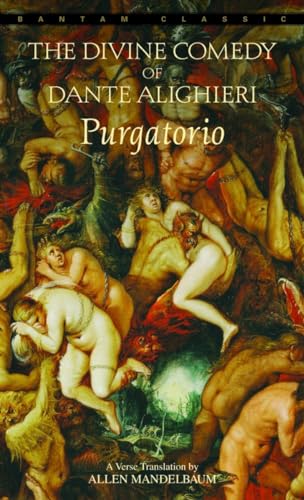
This splendid verse translation by Allen Mandelbaum provides an entirely fresh experience of Dante's great poem of penance and hope. As Dante ascends the Mount of Purgatory toward the Earthly Paradise and his beloved Beatrice, through "that second kingdom in which the human soul is cleansed of sin," all the passion and suffering, poetry and philosophy are rendered with the immediacy of a poet of our own age. With extensive notes and commentary prepared especially for this edition.
Die Inhaltsangabe kann sich auf eine andere Ausgabe dieses Titels beziehen.
Über die Autorin bzw. den Autor
DANTE ALIGHIERI was born in Florence, Italy in 1265. His early poetry falls into the tradition of love poetry that passed from the Provencal to such Italian poets as Guido Cavalcanti, Dante's friend and mentor. Dante's first major work is the Vita Nuova, 1293-1294. This sequence of lyrics, sonnets, and prose narrative describes his love, first earthly, then spiritual, for Beatrice, whom he had first seen as a child of nine, and who had died when Dante was 25. Dante married about 1285, served Florence in battle, and rose to a position of leadership in the bitter factional politics of the city-state. As one of the city's magistrates, he found it necessary to banish leaders of the so-called "Black" faction, and his friend Cavalcanti, who like Dante was a prominent "White." But after the Blacks seized control of Florence in 1301, Dante himself was tried in absentia and was banished from the city on pain of death. He never returned to Florence. We know little about Dante's life in exile. Legend has it that he studied at Paris, but if so, he returned to Italy, for his last years were spent in Verona and Ravenna. In exile he wrote his Convivio, kind of poetic compendium of medieval philosophy, as well as a political treatise, Monarchia. He began his Comedy (later to be called the Divine Comedy) around 1307-1308. On a diplomatic mission to Venice in 1321, Dante fell ill, and returned to Ravenna, where he died.
Allen Mendelbaum's five verse volumes are: Chelmaxions; The Savantasse of Montparnasse; Journeyman; Leaves of Absence; and A Lied of Letterpress. His volumes of verse translation include The Aeneid of Virgil, a University of California Press volume (now available from Bantam) for which he won a National Book Award; the Inferno, Purgatorio, and Paradiso volumes of the California Dante (now available from Bantam); The Odyssey of Homer (now available from Bantam); The Metamorphoses of Ovid, a finalist for the Pulitzer Prize in poetry; Ovid in Sicily; Selected Poems of Giuseppe Ungaretti; Selected Writings of Salvatore Quasimodo; and David Maria Turoldo. Mandelbaum is co-editor with Robert Richardson Jr. of Three Centuries of American Poetry (Bantam Books) and, with Yehuda Amichai, of the eight volumes of the JPS Jewish Poetry Series. After receiving his Ph.D. from Columbia, he was in the Society of Fellows at Harvard. While chairman of the Ph.D. program in English at the Graduate Center of CUNY, he was a visiting professor at Washington University in St. Louis, and at the universities of Houston, Denver, Colorado, and Purdue. His honorary degrees are from Notre Dame University, Purdue University, the University of Assino, and the University of Torino. He received the Gold Medal of Honor from the city of Florence in 2000, celebrating the 735th anniversary of Dante's birth, the only translator to be so honored; and in 2003 he received the President of Italy's award for translation. He is now Professor of the History of Literary Criticism at the University of Turin and the W.R. Kenan Professor of Humanities at Wake Forest University.
Von der hinteren Coverseite
This story begins in a shadowed forest on Good Friday in the year of our Lord 1300. It proceeds on a journey that, in its intense re-creation of the depths and the heights of human experience, has become the key with which Western civilization has sought to unlock the mystery of its own identity.
Aus dem Klappentext
This splendid verse translation by Allen Mandelbaum provides an entirely fresh experience of Dante's great poem of penance and hope. As Dante ascends the Mount of Purgatory toward the Earthly Paradise and his beloved Beatrice, through "that second kingdom in which the human soul is cleansed of sin," all the passion and suffering, poetry and philosophy are rendered with the immediacy of a poet of our own age. With extensive notes and commentary prepared especially for this edition.
Auszug. © Genehmigter Nachdruck. Alle Rechte vorbehalten.
FOREWORD
If a poem is not forgotten as soon as the circumstances of its origin, it begins at once to evolve an existence of its own, in minds and lives, and then even in words, that its singular maker could never have imagined. The poem that survives the receding particulars of a given age and place soon becomes a shifting kaleidoscope of perceptions, each of them in turn provisional and subject to time and change, and increasingly foreign to those horizons of human history that fostered the original images and references.
Over the years of trying to approach Dante through the words he left and some of those written about him, I have come to wonder what his very name means now, and to whom. Toward the end of the Purgatorio, in which the journey repeatedly brings the pilgrim to reunions with poets, memories and projections of poets, the recurring names of poets, Beatrice, at a moment of unfathomable loss and exposure, calls the poem's narrator and protagonist by name, "Dante," and the utterance of it is unaccountably startling and humbling. Even though it is spoken by that Beatrice who has been the sense and magnet of the whole poem and, as he has come to imagine it, of his life, and though it is heard at the top of the mountain of Purgatory, with the terrible journey done and the prospect of eternal joy ahead, the sound of his name at that moment is not at all reassuring. Would it ever be? And who would it reassure? There was, and there is, first of all, Dante the narrator. And there was Dante the man living and suffering in time, and at once we can see that there is a distinction, a division, between them. And then there was, and there is, Dante the representation of Everyman, of a brief period in the history of Italy and of Florence, of a philosophical position, a political allegiance -- the list is indeterminate. Sometimes he seems to be all of them at once, and sometimes particular aspects occupy the foreground.
The commentaries date back into his own lifetime -- indeed, he begins them himself, with the Vita Nuova -- and the exegetes recognized from the beginning, whether they approved or not, the importance of the poem, the work, the vision, as they tried to arrive at some fixed significance in those words, in a later time when the words themselves were not quite the same.
Any reader of Dante now is in debt to generations of scholars working for centuries to illuminate the unknown by means of the known. Any translator shares that enormous debt. A translation, on the other hand, is seldom likely to be of much interest to scholars, who presumably sustain themselves directly upon the inexhaustible original. A translation is made for the general reader of its own time and language, a person who, it is presumed, cannot read, or is certainly not on familiar terms with, the original, and may scarcely know it except by reputation.
It is hazardous to generalize even about the general reader, who is nobody in particular and is encountered only as an exception. But my impression is that most readers at present whose first language is English probably think of Dante as the author of one work, The Divine Comedy, of a date vaguely medieval, its subject a journey through Hell. The whole poem, for many, has come to be known by the Inferno alone, the first of the three utterly distinct sections of the work, the first of the three states of the psyche that Dante set himself to explore and portray.
There are surely many reasons for this predilection, if that is the word, for the Inferno. Some of them must come from the human sensibility's immediate recognition of perennial aspects of its own nature. In the language of modern psychology the Inferno portrays the locked, unalterable ego, form after form of it, the self and its despair forever inseparable. The terrors and pain, the absence of any hope, are the ground of the drama of the Inferno, its nightmare grip upon the reader, its awful authority, and the feeling, even among the secular, that it is depicting something in the human makeup that cannot, with real assurance, be denied. That authority, with the assistance of a succession of haunting illustrations of the Inferno, has made moments and elements of that part of the journey familiar and disturbing images which remain current even in our scattered and evanescent culture.
The literary presence of the Inferno in English has been renewed in recent years. In 1991 Daniel Halpern asked a number of contemporary poets to provide translations of cantos of the Inferno which would eventually comprise a complete translation of the first part of the Commedia. Seamus Heaney had already published fine versions of sections from several of the cantos, including part of canto 3 in Seeing Things (1991), and he ended up doing the opening cantos. When Halpern asked me to contribute to the project, I replied chiefly with misgivings, to begin with. I had been trying to read Dante, and reading about him, since I was a student, carrying one volume or another of the bilingual Temple Classics edition -- pocket-sized books -- with me wherever I went. I had read parts, at least, of the best-known translations of the Commedia: Henry Francis Cary's because it came with the Gustave Doré illustrations and was in the house when I was a child; Longfellow's despite a late-adolescent resistance to nineteenth-century poetic conventions; Laurence Binyon's at the recommendation of Ezra Pound, although he seemed to me terribly tangled; John Ciardi's toward which I had other reservations. The closer I got to feeling that I was beginning to "know" a line or a passage, having the words by memory, repeating some stumbling approximation of the sounds and cadence, pondering what I had been able to glimpse of the rings of sense, the more certain I became that -- beyond the ordinary and obvious impossibility of translating poetry or anything else -- the translation of Dante had a dimension of impossibility of its own. I had even lectured on Dante and demonstrated the impossibility of translating him, taking a single line from the introductory first canto, examining it word by word:
Tant' ê amara che poco ê più morte
indicating the sounds of the words, their primary meanings, implications in the context of the poem and in the circumstances and life of the narrator, the sound of the line insofar as I could simulate it and those present could repeat it aloud and begin to hear its disturbing mantric tone. How could that, then, really be translated? It could not, of course. It could not be anything else. It could not be the original in other words, in another language. I presented the classical objection to translation with multiplied emphasis. Translation of poetry is an enterprise that is always in certain respects impossible, and yet on occasion it has produced something new, something else, of value, and sometimes, on the other side of a sea change, it has brought up poetry again.
Halpern did not dispute my objections, but he told me which poets he was asking to contribute to the project. He asked me which cantos I would like to do if I decided to try any myself. I thought, in spite of what I had said, of the passage at the end of canto 26, where Odysseus, adrift in a two-pointed flame in the abyss of Hell, tells Virgil "where he went to die" after his return to Ithaca. Odysseus recounts his own speech to "that small company by whom I had not been deserted," exhorting them to sail with him past the horizons of the known world to the unpeopled side of the earth, in order not to live "like brutes, but in pursuit of virtue and knowledge," and of their sailing, finally, so far that they saw the summit of Mount Purgatory rising from the sea, before a wave came...
„Über diesen Titel“ kann sich auf eine andere Ausgabe dieses Titels beziehen.
Suchergebnisse für Purgatorio: The Divine Comedy of Dante Alighieri (La...

Beispielbild für diese ISBN
Purgatorio
Anbieter: World of Books (was SecondSale), Montgomery, IL, USA
Verkäuferbewertung 5 von 5 Sternen

Zustand: Fair. Barry Moser (illustrator). A verse translation of Dante's awe-inspiring poem of penance and hope, masterfully translated by award-winning professor Allen Mandelbaum "Exactly what we have waited for these years, a Dante with clarity, eloquence, terror and profoundly moving depths."--Robert Fagles, Princeton University "Tough and supple, tender and violent . . . vigorous, vernacular . . . Mandelbaum's Dante will stand high among modern translations."--Christian Science Monitor As Dante ascends the Mount of Purgatory toward the Earthly Paradise and his beloved Beatrice, through "that second kingdom in which the human soul is cleansed of sin," all the passion and suffering, poetry and philosophy are rendered with the immediacy of a poet of our own age. This edition includes exclusive notes and commentary prepared especially for this edition. Artikel-Nr. 00108292316
Gebraucht kaufen
EUR 4,61
Versand gratis
Versand innerhalb von USA
Versand innerhalb von USA
Anzahl: 2 verfügbar
Beispielbild für diese ISBN
Purgatorio
Verlag:
Bantam Classics, 1984
ISBN 10: 055321344X
ISBN 13: 9780553213447
Gebraucht
Mass Market Paperback
Anbieter: ThriftBooks-Reno, Reno, NV, USA
Verkäuferbewertung 5 von 5 Sternen
Mass Market Paperback. Zustand: Fair. No Jacket. Barry Moser (illustrator). Readable copy. Pages may have considerable notes/highlighting. ~ ThriftBooks: Read More, Spend Less. Artikel-Nr. G055321344XI5N00
Gebraucht kaufen
EUR 5,94
Versand gratis
Versand innerhalb von USA
Versand innerhalb von USA
Anzahl: 3 verfügbar
Beispielbild für diese ISBN
Purgatorio
Verlag:
Bantam Classics, 1984
ISBN 10: 055321344X
ISBN 13: 9780553213447
Gebraucht
Mass Market Paperback
Anbieter: ThriftBooks-Phoenix, Phoenix, AZ, USA
Verkäuferbewertung 5 von 5 Sternen
Mass Market Paperback. Zustand: Very Good. No Jacket. Barry Moser (illustrator). May have limited writing in cover pages. Pages are unmarked. ~ ThriftBooks: Read More, Spend Less. Artikel-Nr. G055321344XI4N00
Gebraucht kaufen
EUR 5,94
Versand gratis
Versand innerhalb von USA
Versand innerhalb von USA
Anzahl: 1 verfügbar
Beispielbild für diese ISBN
Purgatorio
Verlag:
Bantam Classics, 1984
ISBN 10: 055321344X
ISBN 13: 9780553213447
Gebraucht
Mass Market Paperback
Anbieter: ThriftBooks-Dallas, Dallas, TX, USA
Verkäuferbewertung 5 von 5 Sternen
Mass Market Paperback. Zustand: Good. No Jacket. Barry Moser (illustrator). Pages can have notes/highlighting. Spine may show signs of wear. ~ ThriftBooks: Read More, Spend Less. Artikel-Nr. G055321344XI3N00
Gebraucht kaufen
EUR 5,94
Versand gratis
Versand innerhalb von USA
Versand innerhalb von USA
Anzahl: 1 verfügbar
Beispielbild für diese ISBN
Purgatorio
Verlag:
Bantam Classics, 1984
ISBN 10: 055321344X
ISBN 13: 9780553213447
Gebraucht
Mass Market Paperback
Anbieter: ThriftBooks-Phoenix, Phoenix, AZ, USA
Verkäuferbewertung 5 von 5 Sternen
Mass Market Paperback. Zustand: Fair. No Jacket. Barry Moser (illustrator). Readable copy. Pages may have considerable notes/highlighting. ~ ThriftBooks: Read More, Spend Less. Artikel-Nr. G055321344XI5N00
Gebraucht kaufen
EUR 5,94
Versand gratis
Versand innerhalb von USA
Versand innerhalb von USA
Anzahl: 3 verfügbar
Beispielbild für diese ISBN
Purgatorio
Verlag:
Bantam Classics, 1984
ISBN 10: 055321344X
ISBN 13: 9780553213447
Gebraucht
Mass Market Paperback
Anbieter: ThriftBooks-Dallas, Dallas, TX, USA
Verkäuferbewertung 5 von 5 Sternen
Mass Market Paperback. Zustand: Fair. No Jacket. Barry Moser (illustrator). Readable copy. Pages may have considerable notes/highlighting. ~ ThriftBooks: Read More, Spend Less. Artikel-Nr. G055321344XI5N00
Gebraucht kaufen
EUR 5,94
Versand gratis
Versand innerhalb von USA
Versand innerhalb von USA
Anzahl: 3 verfügbar
Beispielbild für diese ISBN
Purgatorio
Verlag:
Bantam Classics, 1984
ISBN 10: 055321344X
ISBN 13: 9780553213447
Gebraucht
Mass Market Paperback
Anbieter: ThriftBooks-Dallas, Dallas, TX, USA
Verkäuferbewertung 5 von 5 Sternen
Mass Market Paperback. Zustand: Fair. No Jacket. Barry Moser (illustrator). Former library book; Readable copy. Pages may have considerable notes/highlighting. ~ ThriftBooks: Read More, Spend Less. Artikel-Nr. G055321344XI5N10
Gebraucht kaufen
EUR 5,94
Versand gratis
Versand innerhalb von USA
Versand innerhalb von USA
Anzahl: 1 verfügbar
Beispielbild für diese ISBN
Purgatorio
Verlag:
Bantam Classics, 1984
ISBN 10: 055321344X
ISBN 13: 9780553213447
Gebraucht
Mass Market Paperback
Anbieter: ThriftBooks-Atlanta, AUSTELL, GA, USA
Verkäuferbewertung 5 von 5 Sternen
Mass Market Paperback. Zustand: Very Good. No Jacket. Barry Moser (illustrator). May have limited writing in cover pages. Pages are unmarked. ~ ThriftBooks: Read More, Spend Less. Artikel-Nr. G055321344XI4N00
Gebraucht kaufen
EUR 5,94
Versand gratis
Versand innerhalb von USA
Versand innerhalb von USA
Anzahl: 1 verfügbar
Beispielbild für diese ISBN
Purgatorio
Verlag:
Bantam Classics, 1984
ISBN 10: 055321344X
ISBN 13: 9780553213447
Gebraucht
Mass Market Paperback
Anbieter: ThriftBooks-Reno, Reno, NV, USA
Verkäuferbewertung 5 von 5 Sternen
Mass Market Paperback. Zustand: Very Good. No Jacket. Barry Moser (illustrator). May have limited writing in cover pages. Pages are unmarked. ~ ThriftBooks: Read More, Spend Less. Artikel-Nr. G055321344XI4N00
Gebraucht kaufen
EUR 5,94
Versand gratis
Versand innerhalb von USA
Versand innerhalb von USA
Anzahl: 1 verfügbar
Beispielbild für diese ISBN
Purgatorio
Verlag:
Bantam Classics, 1984
ISBN 10: 055321344X
ISBN 13: 9780553213447
Gebraucht
Mass Market Paperback
Anbieter: ThriftBooks-Atlanta, AUSTELL, GA, USA
Verkäuferbewertung 5 von 5 Sternen
Mass Market Paperback. Zustand: Fair. No Jacket. Barry Moser (illustrator). Former library book; Readable copy. Pages may have considerable notes/highlighting. ~ ThriftBooks: Read More, Spend Less. Artikel-Nr. G055321344XI5N10
Gebraucht kaufen
EUR 5,94
Versand gratis
Versand innerhalb von USA
Versand innerhalb von USA
Anzahl: 1 verfügbar