
Verwandte Artikel zu Henry IV, Part Two (Bantam Classic)
Inhaltsangabe
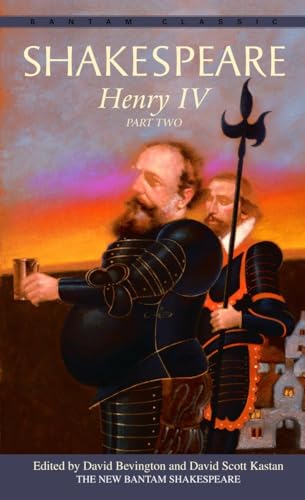
The stirring continuation of the themes begun in Henry IV, Part One again pits a rebellion within the State and that master of misrule, Falstaff, against the maturing of Prince Hal. Alternating scenes between bawdy tavern and regal court, between revelry and politics, Shakespeare probes at the sources, uses, and responsibilities of power as an old king dies and a young king must choose between a ruler's solemn duty and a merry but dissipated friend, Falstaff. The play represents Shakespeare at the peak of his maturity in writing historical drama and comedy.
Die Inhaltsangabe kann sich auf eine andere Ausgabe dieses Titels beziehen.
Über die Autorin bzw. den Autor
William Shakespeare was born in Stratford-upon-Avon in April 1564, and his birth is traditionally celebrated on April 23. The facts of his life, known from surviving documents, are sparse. He was one of eight children born to John Shakespeare, a merchant of some standing in his community. William probably went to the King’s New School in Stratford, but he had no university education. In November 1582, at the age of eighteen, he married Anne Hathaway, eight years his senior, who was pregnant with their first child, Susanna. She was born on May 26, 1583. Twins, a boy, Hamnet ( who would die at age eleven), and a girl, Judith, were born in 1585. By 1592 Shakespeare had gone to London working as an actor and already known as a playwright. A rival dramatist, Robert Greene, referred to him as “an upstart crow, beautified with our feathers.” Shakespeare became a principal shareholder and playwright of the successful acting troupe, the Lord Chamberlain’s Men (later under James I, called the King’s Men). In 1599 the Lord Chamberlain’s Men built and occupied the Globe Theater in Southwark near the Thames River. Here many of Shakespeare’s plays were performed by the most famous actors of his time, including Richard Burbage, Will Kempe, and Robert Armin. In addition to his 37 plays, Shakespeare had a hand in others, including Sir Thomas More and The Two Noble Kinsmen, and he wrote poems, including Venus and Adonis and The Rape of Lucrece. His 154 sonnets were published, probably without his authorization, in 1609. In 1611 or 1612 he gave up his lodgings in London and devoted more and more time to retirement in Stratford, though he continued writing such plays as The Tempest and Henry VII until about 1613. He died on April 23 1616, and was buried in Holy Trinity Church, Stratford. No collected edition of his plays was published during his life-time, but in 1623 two members of his acting company, John Heminges and Henry Condell, put together the great collection now called the First Folio.
Von der hinteren Coverseite
The stirring continuation of the themes begun in "Henry IV, Part One again pits a rebellion within the State and that master of misrule, Falstaff, against the maturing of Prince Hal. Alternating scenes between bawdy tavern and regal court, between revelry and politics, Shakespeare probes at the sources, uses, and responsibilities of power as an old king dies and a young king must choose between a ruler's solemn duty and a merry but dissipated friend, Falstaff. The play represents Shakespeare at the peak of his maturity in writing historical drama and comedy.
Auszug. © Genehmigter Nachdruck. Alle Rechte vorbehalten.
Introduction
Shakespeare wrote 2 Henry IV quite soon after 1 Henry IV, perhaps in 1597, partly, no doubt, to capitalize on the enormous theatrical success of Falstaff and partly to finish the story of Falstaff’s rejection. In writing 2 Henry IV, Shakespeare drew on materials similar to those used for 1 Henry IV, notably Raphael Holinshed’s Chronicles (1587) and the anonymous play The Famous Victories of Henry V (1583—1588). Moreover, he undertook to write a play that structurally is much like its predecessor, revealing more similarity between these plays than one can find elsewhere in Shakespeare. Even the three Henry VI plays do not reiterate structural patterns to the same degree. Is Shakespeare repeating himself, rewriting the earlier play, and, if so, why? Is 2 Henry IV essentially a way of giving audiences more of what they had found so entertaining in the earlier play, or is it a way of reflecting on new and troublesome issues only partially raised in 1 Henry IV? The similarities are indeed marked, though, as we shall see, their chief function may be to highlight the important contrasts that arise through a consideration of the surface resemblances.
The structural pattern runs as follows. In both plays, Shakespeare alternates between scenes of political seriousness and scenes of comic irresponsibility, juxtaposing a rebellion in the land with a rebellion in the King’s own family. In 1 Henry IV, we move from a council of war (1.1) to a planning of the robbery at Gad’s Hill (1.2). The scenes comment on each other by their nearness and by their mutual concern with lawlessness. Similarly, in 2 Henry IV, we are at first introduced to a political rebellion in the north of England, after which we encounter Falstaff and Prince Hal’s page. In both plays, 2.2 shows us Hal with Poins, setting up a future meeting to embarrass Falstaff by means of a plot, and, in both plays, 2.4 is a long, centrally located scene at the tavern, involving Hal and Falstaff in a contest of wits devised to expose Falstaff as a resourceful liar. The festivities in both scenes are brought to an end by a knocking at the door. (The act-scene divisions may not be Shakespeare’s, for they do not appear in the early quartos of either play; nevertheless, the structural location of these scenes is similar.) Between these linked scenes of comic action, we turn in both plays to the rebel camp of the Percys for a discussion of military planning against King Henry (2.3). In both plays, Falstaff goes off supposedly to fight against the rebels, but instead manages to abuse his authority as recruiting officer and to garner un- deserved honors, either through wounding the dead Hotspur in the leg or through capturing Coleville of the Dale with the aid of an inflated reputation. The battle scenes are punctuated by Falstaff’s wry soliloquies; his disputation on wine in 2 Henry IV (4.3.88—123) serves a function like that of his better-known catechism on honor in 1 Henry IV (5.1.129—40). Both plays introduce a confrontation between Hal and his father: the son is penitent for his waywardness, the father lectures on statecraft, and the prodigal son is recovered into kingly grace. Prince Hal goes on thereafter to win public honor and to prove himself his father’s true son. Even the rejection of Falstaff, with which the second play ends, finds its counterpart in 1 Henry IV in Hal’s impatience with Falstaff during the battle of Shrewsbury, his elegy over the seemingly dead body of his onetime companion, and his resolve to be henceforth a prince.
These resemblances, and still others, are further highlighted when we realize that Shakespeare continues to use in his second play the structural device of foils, or paired characters, around Hal, who help define alternative models of conduct. The father is, as before, an awesome figure of authority–one whose sternness Hal never fully adopts and yet one whose public role as king Hal must inherit. Falstaff, as before, offers himself as a companion in revelry, dissipation, and joie de vivre, and must be rejected, even though much of what he says offers insight into the coldness of King Henry and especially of Hal’s dutiful brother Prince John. Yet the chief purpose of these re- capitulations is to suggest profound differences. 2 Henry IV does not simply go over familiar material. Even the resemblances noted so far embody significant changes: the opening scene of the first play takes place at court, the second in the country; the second scene of the first play sets up the trick to be played on Falstaff, whereas in the second play this event takes place in 2.2; this same second scene of the first play is chiefly a battle of wits between Hal and Falstaff, whereas in the second play Falstaff has to cope with the pointed questioning of the Lord Chief Justice; and so on. Repeatedly, the similarities of situations reveal how much Hal has still to learn, how much Falstaff has changed, and how much more complicated the political process is than it first appeared. The foil relationships in this play focus less on honor, as in 1 Henry IV, than on two related matters: rumor or reputation, and justice.
Rumor begins the play–quite literally, since Rumor is presented to us in allegorized form as portrayed by Virgil, painted full of tongues, spreading false information about the battle of Shrewsbury just ended. Rumor takes particular delight in its most cruel trick of all–raising false hopes and then dashing them. In the scene following at the Percys’ household, we see Rumor as it manifests itself in the real world of men, beguiling Northumberland with the “news” of his son Hotspur’s triumph, only to disappoint him afterward with the stark truth of defeat and death. What is the function of the uncharacteristic allegory at the start of this play? It serves first to establish a new dispiriting tone. The rebels are in disarray, and their cause is in jeopardy. Hotspur is dead, and with him has died the bright honor of his cause. His kinsmen, always more Machiavellian than he, are now warier than ever. Northumberland is persuaded, in a later scene, to prevaricate to his allies and to withdraw to Scotland when they most need his support, waiting to come in on their side only when he can be sure of success. The atmosphere of realpolitik and of dealing in false appearances is a consequence of a world governed by rumor. The rebels’ case is never as attractive in this play as in 1 Henry IV; Hotspur’s idealism and chivalry are sorely missed.
Rumor has profound consequences for the King’s side as well, and for Falstaff and Prince Hal. Falstaff rides on false reputation through the early scenes of 2 Henry IV. He evades arrest at the hands of the Lord Chief Justice because of his presumed deeds at Shrewsbury, which we know to be illusory. His day’s service at Shrewsbury “hath a little gilded over” his “night’s exploit on Gad’s Hill,” as the Lord Chief Justice reluctantly concedes (1.2.147—8). His reputation makes possible his capture of Coleville of the Dale at Gaultree Forest, even though, by this time, Falstaff’s reputation is clearly beginning to wear thin.
Conversely, Hal discovers that his reputation for prodigality will not leave him. Despite his having lost track of Falstaff, not even knowing of the old man’s whereabouts until he agrees to revisit his onetime companion in the tavern for old times’ sake, Hal realizes that everyone assumes the worst of him. All expect his future reign to be one of continual...
„Über diesen Titel“ kann sich auf eine andere Ausgabe dieses Titels beziehen.
Suchergebnisse für Henry IV, Part Two (Bantam Classic)

Beispielbild für diese ISBN
Henry IV, Part Two (Bantam Classic)
Anbieter: World of Books (was SecondSale), Montgomery, IL, USA
Verkäuferbewertung 5 von 5 Sternen

Zustand: Good. Item in good condition. Textbooks may not include supplemental items i.e. CDs, access codes etc. Artikel-Nr. 00037480635
Gebraucht kaufen
EUR 4,48
Versand gratis
Versand innerhalb von USA
Versand innerhalb von USA
Anzahl: 3 verfügbar
Beispielbild für diese ISBN
Henry IV, Part Two (Henry IV, Part II)
Verlag:
Bantam Classics (edition First Edition), 1988
ISBN 10: 055321294X
ISBN 13: 9780553212945
Gebraucht
Paperback
Erstausgabe
Anbieter: BooksRun, Philadelphia, PA, USA
Verkäuferbewertung 5 von 5 Sternen
Paperback. Zustand: Fair. First Edition. The item might be beaten up but readable. May contain markings or highlighting, as well as stains, bent corners, or any other major defect, but the text is not obscured in any way. Artikel-Nr. 055321294X-7-1
Gebraucht kaufen
EUR 4,49
Versand gratis
Versand innerhalb von USA
Versand innerhalb von USA
Anzahl: 1 verfügbar
Beispielbild für diese ISBN
Henry IV, Part Two (Henry IV, Part II)
Verlag:
Bantam Classics (edition First Edition), 1988
ISBN 10: 055321294X
ISBN 13: 9780553212945
Gebraucht
Paperback
Erstausgabe
Anbieter: BooksRun, Philadelphia, PA, USA
Verkäuferbewertung 5 von 5 Sternen
Paperback. Zustand: Very Good. First Edition. It's a well-cared-for item that has seen limited use. The item may show minor signs of wear. All the text is legible, with all pages included. It may have slight markings and/or highlighting. Artikel-Nr. 055321294X-11-18
Gebraucht kaufen
EUR 4,86
Versand gratis
Versand innerhalb von USA
Versand innerhalb von USA
Anzahl: 1 verfügbar
Beispielbild für diese ISBN
Henry IV, Part Two
Verlag:
Random House Publishing Group, 1988
ISBN 10: 055321294X
ISBN 13: 9780553212945
Gebraucht
Softcover
Anbieter: Better World Books: West, Reno, NV, USA
Verkäuferbewertung 5 von 5 Sternen
Zustand: Very Good. Pages intact with possible writing/highlighting. Binding strong with minor wear. Dust jackets/supplements may not be included. Stock photo provided. Product includes identifying sticker. Better World Books: Buy Books. Do Good. Artikel-Nr. 652831-75
Gebraucht kaufen
EUR 6,57
Versand gratis
Versand innerhalb von USA
Versand innerhalb von USA
Anzahl: 1 verfügbar
Beispielbild für diese ISBN
Henry IV, Part Two
Verlag:
Random House Publishing Group, 1988
ISBN 10: 055321294X
ISBN 13: 9780553212945
Gebraucht
Softcover
Anbieter: Better World Books, Mishawaka, IN, USA
Verkäuferbewertung 5 von 5 Sternen
Zustand: Good. Pages intact with minimal writing/highlighting. The binding may be loose and creased. Dust jackets/supplements are not included. Stock photo provided. Product includes identifying sticker. Better World Books: Buy Books. Do Good. Artikel-Nr. 42680268-6
Gebraucht kaufen
EUR 6,57
Versand gratis
Versand innerhalb von USA
Versand innerhalb von USA
Anzahl: 1 verfügbar
Beispielbild für diese ISBN
Henry IV, Part Two
Verlag:
Random House Publishing Group, 1988
ISBN 10: 055321294X
ISBN 13: 9780553212945
Gebraucht
Softcover
Anbieter: Better World Books, Mishawaka, IN, USA
Verkäuferbewertung 5 von 5 Sternen
Zustand: Good. Former library copy. Pages intact with minimal writing/highlighting. The binding may be loose and creased. Dust jackets/supplements are not included. Includes library markings. Stock photo provided. Product includes identifying sticker. Better World Books: Buy Books. Do Good. Artikel-Nr. 652830-6
Gebraucht kaufen
EUR 6,57
Versand gratis
Versand innerhalb von USA
Versand innerhalb von USA
Anzahl: 1 verfügbar
Foto des Verkäufers
Henry Iv (Pt. 2) (Classics Library)
Verlag:
Wordsworth Editions, Limited, 1999
ISBN 10: 055321294X
ISBN 13: 9780553212945
Gebraucht
Paperback
Anbieter: SZ Global, Toronto, ON, Kanada
Verkäuferbewertung 5 von 5 Sternen
Paperback. Zustand: Collectible-Very Good. The stirring continuation of the themes begun in Henry IV, Part One again pits a rebellion within the State and that master of misrule, Falstaff, against the maturing of Prince Hal. Alternating scenes between bawdy tavern and regal court, between revelry and politics, Shakespeare probes at the sources, uses, and responsibilities of power as an old king dies and a young king must choose between a ruler's solemn duty and a merry but dissipated friend, Falstaff. The play represents Shakespeare at the peak of his maturity in writing historical drama and comedy. Artikel-Nr. 9780553212945
Gebraucht kaufen
EUR 15,54
EUR 33,24 Versand
Versand von Kanada nach USA
Versand von Kanada nach USA
Anzahl: 1 verfügbar