Inhaltsangabe
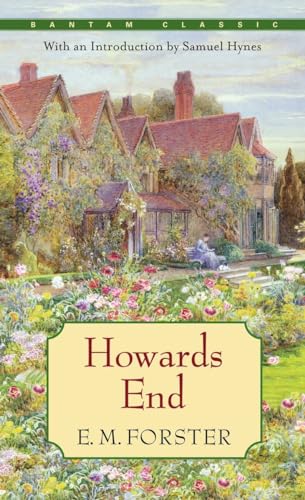
What makes this masterpiece a pure delight for contemporary readers is its vibrant portrait of life in Edwardian England, and the wonderful characters who inhabit the charming old country house in Hertfordshire called Howards End. This cozy house becomes the object of an inheritance dispute between the upright conservative Wilcox family and the Schlegel sisters, Margaret and Helen, sensitive and intuitive women loved by men willing to leap wide social barriers to fulfill their ardor. Through romantic entanglements, disappearing wills, and sudden tragedy, the conflict over the house emerges as a symbolic struggle for England's future. Rich with the tradition, spirit, and wit distinctively English, Howards End is a remarkable novel of rare insight and understanding. As in his celebrated A Passage to India, E. M. Forster brings to vivid life a country and an era through the destinies of his unforgettable characters.
Die Inhaltsangabe kann sich auf eine andere Ausgabe dieses Titels beziehen.
Über die Autorin bzw. den Autor
Edward Morgan Forster was born January 1, 1879 in London and was raised from infancy by his mother and paternal aunts after his father's death. Forster’s boyhood experiences at the Tonbridge School, Kent were an unpleasant contrast to the happiness he found at home, and his suffering left him with an abiding dislike of the English public school system. At King’s College, Cambridge, however he was able to pursue freely his varied interests in philosophy, literature and Mediterranean civilization, and he soon determined to devote his life to writing.
His first two novels, Where Angels Fear to Tread (1905) and The Longest Journey (1907), were both poorly received, and it was not until the publication of Howards End, in 1910, that Forster achieved his first major success as a novelist, with the work many considered his finest creation.
Forster first visited India during 1912 and 1913, and after three years as a noncombatant in Alexandria, Egypt, during World War I and several years in England, he returned for an extended visit in 1921. From those experiences came his most celebrated novel, A Passage to India, his darkest and most probing work and perhaps the best novel about India written by a foreigner.
As a man of letters , Forster was honored during and after World War II for his resistance to any and all forms of tyranny and totalitarianism, and King’s College awarded him a permanent fellowship in 1949. Forster spent his later years at Cambridge writing and teaching, and died at Coventry, England, on June 7, 1970. His novel, Maurice, written several decades earlier, was published posthumously in 1971.
Von der hinteren Coverseite
Howards End is a novel of ideas, not brute facts; in many respects it is an old kind of novel, playful in the eighteenth-century sense, full of tenderness toward favorite characters in the Dickens style, inventive in every structural touch but not a modernist work.
Aus dem Klappentext
Introduction by Alfred Kazan
"From the Hardcover edition.
Auszug. © Genehmigter Nachdruck. Alle Rechte vorbehalten.
Chapter One
ONE MAY as well begin with Helen's letters to her sister.
Howards End,
Tuesday.
Dearest Meg,
It isn't going to be what we expected. It is old and little, and altogether delightful-red brick. We can scarcely pack in as it is, and the dear knows what will happen when Paul (younger son) arrives tomorrow. From hall you go right or left into dining-room or drawing-room. Hall itself is practically a room. You open another door in it, and there are the stairs going up in a sort of tunnel to the first-floor. Three bed-rooms in a row there, and three attics in a row above. That isn't all the house really, but it's all that one notices-nine windows as you look up from the front garden.
Then there's a very big wych-elm-to the left as you look up-leaning a little over the house, and standing on the boundary between the garden and meadow. I quite love that tree already. Also ordinary elms, oaks-no nastier than ordinary oaks-pear-trees, apple-trees, and a vine. No silver birches, though. However, I must get on to my host and hostess. I only wanted to show that it isn't the least what we expected. Why did we settle that their house would be all gables and wiggles, and their garden all gamboge-coloured paths? I believe simply because we associate them with expensive hotels-Mrs. Wilcox trailing in beautiful dresses down long corridors, Mr. Wilcox bullying porters, etc. We females are that unjust.
I shall be back Saturday; will let you know train later. They are as angry as I am that you did not come too; really Tibby is too tiresome, he starts a new mortal disease every month. How could he have got hay fever in London? and even if he could, it seems hard that you should give up a visit to hear a schoolboy sneeze. Tell him that Charles Wilcox (the son who is here) has hay fever too, but he's brave, and gets quite cross when we inquire after it. Men like the Wilcoxes would do Tibby a power of good. But you won't agree, and I'd better change the subject.
This long letter is because I'm writing before breakfast. Oh, the beautiful vine leaves! The house is covered with a vine. I looked out earlier, and Mrs. Wilcox was already in the garden. She evidently loves it. No wonder she sometimes looks tired. She was watching the large red poppies come out. Then she walked off the lawn to the meadow, whose corner to the right I can just see. Trail, trail, went her long dress over the sopping grass, and she came back with her hands full of the hay that was cut yesterday-I suppose for rabbits or something, as she kept on smelling it. The air here is delicious. Later on I heard the noise of croquet balls, and looked out again, and it was Charles Wilcox practising; they are keen on all games. Presently he started sneezing and had to stop. Then I hear more clicketing, and it is Mr. Wilcox practising, and then, "a-tissue, a-tissue": he has to stop too. Then Evie comes out, and does some calisthenic exercises on a machine that is tacked on to a greengage-tree-they put everything to use-and then she says "a-tissue," and in she goes. And finally Mrs. Wilcox reappears, trail, trail, still smelling hay and looking at the flowers. I inflict all this on you because once you said that life is sometimes life and sometimes only a drama, and one must learn to distinguish t'other from which, and up to now I have always put that down as "Meg's clever nonsense." But this morning, it really does seem not life but a play, and it did amuse me enormously to watch the W's. Now Mrs. Wilcox has come in.
I am going to wear [omission]. Last night Mrs. Wilcox wore an [omission], and Evie [omission]. So it isn't exactly a go-as-you-please place, and if you shut your eyes it still seems the wiggly hotel that we expected. Not if you open them. The dog-roses are too sweet. There is a great hedge of them over the lawn-magnificently tall, so that they fall down in garlands, and nice and thin at the bottom, so that you can see duck
„Über diesen Titel“ kann sich auf eine andere Ausgabe dieses Titels beziehen.
Weitere beliebte Ausgaben desselben Titels

Suchergebnisse für Howards End

Beispielbild für diese ISBN
Howards End
Verlag:
Bantam Classics (edition ), 1985
ISBN 10: 0553212087
ISBN 13: 9780553212082
Gebraucht
Mass Market Paperback
Anbieter: BooksRun, Philadelphia, PA, USA
Verkäuferbewertung 5 von 5 Sternen

Mass Market Paperback. Zustand: Fair. The item might be beaten up but readable. May contain markings or highlighting, as well as stains, bent corners, or any other major defect, but the text is not obscured in any way. Artikel-Nr. 0553212087-7-1
Gebraucht kaufen
EUR 5,00
Versand gratis
Versand innerhalb von USA
Versand innerhalb von USA
Anzahl: 1 verfügbar
Beispielbild für diese ISBN
Howards End
Anbieter: Wonder Book, Frederick, MD, USA
Verkäuferbewertung 5 von 5 Sternen
Zustand: Very Good. Very Good condition. A copy that may have a few cosmetic defects. May also contain light spine creasing or a few markings such as an owner's name, short gifter's inscription or light stamp. Artikel-Nr. I05K-02834
Gebraucht kaufen
EUR 5,35
Versand gratis
Versand innerhalb von USA
Versand innerhalb von USA
Anzahl: 1 verfügbar
Beispielbild für diese ISBN
Howards End
Verlag:
Bantam Classics, 1985
ISBN 10: 0553212087
ISBN 13: 9780553212082
Gebraucht
Mass Market Paperback
Anbieter: ThriftBooks-Reno, Reno, NV, USA
Verkäuferbewertung 5 von 5 Sternen
Mass Market Paperback. Zustand: Very Good. No Jacket. May have limited writing in cover pages. Pages are unmarked. ~ ThriftBooks: Read More, Spend Less. Artikel-Nr. G0553212087I4N00
Gebraucht kaufen
EUR 5,62
Versand gratis
Versand innerhalb von USA
Versand innerhalb von USA
Anzahl: 1 verfügbar
Beispielbild für diese ISBN
Howards End
Verlag:
Bantam Classics, 1985
ISBN 10: 0553212087
ISBN 13: 9780553212082
Gebraucht
Mass Market Paperback
Anbieter: ThriftBooks-Dallas, Dallas, TX, USA
Verkäuferbewertung 5 von 5 Sternen
Mass Market Paperback. Zustand: Very Good. No Jacket. May have limited writing in cover pages. Pages are unmarked. ~ ThriftBooks: Read More, Spend Less. Artikel-Nr. G0553212087I4N00
Gebraucht kaufen
EUR 5,62
Versand gratis
Versand innerhalb von USA
Versand innerhalb von USA
Anzahl: 1 verfügbar
Beispielbild für diese ISBN
Howards End
Verlag:
Bantam Classics, 1985
ISBN 10: 0553212087
ISBN 13: 9780553212082
Gebraucht
Mass Market Paperback
Anbieter: ThriftBooks-Atlanta, AUSTELL, GA, USA
Verkäuferbewertung 5 von 5 Sternen
Mass Market Paperback. Zustand: Very Good. No Jacket. Former library book; May have limited writing in cover pages. Pages are unmarked. ~ ThriftBooks: Read More, Spend Less. Artikel-Nr. G0553212087I4N10
Gebraucht kaufen
EUR 5,62
Versand gratis
Versand innerhalb von USA
Versand innerhalb von USA
Anzahl: 1 verfügbar
Beispielbild für diese ISBN
Howards End
Verlag:
Bantam Classics, 1985
ISBN 10: 0553212087
ISBN 13: 9780553212082
Gebraucht
Mass Market Paperback
Anbieter: ThriftBooks-Atlanta, AUSTELL, GA, USA
Verkäuferbewertung 5 von 5 Sternen
Mass Market Paperback. Zustand: Very Good. No Jacket. May have limited writing in cover pages. Pages are unmarked. ~ ThriftBooks: Read More, Spend Less. Artikel-Nr. G0553212087I4N00
Gebraucht kaufen
EUR 5,62
Versand gratis
Versand innerhalb von USA
Versand innerhalb von USA
Anzahl: 1 verfügbar
Beispielbild für diese ISBN
Howards End
Verlag:
Random House Publishing Group, 1985
ISBN 10: 0553212087
ISBN 13: 9780553212082
Gebraucht
Softcover
Anbieter: Better World Books, Mishawaka, IN, USA
Verkäuferbewertung 5 von 5 Sternen
Zustand: Good. Reissue. Former library book; may include library markings. Used book that is in clean, average condition without any missing pages. Artikel-Nr. 3339435-6
Gebraucht kaufen
EUR 5,69
Versand gratis
Versand innerhalb von USA
Versand innerhalb von USA
Anzahl: 1 verfügbar
Beispielbild für diese ISBN
Howards End
Verlag:
Random House Publishing Group, 1985
ISBN 10: 0553212087
ISBN 13: 9780553212082
Gebraucht
Softcover
Anbieter: Better World Books, Mishawaka, IN, USA
Verkäuferbewertung 5 von 5 Sternen
Zustand: Good. Reissue. Used book that is in clean, average condition without any missing pages. Artikel-Nr. GRP102057781
Gebraucht kaufen
EUR 5,69
Versand gratis
Versand innerhalb von USA
Versand innerhalb von USA
Anzahl: 1 verfügbar
Beispielbild für diese ISBN
Howards End
Verlag:
Random House Publishing Group, 1985
ISBN 10: 0553212087
ISBN 13: 9780553212082
Gebraucht
Softcover
Anbieter: Better World Books: West, Reno, NV, USA
Verkäuferbewertung 5 von 5 Sternen
Zustand: Good. Reissue. Former library book; may include library markings. Used book that is in clean, average condition without any missing pages. Artikel-Nr. 3339435-6
Gebraucht kaufen
EUR 5,69
Versand gratis
Versand innerhalb von USA
Versand innerhalb von USA
Anzahl: 1 verfügbar
Beispielbild für diese ISBN
Howards End
Anbieter: WorldofBooks, Goring-By-Sea, WS, Vereinigtes Königreich
Verkäuferbewertung 5 von 5 Sternen
Paperback. Zustand: Very Good. The book has been read, but is in excellent condition. Pages are intact and not marred by notes or highlighting. The spine remains undamaged. Artikel-Nr. GOR005245710
Gebraucht kaufen
EUR 3,17
EUR 6,47 shipping
Versand von Vereinigtes Königreich nach USA
Versand von Vereinigtes Königreich nach USA
Anzahl: 2 verfügbar