
Verwandte Artikel zu A Close Run Thing: Wellington's Army of 1815
Inhaltsangabe
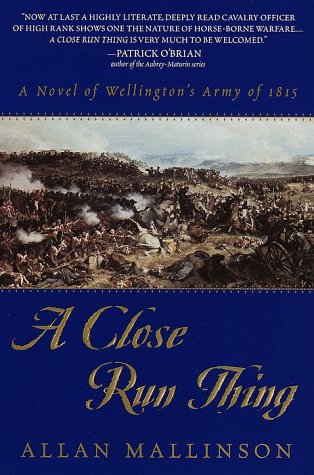
British cavalry soldier Cornet Matthew Hervey and his regiment, the 6th Light Dragoons, journey from the Pyrenees to the distant shores of Cork, and finally to Belgium in mid-June, 1815, at the crossroads of Quatre Bras near the small village of Waterloo.
Die Inhaltsangabe kann sich auf eine andere Ausgabe dieses Titels beziehen.
Über die Autorin bzw. den Autor
Allan Mallinson is a serving cavalry officer in the British army and the author of Light Dragoons, a history of the British cavalry. He lives with his wife and two daughters on Salisbury Plain.
Aus dem Klappentext
tion of Patrick O'Brian's beloved historical military adventures comes the first in a dashing new series featuring Cornet Matthew Hervey, a young cavalry officer in Wellington's army of 1815. Bringing alive the Napoleonic era and the armies whose blood stained the soil of turbulent nations, here is the story of one man whose valor and vision bring him honor, betrayal, and a challenge beyond his imagining.
For two decades, since the French Revolution, Britain and her allies have fought a seemingly endless war to loosen Bonaparte's stranglehold on Europe. And Englishmen such as Matthew Hervey, led by the "Iron Duke" of Wellington, have left the green pastures of home to follow the drum in His Majesty's cavalry. By 1814 Hervey, a twenty-three-year-old parson's son, has been on campaign with the 6th Light Dragoons for over five years--only to find his military career endangered by an impetuous act of gallantry....
With the French army at last defeated and Bonaparte exil
Auszug. © Genehmigter Nachdruck. Alle Rechte vorbehalten.
Britain had persevered in war with revolutionary France, with but one short break, since 1793. The Royal Navy, at Aboukir in 1798 and Trafalgar in 1805, had confined Bonaparte to Europe; British money had financed the allies when they were ready to come forward; and a British army in the Iberian peninsula had, from 1809, maintained a front which had drained French resources and given hope to other Europeans. By the beginning of 1814, Bonaparte could defend only France. Russian, Prussian, and Austrian armies were closing in from the east, while the British, already in the Pyrenees, stood ready to invade from the southwest.
Chapter 1: In the Heat of Battle
The Convent of St. Mary of Magdala, Toulouse, April 12, 1814
"It is a very singular thing indeed, Mr. Hervey, for a cornet to be placed in arrest upon the field of battle."
Joseph Edmonds was deploying all his considerable facility with words in order to convey the gravity of the matter at hand.
"Tell me, if you please, precisely and dispassionately, the circumstances by which this was brought about."
Cornet Hervey stood rigidly to attention before the major's desk, his left hand clasping the sword scabbard to his side, his right hand clenched with the thumb pointing downward along the double yellow stripe of his overalls. His eyes were set front, and filling the limited arc of their fixed gaze were two symbols which, while if not to his mind entirely contradictory, in their juxtaposition seemed somehow incongruous. For on the wall behind the desk was a large wooden cross with a painted figure of the crucified Christ. Next to it--perhaps even leaning against it--was the regimental guidon, a piece of red silk on a beechwood staff, its richly embroidered battle honors still resplendent despite the staining and fading. The irony, that he had been raised in a household whose world was shaped by the first symbol, and had then elected to throw himself wholeheartedly behind the second, was not lost on him even at this exigent moment. He had little imagined such a convergence, however, nor its place--a nunnery hastily and rudely requisitioned for the purposes of the military. He drew in a deep breath, his stomach feeling tighter than ever it had done when he had been awaiting combat, and began the recollection of the events which had brought him now before his commanding officer.
"Sir, yesterday forenoon I was in command of the flank picket, as you had placed me, one-quarter of a league to the west of our lines of attack upon this city. . . ."
The fateful encounter with authority had begun spectacularly. Edmonds had not expected any affair on the left flank. Not that that was why he had entrusted the picket to Hervey: he had long been of the conviction that the worst that could happen in battle usually did (and as a consequence he had never been wrong footed--at least, that is, in the field), and Hervey and his standing patrol were a trusty yet economical insurance.
Hervey had disposed his command, a half troop (by the Sixth's depleted muster scarcely two dozen men), in the dead ground to the rear of a shallow ridge running obliquely to the army's front. They were dismounted and standing easy. Posted as vidette a furlong to their front, with a view into the valley beyond the ridge, was his picket serjeant. And it was the sudden animation in that sentinel that alerted Hervey now.
"Mount!" he called, and his troopers began tightening girths before springing back into their saddles. Without an order the contact man-- the picket corporal--galloped off to Serjeant Armstrong, who had by now worked his way in cover along the ridge and farther to the flank.
Five minutes passed before the corporal returned, with intelligence that thrilled through the ranks: "Sir, there is a horse battery, six guns, approaching."
"And supports?" pressed Hervey.
"None observed, sir."
"None? No supports? That is not possible!"
"Serjeant Armstrong says there are none within the mile as he can see, sir."
Hervey could scarce believe it. But, supports or no, it would still be David and Goliath if the guns came into action before they could close with them. He hesitated not another second and took the patrol in a brisk hand gallop toward Armstrong. As they broached the ridge he held them up and edged forward with just his covering corporal to where Serjeant Armstrong was crouching in the saddle to observe over the bracken.
"They've halted, sir, just this minute," said the serjeant in his melodious Tyneside.
"Whyever do you suppose they have stopped there?" asked Hervey, peering through his telescope.
"Can't make it out at all," Armstrong replied.
They both watched the battery, halted in the valley two full furlongs away, eager to know in which direction it would next move. Armstrong thought it must turn about; Hervey was sure it would wheel left and run parallel to the ridge. Suddenly both their predictions were confounded: the French began dismounting to unlimber the guns.
Hervey's reaction was instinctive: "Draw swords! Charge!" he cried, ramming the telescope into its saddle holster and digging his spurs into his mare's flanks.
His troopers took off after him as eager as greyhounds springing a hare, but Hervey would not check his pace for the sake of dressing: he was a dozen lengths clear of the front rank by the time they were halfway to the battery, only his covering corporal within challenging distance. The French, who had seen them the instant they crested the ridge, were now frantically ramming charges down the barrels of the eight-pounders, the limbers racing back whence they had come. At a hundred yards Hervey stretched his sword arm fully to the engage and fixed on the narrow gap between the center guns. Not one had managed to load with canister by the time the troopers fell on them. In a panic two guns were fired with charges only, adding smoke to the confusion but nothing more injurious than the deafening reports. Had the gunners taken up sidearms instead, they might have inflicted some damage, but it was too late now. Hervey slashed at the battery commander as the Frenchman belatedly reached for his pistol, and the officer fell from his horse screaming, his arm all but severed at the shoulder. Hervey galloped on to the limbers, which were making heavy weather of crossing a half-sunken track (the guns were no immediate threat now and could wait--the limbers and teams would not). They showed no sign of yielding as Hervey made for the lead team, and he glanced behind to see who was with him. More than a dozen, and he could see Serjeant Armstrong still at the guns. It would do.
If only the drivers had yielded. Then they could have been made prisoner, or even set free. But no, they tried to run. In panic, or in duty to the teams? There was no time to care, even had there been time to think. Hervey pointed rather than cut at the lead driver, using his forward momentum to take the blade halfway to the hilt in the Frenchman's side. He followed through as if at sword drill in camp, effortlessly recovering the saber to set about the wheeler drivers in the same fashion. Behind him it was the same, his dragoons doing swift execution. And then they cut the traces to set loose the teams, and began driving them back toward the British lines.
Still the fight was not gone from the battery, and small-arms fire (albeit ragged) began at the guns. Hervey galloped at once to the relief of Serjeant Armstrong and his half-dozen prizetakers, but the firing was ended by the time he came up. "Start spiking, then, Serjeant Armstrong," he called, "and fire the...
„Über diesen Titel“ kann sich auf eine andere Ausgabe dieses Titels beziehen.
Suchergebnisse für A Close Run Thing: Wellington's Army of 1815

Beispielbild für diese ISBN
A Close Run Thing (Wellington's Infantry)
Anbieter: Wonder Book, Frederick, MD, USA
Verkäuferbewertung 5 von 5 Sternen

Zustand: Good. Good condition. Very Good dust jacket. A copy that has been read but remains intact. May contain markings such as bookplates, stamps, limited notes and highlighting, or a few light stains. Artikel-Nr. T09A-04841
Gebraucht kaufen
EUR 6,19
Versand gratis
Versand innerhalb von USA
Versand innerhalb von USA
Anzahl: 1 verfügbar
Beispielbild für diese ISBN
A Close Run Thing : A Novel of Wellington's Army of 1815
Verlag:
Bantam Doubleday Dell Publishing Group, 1999
ISBN 10: 0553111140
ISBN 13: 9780553111149
Gebraucht
Hardcover
Anbieter: Better World Books: West, Reno, NV, USA
Verkäuferbewertung 5 von 5 Sternen
Zustand: Good. Bantam Books ed. Pages intact with minimal writing/highlighting. The binding may be loose and creased. Dust jackets/supplements are not included. Stock photo provided. Product includes identifying sticker. Better World Books: Buy Books. Do Good. Artikel-Nr. 9188215-75
Gebraucht kaufen
EUR 6,50
Versand gratis
Versand innerhalb von USA
Versand innerhalb von USA
Anzahl: 1 verfügbar
Beispielbild für diese ISBN
A Close Run Thing : A Novel of Wellington's Army of 1815
Verlag:
Bantam Doubleday Dell Publishing Group, 1999
ISBN 10: 0553111140
ISBN 13: 9780553111149
Gebraucht
Hardcover
Anbieter: Better World Books, Mishawaka, IN, USA
Verkäuferbewertung 5 von 5 Sternen
Zustand: Good. Bantam Books ed. Pages intact with minimal writing/highlighting. The binding may be loose and creased. Dust jackets/supplements are not included. Stock photo provided. Product includes identifying sticker. Better World Books: Buy Books. Do Good. Artikel-Nr. 9188215-75
Gebraucht kaufen
EUR 6,50
Versand gratis
Versand innerhalb von USA
Versand innerhalb von USA
Anzahl: 1 verfügbar
Beispielbild für diese ISBN
A Close Run Thing : A Novel of Wellington's Army of 1815
Verlag:
Bantam Doubleday Dell Publishing Group, 1999
ISBN 10: 0553111140
ISBN 13: 9780553111149
Gebraucht
Hardcover
Anbieter: Better World Books, Mishawaka, IN, USA
Verkäuferbewertung 5 von 5 Sternen
Zustand: Very Good. Bantam Books ed. Former library copy. Pages intact with possible writing/highlighting. Binding strong with minor wear. Dust jackets/supplements may not be included. Includes library markings. Stock photo provided. Product includes identifying sticker. Better World Books: Buy Books. Do Good. Artikel-Nr. GRP76662154
Gebraucht kaufen
EUR 6,50
Versand gratis
Versand innerhalb von USA
Versand innerhalb von USA
Anzahl: 1 verfügbar
Beispielbild für diese ISBN
A Close Run Thing
Anbieter: ThriftBooks-Dallas, Dallas, TX, USA
Verkäuferbewertung 5 von 5 Sternen
Hardcover. Zustand: Good. No Jacket. Pages can have notes/highlighting. Spine may show signs of wear. ~ ThriftBooks: Read More, Spend Less. Artikel-Nr. G0553111140I3N00
Gebraucht kaufen
EUR 7,51
Versand gratis
Versand innerhalb von USA
Versand innerhalb von USA
Anzahl: 1 verfügbar
Beispielbild für diese ISBN
A Close Run Thing
Anbieter: ThriftBooks-Atlanta, AUSTELL, GA, USA
Verkäuferbewertung 5 von 5 Sternen
Hardcover. Zustand: Good. No Jacket. Former library book; Pages can have notes/highlighting. Spine may show signs of wear. ~ ThriftBooks: Read More, Spend Less. Artikel-Nr. G0553111140I3N10
Gebraucht kaufen
EUR 7,51
Versand gratis
Versand innerhalb von USA
Versand innerhalb von USA
Anzahl: 1 verfügbar
Beispielbild für diese ISBN
A Close Run Thing: Wellington's Army of 1815
Anbieter: WorldofBooks, Goring-By-Sea, WS, Vereinigtes Königreich
Verkäuferbewertung 5 von 5 Sternen
Hardback. Zustand: Very Good. The book has been read, but is in excellent condition. Pages are intact and not marred by notes or highlighting. The spine remains undamaged. Artikel-Nr. GOR002771810
Gebraucht kaufen
EUR 5,16
EUR 6,52 Versand
Versand von Vereinigtes Königreich nach USA
Versand von Vereinigtes Königreich nach USA
Anzahl: 3 verfügbar
Beispielbild für diese ISBN
A Close Run Thing: A Novel of Wellington's Army of 1815
Anbieter: Browse Awhile Books, Tipp City, OH, USA
Verkäuferbewertung 5 von 5 Sternen
Hard Cover (x-library). Zustand: Very Good. 1st Printing. Ex-library with usual markings and labels. Dust jacket in plastic sleeve, glued to end papers. Artikel-Nr. 01058616
Gebraucht kaufen
EUR 10,63
EUR 6,02 Versand
Versand innerhalb von USA
Versand innerhalb von USA
Anzahl: 1 verfügbar
Foto des Verkäufers
A Close Run Thing: Wellington's Army of 1815
Anbieter: WeBuyBooks, Rossendale, LANCS, Vereinigtes Königreich
Verkäuferbewertung 5 von 5 Sternen
Zustand: Like New. Most items will be dispatched the same or the next working day. An apparently unread copy in perfect condition. Dust cover is intact with no nicks or tears. Spine has no signs of creasing. Pages are clean and not marred by notes or folds of any kind. Artikel-Nr. rev8574480164
Gebraucht kaufen
EUR 9,61
EUR 8,62 Versand
Versand von Vereinigtes Königreich nach USA
Versand von Vereinigtes Königreich nach USA
Anzahl: 1 verfügbar
Foto des Verkäufers
A Close Run Thing: A Novel of Wellington's Army of 1815
Verlag:
Bantam Books, NY, 1999
ISBN 10: 0553111140
ISBN 13: 9780553111149
Gebraucht
Hardcover
Erstausgabe
Anbieter: Kenneth Mallory Bookseller ABAA, Decatur, GA, USA
Verkäuferbewertung 5 von 5 Sternen
Hardcover. Zustand: Very good. Hardcover. First American Edition. Very good hardback in a very good dustjacket. Artikel-Nr. 43562
Gebraucht kaufen
EUR 13,29
EUR 5,15 Versand
Versand innerhalb von USA
Versand innerhalb von USA
Anzahl: 1 verfügbar