
Verwandte Artikel zu Dogs Behaving Badly: An A-To-Z Guide to Understanding...
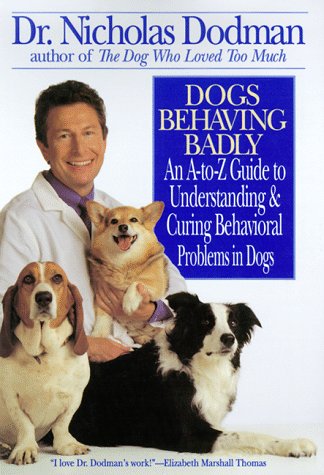
Dogs Behaving Badly: An A-To-Z Guide to Understanding and Curing Behavioral Problems in Dogs - Hardcover
Inhaltsangabe
Applying the latest discoveries in canine behaviorism and pharmacology, an expert animal psychologist and veterinarian provides dog owners and canine lovers with a comprehensive tool to treat their pets' every medical and emotional need.
Die Inhaltsangabe kann sich auf eine andere Ausgabe dieses Titels beziehen.
Über die Autorin bzw. den Autor
Dr. Nicholas Dodman, who has been hailed as the "world's leading veterinary psychopharmacologist" by Dr. John Ratey of Harvard Medical School, runs the renowned Tufts University Veterinary Center. An international expert in domestic-animal research as well as in the veterinary practice of animal psychology, Dr. Dodman is the author of The Dog Who Loved Too Much and The Cat Who Cried for Help.
Aus dem Klappentext
60;Nicholas Dodman, bestselling author of The Dog Who Loved Too Much--praised as "the most important book on dog behavior of this century" by Elizabeth Marshall Thomas--has written the book every dog owner has been waiting for: an authoritative and practical A-to-Z guide to understanding canine behavioral problems and what we can do about them... Dogs Behaving Badly.
With wit, wisdom, and compassion, Dr. Dodman gets us inside the minds of our pets to learn what makes them do the crazy things they do. From aggression to zoonosis and just about everything in between, he tackles such common problems as nipping, tail chasing, excessive barking, and garbage scavenging, as well as more difficult conditions that often defy explanation--not to mention treatment.
Drawing on the latest research in canine behaviorism and pharmacology, in addition to case histories from his own practice at the prestigious Tufts University Veterina
Auszug. © Genehmigter Nachdruck. Alle Rechte vorbehalten.
By now almost everyone has heard of the syndrome of medical hyperactivity that is supposed to affect so many schoolchildren. These children have difficulty concentrating, are not good at following directions, fidget constantly, find it hard to sit still, and are easily bored. Another name for this nebulous constellation of signs is attention deficient hyperactivity disorder, or ADHD for short. In girls, the hyperactivity component is often lacking, giving rise to a purer attention deficit disorder, just plain ADD, whereas in boys, the hyperactivity component is more common and the syndrome is often associated with aggression. Although it used to be thought that ADHD was confined to childhood years, it has come to light recently that the disorder persists throughout life, though it often goes unrecognized and undiagnosed. Typical signs of ADHD in adults include difficulty in getting started on projects, forgetfulness, procrastination, and a constant need for stimulation that manifests as thrill-seeking behavior. The question is, could dogs possibly be affected with a similar syndrome? Some say yes, and some say no.
The term hyperactivity has vernacular implications as well as being a possible medical diagnosis. It is common for owners and trainers to refer to a particular dog as hyperactive, meaning that it runs around a lot and won't listen. According to this rather loose definition, almost all puppies are hyperactive; observation tells us that puppyhood and hyperactivity are virtually synonymous. But do all puppies grow up to be forgetful procrastinators? I don't think so. On the other hand, if we always interpret restlessness, limited attention span, and a high activity level in dogs as normal behavior, or a variation on a theme of normalcy, we will never diagnose hyperactivity.
Behaviorists' views on the existence of hyperactivity in dogs are equivocal, with opinions ranging from one extreme to the other. The head of the behavior clinic at the Veterinary Hospital of the University of Pennsylvania, Dr. Karen Overall, says that she has yet to diagnose a case of hyperactivity in dogs. On the other hand, Dr. Walter Burghart, a veterinary practitioner in Texas with a special interest in animal behavior, believes that hyperactivity is the driving force behind many of the behavior problems that we see in domestic dogs. The case can be argued both ways, depending on your point of view. In support of Dr. Overall's position, I, too, have had precious few, if any, dogs that I have confirmed as hyperactive according to the strict medical definition of the word. In support of Dr. Burghart's view, though, I have seen many dogs that could reasonably be described as overactive or hyperactive that present with a variety of behavior problems apparently secondary to this underlying disturbance. Some might say that the proof of this pudding lies in the response to stimulants, such as Ritalin and amphetamine.
The paradoxical response of hyperactive schoolchildren to treatment with the stimulant Ritalin is almost legend. I have even heard parents and schoolteachers say, "Oh, that kid's hyperactive. He should be put on Ritalin." Now, Ritalin would make a normal child tear around like a turkey with its head cut off, but for some reason it has a calming effect on hyperactive children, enabling them to pay attention and focus on the job at hand. In fact, in their book Driven to Destruction, psychiatrists David Hallowell and John Ratey liken the effect of Ritalin on a hyperactive child to that of putting a pair of spectacles on a child that is nearsighted. It has the effect of permitting him to focus. If supposedly medically hyperactive dogs were to respond to stimulants in a similar way, you would think that this would be powerful evidence in favor of a true medical-syndrome hyperactivity. And wouldn't you know it; some hyperactive dogs do calm down when treated with stimulants. One veterinary behaviorist colleague of mine, Dr. Andrew Luescher, now head of the behavior program at Purdue Veterinary School in Indiana, employs a diagnostic test in which putatively hyperactive dogs are administered a small dose of amphetamine by mouth and their behavioral and physiologic responses are monitored for four hours thereafter. Dogs that become restless and whose heart rate and respiratory rate increases following medication are considered "normal," whereas hyperactivity is confirmed in dogs whose activity level is reduced by this treatment and whose heart rate and respiratory rate subsequently is slowed.
Dr. Burghart uses a slightly more protracted but analogous approach to diagnosing hyperactivity in some of his patients. He advises a course of the antidepressant Elavil to be given at home and for the owners to monitor and record the dog's response to this treatment. Elavil (whose very name is a pun on the word elevate--as in elevate mood) has stimulant properties and it can be argued that it produces a stimulant effect analogous to that of amphetamines. Again, the diagnosis is (supposedly) confirmed if owners report calming of the dog's behavior as a result of this test. Unfortunately, Elavil also produces a calming and mood-stabilizing effect by a different mechanism, leaving these conclusions somewhat open to debate.
All this talk of hyperactivity in dogs and its similarity with hyperactivity in children was initiated by scientist Samuel Corssen and coworkers in the 1970s. Corssen produced a behavioral change he called hyperkinesis in a cruel study on laboratory dogs by stressing them with inescapable random electric shocks. It is of little surprise that some of these dogs developed an increased heart rate, heavy breathing, salivation, and metabolic changes associated with stress. What is more surprising is that some of the dogs in the experiment did not show the same signs, or at least adapted quickly. He described the traumatized responders as antidiuretic dogs because their urine production fell. Finding that these antidiuretic dogs became calmer when treated with Ritalin or amphetamine, he drew parallels with the human condition of hyperactivity. More relevantly, Corssen also found that amphetamine had a beneficial calming effect on what he referred to as naturally occurring untrainable hyperkinetic dogs--untrainable dogs that had not yet been exposed to his Frankensteinian experiment. These dogs were so labeled because they did not cooperate with his handlers and were not easily commanded. Furthermore, they fought violently against the restraining harnesses and "tried to bite and chew everything within their reach." I'm not sure whether these dogs were truly hyperactive or just smart, but either way, they were calmed following treatment with stimulants. Actually, not all naturally hyperkinetic dogs responded to amphetamine in this way; only six of eight did. Interestingly, the two that were resistant to the treatment were both wirehaired fox terriers. (No surprise there--WHFTs seem refractory to all treatments.)
Although I don't condone Corssen's methods, I believe that his results, since they already exist, are worth reference. I too have found that some apparently hyperactive dogs become calmer when treated with stimulants and have had my most memorable treatment failures with wirehaired fox terriers. Although a delightful breed, wirehaired fox terriers, like my friends the bull...
„Über diesen Titel“ kann sich auf eine andere Ausgabe dieses Titels beziehen.
Suchergebnisse für Dogs Behaving Badly: An A-To-Z Guide to Understanding...

Beispielbild für diese ISBN
Dogs Behaving Badly: An A-To-Z Guide to Understanding and Curing Behavioral Problems in Dogs
Anbieter: World of Books (was SecondSale), Montgomery, IL, USA
Verkäuferbewertung 5 von 5 Sternen

Zustand: Good. Item in good condition. Textbooks may not include supplemental items i.e. CDs, access codes etc. Artikel-Nr. 00083492252
Gebraucht kaufen
EUR 4,68
Versand gratis
Versand innerhalb von USA
Versand innerhalb von USA
Anzahl: 3 verfügbar
Beispielbild für diese ISBN
Dogs Behaving Badly: An A-To-Z Guide to Understanding and Curing Behavioral Problems in Dogs
Anbieter: World of Books (was SecondSale), Montgomery, IL, USA
Verkäuferbewertung 5 von 5 Sternen
Zustand: Acceptable. Item in good condition. Textbooks may not include supplemental items i.e. CDs, access codes etc. Artikel-Nr. 00068170669
Gebraucht kaufen
EUR 4,68
Versand gratis
Versand innerhalb von USA
Versand innerhalb von USA
Anzahl: 1 verfügbar
Beispielbild für diese ISBN
Dogs Behaving Badly: An A-To-Z Guide to Understanding and Curing Behavioral Problems in Dogs
Anbieter: BooksRun, Philadelphia, PA, USA
Verkäuferbewertung 5 von 5 Sternen
Hardcover. Zustand: Very Good. 1. With dust jacket. It's a well-cared-for item that has seen limited use. The item may show minor signs of wear. All the text is legible, with all pages included. It may have slight markings and/or highlighting. Artikel-Nr. 0553108735-11-1-29
Gebraucht kaufen
EUR 4,79
Versand gratis
Versand innerhalb von USA
Versand innerhalb von USA
Anzahl: 1 verfügbar
Beispielbild für diese ISBN
Dogs Behaving Badly: An A-To-Z Guide to Understanding and Curing Behavioral Problems in Dogs
Anbieter: Wonder Book, Frederick, MD, USA
Verkäuferbewertung 5 von 5 Sternen
Zustand: Very Good. Very Good condition. Very Good dust jacket. A copy that may have a few cosmetic defects. May also contain light spine creasing or a few markings such as an owner's name, short gifter's inscription or light stamp. Artikel-Nr. B15B-02366
Gebraucht kaufen
EUR 6,42
Versand gratis
Versand innerhalb von USA
Versand innerhalb von USA
Anzahl: 1 verfügbar
Beispielbild für diese ISBN
Dogs Behaving Badly: An A-To-Z Guide to Understanding and Curing Behavioral Problems in Dogs
Anbieter: Wonder Book, Frederick, MD, USA
Verkäuferbewertung 5 von 5 Sternen
Zustand: As New. Like New condition. Very Good dust jacket. A near perfect copy that may have very minor cosmetic defects. Artikel-Nr. N14M-00490
Gebraucht kaufen
EUR 6,42
Versand gratis
Versand innerhalb von USA
Versand innerhalb von USA
Anzahl: 1 verfügbar
Beispielbild für diese ISBN
Dogs Behaving Badly: An A-To-Z Guide to Understanding and Curing Behavioral Problems in Dogs
Anbieter: ThriftBooks-Phoenix, Phoenix, AZ, USA
Verkäuferbewertung 5 von 5 Sternen
Hardcover. Zustand: Very Good. No Jacket. May have limited writing in cover pages. Pages are unmarked. ~ ThriftBooks: Read More, Spend Less. Artikel-Nr. G0553108735I4N00
Gebraucht kaufen
EUR 6,78
Versand gratis
Versand innerhalb von USA
Versand innerhalb von USA
Anzahl: 1 verfügbar
Beispielbild für diese ISBN
Dogs Behaving Badly: An A-To-Z Guide to Understanding and Curing Behavioral Problems in Dogs
Anbieter: ThriftBooks-Dallas, Dallas, TX, USA
Verkäuferbewertung 5 von 5 Sternen
Hardcover. Zustand: Very Good. No Jacket. May have limited writing in cover pages. Pages are unmarked. ~ ThriftBooks: Read More, Spend Less. Artikel-Nr. G0553108735I4N00
Gebraucht kaufen
EUR 6,78
Versand gratis
Versand innerhalb von USA
Versand innerhalb von USA
Anzahl: 1 verfügbar
Beispielbild für diese ISBN
Dogs Behaving Badly : An A-to-Z Guide to Understanding and Curing Behavioral Problems in Dogs
Verlag:
Random House Publishing Group, 1999
ISBN 10: 0553108735
ISBN 13: 9780553108736
Gebraucht
Hardcover
Erstausgabe
Anbieter: Better World Books: West, Reno, NV, USA
Verkäuferbewertung 5 von 5 Sternen
Zustand: Good. 1st Edition. Former library copy. Pages intact with minimal writing/highlighting. The binding may be loose and creased. Dust jackets/supplements are not included. Includes library markings. Stock photo provided. Product includes identifying sticker. Better World Books: Buy Books. Do Good. Artikel-Nr. 4387958-6
Gebraucht kaufen
EUR 7,38
Versand gratis
Versand innerhalb von USA
Versand innerhalb von USA
Anzahl: 2 verfügbar
Beispielbild für diese ISBN
Dogs Behaving Badly : An A-to-Z Guide to Understanding and Curing Behavioral Problems in Dogs
Verlag:
Random House Publishing Group, 1999
ISBN 10: 0553108735
ISBN 13: 9780553108736
Gebraucht
Hardcover
Erstausgabe
Anbieter: Better World Books: West, Reno, NV, USA
Verkäuferbewertung 5 von 5 Sternen
Zustand: Good. 1st Edition. Pages intact with minimal writing/highlighting. The binding may be loose and creased. Dust jackets/supplements are not included. Stock photo provided. Product includes identifying sticker. Better World Books: Buy Books. Do Good. Artikel-Nr. 2379310-75
Gebraucht kaufen
EUR 7,38
Versand gratis
Versand innerhalb von USA
Versand innerhalb von USA
Anzahl: 1 verfügbar
Beispielbild für diese ISBN
Dogs Behaving Badly : An A-to-Z Guide to Understanding and Curing Behavioral Problems in Dogs
Verlag:
Random House Publishing Group, 1999
ISBN 10: 0553108735
ISBN 13: 9780553108736
Gebraucht
Hardcover
Erstausgabe
Anbieter: Better World Books, Mishawaka, IN, USA
Verkäuferbewertung 5 von 5 Sternen
Zustand: Good. 1st Edition. Pages intact with minimal writing/highlighting. The binding may be loose and creased. Dust jackets/supplements are not included. Stock photo provided. Product includes identifying sticker. Better World Books: Buy Books. Do Good. Artikel-Nr. 2379310-75
Gebraucht kaufen
EUR 7,38
Versand gratis
Versand innerhalb von USA
Versand innerhalb von USA
Anzahl: 2 verfügbar