
Verwandte Artikel zu First Evidence
Inhaltsangabe
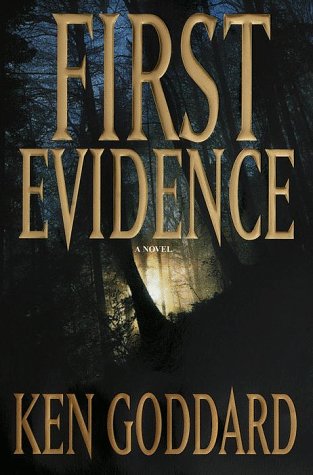
A chilling tale of murder, forensic detection, and vivid speculation pits Colin Cellars, an experienced crime scene investigator, against a culprit who may be unlike any this world has ever spawned.
Die Inhaltsangabe kann sich auf eine andere Ausgabe dieses Titels beziehen.
Über die Autorinnen und Autoren
Ken Goddard is the author of six previous novels, including the New York Times bestseller Balefire. He has served as a criminalist in three California police and sheriff's departments, and has served as an instructor in crime scene investigation and forensic techniques at police, sheriff, and federal law enforcement academies throughout the United States. He lives in Ashland, Oregon, where he is currently director of the National Fish and Wildlife Forensics Laboratory, the only full-service wildlife crime laboratory in the world.
Ken Goddard is currently director of the National Fish and Wildlife Forensics Laboratory, the only full-service wildlife crime laboratory in the world.
Aus dem Klappentext
;i>New York Times bestselling author of Balefire comes a chilling tale of murder, forensic detection, and vivid speculation, pitting a unique crime scene investigator against a culprit who may be unlike any this world ever spawned....
As an experienced crime scene investigator, Colin Cellars has had to contend with missing evidence before. But never has he encountered such a chaotic crime scene as the one at a remote cabin nestled in the deep woods of the Pacific Northwest--site of a reported shoot-out. Cellars cannot find a trace of perpetrator or victim. He can't even confirm there has been a murder, much less that the cabin's owner--and the presumed victim--could be his long-estranged former best friend. But something violent and inexplicable has happened, and each time he approaches the scene seeking clearer evidence, eerie occurrences confound the case further.
Cellars is determined to unravel the contradictions, enlisting his closest friends to aid h
Auszug. © Genehmigter Nachdruck. Alle Rechte vorbehalten.
There had been no warning.
No sound of an approaching vehicle echoing in the cold, crisp mountain air.
No crunch of gravel--or even dried-out pine needles--giving way under a heavy tire or boot.
No muted beeping of tripped sensors.
No creaking floorboards.
No whispered voices.
Nothing whatsoever.
Or at least nothing perceptible to any human senses.
And certainly nothing to make Bob Dawson think he might be in any kind of danger from someone--or some thing--trying to break into his cabin.
Which was an interesting concept in itself, because if anyone had ever bothered to ask him, Dawson would have responded--without the slightest sense of deceit or bravado--that he honestly couldn't remember the last time he'd felt threatened, much less afraid, of anyone or anything.
He'd been like that for as long as he could remember. First as a scrappy kid with lightning-fast reflexes and a seemingly permanent set of bruised knuckles and bloody nose. Then as an adrenaline-loving Army gunship pilot who made the easy transition to federal law enforcement, flying drug interdiction missions for the DEA. And now as a medically retired ex-federal agent turned bodybuilding Oregon hermit, thanks to a mysterious air crash that had never been satisfactorily explained to anyone--especially the DEA. Six months later, they were still searching the Marble Mountain Wilderness area in northern California for the remains of their supposedly shattered and burned helicopter.
But setting those minor discrepancies aside, if you were looking for someone tough, smart, aggressive, and flat-out crazy enough to take on the local school bully, the mob, biker gangs, low-flying drug runners, or just your average malicious two-bit asshole--face-to-face, single-handed, no backup necessary--then Bob Dawson was definitely your man.
If you could find him.
Which wasn't an easy thing to do, as four tired, confused, discouraged, and thoroughly pissed-off Internal Affairs investigators from the DEA would have been more than happy to testify.
Of course, they hadn't thought to look for him in a cave on a privately owned 320-acre parcel of forested land located at the far end of a rarely used logging road that had been turned over to the county when the timber industry went belly up several years ago. Which was just as well because there were hundreds of such parcels in Jasper County.
Nor had it ever occurred to them that a retired DEA agent/pilot--and especially one who had supposedly just barely survived a brutal helicopter crash--might spend the next six months handcrafting then concealing a log cabin over the top of that cave without ever bothering to mention the fact to the Jasper County Planning Department.
All of which provided ample demonstration that the DEA simply didn't know their man.
In spite of his ready smile and outwardly gregarious nature, Dawson was very much a loner, a man who valued almost nothing--other than his dog and his memories of three childhood friends--more than his treasured solitude and privacy. The seemingly endless succession of pretty and adventuresome young women who briefly crossed his path found that out quickly, too. A few days, or a week or two at the most, was all it ever took for even the most dense or inattentive of them to discover the underlying reality. In spite of all outward appearances, this ruggedly handsome, muscular, humorous, artistic, and enticingly dangerous man was a person very much out of place and out of step with the surrounding world.
Born in the wrong state, and in the wrong century. That's what everybody had told him from as far back as he could remember. Should have popped out of his mama's womb in the middle of the Texas Panhandle or the Missouri Breaks, rather than the mountains of southern Oregon. Back in the time and place where the concept of one riot, one marshal, a damsel in distress, and not even a prayer of a backup, really meant something.
Which is one hell of an ironic twist, when you stop to think about it.
From his crouched position in the far corner of his cabin, Dawson stared numbly at the torn and bloody carcass of his dog. The malamute's lifeless eyes stared back, questioning and accusing. How did we end up in this situation? Your fault or mine?
Ironic as hell, because there isn't a distressed damsel within twenty miles of this place, or at least none that I know of, and I could sure use some backup right about now.
He felt a drop of sweat--or maybe it was blood, he couldn't tell which, and really didn't care--start to slide down his cheek, and he instinctively readjusted his hands around the polished walnut grip of the ancient but fully functional revolver. Couldn't risk a slip now because his first shot had to be dead on the money. Might not be time for a second shot because whoever or whatever it was, and wherever it had gone, it was too damned fast.
Might even be faster than the damned bullet for all I know.
Dawson blinked in confusion at the thought. Then a chill ran down his spine as he turned his attention for a brief moment to the weapon he was holding in an instinctive, straight-armed, two-handed combat grip.
But he really didn't have to look. Now that his attention was focused, he knew it by feel. His treasured model 1873 Single Action Army Colt "Peacemaker." The very same make and model of revolver that Colonel George Armstrong Custer's men carried at the Little Bighorn. And loaded with ancient, balloon-head, copper-cased ammunition dating back to Custer's disastrous fight with Sitting Bull's Sioux and Low Dog's Oglala warriors: a .45-caliber, 250-grain soft-nosed lead bullet sitting in front of forty grains of FFg black powder.
Translation: a big, slow, and undependable bullet.
Shit, I should have gone for the Smith. What the hell's the matter with me?
But then he glanced across the basement, in the direction of his open bedroom, where his modern Smith & Wesson .44 Magnum revolver lay beneath his pillow, and remembered. The far more lethal weapon--with its deafening concussion, and incredibly fast and reliable hollow-point rounds--had been a good two or three seconds away from where he'd tumbled to the floor.
No, that's right, I wouldn't have made it. Good decision, he told himself as he readjusted his grip again. He was vaguely aware that his arms and wrists were starting to get tired, but he had no idea why.
Thinking about his other weapon options caused Dawson to realize that his right shoulder was pressing against the heavy octagonal barrel of his Sharps rifle--a weapon made famous by the fictional Matthew Quigley--and the shorter rounded barrel of his Sharps Military Carbine. Both weapons were chambered for the middle-finger-sized .45-70 cartridge--which meant a substantially bigger, faster, and harder-hitting projectile--and thus a serious temptation, given the unknown nature of his now-barricaded intruder. It would be easy to twist around and grab one of the unloaded rifles. But the Sharps were single-shot weapons, and slow loaders to boot. And the dozen black powder cartridges he'd carefully hand-loaded for each weapon the old-fashioned way were secured in wrapped-up canvas cartridge belts hung over the trigger guards, so he quickly pushed that option out of his mind.
Colt single action's a fine gun, long as I don't have to reload. Gotta forget about that goddamned fool Custer and stay with my instincts. Only way I'm going to get out of this room alive.
He understood now, much too late, what his subconscious mind had been complaining about all along: that he and the dog would have had a much better chance if he'd actually possessed some sense of what sphincter-loosening fear was all about. Given that insight, he might...
„Über diesen Titel“ kann sich auf eine andere Ausgabe dieses Titels beziehen.
Weitere beliebte Ausgaben desselben Titels

Suchergebnisse für First Evidence

Beispielbild für diese ISBN
First Evidence
Anbieter: World of Books (was SecondSale), Montgomery, IL, USA
Verkäuferbewertung 5 von 5 Sternen

Zustand: Very Good. Item in very good condition! Textbooks may not include supplemental items i.e. CDs, access codes etc. Artikel-Nr. 00097736549
Gebraucht kaufen
EUR 3,94
Versand gratis
Versand innerhalb von USA
Versand innerhalb von USA
Anzahl: 1 verfügbar
Beispielbild für diese ISBN
First Evidence
Anbieter: World of Books (was SecondSale), Montgomery, IL, USA
Verkäuferbewertung 5 von 5 Sternen
Zustand: Good. Item in good condition. Textbooks may not include supplemental items i.e. CDs, access codes etc. Artikel-Nr. 00082241122
Gebraucht kaufen
EUR 3,94
Versand gratis
Versand innerhalb von USA
Versand innerhalb von USA
Anzahl: 1 verfügbar
Beispielbild für diese ISBN
First Evidence
Anbieter: Wonder Book, Frederick, MD, USA
Verkäuferbewertung 5 von 5 Sternen
Zustand: Very Good. Very Good condition. Very Good dust jacket. A copy that may have a few cosmetic defects. May also contain light spine creasing or a few markings such as an owner's name, short gifter's inscription or light stamp. Artikel-Nr. P01C-01433
Gebraucht kaufen
EUR 6,24
Versand gratis
Versand innerhalb von USA
Versand innerhalb von USA
Anzahl: 1 verfügbar
Beispielbild für diese ISBN
First Evidence
Verlag:
Bantam (edition First Edition), 1999
ISBN 10: 0553108646
ISBN 13: 9780553108644
Gebraucht
Hardcover
Erstausgabe
Anbieter: BooksRun, Philadelphia, PA, USA
Verkäuferbewertung 5 von 5 Sternen
Hardcover. Zustand: Very Good. First Edition. It's a well-cared-for item that has seen limited use. The item may show minor signs of wear. All the text is legible, with all pages included. It may have slight markings and/or highlighting. Artikel-Nr. 0553108646-11-1
Gebraucht kaufen
EUR 6,70
Versand gratis
Versand innerhalb von USA
Versand innerhalb von USA
Anzahl: 1 verfügbar
Beispielbild für diese ISBN
First Evidence
Verlag:
Bantam Doubleday Dell Publishing Group, 1999
ISBN 10: 0553108646
ISBN 13: 9780553108644
Gebraucht
Hardcover
Erstausgabe
Anbieter: Better World Books, Mishawaka, IN, USA
Verkäuferbewertung 5 von 5 Sternen
Zustand: Good. First Edition. Former library copy. Pages intact with minimal writing/highlighting. The binding may be loose and creased. Dust jackets/supplements are not included. Includes library markings. Stock photo provided. Product includes identifying sticker. Better World Books: Buy Books. Do Good. Artikel-Nr. 8437897-75
Gebraucht kaufen
EUR 6,73
Versand gratis
Versand innerhalb von USA
Versand innerhalb von USA
Anzahl: 2 verfügbar