
Verwandte Artikel zu Protein Power: The Metabolic Breakthrough
Inhaltsangabe
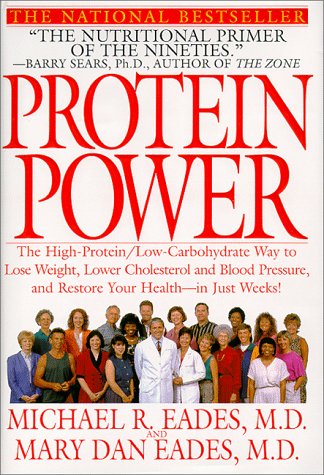
Presents an innovative new eating regimen, designed to help readers take off weight and achieve optimal health, that emphasizes a protein-rich, moderate-fat, and low-carbohydrate diet to help balance a body's natural hormones. 60,000 first printing. Tour.
Die Inhaltsangabe kann sich auf eine andere Ausgabe dieses Titels beziehen.
Über die Autorin bzw. den Autor
Michael R. Eades, M.D., author of Thin So Fast, and Mary Dan Eades, M.D., author of The Doctor's Complete Guide to Vitamins and Minerals, live in Little Rock, Arkansas, where they practice bariatric (weight loss) and general family medicine. They are the founders of Medi-Stat Medical Centers.
From the Trade Paperback edition.
Aus dem Klappentext
feel fitter, lower your cholesterol, and enjoy the foods you never thought you'd eat again! A rasher of bacon, a juicy steak, a wedge of cheese, a buttery omelet...Now, a team of pioneering doctors shows you how their groundbreaking, protein-rich eating plan succeeds where low-fat diets fail-- to help you take off the weight and achieve optimal health naturally, without counting fat grams, without worrying about fat percentages, and without going up the foods you love! Finally, a diet you can live with that works.
PROTEIN POWER
Based on cutting-edge research, this revolutionary, medically sound, deliciously satisfying plan has already helped thousands of patients lose weight and achieve other lifesaving health benefits, including lower cholesterol and blood pressure readings and an improvement or reversal of common disorders such as heart disease, adult-onset diabetes, and gout. Developed by Doctors Michael and Mary Dan Eades, the simple regimen calls for a new way of eating
Auszug. © Genehmigter Nachdruck. Alle Rechte vorbehalten.
You may be wondering how a couple of physicians who specialize in weight loss in a relatively small city in Middle America devised a nutritional program that works as well as this one does, while most of the scientists in the major universities are headed off in the opposite direction, puzzling over why their success with low-fat diet plans has been so minimal. In a nutshell, we lucked out. We lucked out because that's how science works. Science progresses because people continue to question why. Researchers propose hypotheses based on their understanding of the natural world and then test them--and most of the time these theories blow up in their faces. The lucky ones stumble onto the hypotheses that turn out to be valid. But of course there's more than luck involved because as Louis Pasteur said, "Chance favors the prepared mind," and in our case our minds were prepared by many years of clinical practice with patients suffering all the illnesses that are heir to disordered insulin metabolism as well as by our unique combination of medical interests. Mike is a collector of diet books and old medical texts and has a strong interest in paleopathology and biochemistry; Mary Dan is interested in anthropology and has published a book on eating disorders and the deranged metabolic status of eating-disordered patients.
We have a copy of the earliest diet book ever to sweep the nation, Banting's Letter on Corpulence, first printed in the middle 1800s. This restricted-carbohydrate diet worked like a charm for Banting and, if sales were any indication, many others. It has always intrigued us because it completely flies in the face of today's low-fat paradigm. At about the same time we ran across Banting we began attending paleopathology conferences and studying anthropology, where we learned what paleopathologists and anthropologists have known for years: the agricultural revolution and the increased consumption of carbohydrates it brought along with it played havoc with the health of early man. Mary Dan's extensive study of eating disorders and metabolic hormonal derangements combined with Mike's interest in biochemistry rounded out the "preparation" of our minds. We looked at Banting's success with carbohydrate restriction along with the paeopathological/anthropological data showing a decline in health acompanying an increase in carbohydrate intake and concluded that maybe the intake of large amounts of carbohydrates wasn't necessarily a good thing. That became our first mini-hypothesis: excess carbohydrate consumption isn't good. But why not?
We knew, as does every doctor, that the immediate effect of carbohydrate consumption is increased blood glucose, then an increased insulin level. We thought that perhaps the increased insulin levels might be to blame for part of the problem. As we studied the medical literature, we found that researchers the world over were finding elevated insulin levels associated with obesity, heart disease, high blood presure, and diabetes--the common diseases of modern man. We also found that the same researchers were for the most part trying to treat these patients by giving them more of the same thing we were begining to believe may have caused the problem in the first place: the high-carbohydrate, low-fat diet. It made more sense to us that if excess insulin indeed causes these disorders, or at the very least makes them worse, as the increasing mountain of research indicated, perhaps patients would be better off reducing their carbohydrate intake, not increasing it.
We took then as our working hypothesis that excess carbohydrate leads to excess insulin, which leads to obesity, high blood pressure, and all the rest. It fit with the anthropological and paleopathological data and, at least as far as obesity was concerned, with Banting's Dietary theory. We then began to examine this hypothesis from a basic biochemical perspective and found that it worked beautifully. From all perspectives our hypothesis looked good on paper, so we began to test it carefully, first on ourselves, then on patients in our practice. We found that the results were rapid, dramatic, and pretty much uniform--just what we expected based on the underlying science. As we worked with our patients, we continued to refine our techniques, expand our range of dietary choices, and in general collect those little tips and tricks that make the practice of medicine an art as well as a science. We are still learning and refining every day, and, as with any technique that works, more and more practitioners are beginning to use a restricted-carbohydrate diet for their patients and are adding their own unique refinements to the rapidly growing body of data.
This book is arranged in basically the sequence of our own development and refinement of our hypothesis. The first chapters give an overview and an explanation from a historical, anthropological, and biochemical perspective, which should give you the information and explanations you need to become comfortable with these seemingly radical ideas. If you don't care about the "why" of all this, just read "The Bottom Line," the summaries at the end of each chapter. The latter part of the book is a nuts-and-bolts primer on how to implement these nutritional strategies in your own health-preserving and rejuvenation program. (On the other hand, if you'd like to read more, please write to us in care of our publisher, and we'll send you a bibliography.)
You'll find the program in a nutshell on page 155, but please read all of Chapter 10, all about exercise in Chapter 12, and the essential list of vitamins at the end of Chapter 8, in addition to the Bottom Line Summaries.
Will this program work for you? In good conscience, we can only say probably. The reason we hedge a little is because of biochemical individuality--we are all as different biochemically as we are in appearance. Every doctor has encountered patients in whom medicines seem to work in an opposite fashion to that intended, patients who are kept awake by sleeping pills and pass out on stimulants. These and similar experiences keep practiced physicians from ever making blanket this-will-work-in-all-circumstances statements. AlI we can tell you is that in the almost ten years we have been treating patients with this program we have never had a negative outcome. If you're like the vast majority of our patients, you will find the results as striking and life changing as we have and will adopt this program, modified
„Über diesen Titel“ kann sich auf eine andere Ausgabe dieses Titels beziehen.
Suchergebnisse für Protein Power: The Metabolic Breakthrough

Beispielbild für diese ISBN
Protein Power
Anbieter: World of Books (was SecondSale), Montgomery, IL, USA
Verkäuferbewertung 5 von 5 Sternen

Zustand: Good. Item in good condition. Textbooks may not include supplemental items i.e. CDs, access codes etc. Artikel-Nr. 00095394111
Gebraucht kaufen
EUR 3,87
Versand gratis
Versand innerhalb von USA
Versand innerhalb von USA
Anzahl: 20 verfügbar
Beispielbild für diese ISBN
Protein Power
Anbieter: World of Books (was SecondSale), Montgomery, IL, USA
Verkäuferbewertung 5 von 5 Sternen
Zustand: Acceptable. Item in acceptable condition! Textbooks may not include supplemental items i.e. CDs, access codes etc. Artikel-Nr. 00095281489
Gebraucht kaufen
EUR 3,87
Versand gratis
Versand innerhalb von USA
Versand innerhalb von USA
Anzahl: 5 verfügbar
Beispielbild für diese ISBN
Protein Power: The High-Protein/Low Carbohydrate Way to Lose Weight, Feel Fit, and Boost Your Health-in Just Weeks!
Anbieter: BooksRun, Philadelphia, PA, USA
Verkäuferbewertung 5 von 5 Sternen
Hardcover. Zustand: Fair. With dust jacket. The item might be beaten up but readable. May contain markings or highlighting, as well as stains, bent corners, or any other major defect, but the text is not obscured in any way. Artikel-Nr. 0553101838-7-1-29
Gebraucht kaufen
EUR 5,06
Versand gratis
Versand innerhalb von USA
Versand innerhalb von USA
Anzahl: 1 verfügbar
Beispielbild für diese ISBN
Protein Power: The High-Protein/Low Carbohydrate Way to Lose Weight, Feel Fit, and Boost Your Health-in Just Weeks!
Anbieter: BooksRun, Philadelphia, PA, USA
Verkäuferbewertung 5 von 5 Sternen
Hardcover. Zustand: Very Good. With dust jacket. It's a well-cared-for item that has seen limited use. The item may show minor signs of wear. All the text is legible, with all pages included. It may have slight markings and/or highlighting. Artikel-Nr. 0553101838-11-18-29
Gebraucht kaufen
EUR 5,95
Versand gratis
Versand innerhalb von USA
Versand innerhalb von USA
Anzahl: 1 verfügbar
Beispielbild für diese ISBN
Protein Power: The High-Protein/Low Carbohydrate Way to Lose Weight, Feel Fit, and Boost Your Health-in Just Weeks!
Anbieter: ThriftBooks-Phoenix, Phoenix, AZ, USA
Verkäuferbewertung 5 von 5 Sternen
Hardcover. Zustand: Very Good. No Jacket. Missing dust jacket; May have limited writing in cover pages. Pages are unmarked. ~ ThriftBooks: Read More, Spend Less. Artikel-Nr. G0553101838I4N01
Gebraucht kaufen
EUR 6,56
Versand gratis
Versand innerhalb von USA
Versand innerhalb von USA
Anzahl: 1 verfügbar
Beispielbild für diese ISBN
Protein Power: The High-Protein/Low Carbohydrate Way to Lose Weight, Feel Fit, and Boost Your Health-in Just Weeks!
Anbieter: ThriftBooks-Atlanta, AUSTELL, GA, USA
Verkäuferbewertung 5 von 5 Sternen
Hardcover. Zustand: Very Good. No Jacket. May have limited writing in cover pages. Pages are unmarked. ~ ThriftBooks: Read More, Spend Less. Artikel-Nr. G0553101838I4N00
Gebraucht kaufen
EUR 6,60
Versand gratis
Versand innerhalb von USA
Versand innerhalb von USA
Anzahl: 1 verfügbar
Beispielbild für diese ISBN
Protein Power: The High-Protein/Low Carbohydrate Way to Lose Weight, Feel Fit, and Boost Your Health-in Just Weeks!
Anbieter: ThriftBooks-Dallas, Dallas, TX, USA
Verkäuferbewertung 5 von 5 Sternen
Hardcover. Zustand: Very Good. No Jacket. Missing dust jacket; May have limited writing in cover pages. Pages are unmarked. ~ ThriftBooks: Read More, Spend Less. Artikel-Nr. G0553101838I4N01
Gebraucht kaufen
EUR 6,60
Versand gratis
Versand innerhalb von USA
Versand innerhalb von USA
Anzahl: 1 verfügbar
Beispielbild für diese ISBN
Protein Power : The Metabolic Breakthrough
Verlag:
Bantam Doubleday Dell Publishing Group, 1996
ISBN 10: 0553101838
ISBN 13: 9780553101836
Gebraucht
Hardcover
Anbieter: Better World Books, Mishawaka, IN, USA
Verkäuferbewertung 5 von 5 Sternen
Zustand: Good. Pages intact with minimal writing/highlighting. The binding may be loose and creased. Dust jackets/supplements are not included. Stock photo provided. Product includes identifying sticker. Better World Books: Buy Books. Do Good. Artikel-Nr. GRP102268213
Gebraucht kaufen
EUR 7,19
Versand gratis
Versand innerhalb von USA
Versand innerhalb von USA
Anzahl: 2 verfügbar
Beispielbild für diese ISBN
Protein Power : The Metabolic Breakthrough
Verlag:
Bantam Doubleday Dell Publishing Group, 1996
ISBN 10: 0553101838
ISBN 13: 9780553101836
Gebraucht
Hardcover
Anbieter: Better World Books: West, Reno, NV, USA
Verkäuferbewertung 5 von 5 Sternen
Zustand: Good. Pages intact with minimal writing/highlighting. The binding may be loose and creased. Dust jackets/supplements are not included. Stock photo provided. Product includes identifying sticker. Better World Books: Buy Books. Do Good. Artikel-Nr. GRP102268213
Gebraucht kaufen
EUR 7,19
Versand gratis
Versand innerhalb von USA
Versand innerhalb von USA
Anzahl: 1 verfügbar
Beispielbild für diese ISBN
Protein Power : The Metabolic Breakthrough
Verlag:
Bantam Doubleday Dell Publishing Group, 1996
ISBN 10: 0553101838
ISBN 13: 9780553101836
Gebraucht
Hardcover
Anbieter: Better World Books, Mishawaka, IN, USA
Verkäuferbewertung 5 von 5 Sternen
Zustand: Very Good. Pages intact with possible writing/highlighting. Binding strong with minor wear. Dust jackets/supplements may not be included. Stock photo provided. Product includes identifying sticker. Better World Books: Buy Books. Do Good. Artikel-Nr. 4227844-6
Gebraucht kaufen
EUR 7,19
Versand gratis
Versand innerhalb von USA
Versand innerhalb von USA
Anzahl: 2 verfügbar