
Verwandte Artikel zu A Newcomer's Guide to the Afterlife: On the Other...
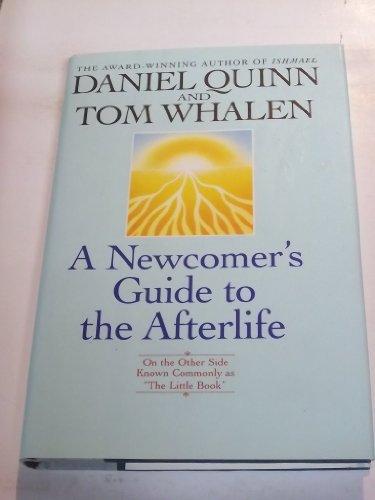
A Newcomer's Guide to the Afterlife: On the Other Side Known Commonly As "the Little Book" - Hardcover
Inhaltsangabe
Co-written by the author of Ishmael, a collection of uncommon wisdom, uncanny perceptions, and unexpected humor purports to be a handbook for the recently deceased, depicting life after death, including the after-lives of celebrities.
Die Inhaltsangabe kann sich auf eine andere Ausgabe dieses Titels beziehen.
Über die Autorin bzw. den Autor
Daniel Quinn's first book, <b>Ishmael</b>, won the Turner Tomorrow Fellowship, a prize for fiction presenting creative and positive solutions to global problems. He is also the author of <b>Providence</b>, <b>The Story of B</b>, and <b>My Ishmael</b>.
Aus dem Klappentext
a dead woman named Delores who appeared to one of the authors in a dream, <i>A Newcomer's Guide to the Afterlife</i> is the text that was presented to her shortly after she crossed over to the "other side." With the help of Tom Whalen, Daniel Quinn was able to decipher for living readers the cryptic messages encoded in the text of what is commonly known among the dead as "The Little Book." Filled with wisdom, secrets, strange imaginings, uncanny perceptions, and unexpected humor--<i>A Newcomer's Guide to the Afterlife</i> can be read as parable, allegory, or exactly as what it proclaims itself to be.
Auszug. © Genehmigter Nachdruck. Alle Rechte vorbehalten.
Q. What am I doing here? I feel totally disoriented and helpless.
A. This is normal for the newly dead and will pass. Your circumstances have changed as drastically as it is possible for circumstances to change. Every single one of us felt this way initially. Every single one of us eventually learned the ropes and regained our sense of balance and self-possession. The Little Book is designed to serve as a ready first aid to this objective.
Q. What's wrong with my legs? It's as though they were made of rubber.
A. You have what is popularly known as the staggers, which we all have when we arrive in the Afterlife. You'll be back to normal in a few days.
Q. Exactly where am I?
A. In life, it seemed to you that you inhabited a universe of stars, galaxies, and so on, and you located yourself as an individual on the planet Earth, on one of its continents or islands, perhaps in one of its cities. In your stay in that universe, this seemed "normal." A quick look round will convince you that you no longer inhabit that universe. It's said that we inhabit "another dimension" or "a parallel universe," but these phrases have no precise meaning. Basically, you're somewhere else, and this somewhere else will soon seem completely normal to you.
Q. But everything already looks completely normal.
A. Our environment is locally psycho-reactive, which is to say that it responds to our individual expectations in ways that are not explainable in ordinary causal terms. If you are, let us say, an American urbanite of the 1990s, your surroundings will almost certainly look and function like a sort of idealized American city of that era. If, on the other hand, you are a Kayapo Indian of the 1990s, your surroundings will look and function like a rain forest in the interior of Brazil.
Q. Is this heaven then?
A. Some believe so. Some argue that it cannot be, since no divine presence makes itself felt. Some believe it to be a purgatory from which some or all of us will eventually be delivered. Even in the Afterlife, questions remain.
Q. Why do people call this place Detroit [Nepal, Havana, Beijing, Hong Kong, Sheffield, Nebraska]? It isn't at all the way I remember it.
A. Place names in the Afterlife are not subject to any objective standard. Several large French cities are named Paris, and they are not all in the same general area (not, in other words, all in "France"). Shades in your area (or at least some of them) have adopted the habit of calling it Detroit (or whatever). It doesn't mean much of anything. Humor them--or call it whatever you please (maybe you'll start a new trend).
Q. Are maps available?
A. Yes, and they are delightful to look upon. Maps as small as your thumb, maps as large as the landscape. Minutely detailed maps with names of places you've never been. Glorious maps, filigreed, flagged, annotated, and totally impractical.
Q. Why is it always overcast? Doesn't the sun ever shine?
A. It isn't "overcast," and there is no sun to shine. The light (and the alternation of "day" and "night") is assumed to be our environment's response to our expectations of it. Finicky speakers say that we experience light (and the rest of the Afterlife), not that light (or anything else in the Afterlife) exists. If you would prefer to pass your time entirely in the "day," you will want to search out one of the so-called Northern Cities, where "the sun shines twenty-four hours a day."
Q. What is my body made of?
A. The nature of matter in this continuum (including the matter in your body) is as mysterious as the nature of matter in the continuum we knew when alive. Clearly our bodies are not as "substantial" as in life--not as heavy or impermeable.
Q. I thought memory was a brain function, pure and simple. How can I have memories if I don't have a brain?
A. You clearly do have a brain, just as you clearly have arms, legs, eyes, nose, hair, and so on. All the organs are there, though their function may or may not be.
Q. I don't have any feeling of hunger, but I've seen people eating. Will I get hungry later?
A. Food is not a necessity in the Afterlife. "Eating" (it has to be enclosed in quotation marks) is an experience quite unlike the one you knew in life. Try it, and spare me the necessity of describing something you will inevitably experience for yourself.
Q. What about sleep? Do people sleep here?
A. People rest, doze, tune out, power down, and, yes, sleep (though neurologists insist that none of these states actually correspond to what the living call sleep). Some find they have no need of it, some spend as much time at it as they can. It continues to provide a handy means of ending a tiresome visit: "I have to go home and sleep now, thank you. Auf Wiedersehen!"
Q. What's the proper way to talk about things here? Do you call people ghosts or spirits or what?
A. You may call people people. People are called ghosts or shades only in a semi-jocular or casual way, except when referring to their former status, as in, "Today I met the shade of my second cousin Alf." (Most people, however, would simply say, "Today I met my second cousin Alf.") You will seldom hear people refer to us as spirits. Most people think of spirits as bodiless beings (which we are clearly not).
Q. Do people refer to themselves as dead?
A. We often refer to ourselves collectively as "the dead" but as individuals seldom think of ourselves as such, since we are manifestly alive (though in a somewhat attenuated form). We say, "I live two streets over," "This is not a bad life we have here," "I live for my work," "I prefer to live alone," and so on.
Q. I worry that, being a newcomer, I may inadvertently violate some custom or give offense to someone. Are there guides to etiquette and good manners?
A. Such guides exist, though they were more in evidence in the seventeenth, eighteenth, and nineteenth centuries. In general, the good manners you practiced in life will serve perfectly well here. Special customs do not seem to arise among the dead; if you think about it, you'll see that the conditions and occasions that fostered the development of customs in life are largely absent here.
Q. I heard someone talk about "losing his head." What does this mean?
A. Losing your head is a sort of jocular euphemism for dying; the reference is of course to decapitation. When in a few days or weeks you have recovered from the shock of "losing your head," it will be said that you "have your head on"--in...
„Über diesen Titel“ kann sich auf eine andere Ausgabe dieses Titels beziehen.
Suchergebnisse für A Newcomer's Guide to the Afterlife: On the Other...

Beispielbild für diese ISBN
A Newcomer's Guide to the Afterlife
Verlag:
Bantam (edition First Edition), 1997
ISBN 10: 0553096702
ISBN 13: 9780553096705
Gebraucht
Hardcover
Erstausgabe
Anbieter: BooksRun, Philadelphia, PA, USA
Verkäuferbewertung 5 von 5 Sternen

Hardcover. Zustand: Very Good. First Edition. With dust jacket. It's a well-cared-for item that has seen limited use. The item may show minor signs of wear. All the text is legible, with all pages included. It may have slight markings and/or highlighting. Artikel-Nr. 0553096702-8-1-29
Gebraucht kaufen
EUR 5,38
Versand gratis
Versand innerhalb von USA
Versand innerhalb von USA
Anzahl: 1 verfügbar
Beispielbild für diese ISBN
A Newcomer's Guide to the Afterlife : On the Other Side Known Commonly As "The Little Book"
Verlag:
Bantam Doubleday Dell Publishing Group, 1997
ISBN 10: 0553096702
ISBN 13: 9780553096705
Gebraucht
Hardcover
Erstausgabe
Anbieter: Better World Books, Mishawaka, IN, USA
Verkäuferbewertung 5 von 5 Sternen
Zustand: Good. 1st. Former library copy. Pages intact with minimal writing/highlighting. The binding may be loose and creased. Dust jackets/supplements are not included. Includes library markings. Stock photo provided. Product includes identifying sticker. Better World Books: Buy Books. Do Good. Artikel-Nr. 651388-6
Gebraucht kaufen
EUR 6,56
Versand gratis
Versand innerhalb von USA
Versand innerhalb von USA
Anzahl: 1 verfügbar
Beispielbild für diese ISBN
A Newcomer's Guide to the Afterlife
Anbieter: ThriftBooks-Atlanta, AUSTELL, GA, USA
Verkäuferbewertung 5 von 5 Sternen
Hardcover. Zustand: Very Good. No Jacket. May have limited writing in cover pages. Pages are unmarked. ~ ThriftBooks: Read More, Spend Less. Artikel-Nr. G0553096702I4N00
Gebraucht kaufen
EUR 7,38
Versand gratis
Versand innerhalb von USA
Versand innerhalb von USA
Anzahl: 1 verfügbar
Beispielbild für diese ISBN
A Newcomer's Guide to the Afterlife
Anbieter: ThriftBooks-Atlanta, AUSTELL, GA, USA
Verkäuferbewertung 5 von 5 Sternen
Hardcover. Zustand: Good. No Jacket. Pages can have notes/highlighting. Spine may show signs of wear. ~ ThriftBooks: Read More, Spend Less. Artikel-Nr. G0553096702I3N00
Gebraucht kaufen
EUR 7,38
Versand gratis
Versand innerhalb von USA
Versand innerhalb von USA
Anzahl: 1 verfügbar