
Verwandte Artikel zu Outside In: The Power of Putting Customers at the Center...
Inhaltsangabe
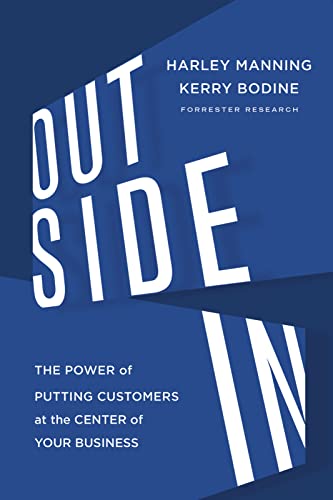
What simple innovation brought billions in new investments to Fidelity? What basic misunderstanding was preventing Office Depot from achieving its growth potential? What surprising insights helped the Mayo Clinic better serve both doctors and patients?
The solution in each case was a focus on customer experience, the most powerful—and misunderstood—element of corporate strategy today.
Customer experience is, quite simply, how your customers perceive their every interaction with your company. It’s a fundamental business driver. Here’s proof: over a recent five-year period during which the S&P 500 was flat, a stock portfolio of customer experience leaders grew twenty-two percent.
In an age when customers have access to vast amounts of data about your company and its competitors, customer experience is the only sustainable source of competitive advantage. But how to excel at it?
Based on fourteen years of research by the customer experience leaders at Forrester Research, Outside In offers a complete roadmap to attaining the experience advantage. It starts with the concept of the Customer Experience Ecosystem—proof that the roots of customer experience problems lie not just with customer-facing employees like your sales staff, but with behind-the-scenes employees like accountants, lawyers, and programmers, as well as the policies, processes, and technologies that all your employees use every day. Identifying and solving these problems has the potential to dramatically increase sales and decrease costs.
Die Inhaltsangabe kann sich auf eine andere Ausgabe dieses Titels beziehen.
Über die Autorinnen und Autoren
Harley Manning founded Forrester’s customer experience research practice when he joined the firm in 1998. Today he leads a team of analysts that cover enterprise-level customer experience topics ranging from strategy to metrics and business models.
Kerry Bodine leads Forrester’s research on experience design. Kerry’s research, analysis, and opinions appear frequently on sites like Harvard Business Review, Forbes, and Advertising Age, and she blogs for Forrester and 1to1 Media.
Von der hinteren Coverseite
BLURBS TK
Aus dem Klappentext
What simple innovation brought billions in new investments to Fidelity? What basic misunderstanding was preventing Office Depot from achieving its growth potential? What surprising insights helped the Mayo Clinic better serve both doctors and patients?
The solution in each case was a focus on customer experience, the most powerful and misunderstood element of corporate strategy today.
Customer experience is, quite simply, how your customers perceive their every interaction with your company. It s a fundamental business driver. Here s proof: over a recent five-year period during which the S&P 500 was flat, a stock portfolio of customer experience leaders grew twenty-two percent.
In an age when customers have access to vast amounts of data about your company and its competitors, customer experience is the only sustainable source of competitive advantage. But how to excel at it?
Based on fourteen years of research by the customer experience leaders at Forrester Research, "Outside In" offers a complete roadmap to attaining the experience advantage. It starts with the concept of the Customer Experience Ecosystem proof that the roots of customer experience problems lie not just with customer-facing employees like your sales staff, but with behind-the-scenes employees like accountants, lawyers, and programmers, as well as the policies, processes, and technologies that all your employees use every day. Identifying and solving these problems has the potential to dramatically increase sales and decrease costs.
"
Auszug. © Genehmigter Nachdruck. Alle Rechte vorbehalten.
1
You Need Your Customers More Than They Need You
Kevin Peters sat alone in his car in the rain, watching the entrance of an Office Depot store. He was wearing a baseball cap and a well-worn pair of jeans.
Over the course of the last half hour he’d watched one customer after another emerge from the store. None of them carried a shopping bag. On their way out, they walked past an Office Depot employee leaning against a wall under the awning, smoking a cigarette out of the rain.
Kevin was torn. On the one hand, he didn’t want anyone to know he was there. As the president of Office Depot’s North American retail division, he’d come to this parking lot in New Jersey on a gray, dreary day to get a firsthand look at how customers experienced one of his stores. His method, already followed at dozens of other locations, was to observe customers coming and going, then enter, walk the aisles, and talk to customers about whether they were finding what they needed and how they liked the store in general.
The success of each visit hinged on the store manager not knowing he was there. Kevin wanted to see the store as a customer on a shopping trip, not as an executive on an inspection tour. But this situation was too much. Frustrated customers were leaving without products while one of his employees not only ignored them but laid down a cloud of tobacco smoke for them to walk through on their way out the door. Should he blow his cover by telling the manager to get his slacking employee back in the store to help shoppers?
Kevin made a decision: This couldn’t stand. There was no way he was going to sit idly by and watch his business erode one customer at a time. He abandoned his undercover plans, got out of his car, and walked into the store on a new mission.
Because he’d planned to go incognito, Kevin hadn’t bothered to find out the name of the store manager. But he knew that every retail location has a stanchion near the front of the store with a picture of the manager and, right under it, this service promise: “If you are not satisfied with your shopping experience, please see me or another manager on duty.” Kevin walked over to the stanchion, looked up to see what the store manager looked like—and found a picture of the smoking employee outside.
When he tells this story you can see very real pain in Kevin’s face and hear it in his voice. “The darn store manager! The person with whom we trusted our customer relationship.” He pauses and
repeats, “The person with whom we trusted our customer relationship.”
What Went Wrong at Office Depot?
What underlying problem brought Kevin hundreds of miles away from his executive office in Boca Raton, Florida, and into one of his own stores—in disguise?
The story began months earlier when Kevin first got the job of president. It wasn’t a great time to take over the helm of a retail chain. The economic downturn that began in 2008 had not been kind to retailers in general, and Office Depot’s store sales had declined even more than those of its competitors.
What puzzled Kevin was that, even as sales declined, Office Depot’s “mystery shopping” scores—compiled by a third-party research firm—were going through the roof. How could this be? How could customers be having a great in-store experience while not actually buying anything? The answer clearly didn’t lie in Office Depot’s Boca Raton headquarters, so Kevin set out to find it in the
stores.
Kevin visited over seventy locations across the United States fully expecting to find a differentiated experience—one that set Office Depot apart from other office supply stores and big box retailers. He didn’t. Instead, the experiences he found ranged from, in his own words, “poor to fair and, on a few occasions, good.” But never good enough to truly differentiate Office Depot from its customers’ other options.
By the time Kevin finished talking to hundreds of customers and watching them while they shopped, he’d begun to solve the puzzle. The mystery-shopping scores were actually correct—they were just asking the wrong questions: “Are the floors clean?” and “Are the shelves fully stocked?” As Kevin put it, “Who cares?”
Not his customers, as it turned out. They’re mostly small-business owners who don’t make money when they’re not in front of a client or preparing work for a client. They want to find the office products they came for, quickly and easily. In other words, they want to get in, buy, and get out.
But Office Depot stores didn’t help them do that. They were large and their signage was cluttered and confusing, making the stores hard for customers to navigate. Employees, both associates and managers, were neither as empathetic nor as helpful as they should have been. They had been coached all along to focus on tasks, not on building relationships with customers by listening carefully and responding to their needs. Wham, bam, thank you customer, and—oh, wait—did you forget to buy something? Sorry, I was so busy stocking the shelves and fixing the planogram that I missed that part.
Ultimately, Kevin knew that if he wanted to reverse the downward slide in sales, he needed to transform virtually every aspect of his in-store experience. Quickly.1
You Are in the Customer Experience Business—Whether You Know It or Not
This book is about customer experience, something that is fundamental to the success of every business. For most companies, customer experience is the single greatest predictor of whether customers will return—or defect to a competitor. It’s so critical that even virtual monopolies like cable providers and health insurers suffer when they fail at it (which most do, as we’ll see in the next chapter).
Customer experience goes to the heart of everything you do—how you conduct your business, the way your people behave when they interact with customers and each other, the value you provide. You literally can’t afford to ignore it, because your customers take it personally each and every time they touch your products, your services, and your support.
So why are so many business leaders seemingly blind to the importance of customer experience? Primarily, it’s because they don’t know what they don’t know—starting with what “customer experience” actually means. Sure, most executives have at least heard the term “customer experience,” but they often believe it’s just another way of saying “customer satisfaction.”
That misunderstanding is a disaster in the making. Because if you don’t understand what customer experience is and why it’s important, you risk losing your customers to companies that do—think Apple, Amazon, Southwest Airlines, or USAA.
To appreciate what customer experience really means, let’s start by clearing up a few of the more enduring misconceptions about it.
We’ll do that by listing some of the things that customer experience is not.
It’s not soft and fluffy. Of course you love your customers—if not for them, you couldn’t pay your mortgage. But loving your customers won’t help you succeed unless you do something about it, like offering them products that meet their needs, and...
„Über diesen Titel“ kann sich auf eine andere Ausgabe dieses Titels beziehen.
Suchergebnisse für Outside In: The Power of Putting Customers at the Center...

Beispielbild für diese ISBN
Outside In: The Power of Putting Customers at the Center of Your Business
Anbieter: World of Books (was SecondSale), Montgomery, IL, USA
Verkäuferbewertung 5 von 5 Sternen

Zustand: Acceptable. Item in acceptable condition! Textbooks may not include supplemental items i.e. CDs, access codes etc. Artikel-Nr. 00091085511
Gebraucht kaufen
EUR 4,05
Versand gratis
Versand innerhalb von USA
Versand innerhalb von USA
Anzahl: 3 verfügbar
Beispielbild für diese ISBN
Outside In: The Power of Putting Customers at the Center of Your Business
Anbieter: World of Books (was SecondSale), Montgomery, IL, USA
Verkäuferbewertung 5 von 5 Sternen
Zustand: Very Good. Item in very good condition! Textbooks may not include supplemental items i.e. CDs, access codes etc. Artikel-Nr. 00096963522
Gebraucht kaufen
EUR 4,05
Versand gratis
Versand innerhalb von USA
Versand innerhalb von USA
Anzahl: 12 verfügbar
Beispielbild für diese ISBN
Outside In: The Power of Putting Customers at the Center of Your Business
Anbieter: World of Books (was SecondSale), Montgomery, IL, USA
Verkäuferbewertung 5 von 5 Sternen
Zustand: Good. Item in good condition. Textbooks may not include supplemental items i.e. CDs, access codes etc. Artikel-Nr. 00070269787
Gebraucht kaufen
EUR 4,05
Versand gratis
Versand innerhalb von USA
Versand innerhalb von USA
Anzahl: Mehr als 20 verfügbar
Foto des Verkäufers
Outside In: The Power of Putting Customers at the Center of Your Business
Anbieter: Dream Books Co., Denver, CO, USA
Verkäuferbewertung 5 von 5 Sternen
Zustand: good. Gently used with minimal wear on the corners and cover. A few pages may contain light highlighting or writing, but the text remains fully legible. Dust jacket may be missing, and supplemental materials like CDs or codes may not be included. May be ex-library with library markings. Ships promptly! Artikel-Nr. DBV.0547913982.G
Gebraucht kaufen
EUR 5,92
Versand gratis
Versand innerhalb von USA
Versand innerhalb von USA
Anzahl: 1 verfügbar
Beispielbild für diese ISBN
Outside in: The Power of Putting Customers at the Center of Your Business
Anbieter: ThriftBooks-Dallas, Dallas, TX, USA
Verkäuferbewertung 5 von 5 Sternen
Hardcover. Zustand: Good. No Jacket. Pages can have notes/highlighting. Spine may show signs of wear. ~ ThriftBooks: Read More, Spend Less. Artikel-Nr. G0547913982I3N00
Gebraucht kaufen
EUR 5,96
Versand gratis
Versand innerhalb von USA
Versand innerhalb von USA
Anzahl: 1 verfügbar
Beispielbild für diese ISBN
Outside in: The Power of Putting Customers at the Center of Your Business
Anbieter: ThriftBooks-Reno, Reno, NV, USA
Verkäuferbewertung 5 von 5 Sternen
Hardcover. Zustand: Very Good. No Jacket. May have limited writing in cover pages. Pages are unmarked. ~ ThriftBooks: Read More, Spend Less. Artikel-Nr. G0547913982I4N00
Gebraucht kaufen
EUR 5,96
Versand gratis
Versand innerhalb von USA
Versand innerhalb von USA
Anzahl: 1 verfügbar
Beispielbild für diese ISBN
Outside in: The Power of Putting Customers at the Center of Your Business
Anbieter: ThriftBooks-Phoenix, Phoenix, AZ, USA
Verkäuferbewertung 5 von 5 Sternen
Hardcover. Zustand: Very Good. No Jacket. May have limited writing in cover pages. Pages are unmarked. ~ ThriftBooks: Read More, Spend Less. Artikel-Nr. G0547913982I4N00
Gebraucht kaufen
EUR 5,96
Versand gratis
Versand innerhalb von USA
Versand innerhalb von USA
Anzahl: 1 verfügbar
Beispielbild für diese ISBN
Outside in: The Power of Putting Customers at the Center of Your Business
Anbieter: ThriftBooks-Dallas, Dallas, TX, USA
Verkäuferbewertung 5 von 5 Sternen
Hardcover. Zustand: Very Good. No Jacket. May have limited writing in cover pages. Pages are unmarked. ~ ThriftBooks: Read More, Spend Less. Artikel-Nr. G0547913982I4N00
Gebraucht kaufen
EUR 5,96
Versand gratis
Versand innerhalb von USA
Versand innerhalb von USA
Anzahl: 1 verfügbar
Beispielbild für diese ISBN
Outside In : The Power of Putting Customers at the Center of Your Business
Verlag:
HarperCollins Publishers, 2012
ISBN 10: 0547913982
ISBN 13: 9780547913988
Gebraucht
Hardcover
Erstausgabe
Anbieter: Better World Books, Mishawaka, IN, USA
Verkäuferbewertung 5 von 5 Sternen
Zustand: Very Good. 1st Edition. Pages intact with possible writing/highlighting. Binding strong with minor wear. Dust jackets/supplements may not be included. Stock photo provided. Product includes identifying sticker. Better World Books: Buy Books. Do Good. Artikel-Nr. 4206531-20
Gebraucht kaufen
EUR 6,19
Versand gratis
Versand innerhalb von USA
Versand innerhalb von USA
Anzahl: 1 verfügbar
Beispielbild für diese ISBN
Outside In : The Power of Putting Customers at the Center of Your Business
Verlag:
HarperCollins Publishers, 2012
ISBN 10: 0547913982
ISBN 13: 9780547913988
Gebraucht
Hardcover
Erstausgabe
Anbieter: Better World Books, Mishawaka, IN, USA
Verkäuferbewertung 5 von 5 Sternen
Zustand: Good. 1st Edition. Former library copy. Pages intact with minimal writing/highlighting. The binding may be loose and creased. Dust jackets/supplements are not included. Includes library markings. Stock photo provided. Product includes identifying sticker. Better World Books: Buy Books. Do Good. Artikel-Nr. 4749036-20
Gebraucht kaufen
EUR 6,19
Versand gratis
Versand innerhalb von USA
Versand innerhalb von USA
Anzahl: 1 verfügbar