
Verwandte Artikel zu Final Jeopardy: The Story of Watson, the Computer That...
Final Jeopardy: The Story of Watson, the Computer That Will Transform Our World – IBM's Pursuit of Machines That Think Like Humans - Softcover
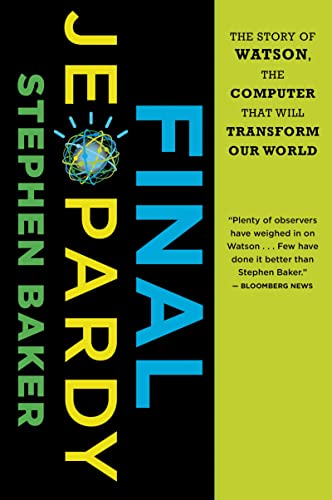
Inhaltsangabe
“The place to go if you’re really interested in this version of the quest for creating Artificial Intelligence (AI).”—Seattle Times
For centuries, people have dreamed of creating a machine that thinks like a human. Scientists have made progress: computers can now beat chess grandmasters and help prevent terrorist attacks. Yet we still await a machine that exhibits the rich complexity of human thought—one that doesn’t just crunch numbers, or take us to a relevant Web page, but understands us and gives us what we need. With the creation of Watson, IBM’s Jeopardy! playing computer, we are one step closer to that goal.
But how did we get here? In Final Jeopardy, Stephen Baker traces the arc of Watson’s “life,” from its birth in the IBM labs to its big night on the podium. We meet Hollywood moguls and Jeopardy! masters, genius computer programmers and ambitious scientists, including Watson’s eccentric creator, David Ferrucci. We see how a new generation of Watsons could transform medicine, the law, marketing, even science itself, as machines process huge amounts of data at lightning speed, answer our questions, and possibly come up with new hypotheses. As fast and fun as the game itself, Final Jeopardy shows how smart machines will fit into our world—and how they’ll disrupt it.
“Like Tracy Kidder’s Soul of a New Machine, Baker’s book finds us at the dawn of a singularity. It’s an excellent case study, and does good double duty as a Philip K. Dick scenario, too.”—Kirkus Reviews
“Baker’s narrative is both charming and terrifying . . . an entertaining romp through the field of artificial intelligence—and a sobering glimpse of things to come.”—Publishers Weekly, starred review
Die Inhaltsangabe kann sich auf eine andere Ausgabe dieses Titels beziehen.
Über die Autorin bzw. den Autor
STEPHEN BAKER was BusinessWeek's senior technology writer for a decade, based first in Paris and later New York. He has also written for the Los Angeles Times, Boston Globe, and the Wall Street Journal. Roger Lowenstein called his first book, The Numerati, "an eye-opening and chilling book." Baker blogs at finaljeopardy.net.
Von der hinteren Coverseite
“The place to go if you’re really interested in this version of the quest for creating Artificial Intelligence (AI).”—Seattle Times
For centuries, people have dreamed of creating a machine that thinks like a human. Scientists have made progress: computers can now beat chess grandmasters and help prevent terrorist attacks. Yet we still await a machine that exhibits the rich complexity of human thought—one that doesn’t just crunch numbers, or take us to a relevant Web page, but understands us and gives us what we need. With the creation of Watson, IBM’s Jeopardy! playing computer, we are one step closer to that goal.
But how did we get here? In Final Jeopardy, Stephen Baker traces the arc of Watson’s “life,” from its birth in the IBM labs to its big night on the podium. We meet Hollywood moguls and Jeopardy! masters, genius computer programmers and ambitious scientists, including Watson’s eccentric creator, David Ferrucci. We see how a new generation of Watsons could transform medicine, the law, marketing, even science itself, as machines process huge amounts of data at lightning speed, answer our questions, and possibly come up with new hypotheses. As fast and fun as the game itself, Final Jeopardy shows how smart machines will fit into our world—and how they’ll disrupt it.
“Like Tracy Kidder’s Soul of a New Machine, Baker’s book finds us at the dawn of a singularity. It’s an excellent case study, and does good double duty as a Philip K. Dick scenario, too.”—Kirkus Reviews
“Baker’s narrative is both charming and terrifying . . . an entertaining romp through the field of artificial intelligence—and a sobering glimpse of things to come.”—Publishers Weekly, starred review
STEPHEN BAKER was BusinessWeek’s senior technology writer for a decade, based first in Paris and later New York. He has also written for the Los Angeles Times, the Boston Globe, and the Wall Street Journal. Roger Lowenstein called his first book, The Numerati, “an eye-opening and chilling book.” Baker blogs at finaljeopardy.net.
Aus dem Klappentext
The thrilling story of the computer that can play Jeopardy! Alex Trebek: Meet Watson. For centuries, people have dreamed of creating a machine that thinks like a human. Scientists have made progress: computers can now beat chess grandmasters and help prevent terrorist attacks. Yet we still await a machine that exhibits the rich complexity of human thought -- one that doesn't just crunch numbers, or take us to a relevant Web page, but understands us and gives us what we need. That vision has driven a team of engineers at IBM. Over three years, they created "Watson" and prepared it for a showdown on "Jeopardy!, "where it would take on two of the game's all-time champions, Ken Jennings and Brad Rutter, in a nationally televised event. "Final Jeopardy "is the entertaining, illuminating story of that computer and that epic match. It's a classic tale of Man vs. Machine. Like its human competitors, Watson has to understand language, including puns and irony, and master everything from history, literature, and science to arts, entertainment, and game strategy. After years of training, Watson can find the scrambled state capital in "Hair Gel" ("What is Raleigh?") and even come up with the facial accessory that made Moshe Dayan recognizable worldwide ("What is an eye patch?"). Watson may just be the smartest machine on earth."" "Final Jeopardy "traces the arc of Watson's "life," from its birth in the IBM labs to its big night on the podium. We meet Hollywood moguls and "Jeopardy! "masters, genius computer programmers and ambitious scientists, including Watson's eccentric creator, David Ferrucci. We gain access to Ferrucci's War Room, where the IBM team works tirelessly to boost Watson's speed to the buzzer, improve its performance in "train wreck" categories (such as "Books in Espanol"), and fix glitches like the speech defect Watson developed during its testing phase, when it started adding a "d "to words ending in "n "("What is Pakistand?"). Much is at stake, especially for IBM. A new generation of Watsons could transform medicine, the law, marketing, even science itself, as machines process huge amounts of data at lightning speed, answer our questions, and possibly come up with new hypotheses. Showdown aside, it's clear that the future has arrived. But with it come questions: Where does it leave humans? What will Watson's heirs be capable of in ten or twenty years? Is it time to declare defeat in the realm of facts? What should we teach our children? And what should we carry around in our own heads?"" "Final Jeopardy "takes on these questions and more in a narrative that's as fast and fun as the game itself. Baker shows us how smart machines will fit into our world -- and how they'll disrupt it.
Auszug. © Genehmigter Nachdruck. Alle Rechte vorbehalten.
Introduction
Watson paused. The closest thing it had to a face, a glowing
orb on a flat-panel screen, turned from forest green to
a dark shade of blue. Filaments of yellow and red streamed
steadily across it, like the paths of jets circumnavigating the
globe. This pattern represented a state of quiet anticipation
as the supercomputer awaited the next clue. It was a September
morning in 2010 at IBM Research, in the hills north of
New York City, and the computer, known as Watson, was annihilating
two humans, both champion players, in practice
rounds of Jeopardy! Within months, it would be playing the
game on national television in a million-dollar man vs. machine
match against two of Jeopardy ’s all-time greats.
As Todd Crain, an actor and the host of these test games,
started to read the next clue, the filaments on Watson’s display
began to jag and tremble. Watson was thinking — or coming
as close to it as a computer could. The $1,600 clue, in the category
The Eyes Have It, read: “This facial ware made Israel’s
Moshe Dayan instantly recognizable worldwide.”
The three players — two human and one electronic — could
read the words as soon as they appeared on the big Jeopardy
board. But they had to wait for Crain to read the entire clue
before buzzing. That was the rule. As the host pronounced
the last word, a light would signal that contestants could buzz.
The first to hit the button could win $1,600 with the right answer
— or lose the same amount with a wrong one. (In these
test matches, they played with funny money.)
This pause for reading gave Watson three or four seconds
to hunt down the answer. The first step was to figure out what
the clue meant. One of its programs promptly picked apart
the grammar of the sentence, identifying the verbs, objects,
and key words. In another section, research focused on Moshe
Dayan. Was this a person? A place in Israel? Perhaps a holy
site? Names like John and Maria would signal a person. But
Moshe was more puzzling.
During these seconds, Watson’s cognitive apparatus —
2,208 computer processors working in concert — mounted a
massive research operation through thousands of documents
around Moshe Dayan and his signature facial ware. After
a second or so, different programs, or algorithms, began to
suggest hundreds of possible answers. To us, many of them
would look like wild guesses. Some were phrases that Dayan
had uttered, others were references to his military campaigns
and facts about Israel. Still others cited various articles of his
clothing. At this point, the computer launched its second
stage of analysis, figuring out which response, if any, merited
its confidence. It proceeded to check and recheck facts, making
sure that Moshe Dayan was indeed a person, an Israeli,
and that the answer referred to something he wore on his face.
A person looking at Watson’s frantic and repetitive labors
might conclude that the player was unsure of itself, laughably
short on common sense, and scandalously wasteful of com-
puting resources. This was all true. Watson barked up every
tree from every conceivable angle. The pattern on its screen
during this process, circles exploding into little stars, provided
only a hint of the industrial-scale computing at work. In a
room behind the podium, visible through a horizontal window,
Watson’s computers churned, and the fans cooling them
roared. This time, its three seconds of exertion paid off. Watson
came up with a response, sending a signal to a mechanical
device on the podium. It was the size of a large aspirin bottle
with a clear plastic covering. Inside was a Jeopardy buzzer.
About one one-hundredth of a second later, a metal finger inside
this contraption shot downward, pressing the button.
Justin Bernbach, a thirty-eight-year-old airline lobbyist
from Brooklyn, stood to Watson’s left. He had pocketed
$155,000 while winning seven straight Jeopardy matches in
2009. Unlike Watson, Bernbach understood the sentence. He
knew precisely who Moshe Dayan was as soon as he saw the
clue, and he carried an image of the Israeli leader in his mind.
He gripped the buzzer in his fist and frantically pressed it four
or five times as the light came on.
But Watson had arrived first.
“Watson?” said Crain.
The computer’s amiable male voice arranged the answer,
as Jeopardy demands, in the form of a question: “What is eye
patch?”
“Very good,” Crain said. “An eye patch on his lefteye.
Choose again, Watson.”
Bernbach slumped at his podium. This match with the
machine wasn’t going well.
It was going magnificently for David Ferrucci. As the chief scientist
of the team developing the Jeopardy computer, Ferrucci
was feeling vindicated. Only three years earlier, the suggestion
that a computer might match wits and word skills with human
champions in Jeopardy sparked opposition bordering on
ridicule in the halls of IBM Research. And the final goal of
the venture, a nationally televised match against two Jeopardy
legends, Ken Jennings and Brad Rutter, seemed risky to some,
a bit déclassé to others. Jeopardy, a television show, appeared
to lack the timeless cachet of chess, which IBM computers
had mastered a decade earlier.
Nonetheless, Ferrucci and his team went ahead and built
their machine. Months earlier, it had fared well in a set of
test matches. But the games revealed flaws in the machine’s
logic and game strategy. It was a good player, but to beat Jennings
and Rutter, who would be jousting for a million-dollar
top prize, it would have to be great. So they had worked
long hours over the summer to revamp Watson. This September
event was the coming-out party for Watson 2.0. It was
the first of fifty-six test matches against a higher level of competitor:
people, like Justin Bernbach, who had won enough
matches to compete in Jeopardy ’s Tournament of Champions.
In these early matches, Watson was having its way with
them. Ferrucci, monitoring the matches from a crowded observation
booth, was all smiles. Keen to promote its Jeopardy
phenom, IBM’s advertising agency, Ogilvy & Mather, had
hired a film crew to follow Ferrucci’s team and capture the
drama of this opening round of championship matches. The
observation room was packed with cameras. Microphones on
long booms recorded the back-and-forth of engineers as they
discussed algorithms and Watson’s response time, known as
latency. Ferrucci, wearing a mike on his lapel, gave a blow-byblow
commentary as Watson, on the other side of the glass,
strutted its new and smarter self.
It was almost as if Watson, like a person giddy with hubris,
was primed for a fall. The computer certainly had its
weaknesses. Even when functioning smoothly, it would make
its share of wacky mistakes. Right before the lunch break,
one clue asked about “the inspiration for this title object in
a novel and a 1957 movie [which] actually spanned the Mae
Khlung.” Now, it would be reasonable for a computer to miss
“The Bridge over the River Kwai,” especially since the actual
river has a different name. Perhaps Watson had trouble understanding
the sentence, which was convoluted at best. But
how did the computer land on its outlandish response, “What
is Kafka?” Ferrucci didn’t know. Those things happened, and
Watson still won the two morning matches.
It was after lunch that things...
„Über diesen Titel“ kann sich auf eine andere Ausgabe dieses Titels beziehen.
Suchergebnisse für Final Jeopardy: The Story of Watson, the Computer That...

Beispielbild für diese ISBN
Final Jeopardy: The Story of Watson, the Computer That Will Transform Our World
Anbieter: World of Books (was SecondSale), Montgomery, IL, USA
Verkäuferbewertung 5 von 5 Sternen

Zustand: Very Good. Item in very good condition! Textbooks may not include supplemental items i.e. CDs, access codes etc. Artikel-Nr. 00110224587
Gebraucht kaufen
EUR 4,00
Versand gratis
Versand innerhalb von USA
Versand innerhalb von USA
Anzahl: 1 verfügbar
Beispielbild für diese ISBN
Final Jeopardy : The Story of Watson, the Computer That Will Transform Our World
Verlag:
HarperCollins Publishers, 2012
ISBN 10: 0547747195
ISBN 13: 9780547747194
Gebraucht
Softcover
Anbieter: Better World Books, Mishawaka, IN, USA
Verkäuferbewertung 5 von 5 Sternen
Zustand: Good. Reprint. Pages intact with minimal writing/highlighting. The binding may be loose and creased. Dust jackets/supplements are not included. Stock photo provided. Product includes identifying sticker. Better World Books: Buy Books. Do Good. Artikel-Nr. 7882615-6
Gebraucht kaufen
EUR 6,38
Versand gratis
Versand innerhalb von USA
Versand innerhalb von USA
Anzahl: 4 verfügbar
Beispielbild für diese ISBN
Final Jeopardy: The Story of Watson, the Computer That Will Transform Our World Ã
Anbieter: Heisenbooks, Fairless Hills, PA, USA
Verkäuferbewertung 2 von 5 Sternen

paperback. Zustand: Good. Artikel-Nr. WI-XBX-g-155970
Gebraucht kaufen
EUR 4,37
EUR 3,45 Versand
Versand innerhalb von USA
Versand innerhalb von USA
Anzahl: 1 verfügbar
Beispielbild für diese ISBN
Final Jeopardy: The Story of Watson, the Computer That Will Transform Our World
Anbieter: AwesomeBooks, Wallingford, Vereinigtes Königreich
Verkäuferbewertung 5 von 5 Sternen
Paperback. Zustand: Very Good. Final Jeopardy: The Story of Watson, the Computer That Will Transform Our World This book is in very good condition and will be shipped within 24 hours of ordering. The cover may have some limited signs of wear but the pages are clean, intact and the spine remains undamaged. This book has clearly been well maintained and looked after thus far. Money back guarantee if you are not satisfied. See all our books here, order more than 1 book and get discounted shipping. Artikel-Nr. 7719-9780547747194
Gebraucht kaufen
EUR 4,54
EUR 4,81 Versand
Versand von Vereinigtes Königreich nach USA
Versand von Vereinigtes Königreich nach USA
Anzahl: 2 verfügbar
Beispielbild für diese ISBN
Final Jeopardy: The Story of Watson, the Computer that will Transform Our World
Anbieter: Powell's Bookstores Chicago, ABAA, Chicago, IL, USA
Verkäuferbewertung 5 von 5 Sternen
Paperback. Zustand: Used-Very Good. Reprint. Pbk. Some shelf-wear. Else clean copy. Artikel-Nr. 1824056
Gebraucht kaufen
EUR 7,14
EUR 6,50 Versand
Versand innerhalb von USA
Versand innerhalb von USA
Anzahl: 1 verfügbar
Beispielbild für diese ISBN
Final Jeopardy: The Story of Watson, the Computer that will Transform Our World
Anbieter: Powell's Bookstores Chicago, ABAA, Chicago, IL, USA
Verkäuferbewertung 5 von 5 Sternen
Paperback. Zustand: Used-Very Good. Reprint. Pbk. Some shelf-wear. Else clean copy. Artikel-Nr. 1799588
Gebraucht kaufen
EUR 7,14
EUR 6,50 Versand
Versand innerhalb von USA
Versand innerhalb von USA
Anzahl: 1 verfügbar
Beispielbild für diese ISBN
Final Jeopardy: The Story of Watson, the Computer That Will Transform Our World
Anbieter: medimops, Berlin, Deutschland
Verkäuferbewertung 5 von 5 Sternen
Zustand: good. Befriedigend/Good: Durchschnittlich erhaltenes Buch bzw. Schutzumschlag mit Gebrauchsspuren, aber vollständigen Seiten. / Describes the average WORN book or dust jacket that has all the pages present. Artikel-Nr. M00547747195-G
Gebraucht kaufen
EUR 4,52
EUR 10,00 Versand
Versand von Deutschland nach USA
Versand von Deutschland nach USA
Anzahl: 1 verfügbar
Beispielbild für diese ISBN
Final Jeopardy: The Story of Watson, the Computer That Will Transform Our World
Verlag:
Mariner Books 27/03/2012, 2012
ISBN 10: 0547747195
ISBN 13: 9780547747194
Gebraucht
Paperback
Anbieter: Bahamut Media, Reading, Vereinigtes Königreich
Verkäuferbewertung 5 von 5 Sternen
Paperback. Zustand: Very Good. Shipped within 24 hours from our UK warehouse. Clean, undamaged book with no damage to pages and minimal wear to the cover. Spine still tight, in very good condition. Remember if you are not happy, you are covered by our 100% money back guarantee. Artikel-Nr. 6545-9780547747194
Gebraucht kaufen
EUR 6,77
EUR 8,15 Versand
Versand von Vereinigtes Königreich nach USA
Versand von Vereinigtes Königreich nach USA
Anzahl: 1 verfügbar
Beispielbild für diese ISBN
Final Jeopardy: The Story of Watson, the Computer That Will Transform Our World
Anbieter: Sell Books, Elland, YORKS, Vereinigtes Königreich
Verkäuferbewertung 5 von 5 Sternen
paperback. Zustand: Good. Our good condition books are generally good for reading but not for gifting or collecting. They could have imperfections such as creasing, fanning, inscriptions, margin notes, yellowing, staining on edge or cover or pages, bumps, scuffs, etc etc (sometimes multiple of these). It's a wide category that encompasses anything that isn't almost-new down to anything that is slightly better than poor. We would NOT recommend gifting Good books - these should be considered reading copies. Our books are dispatched from a Yorkshire former cotton mill. We list via barcode/ISBN so please note that the images are stock images and may not be the exact copy you receive, furthermore the details about edition and year might not be accurate as many publishers reuse the same ISBN for multiple editions and as we simply scan a barcode or enter an ISBN we do not check the validity of the edition data when listing. If you're looking for an exact edition please don't order (at least not without checking with us first, although we don't always have time to check). We aim to dispatch prompty, the service used will depend on order value and book size. We can ship to most countries, see our shipping policies. Payment is via Abe only. Artikel-Nr. L-BIS00464-MIX-20230905-G
Gebraucht kaufen
EUR 1,90
EUR 14,19 Versand
Versand von Vereinigtes Königreich nach USA
Versand von Vereinigtes Königreich nach USA
Anzahl: 1 verfügbar
Beispielbild für diese ISBN
Final Jeopardy: The Story of Watson, the Computer that Will Transform Our World
Anbieter: PBShop.store US, Wood Dale, IL, USA
Verkäuferbewertung 5 von 5 Sternen
PAP. Zustand: New. New Book. Shipped from UK. Established seller since 2000. Artikel-Nr. L2-9780547747194
Neu kaufen
EUR 21,18
Versand gratis
Versand innerhalb von USA
Versand innerhalb von USA
Anzahl: Mehr als 20 verfügbar