
Verwandte Artikel zu SONIC BOOM PA: How Sound Transforms the Way We Think,...
SONIC BOOM PA: How Sound Transforms the Way We Think, Feel, and Buy – Strategic Sound, Sonic Branding, and Business Influence - Softcover
Inhaltsangabe
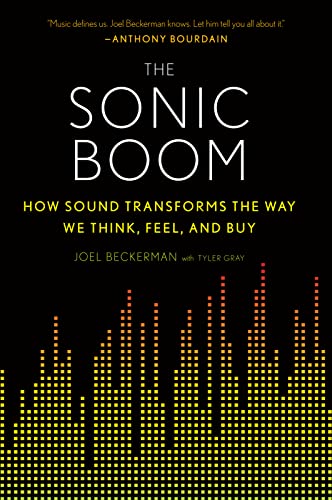
"Music defines us. Joel Beckerman knows. Let him tell you all about it." —Anthony Bourdain
“Equal parts sociological study and business advice, using unique everyday examples—for instance, how the fate of the Chili’s fajita empire rested on the sound of the sizzling platter, and how Disneyland approaches soundscapes for a fully immersive experience—to explain how sound effects our mood and shopping habits.”—EW.com
Sound and music surround us so constantly that we often take them for granted. But sound has surprising power to influence our decisions, opinions, and actions in ways we might not even notice. Discordant ambient noise can induce anxiety; ice cream truck jingles can bring you back to your childhood. In The Sonic Boom, composer and strategic sound expert Joel Beckerman provides a new framework for thinking about sound’s effects on every aspect of our lives.
You don’t need to be a musician or a composer to harness the power of sound. Companies, brands, and individuals can strategically use sound to get to the core of their mission, influence how they’re perceived by their audiences, and gain a competitive edge. Whether you’re a corporate giant connecting with millions of customers or a teacher connecting with one classroom of students, the key to an effective sonic strategy is the creation of “boom moments”—transcendent instants when sound connects with a listener’s emotional core.
“I’ve spent my life curating, creating, and collecting sounds. But Beckerman and Gray have shown here that there are still plenty of sounds that we’ve all missed. The Sonic Boom reveals the music and structured cacophony of everyday life.” —Moby
Die Inhaltsangabe kann sich auf eine andere Ausgabe dieses Titels beziehen.
Über die Autorinnen und Autoren
Hailed as “equal parts Philip Glass and Don Draper” by Details Magazine, JOEL BECKERMAN is an award-winning composer and producer for television. He is the founder of Man Made Music, a company specializing in sonic branding. Fast Company named him one of their “Most Creative People in Business” and Man Made Music one of their “Most Innovative Companies” in music. He created original scores for more than fifty television programs, won ASCAP’s “Most Performed” theme award for the past eight years, and has developed signature sonic branding programs for global giants such as Disney, AT&T, and Southwest Airlines. Beckerman has worked with John Legend, will.i.am, Moby, OK Go, Morgan Freeman, and the composer John Williams. He lives in New Providence, New Jersey.
TYLER GRAY is editorial director for Edelman in the New York City office. He was previously editorial director for Fast Company and is the author of The Hit Charade.
Von der hinteren Coverseite
“Equal parts sociological study and business advice, using unique everyday examples—for instance, how the fate of the Chili’s fajita empire rested on the sound of the sizzling platter, and how Disneyland approaches soundscapes for a fully immersive experience—to explain how sound effects our mood and shopping habits.”—EW.com
Sound and music surround us so constantly that we often take them for granted. But sound has surprising power to influence our decisions, opinions, and actions in ways we might not even notice. Discordant ambient noise can induce anxiety; ice cream truck jingles can bring you back to your childhood. In The Sonic Boom, composer and strategic sound expert Joel Beckerman provides a new framework for thinking about sound’s effects on every aspect of our lives.
You don’t need to be a musician or a composer to harness the power of sound. Companies, brands, and individuals can strategically use sound to get to the core of their mission, influence how they’re perceived by their audiences, and gain a competitive edge. Whether you’re a corporate giant connecting with millions of customers or a teacher connecting with one classroom of students, the key to an effective sonic strategy is the creation of “boom moments”—transcendent instants when sound connects with a listener’s emotional core.
“I’ve spent my life curating, creating, and collecting sounds. But Beckerman and Gray have shown here that there are still plenty of sounds that we’ve all missed. The Sonic Boom reveals the music and structured cacophony of everyday life.” —Moby
JOEL BECKERMAN is the founder and lead composer of Man Made Music and has created unique sonic branding strategies for companies such as Disney, Mercedes, and AT&T.
TYLER GRAY is an editorial director for Edelman in the New York City office. He was recently editorial director for Fast Company and is the author of The Hit Charade.
Sound and music surround us so constantly that we often take them for granted. But sound has surprising power to influence our decisions, opinions, and actions in ways we might not even notice. Discordant ambient noise can induce anxiety; ice cream truck jingles can bring you back to your childhood. In The Sonic Boom, composer and strategic sound expert Joel Beckerman provides a new framework for thinking about sound’s effects on every aspect of our lives.
You don’t need to be a musician or a composer to harness the power of sound. Companies, brands, and individuals can strategically use sound to get to the core of their mission, influence how they’re perceived by their audiences, and gain a competitive edge. Whether you’re a corporate giant connecting with millions of customers or a teacher connecting with one classroom of students, the key to an effective sonic strategy is the creation of “boom moments”—transcendent instants when sound connects with a listener’s emotional core.
“I’ve spent my life curating, creating, and collecting sounds. But Beckerman and Gray have shown here that there are still plenty of sounds that we’ve all missed. The Sonic Boom reveals the music and structured cacophony of everyday life.” —Moby
JOEL BECKERMAN is the founder and lead composer of Man Made Music and has created unique sonic branding strategies for companies such as Disney, Mercedes, and AT&T.
TYLER GRAY is an editorial director for Edelman in the New York City office. He was recently editorial director for Fast Company and is the author of The Hit Charade.
Auszug. © Genehmigter Nachdruck. Alle Rechte vorbehalten.
The Sonic Boom
How Sound Transforms the Way We Think, Feel, and Buy
By Joel Beckerman, Tyler GrayHoughton Mifflin Harcourt Publishing Company
Copyright © 2014 Man Made Music, Inc.
All rights reserved.
ISBN: 978-0-544-57016-0All rights reserved.
Contents
Title Page,
Contents,
Copyright,
Dedication,
Introduction,
Night-Vision Goggles for Your Ears,
The Boom Moment,
Sonic Landscapes,
The Principles of Sonic Branding,
Rethinking Possibilities,
Amplifying Messages,
Scoring the Experience,
Creating Boom Moments Every Day,
Hearing Around Corners,
Acknowledgments,
Notes,
Index,
About the Authors,
Footnotes,
CHAPTER 1
Night-Vision Goggles for Your Ears
On September 26, 2011, Sarah Churman, a twenty-nine-year-old mother of two from Fort Worth, Texas, got into her car with her husband. When she closed the door, she says, the noise of it shutting sounded like a bomb going off. Sarah grabbed her phone and dialed her mother-in-law. During the call, one of her two daughters hopped on the line. "Hi, Mommy, I love you," she said. Sarah started bawling so hard that she couldn't catch her breath.
When her husband, Sloan, pulled off the highway later and Sarah opened her door, she said the sound of traffic was roaring. The horns honking and engines revving were thunderous. The two made their way into an Outback Steakhouse and got a table. When the waitress put their drinks down, Sarah jumped at the startling sound. When she began to eat her salad, the crunch of the lettuce was so powerful she couldn't hear what her husband was saying. The noise in her own head was like a cheap used-car commercial with the sound turned up to eleven. It was almost deafening.
Sarah was born with profound hearing loss. For years, she hadn't been able to hear anything quieter than eighty-five decibels. You could rev a gas-powered chain saw or shoot a .22-caliber rifle right next to her ear, and it would sound to her like a mumble. Then Sarah had a device surgically implanted in one ear. It processed sound vibrations, amplified them using the middle-ear bones, and sent them off into Sarah's brain, a task most people's ears handle naturally with tiny hairs (which Sarah was born without). Even in the most successful cases, recipients of the kind of implant Sarah got don't perceive sound quite the same way as people born without hearing problems do. But it's the next best thing. Her mother-in-law used the money she'd saved for retirement to pay for Sarah's surgery. Eight weeks after it, when Sarah's ear had healed, a technician turned the device on, and Sarah began to hear for the first time in twenty-nine years. Sarah truly appreciates the power of sound, something most of us take for granted.
If her name sounds familiar, you might have seen Sarah's first moments of hearing on YouTube or on Ellen DeGeneres's daytime talk show. Sloan captured the event on video and uploaded it. Then it went viral. By mid-2013, more than twenty million people had watched the clip: "Twenty-nine years old and hearing myself for the first time!" It's a heart-melting scene. The slender, brown-haired woman with a full sleeve of tattoos on her right arm stares doe-eyed at a technician, who slowly dials up Sarah's equipment. There's some beeping that Sarah hears first, and then you can see the full breadth of sound wash over her as the implant comes alive. She'd worn hearing aids most of her life, but she described them as always having a constant hum or white noise in the background and allowing her to hear only the loudest external sounds, and even then, every sound blended together so they all sounded muffled or garbled, like Charlie Brown's teacher. This sound was different: clear, bright, and loud as hell. In the YouTube video, she tries to play it cool when the device starts working. That goes to pot in about one second. The flood of emotion that comes with her new sense is almost too much for her to bear. She's self-conscious, so she covers her mouth, which is the way a proficient lip reader like her tries to hide what she's feeling. When Sarah starts shaking and tears start flowing, though, the emotion is obvious. And it's contagious. You can't help but imagine what's happening in her head.
In her memoir Powered On, Sarah shares a perspective you can't get from the video alone:
I realized I could hear the noises coming from my mouth. Then I realized how I sounded, and I got choked up. Then I laughed, and that sent me into a fit of tears. All these sounds were intensified because I was hearing all of this from inside myself for the first time, and I was completely and utterly overwhelmed like you cannot imagine. I feared my heart was gonna explode, and I just couldn't put into words what was racing through my mind.
"I don't want to hear myself cry," she says in the video. Then she laughs and surprises herself. "My laughter sounds so loud!"
"You'll get used to that over time," the technician says.
But it took a while.
It's impossible for a person born with hearing to know what it's like to suddenly get it after twenty-nine years. Even beginning to understand how much sound is all around you is an eye-opening experience. Ever feel frazzled and then realize the TV is blaring an annoying ad or news or a program you don't actually care about? That moment and the next one, when you turn off the TV, is a very basic example of soundscaping. That's the practice of identifying and controlling the sounds affecting you — the loud ones in the foreground, the slightly lower, less important ones in the midground, and the foundational rumblings or whisperings in the background. Some people call the act of noticing these various levels of sound "active listening." Soundscaping is something more. It involves determining which of those sounds are most useful to you, whether you're trying to find your way, figure out what's going on around you, tell a story, or change your mood. Put to use in all kinds of everyday situations, soundscaping is how you use the identification and curation of sound and music to make your world work better. In a way somewhat similar to how Sarah began to hear new sounds and understand the messages they carried, you can grow your sonic vocabulary, the palette of sounds you recognize and use to tell stories or design environments. You can also use this sonic vocabulary to create your own messages and impressions. To get started, you can do a little exercise that will give you a sense of how much sound you're missing at any given moment: Close your eyes and listen to your surroundings, wherever you are. As you do, think about the word wind. Do you suddenly hear air moving against things? Next, think about your own ears ringing. Do you immediately hear it?
Now close your eyes again. This time, keep them closed for a full two minutes and try to identify each tiny sound you hear. In the first few seconds, you'll probably notice the loudest sounds first: the music on the television in the other room, a door closing next to you. That's the foreground. But go deeper. Sit with it for a while. Maybe you hear highway traffic a mile away, or the sound of kids outside playing. That's the background. The midground is everything between the background and the foreground.
The longer you listen and the more you pay attention, the more you'll hear. You're not activating some kind of superpower or bionic hearing. You're not even hearing these sounds for the first time. These vibrations have been picked up by your ears all...
„Über diesen Titel“ kann sich auf eine andere Ausgabe dieses Titels beziehen.
Suchergebnisse für SONIC BOOM PA: How Sound Transforms the Way We Think,...

Beispielbild für diese ISBN
The Sonic Boom: How Sound Transforms the Way We Think, Feel, and Buy
Anbieter: ThriftBooks-Atlanta, AUSTELL, GA, USA
Verkäuferbewertung 5 von 5 Sternen

Paperback. Zustand: As New. No Jacket. Pages are clean and are not marred by notes or folds of any kind. ~ ThriftBooks: Read More, Spend Less. Artikel-Nr. G0544570162I2N00
Gebraucht kaufen
EUR 6,09
Versand gratis
Versand innerhalb von USA
Versand innerhalb von USA
Anzahl: 1 verfügbar
Beispielbild für diese ISBN
The Sonic Boom: How Sound Transforms the Way We Think, Feel, and Buy
Anbieter: ThriftBooks-Atlanta, AUSTELL, GA, USA
Verkäuferbewertung 5 von 5 Sternen
Paperback. Zustand: Good. No Jacket. Pages can have notes/highlighting. Spine may show signs of wear. ~ ThriftBooks: Read More, Spend Less. Artikel-Nr. G0544570162I3N00
Gebraucht kaufen
EUR 6,09
Versand gratis
Versand innerhalb von USA
Versand innerhalb von USA
Anzahl: 1 verfügbar
Beispielbild für diese ISBN
The Sonic Boom : How Sound Transforms the Way We Think, Feel, and Buy
Verlag:
HarperCollins Publishers, 2015
ISBN 10: 0544570162
ISBN 13: 9780544570160
Gebraucht
Softcover
Anbieter: Better World Books, Mishawaka, IN, USA
Verkäuferbewertung 5 von 5 Sternen
Zustand: Very Good. Pages intact with possible writing/highlighting. Binding strong with minor wear. Dust jackets/supplements may not be included. Stock photo provided. Product includes identifying sticker. Better World Books: Buy Books. Do Good. Artikel-Nr. 17136643-6
Gebraucht kaufen
EUR 8,35
Versand gratis
Versand innerhalb von USA
Versand innerhalb von USA
Anzahl: 1 verfügbar
Beispielbild für diese ISBN
The Sonic Boom: How Sound Transforms the Way We Think, Feel, and Buy
Verlag:
Mariner Books (edition Reprint), 2015
ISBN 10: 0544570162
ISBN 13: 9780544570160
Gebraucht
Paperback
Anbieter: BooksRun, Philadelphia, PA, USA
Verkäuferbewertung 5 von 5 Sternen
Paperback. Zustand: Very Good. Reprint. It's a well-cared-for item that has seen limited use. The item may show minor signs of wear. All the text is legible, with all pages included. It may have slight markings and/or highlighting. Artikel-Nr. 0544570162-11-1
Gebraucht kaufen
EUR 8,53
Versand gratis
Versand innerhalb von USA
Versand innerhalb von USA
Anzahl: 1 verfügbar
Beispielbild für diese ISBN
SONIC BOOM PA: How Sound Transforms the Way We Think, Feel, and Buy
Anbieter: WorldofBooks, Goring-By-Sea, WS, Vereinigtes Königreich
Verkäuferbewertung 5 von 5 Sternen
Paperback. Zustand: Fine. Artikel-Nr. GOR011750779
Gebraucht kaufen
EUR 4,29
EUR 6,62 Versand
Versand von Vereinigtes Königreich nach USA
Versand von Vereinigtes Königreich nach USA
Anzahl: 1 verfügbar
Beispielbild für diese ISBN
SONIC BOOM PA: How Sound Transforms the Way We Think, Feel, and Buy
Anbieter: WorldofBooks, Goring-By-Sea, WS, Vereinigtes Königreich
Verkäuferbewertung 5 von 5 Sternen
Paperback. Zustand: Very Good. The book has been read, but is in excellent condition. Pages are intact and not marred by notes or highlighting. The spine remains undamaged. Artikel-Nr. GOR009729681
Gebraucht kaufen
EUR 4,29
EUR 6,62 Versand
Versand von Vereinigtes Königreich nach USA
Versand von Vereinigtes Königreich nach USA
Anzahl: 2 verfügbar
Beispielbild für diese ISBN
SONIC BOOM PA: How Sound Transforms the Way We Think, Feel, and Buy
Anbieter: Sell Books, Elland, YORKS, Vereinigtes Königreich
Verkäuferbewertung 5 von 5 Sternen
paperback. Zustand: Good. Our good condition books are generally good for reading but not for gifting or collecting. They could have imperfections such as creasing, fanning, inscriptions, margin notes, yellowing, staining on edge or cover or pages, bumps, scuffs, etc etc (sometimes multiple of these). It's a wide category that encompasses anything that isn't almost-new down to anything that is slightly better than poor. We would NOT recommend gifting Good books - these should be considered reading copies. Our books are dispatched from a Yorkshire former cotton mill. We list via barcode/ISBN so please note that the images are stock images and may not be the exact copy you receive, furthermore the details about edition and year might not be accurate as many publishers reuse the same ISBN for multiple editions and as we simply scan a barcode or enter an ISBN we do not check the validity of the edition data when listing. If you're looking for an exact edition please don't order (at least not without checking with us first, although we don't always have time to check). We aim to dispatch prompty, the service used will depend on order value and book size. We can ship to most countries, see our shipping policies. Payment is via Abe only. Artikel-Nr. SBAB-L-BBL00999-RAG-20241029-VG
Gebraucht kaufen
EUR 5,12
EUR 9,17 Versand
Versand von Vereinigtes Königreich nach USA
Versand von Vereinigtes Königreich nach USA
Anzahl: 1 verfügbar
Beispielbild für diese ISBN
SONIC BOOM PA: How Sound Transforms the Way We Think, Feel, and Buy ? Strategic Sound, Sonic Branding, and Business Influence
Anbieter: medimops, Berlin, Deutschland
Verkäuferbewertung 5 von 5 Sternen
Zustand: good. Befriedigend/Good: Durchschnittlich erhaltenes Buch bzw. Schutzumschlag mit Gebrauchsspuren, aber vollständigen Seiten. / Describes the average WORN book or dust jacket that has all the pages present. Artikel-Nr. M00544570162-G
Gebraucht kaufen
EUR 4,37
EUR 10,00 Versand
Versand von Deutschland nach USA
Versand von Deutschland nach USA
Anzahl: 2 verfügbar
Beispielbild für diese ISBN
SONIC BOOM PA: How Sound Transforms the Way We Think, Feel, and Buy ? Strategic Sound, Sonic Branding, and Business Influence
Anbieter: medimops, Berlin, Deutschland
Verkäuferbewertung 5 von 5 Sternen
Zustand: very good. Gut/Very good: Buch bzw. Schutzumschlag mit wenigen Gebrauchsspuren an Einband, Schutzumschlag oder Seiten. / Describes a book or dust jacket that does show some signs of wear on either the binding, dust jacket or pages. Artikel-Nr. M00544570162-V
Gebraucht kaufen
EUR 4,37
EUR 10,00 Versand
Versand von Deutschland nach USA
Versand von Deutschland nach USA
Anzahl: 1 verfügbar
Beispielbild für diese ISBN
The Sonic Boom: How Sound Transforms the Way We Think, Feel, and Buy
Anbieter: Anybook.com, Lincoln, Vereinigtes Königreich
Verkäuferbewertung 5 von 5 Sternen
Zustand: Good. This is an ex-library book and may have the usual library/used-book markings inside.This book has soft covers. Clean from markings. In good all round condition. Please note the Image in this listing is a stock photo and may not match the covers of the actual item,250grams, ISBN:9780544570160. Artikel-Nr. 9716921
Gebraucht kaufen
EUR 13,46
EUR 15,41 Versand
Versand von Vereinigtes Königreich nach USA
Versand von Vereinigtes Königreich nach USA
Anzahl: 1 verfügbar