
Verwandte Artikel zu The Meaning of Marriage: Facing the Complexities of...
Inhaltsangabe
“Incredibly rich with wisdom and insight that will leave the reader, whether single or married, feeling uplifted.” —The Washington Times
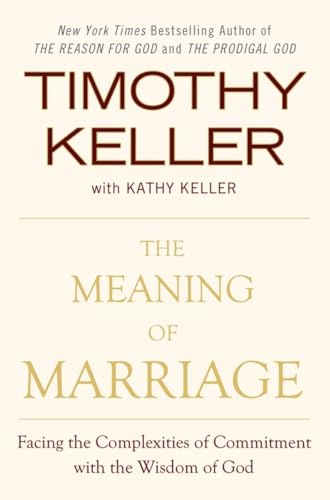
Based on the acclaimed sermon series by New York Times bestselling author Timothy Keller, this book shows everyone—Christians, skeptics, singles, longtime married couples, and those about to be engaged—the vision of what marriage should be according to the Bible.
Modern culture would have you believe that everyone has a soul mate; that romance is the most important part of a successful marriage; that your spouse is there to help you realize your potential; that marriage does not mean forever, but merely for now; and that starting over after a divorce is the best solution to seemingly intractable marriage issues. But these modern-day assumptions are wrong. Timothy Keller, with insights from Kathy, his wife of thirty-seven years, shows marriage to be a glorious relationship that is also misunderstood and mysterious. The Meaning of Marriage offers instruction on how to have a successful marriage, and is essential reading for anyone who wants to know God and love more deeply in this life.
Die Inhaltsangabe kann sich auf eine andere Ausgabe dieses Titels beziehen.
Über die Autorin bzw. den Autor
Timothy Keller was born and raised in Pennsylvania and educated at Bucknell University, Gordon-Conwell Theological Seminary, and Westminster Theological Seminary. His first pastorate was in Hopewell, Virginia. In 1989 he started Redeemer Presbyterian Church in New York City with his wife, Kathy, and their three sons. Today, Redeemer has nearly six thousand regular Sunday attendees and has helped to start more than three hundred new churches around the world. He is the author of The Songs of Jesus, Prayer, Encounters with Jesus, Walking with God Through Pain and Suffering, and Every Good Endeavor, among others, including the perennial bestsellers The Reason for God and The Prodigal God.
Kathy Keller grew up outside Pittsburgh, Pennsylvania, and attended Allegheny College, where she led Christian fellowship groups, before attending Gordon-Conwell Theological Seminary. She met Timothy Keller while studying there, and they were married at the beginning of their final semester. She received her MA in Theological Studies at Gordon-Conwell in 1975. Kathy and Tim then moved to Virginia, where Tim started at his first church, West Hopewell Presbyterian Church, and their three sons were born. After nine years, Kathy and her family moved to New York City to start the Redeemer Presbyterian Church.
Auszug. © Genehmigter Nachdruck. Alle Rechte vorbehalten.
God, the best maker of all marriages,
Combine your hearts in one.
—William Shakespeare, Henry V
A Book for Married People
Think of this book as a tree supplied by three deep roots. The first is my thirty-seven-year marriage to my wife, Kathy.1 She helped me write this book, and she herself wrote chapter 6, Embracing the Other. In chapter 1, I caution readers about the way contemporary culture defines “soul mate” as “a perfectly compatible match.” Nevertheless, when we first began to spend time with each other, we each realized that the other was a rare fit for our hearts. I first met Kathy through her sister, Susan, who was a student with me at Bucknell University. Susan often spoke to Kathy about me and to me about Kathy. As a young girl, Kathy had been led toward the Christian faith by C. S. Lewis’s The Chronicles of Narnia.2 She urged Susan to recommend them to me. I read and was moved by the books and by other Lewis volumes that I subsequently studied. In 1972, we both enrolled at the same school, Gordon-Conwell Theological Seminary on Boston’s North Shore, and there we quickly came to see that we shared the “secret thread” that Lewis says is the thing that turns people into close friends—or more.
You may have noticed that the books you really love are bound together by a secret thread. You know very well what is the common quality that makes you love them, though you cannot put it into words:. . . . Are not all lifelong friendships born at the moment when at last you meet another human being who has some inkling . . . of that something which you were born desiring . . . ?3
Our friendship grew into romance and engagement, and then from a fragile new marriage into a tested and durable one. But this only happened through the “pearls before swine” speech, the Great Dirty Diaper Conflict, the “smashing the wedding china” affair, and other infamous events in our family history that will be described in this book—all mileposts on the very bumpy road to marital joy. Like most young modern couples, we found that marriage was much harder than we expected it to be. At the conclusion of our wedding ceremony, we marched out singing to the hymn “How Firm a Foundation.” Little did we know how relevant some of the lines would be to the arduous and painful work of developing a strong marriage.
When through fiery trials, thy pathway shall lie,
My grace all-sufficient will be thy supply.
For I will be with thee, thy troubles to bless
And sanctify to thee thy deepest distress.4
This book, therefore, is for those spouses who have discovered how challenging day-to-day marriage is and who are searching for practical resources to survive the sometimes overwhelming “fiery trials” of matrimony and to grow through them. Our society’s experience with marriage has given us the metaphor “the honeymoon is over.” This is a book for those who have experienced this as a literal truth and may have fallen back to earth with a thud.
A Book for Unmarried People
The second source for this book is a long pastoral ministry in a city with millions (and a church with thousands) of single adults. Our congregation, Redeemer Presbyterian Church in Manhattan, is a rarity—a very large church that has been for years composed predominantly of singles. Several years ago, when we had about four thousand people in attendance, I asked a very prominent church consultant, “How many churches do you know of our size with three thousand singles?” He answered, “Your church is unique, as far as I know.”
Ministering in the center of New York City in the late 1980s, Kathy and I were constantly struck by the deep ambivalence with which Western culture views marriage. It was then we began to hear all the now society-wide objections—marriage was originally about property and is now in flux, marriage crushes individual identity and has been oppressive for women, marriage stifles passion and is ill-fitted to psychological reality, marriage is “just a piece of paper” that only serves to complicate love, and so on. But beneath these philosophical objections lies a snarl of conflicted personal emotions, born out of many negative experiences with marriage and family life.
Early in our New York City ministry, in the fall of 1991, I preached a nine-week series on marriage. It has since been the most listened-to set of sermons or talks the church has ever produced. I had to begin the series by giving some justification for devoting weeks of teaching on being married to a congregation of mainly unmarried people. My main rationale was that single people today need a brutally realistic yet glorious vision of what marriage is and can be. What I said then fits single readers today, and this book is for them, too.
In preparation for writing this, I read a host of Christian books on marriage. Most of them were written to help married couples work through specific problems. This volume will be useful for that as well, but its primary goal is to give both married and unmarried people a vision for what marriage is according to the Bible. That will help married people correct mistaken views that might be harming their marriage, and it will help single people stop destructively over-desiring marriage or destructively dismissing marriage altogether. Also, a Bible-based marriage book will help each reader have a better idea of who he or she should consider as a prospective mate.
A Book about the Bible
There is a third source for the material in this book, and it is the most foundational. Though this book is rooted in my personal experience of marriage and ministry, it is even more grounded in the teachings of the Old and New Testaments. Nearly four decades ago, as theological students, Kathy and I studied the Biblical teachings on sex, gender, and marriage. Over the next fifteen years, we worked them out in our own marriage. Then, over the last twenty-two years, we have used what we learned from both Scripture and experience to guide, encourage, counsel, and instruct young urban adults with regard to sex and marriage. We offer the fruit of these three influences to you in this book.
But the foundation of it all is the Bible.
In the Bible there are three human institutions that stand apart from all others—the family, the church, and the state. There’s nothing in the Bible about how schools should be run, even though they are crucial to a flourishing society. There’s nothing there about business corporations or museums or hospitals. In fact, there are all sorts of great institutions and human enterprises that the Bible doesn’t address or regulate. And so we are free to invent them and operate them in line with the general principles for human life that the Bible gives us.
But marriage is different. As the Presbyterian Book of Common Worship says, God “established marriage for the welfare and happiness of humankind.” Marriage did not evolve in the late Bronze Age as a way to determine property rights. At the climax of the Genesis account of creation we see God bringing a woman and a man together to unite them in marriage. The Bible begins with a wedding (of Adam and Eve) and ends in the book of Revelation with a wedding (of Christ and the church). Marriage is God’s idea. It is certainly also a human institution, and it reflects the character of the particular human culture in which it is embedded. But the concept and roots of human marriage are in God’s own action, and therefore what the Bible says about God’s design for marriage is...
„Über diesen Titel“ kann sich auf eine andere Ausgabe dieses Titels beziehen.
Suchergebnisse für The Meaning of Marriage: Facing the Complexities of...

Foto des Verkäufers
The Meaning of Marriage: Facing the Complexities of Commitment with the Wisdom of God
Anbieter: Dream Books Co., Denver, CO, USA
Verkäuferbewertung 5 von 5 Sternen

Zustand: acceptable. This copy has clearly been enjoyedâ"expect noticeable shelf wear and some minor creases to the cover. Binding is strong, and all pages are legible. May contain previous library markings or stamps. Artikel-Nr. DBV.0525952470.A
Gebraucht kaufen
EUR 6,46
Versand gratis
Versand innerhalb von USA
Versand innerhalb von USA
Anzahl: 1 verfügbar
Beispielbild für diese ISBN
The Meaning of Marriage Facing
Anbieter: World of Books (was SecondSale), Montgomery, IL, USA
Verkäuferbewertung 5 von 5 Sternen
Zustand: Very Good. Item in very good condition! Textbooks may not include supplemental items i.e. CDs, access codes etc. Artikel-Nr. 00110510186
Gebraucht kaufen
EUR 8,22
Versand gratis
Versand innerhalb von USA
Versand innerhalb von USA
Anzahl: 1 verfügbar
Beispielbild für diese ISBN
The Meaning of Marriage Facing
Anbieter: World of Books (was SecondSale), Montgomery, IL, USA
Verkäuferbewertung 5 von 5 Sternen
Zustand: Acceptable. Item in Acceptable condition. Textbooks may not include supplemental items i.e. CDs, access codes etc. Artikel-Nr. 00109462773
Gebraucht kaufen
EUR 8,22
Versand gratis
Versand innerhalb von USA
Versand innerhalb von USA
Anzahl: 1 verfügbar
Beispielbild für diese ISBN
The Meaning of Marriage Facing
Anbieter: World of Books (was SecondSale), Montgomery, IL, USA
Verkäuferbewertung 5 von 5 Sternen
Zustand: Acceptable. Item in acceptable condition! Textbooks may not include supplemental items i.e. CDs, access codes etc. Artikel-Nr. 00108589741
Gebraucht kaufen
EUR 8,22
Versand gratis
Versand innerhalb von USA
Versand innerhalb von USA
Anzahl: 2 verfügbar
Beispielbild für diese ISBN
The Meaning of Marriage : Facing the Complexities of Commitment with the Wisdom of God
Verlag:
Penguin Publishing Group, 2011
ISBN 10: 0525952470
ISBN 13: 9780525952473
Gebraucht
Hardcover
Anbieter: Better World Books, Mishawaka, IN, USA
Verkäuferbewertung 5 von 5 Sternen
Zustand: Good. Former library copy. Pages intact with minimal writing/highlighting. The binding may be loose and creased. Dust jackets/supplements are not included. Includes library markings. Stock photo provided. Product includes identifying sticker. Better World Books: Buy Books. Do Good. Artikel-Nr. 4489393-6
Gebraucht kaufen
EUR 8,32
Versand gratis
Versand innerhalb von USA
Versand innerhalb von USA
Anzahl: 1 verfügbar
Beispielbild für diese ISBN
The Meaning of Marriage : Facing the Complexities of Commitment with the Wisdom of God
Verlag:
Penguin Publishing Group, 2011
ISBN 10: 0525952470
ISBN 13: 9780525952473
Gebraucht
Hardcover
Anbieter: Better World Books, Mishawaka, IN, USA
Verkäuferbewertung 5 von 5 Sternen
Zustand: Very Good. Pages intact with possible writing/highlighting. Binding strong with minor wear. Dust jackets/supplements may not be included. Stock photo provided. Product includes identifying sticker. Better World Books: Buy Books. Do Good. Artikel-Nr. 4450891-75
Gebraucht kaufen
EUR 8,32
Versand gratis
Versand innerhalb von USA
Versand innerhalb von USA
Anzahl: 1 verfügbar
Beispielbild für diese ISBN
The Meaning of Marriage : Facing the Complexities of Commitment with the Wisdom of God
Verlag:
Penguin Publishing Group, 2011
ISBN 10: 0525952470
ISBN 13: 9780525952473
Gebraucht
Hardcover
Anbieter: Better World Books, Mishawaka, IN, USA
Verkäuferbewertung 5 von 5 Sternen
Zustand: Good. Pages intact with minimal writing/highlighting. The binding may be loose and creased. Dust jackets/supplements are not included. Stock photo provided. Product includes identifying sticker. Better World Books: Buy Books. Do Good. Artikel-Nr. 4265395-6
Gebraucht kaufen
EUR 8,32
Versand gratis
Versand innerhalb von USA
Versand innerhalb von USA
Anzahl: 7 verfügbar
Beispielbild für diese ISBN
The Meaning of Marriage
Anbieter: Majestic Books, Hounslow, Vereinigtes Königreich
Verkäuferbewertung 4 von 5 Sternen

Zustand: New. pp. 283. Artikel-Nr. 6284282
Neu kaufen
EUR 36,04
EUR 7,59 Versand
Versand von Vereinigtes Königreich nach USA
Versand von Vereinigtes Königreich nach USA
Anzahl: 1 verfügbar
Beispielbild für diese ISBN
The Meaning of Marriage: Facing the Complexities of Commitment with the Wisdom of God
Anbieter: Revaluation Books, Exeter, Vereinigtes Königreich
Verkäuferbewertung 5 von 5 Sternen
Hardcover. Zustand: Brand New. 10.2.2011 edition. 288 pages. 9.50x6.50x1.25 inches. In Stock. Artikel-Nr. __0525952470
Neu kaufen
EUR 30,38
EUR 14,60 Versand
Versand von Vereinigtes Königreich nach USA
Versand von Vereinigtes Königreich nach USA
Anzahl: 2 verfügbar
Beispielbild für diese ISBN
The Meaning of Marriage: Facing the Complexities of Commitment with the Wisdom of God
Anbieter: Kennys Bookstore, Olney, MD, USA
Verkäuferbewertung 5 von 5 Sternen
Zustand: New. Artikel-Nr. V9780525952473
Neu kaufen
EUR 36,13
EUR 9,10 Versand
Versand innerhalb von USA
Versand innerhalb von USA
Anzahl: 15 verfügbar