
Verwandte Artikel zu It Was All a Lie: How the Republican Party Became Donald...
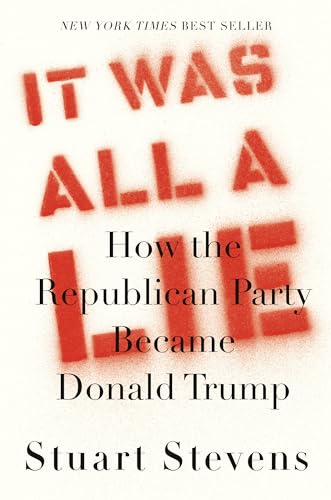
Inhaltsangabe
AN INSTANT NEW YORK TIMES BESTSELLER
"In his bare-knuckles account, Stevens confesses to the reader that the entire apparatus of his Republican Party is built on a pack of lies... This reckoning inspired Stevens to publish this blistering, tell-all history... Although this book will be a hard read for any committed conservatives, they would do well to ponder it."
--Julian E. Zelizer, The New York Times
From the most successful Republican political operative of his generation, a searing, unflinching, and deeply personal exposé of how his party became what it is today
Stuart Stevens spent decades electing Republicans at every level, from presidents to senators to local officials. He knows the GOP as intimately as anyone in America, and in this new book he offers a devastating portrait of a party that has lost its moral and political compass.
This is not a book about how Donald J. Trump hijacked the Republican Party and changed it into something else. Stevens shows how Trump is in fact the natural outcome of five decades of hypocrisy and self-delusion, dating all the way back to the civil rights legislation of the early 1960s. Stevens shows how racism has always lurked in the modern GOP's DNA, from Goldwater's opposition to desegregation to Ronald Reagan's welfare queens and states' rights rhetoric. He gives an insider's account of the rank hypocrisy of the party's claims to embody "family values," and shows how the party's vaunted commitment to fiscal responsibility has been a charade since the 1980s. When a party stands for nothing, he argues, it is only natural that it will be taken over by the loudest and angriest voices in the room.
It Was All a Lie is not just an indictment of the Republican Party, but a candid and often lacerating mea culpa. Stevens is not asking for pity or forgiveness; he is simply telling us what he has seen firsthand. He helped to create the modern party that kneels before a morally bankrupt con man and now he wants nothing more than to see what it has become burned to the ground.
Die Inhaltsangabe kann sich auf eine andere Ausgabe dieses Titels beziehen.
Über die Autorin bzw. den Autor
STUART STEVENS is the author of seven previous books, and his work has appeared in The New York Times, The Washington Post, Esquire, and Outside, among other publications. He has written extensively for television shows, including Northern Exposure, Commander in Chief, and K Street. For twenty-five years, he was the lead strategist and media consultant for some of the nation's toughest political campaigns. He attended Colorado College; Pembroke College, Oxford; Middlebury College; and UCLA film school. He is a former fellow of the American Film Institute.
Auszug. © Genehmigter Nachdruck. Alle Rechte vorbehalten.
1
Race, The Original Republican Sin
You start out in 1954 by saying, “Nigger, nigger, nigger.” By 1968 you can’t say “nigger”—that hurts you. Backfires. So you say stuff like forced busing, states’ rights and all that stuff.
—Lee Atwater, 1981
I played the race card in my very first race.
It was 1978 and my first client was running for Congress in Mississippi. His name was Jon Hinson. He had been chief of staff to a Mississippi congressman named Thad Cochran, who was now running for the Senate. (Actually, back then they called the head staffers “administrative assistants,” or AAs, but as government became more about positioning for that next job and less about service, that sounded too much like “secretaries,” so the more elevated “chief of staff” became common. What lobbying shop wants to pay $500,000 for a former AA?) In high school I had been a page when Hinson ran the congressional office, and I’d kept in touch when visiting the office on trips to D.C.
Hinson was running against the son of Senator John Stennis, a Mississippi icon of the Democratic Party. The son, John Hampton Stennis, was a state representative, and it was assumed he would win easily. I was in film school then at UCLA, and Hinson called and asked if I could make television commercials for his campaign. I told him I didn’t know how to make commercials, that I just made silly little films and wrote scripts I couldn’t sell. “That doesn’t matter,” he said. “You have to do it. I can’t afford to pay anyone who does this for real.” In retrospect, this might not have been the most compelling pitch. But like anyone who has gone to film school, I was eager to get out and actually do something even vaguely related to film, so I said yes.
I’d been one of those kids who loved politics and campaigns and had walked precincts since the 1967 “William Winter for Governor” campaign in Mississippi. Winter ran against the last avowed segregationist to be elected governor, John Bell Williams, and it was a race full of death threats and drama. Winter lost, but I fell in love with politics and read Teddy White’s Making of the President, 1960 over and over. It seemed a strange and intoxicating world, and when I left film school and started working in the Hinson campaign, I instantly felt at home. There was this sense of doing something that might actually matter. If I came up with the right ad, I might make a little history—or at least that’s what I told myself. It was the tiniest bit of history—a Mississippi congressional seat—but it seemed infinitely more consequential than student films and debating what was the greatest opening camera move in cinema. The only problem was we were losing.
Stennis was a towering figure in Mississippi, and his name on the ballot was the obvious default choice for voters. Hinson was right when he said he couldn’t afford to hire anyone, because no one thought he would win and for good reason. We raised some money, put up a few positive ads, and moved comfortably into second place, which is where we seemed stuck. The problem was that the congressional district, which included a lot of Jackson, Mississippi, and Vicksburg, was around 30 percent African American and, true to form, Hinson was getting less than 10 percent of that vote.
Thad Cochran was facing the same problem in his Senate race. No Republican had been elected statewide in Mississippi since Reconstruction, mostly because there really wasn’t much of a functioning Republican Party in Mississippi. Cochran had won a congressional race against a very weak Democrat and then relied on incumbency to win easy races, but every other member of the Mississippi congressional delegation was Democratic. In his Senate race, Cochran had one great advantage: Charles Evers, the brother of the assassinated civil rights leader Medgar Evers, was running as an independent. Not surprisingly, he was drawing a significant portion of the African American vote. With the bulk of the black vote going to a third-party candidate, the race between the Republican and the Democrat largely came down to a fight for white voters. And that was a fight Cochran was winning. He was a young, likable attorney from Jackson and had a strong base in his former congressional district. Evers had no chance of winning, but he was enabling Cochran to move into first place.
What we needed in the Hinson campaign was a like dynamic of an independent African American drawing black votes from the Democrat. And we had one: Evan Doss Jr., a thirty-year-old African American, had qualified to run as an independent for the congressional seat. The problem was that he wasn’t famous like Charles Evers, so few, including those in the black community, knew he was running. So I did the obvious thing: I made ads that showed the Republican, the Democrat, and independent, Evan Doss. I did it like a public service announcement: “In the Fourth Congressional District, three candidates are running.” I put all three on the screen with their names. “Jon Hinson is the Republican nominee. John Hampton Stennis is the Democratic nominee. Evan Doss is running as an independent and would be the first African American candidate elected to Congress in Mississippi since Reconstruction.”
That was it. I thought it was terribly clever, and it didn’t bother me a bit on any “I’m playing the race card” kind of level. What could be wrong with informing voters of the choice they faced? And it worked beautifully. On Election Day, Hinson won with 51.6 percent of the vote followed by John Hampton Stennis with 26.4 percent and Evan Doss with 19 percent. Every vote for Doss was a vote that would have gone to Stennis. In the end, Hinson might have won without the black independent, but it would have been very, very close.
In my first race I had stumbled onto a truth as basic and immutable as the fact that water freezes below thirty-two degrees Fahrenheit: race was the key in which much of American politics and certainly all of southern politics was played. It was really very simple: the Democratic candidate needed 90-plus percent of black votes to win. If a significant portion voted for a third party, the Republican would win.
It hadn’t always been this way. Before 1964, Republican presidential candidates could expect to get between 30 and 40 percent of the African American vote. Dwight Eisenhower got 39 percent in 1956. Four years later, Richard Nixon campaigned with Jackie Robinson and won 32 percent of black voters. In 1964, Barry Goldwater opposed the Civil Rights Act, and his black support plummeted to 7 percent. Since 1964, no Republican presidential candidate has broken 17 percent with African American voters, and by 2016 only 3 percent considered themselves Republican.
Politics is in many ways a perfect marketplace. Candidates and parties learn very quickly what works and what doesn’t and focus time, energy, and money on the share of the marketplace that pollsters tell them is accessible to persuasion or motivation. Since 1964, Republicans have learned that they will have little success in appealing to black voters. It’s not that most campaigns didn’t make at least some effort, but it was always done with the knowledge that breaking 10 percent would be a significant achievement.
What happens if you spend decades focused on appealing to white voters and treating nonwhite voters with, at best, benign neglect? You get good at doing what it takes to appeal to white voters. That is the truth that led to what is famously called...
„Über diesen Titel“ kann sich auf eine andere Ausgabe dieses Titels beziehen.
Weitere beliebte Ausgaben desselben Titels

Suchergebnisse für It Was All a Lie: How the Republican Party Became Donald...

Beispielbild für diese ISBN
It Was All a Lie: How the Repu
Anbieter: World of Books (was SecondSale), Montgomery, IL, USA
Verkäuferbewertung 5 von 5 Sternen

Zustand: Very Good. Item in very good condition! Textbooks may not include supplemental items i.e. CDs, access codes etc. Artikel-Nr. 00106935558
Gebraucht kaufen
EUR 5,40
Versand gratis
Versand innerhalb von USA
Versand innerhalb von USA
Anzahl: 1 verfügbar
Beispielbild für diese ISBN
It Was All a Lie: How the Repu
Anbieter: World of Books (was SecondSale), Montgomery, IL, USA
Verkäuferbewertung 5 von 5 Sternen
Zustand: Good. Item in good condition. Textbooks may not include supplemental items i.e. CDs, access codes etc. Artikel-Nr. 00098676362
Gebraucht kaufen
EUR 5,40
Versand gratis
Versand innerhalb von USA
Versand innerhalb von USA
Anzahl: Mehr als 20 verfügbar
Beispielbild für diese ISBN
It Was All a Lie: How the Republican Party Became Donald Trump
Verlag:
Knopf (edition First Edition), 2020
ISBN 10: 0525658459
ISBN 13: 9780525658450
Gebraucht
Hardcover
Erstausgabe
Anbieter: BooksRun, Philadelphia, PA, USA
Verkäuferbewertung 5 von 5 Sternen
Hardcover. Zustand: Very Good. First Edition. With dust jacket. It's a well-cared-for item that has seen limited use. The item may show minor signs of wear. All the text is legible, with all pages included. It may have slight markings and/or highlighting. Artikel-Nr. 0525658459-8-1-29
Gebraucht kaufen
EUR 5,53
Versand gratis
Versand innerhalb von USA
Versand innerhalb von USA
Anzahl: 1 verfügbar
Beispielbild für diese ISBN
It Was All a Lie: How the Republican Party Became Donald Trump
Anbieter: ThriftBooks-Dallas, Dallas, TX, USA
Verkäuferbewertung 5 von 5 Sternen
Hardcover. Zustand: Good. No Jacket. Missing dust jacket; Pages can have notes/highlighting. Spine may show signs of wear. ~ ThriftBooks: Read More, Spend Less. Artikel-Nr. G0525658459I3N01
Gebraucht kaufen
EUR 5,78
Versand gratis
Versand innerhalb von USA
Versand innerhalb von USA
Anzahl: 2 verfügbar
Beispielbild für diese ISBN
It Was All a Lie: How the Republican Party Became Donald Trump
Anbieter: ThriftBooks-Reno, Reno, NV, USA
Verkäuferbewertung 5 von 5 Sternen
Hardcover. Zustand: Good. No Jacket. Former library book; Pages can have notes/highlighting. Spine may show signs of wear. ~ ThriftBooks: Read More, Spend Less. Artikel-Nr. G0525658459I3N10
Gebraucht kaufen
EUR 5,78
Versand gratis
Versand innerhalb von USA
Versand innerhalb von USA
Anzahl: 1 verfügbar
Beispielbild für diese ISBN
It Was All a Lie: How the Republican Party Became Donald Trump
Anbieter: ThriftBooks-Phoenix, Phoenix, AZ, USA
Verkäuferbewertung 5 von 5 Sternen
Hardcover. Zustand: Good. No Jacket. Former library book; Pages can have notes/highlighting. Spine may show signs of wear. ~ ThriftBooks: Read More, Spend Less. Artikel-Nr. G0525658459I3N10
Gebraucht kaufen
EUR 5,78
Versand gratis
Versand innerhalb von USA
Versand innerhalb von USA
Anzahl: 1 verfügbar
Beispielbild für diese ISBN
It Was All a Lie: How the Republican Party Became Donald Trump
Anbieter: ThriftBooks-Atlanta, AUSTELL, GA, USA
Verkäuferbewertung 5 von 5 Sternen
Hardcover. Zustand: Good. No Jacket. Missing dust jacket; Pages can have notes/highlighting. Spine may show signs of wear. ~ ThriftBooks: Read More, Spend Less. Artikel-Nr. G0525658459I3N01
Gebraucht kaufen
EUR 5,78
Versand gratis
Versand innerhalb von USA
Versand innerhalb von USA
Anzahl: 2 verfügbar
Beispielbild für diese ISBN
It Was All a Lie: How the Republican Party Became Donald Trump
Anbieter: ThriftBooks-Phoenix, Phoenix, AZ, USA
Verkäuferbewertung 5 von 5 Sternen
Hardcover. Zustand: Very Good. No Jacket. May have limited writing in cover pages. Pages are unmarked. ~ ThriftBooks: Read More, Spend Less. Artikel-Nr. G0525658459I4N00
Gebraucht kaufen
EUR 5,78
Versand gratis
Versand innerhalb von USA
Versand innerhalb von USA
Anzahl: 3 verfügbar
Beispielbild für diese ISBN
It Was All a Lie: How the Republican Party Became Donald Trump
Anbieter: ThriftBooks-Phoenix, Phoenix, AZ, USA
Verkäuferbewertung 5 von 5 Sternen
Hardcover. Zustand: Good. No Jacket. Missing dust jacket; Pages can have notes/highlighting. Spine may show signs of wear. ~ ThriftBooks: Read More, Spend Less. Artikel-Nr. G0525658459I3N01
Gebraucht kaufen
EUR 5,78
Versand gratis
Versand innerhalb von USA
Versand innerhalb von USA
Anzahl: 1 verfügbar
Beispielbild für diese ISBN
It Was All a Lie: How the Republican Party Became Donald Trump
Anbieter: ThriftBooks-Reno, Reno, NV, USA
Verkäuferbewertung 5 von 5 Sternen
Hardcover. Zustand: Very Good. No Jacket. Former library book; May have limited writing in cover pages. Pages are unmarked. ~ ThriftBooks: Read More, Spend Less. Artikel-Nr. G0525658459I4N10
Gebraucht kaufen
EUR 5,78
Versand gratis
Versand innerhalb von USA
Versand innerhalb von USA
Anzahl: 8 verfügbar