
Verwandte Artikel zu New Power: How Power Works in Our Hyperconnected World--and...
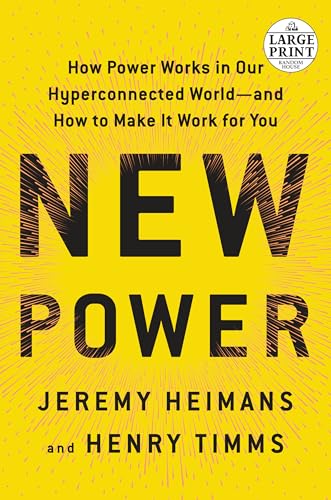
Inhaltsangabe
NOW A NATIONAL BESTSELLER
The definitive guide to spreading ideas, building movements, and leaping ahead in our chaotic, connected age. Get the book New York Times columnist David Brooks calls "the best window I’ve seen into this new world."
Why do some leap ahead while others fall behind in our chaotic, connected age? In New Power, Jeremy Heimans and Henry Timms confront the biggest stories of our time--the rise of mega-platforms like Facebook and Uber; the out-of-nowhere victories of Obama and Trump; the unexpected emergence of movements like #MeToo--and reveal what's really behind them: the rise of "new power."
For most of human history, the rules of power were clear: power was something to be seized and then jealously guarded. This "old power" was out of reach for the vast majority of people. But our ubiquitous connectivity makes possible a different kind of power. "New power" is made by many. It is open, participatory, and peer-driven. It works like a current, not a currency--and it is most forceful when it surges. The battle between old and new power is determining who governs us, how we work, and even how we think and feel.
New Power shines fresh light on the cultural phenomena of our day, from #BlackLivesMatter to the Ice Bucket Challenge to Airbnb, uncovering the new power forces that made them huge. Drawing on examples from business, activism, and pop culture, as well as the study of organizations like Lego, NASA, Reddit, and TED, Heimans and Timms explain how to build new power and channel it successfully. They also explore the dark side of these forces: the way ISIS has co-opted new power to monstrous ends, and the rise of the alt-right's "intensity machine."
In an era increasingly shaped by new power, this groundbreaking book offers us a new way to understand the world--and our role in it.
Die Inhaltsangabe kann sich auf eine andere Ausgabe dieses Titels beziehen.
Über die Autorin bzw. den Autor
JEREMY HEIMANS is a lifelong activist and the co-founder and CEO of Purpose, an organization that builds and supports social movements around the world.
HENRY TIMMS is president and CEO of the 92nd Street Y, a visiting fellow at Stanford, and co-founder of #GivingTuesday, an international day of philanthropy.
Auszug. © Genehmigter Nachdruck. Alle Rechte vorbehalten.
1
WELCOME TO THE NEW POWER WORLD
Power, as philosopher Bertrand Russell puts it, is the “ability to produce intended effects.”
That ability is now in all of our hands. Today, we have thecapacity to make films, friends, or money; to spread hope orspread our ideas; to build community or build up movements; to spread misinformation or propagate violence—all on a vastly greater scale and with greater potential impact than we did even a few years ago.
Yes, this is because technology has changed. But the deeper truth is that we are changing. Our behaviors and expectations are changing. And those who have figured out how to channel all this energy and appetite are producing Russell’s “intended effects” in new and extraordinarily impactful ways.
Think of the hoodie-clad barons who sit atop online platforms a billion users strong, tweaking our daily habits, emotions, and opinions. The political neophytes who have raised passionate crowds and won stunning victories. The everyday people and organizations who are leaping ahead in this chaotic, hyperconnected world—while others fall back.
This book is about how to navigate and thrive in a world defined by the battle and balancing of two big forces. We call them old power and new power.
Old power works like a currency. It is held by few. Once gained, it is jealously guarded, and the powerful have a substantial store of it to spend. It is closed, inaccessible, and leader-driven. It downloads, and it captures.
New power operates differently, like a current. It is made by many. It is open, participatory, and peer-driven. It uploads, and it distributes. Like water or electricity, it’s most forceful when it surges. The goal with new power is not to hoard it but to channel it.
To start to see how old and new power work, here are three very different stories.
#MeToo vs. Harvey Weinstein
Award seasons after award season, movie producer Harvey Weinstein ruled over Hollywood like a god.
In fact, between 1966 and 2016, he actually tied with God for the total number of times each was thanked in acceptance speeches on Oscar night—thirty four. His films garnered over three hundred Oscar nominations. The Queen made him an honorary Commander of the British Empire.
Weinstein hoarded his power and spent it like currency to maintain his vaunted position: he could make or break a star, he had huge personal capacity to green-light a project or sink it. He shaped the fortunes of an entire industry—and in turn that industry protected him even as he carried out a decades-long spree of alleged sexual harassment and assault. He controlled the media through developing a cozy mutually beneficial relationship based on the favors and access he could grant. He even won the 2017 Los Angeles Press Club “Truth Teller” award.
He buffeted himself with an army of lawyers, relying on punishing non-disclosure agreements for those who worked with him and, when necessary, paying off accusers. He hired private security firms—staffed with former spies—to dig for information on women and journalists with allegations against him. The women he preyed upon mostly kept quiet anyway, out of the very real fear of career consequences, while the men who might have stepped up stood by and did nothing, unwilling to spend their own power on a fight.
If Harvey Weinstein, and the closed and hierarchical system that held him up, tell a familiar story about old power, then Weinstein’s fall, and especially what happened next, tells us a lot about how new power works, and why it matters.
In the days after news stories broke about Weinstein and his accusers, the actress Alyssa Milano shared the hashtag #MeToo to encourage women to tell their stories of sexual harassment and assault on Twitter. Terri Conn paid attention. In her twenties, as an emerging actress with a role on a soap opera, Conn had been approached by director James Toback to meet in Central Park to talk about a part. Once there, as she reported to CNN, he assaulted her.
She buried the memory for years. But with the attention on Harvey Weinstein, and the rise of the #MeToo movement, it resurfaced. She finally told her husband, and she started to act. She began by searching Twitter for women who had used both the #MeToo hashtag and #JamesToback. She found others whose stories were frighteningly close to hers. Together they formed a private Twitter group to support one another and find other survivors. Members of this group then took their stories to a journalist at the Los Angeles Times. Within days of an article being published, more than three hundred women came forward with stories of their own about Toback.
Conn’s campaign was one of many. Almost one million tweets used the hashtag #MeToo in forty-eight hours. In just one day, twelve million Facebook comments, posts, and reactions were logged.
The #MeToo movement surged across the world like a current, with different communities adapting it to take on their own targets. In France it became #BalanceTonPorc (Denounce Your Pig), a campaign to name and shame harassers. In Italy women recounted their stories under the banner #QuellaVoltaChe (The Time That). And it moved from industry to industry. Members of Congress revealed that they, too, had been harassed by their male peers. The UK defense minister was forced to resign. The European Parliament had its #MeToo moment. Business leaders were exposed and toppled. Rallies spilled out onto the streets in cities across the world, from Paris to Vancouver. India debated an effort to expose the predatory behavior of well-known professors. An article in China Daily that seemed to suggest workplace harassment and assault were only Western problems was pulled after a wave of online criticism.
No one was the boss of this movement, and no one quite knew where it would go next. #MeToo had been born a decade earlier as the work of grassroots activist Tarana Burke, who encouraged women of color who had been sexually assaulted to share their experiences, peer-to-peer, with other survivors. But now the movement felt ownerless—and this was the source of its strength. Everyone from enterprising designers who created “me too” jewelry to aspiring politicians who aligned with #MeToo to seek to channel its energy.
The most striking thing about #MeToo was the sense of power it gave to its participants: many who had felt for years that they were helpless to stop longtime abusers, or had been afraid of retribution, suddenly found the courage to stand up to them. Every individual story was strengthened by the surge of the much larger current. Each individual act of bravery was, in fact, made by many.
The patient(s) vs. the doctor
The doctor looked up from his computer, stunned. “Where didyou learn that word? That’s my terminology. When did you go to medical school? I can’t see you as a patient anymore if you’re going to go on the internet and just learn stuff that you shouldn’t be learning.”
Then the doctor fired his patient.The offensive word was “tonic-clonic.” His patient had let him know that she thought she had experienced a secondarily generalized tonic-clonic seizure. (In the past, she and her doctor had referred to these moments as “space-outs,” regular seizures that had been causing her serious concern.)
This patient had learned about her condition through PatientsLikeMe, an online community of over 500,000 people living with more than 2,700 diseases, each of whom shares their personal medical data and experiences with others on the platform, creating tens of millions of data points. Think of it as a massive support group, learning...
„Über diesen Titel“ kann sich auf eine andere Ausgabe dieses Titels beziehen.
Suchergebnisse für New Power: How Power Works in Our Hyperconnected World--and...

Beispielbild für diese ISBN
New Power : How Power Works in Our Hyperconnected World--And How to Make It Work for You
Anbieter: Better World Books, Mishawaka, IN, USA
Verkäuferbewertung 5 von 5 Sternen

Zustand: Very Good. Former library copy. Pages intact with possible writing/highlighting. Binding strong with minor wear. Dust jackets/supplements may not be included. Includes library markings. Stock photo provided. Product includes identifying sticker. Better World Books: Buy Books. Do Good. Artikel-Nr. 16068975-6
Gebraucht kaufen
EUR 10,52
Versand gratis
Versand innerhalb von USA
Versand innerhalb von USA
Anzahl: 1 verfügbar
Beispielbild für diese ISBN
New Power : How Power Works in Our Hyperconnected World--And How to Make It Work for You
Anbieter: Better World Books: West, Reno, NV, USA
Verkäuferbewertung 5 von 5 Sternen
Zustand: Very Good. Former library copy. Pages intact with possible writing/highlighting. Binding strong with minor wear. Dust jackets/supplements may not be included. Includes library markings. Stock photo provided. Product includes identifying sticker. Better World Books: Buy Books. Do Good. Artikel-Nr. 16068975-6
Gebraucht kaufen
EUR 15,49
Versand gratis
Versand innerhalb von USA
Versand innerhalb von USA
Anzahl: 1 verfügbar
Beispielbild für diese ISBN
New Power: How Power Works in Our Hyperconnected World--and How to Make It Work for You
Verlag:
Random House Large Print, 2018
ISBN 10: 0525595392
ISBN 13: 9780525595397
Gebraucht
paperback
Anbieter: Studibuch, Stuttgart, Deutschland
Verkäuferbewertung 5 von 5 Sternen
paperback. Zustand: Sehr gut. 560 Seiten; 9780525595397.2 Gewicht in Gramm: 500. Artikel-Nr. 918249
Gebraucht kaufen
EUR 6,99
EUR 80,70 Versand
Versand von Deutschland nach USA
Versand von Deutschland nach USA
Anzahl: 1 verfügbar