
Verwandte Artikel zu The Jungle Grows Back: America and Our Imperiled World
Inhaltsangabe
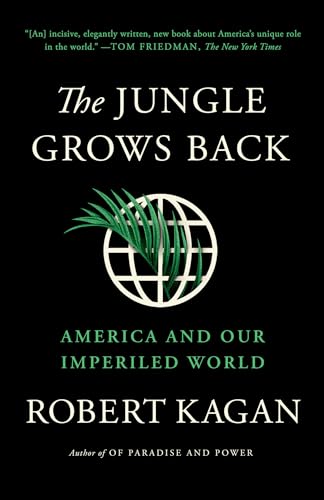
A brilliant and visionary argument for America's role as an enforcer of peace and order throughout the world—and what is likely to happen if we withdraw and focus our attention inward.
Recent years have brought deeply disturbing developments around the globe. American sentiment seems to be leaning increasingly toward withdrawal in the face of such disarray. In this powerful, urgent essay, Robert Kagan elucidates the reasons why American withdrawal would be the worst possible response, based as it is on a fundamental and dangerous misreading of the world. Like a jungle that keeps growing back after being cut down, the world has always been full of dangerous actors who, left unchecked, possess the desire and ability to make things worse. Kagan makes clear how the “realist” impulse to recognize our limitations and focus on our failures misunderstands the essential role America has played for decades in keeping the world's worst instability in check. A true realism, he argues, is based on the understanding that the historical norm has always been toward chaos—that the jungle will grow back, if we let it.
Die Inhaltsangabe kann sich auf eine andere Ausgabe dieses Titels beziehen.
Über die Autorin bzw. den Autor
Robert Kagan is a senior fellow at the Brookings Institution and a columnist for The Washington Post. He is also the author of The Return of History and the End of Dreams, Dangerous Nation, Of Paradise and Power, and A Twilight Struggle. He served in the U.S. State Department from 1984 to 1988. He lives in Virginia with his wife.
Auszug. © Genehmigter Nachdruck. Alle Rechte vorbehalten.
The American-led liberal world order was never a natural phenomenon. It was not the culmination of evolutionary processes across the millennia or the inevitable fulfillment of universal human desires. The past seven-plus decades of relatively free trade, growing respect for individual rights, and relatively peaceful cooperation among nations—the core elements of the liberal order—have been a great historical aberration. Until 1945 the story of humankind going back thousands of years was a long tale of war, tyranny, and poverty. moments of peace were fleeting, democracy so rare as to seem almost accidental, and prosperity the luxury of the powerful few. Our own era has not lacked its horrors, its genocides, its oppressions, its barbarisms. Yet by historical standards, including the standards of the recent past, it has been a relative paradise. Between 1500� and 1945� scarcely a year passed when the strongest powers in the world, the great powers of Europe, were not at war, but since 1945 there have been no wars among the great powers. The great Cold War confrontation between the United States and the Soviet Union ended peacefully, a historical rarity. Meanwhile, deaths from all recent smaller wars have declined dramatically, as indeed have violent deaths of all kinds. Since the end of the Second World War the world has also enjoyed a period of prosperity unlike any other, with more than seven decades of global GDP growth averaging almost �3.5 percent per year, despite the 2007-2008 financial crisis. Since 1945�, some four billion people around the world have climbed out of poverty. The number of democratic governments has grown from no more than a dozen in 1939 to more than a hundred today. The power of the state has been curbed in favor of the individual in large parts of the world, and an ever-expanding panoply of individual rights has come to be respected. What Abraham Lincoln called the "better angels" of human nature have been encouraged, and some of human beings' worst impulses have been suppressed more effectively than before. But all this has been an anomaly in the history of human existence. The liberal world order is fragile and impermanent. Like a garden, it is ever under siege from the natural forces of history, the jungle whose vines and weeds constantly threaten to overwhelm it.
The American-led liberal world order has never been a natural phenomenon. The story of humankind going back thousands of years is a long tale of war, tyranny, and poverty. Moments of peace have been fleeting, democracy so rare as to seem almost accidental, and prosperity the luxury of the powerful few. Our own era has not lacked its horrors, its genocides, its oppressions, its barbarisms. Yet by historical standards, including the standards of the recent past, it has been a relative paradise. Between 1500 and 1945 scarcely a year passed when the strongest powers in the world, the great powers of Europe, were not at war, but since 1945 there have been no wars among the great powers. The great Cold War confrontation between the United States and the Soviet Union ended peacefully, a historical rarity. Meanwhile, deaths from all recent smaller wars have declined dramatically, as indeed have violent deaths of all kinds. Since the end of the Second World War the world has also enjoyed a period of prosperity unlike any other, with more than seven decades of global GDP growth averaging almost 3.5 percent per year, despite the 2007-2008 financial crisis. Since 1945, some four billion people around the world have climbed out of poverty. The number of democratic governments have grown from no more than a dozen in 1939 to more than a hundred today. The power of the state has been curbed in favor of the individual in large parts of the world, and an ever-expanding panoply of individual rights has come to be respected. What Lincoln called the "better angels" of human nature have been encouraged, and some of human beings’ worst impulses have been suppressed more effectively than before. All this has been a great aberration, an anomaly in the recorded history of human existence.
Unfortunately, we tend to take our world for granted. We have lived so long inside the bubble of the liberal world order that we can imagine no other kind of world. We think it is natural and normal, even inevitable. We see all its flaws and wish it could be better, but it doesn't occur to us that the more likely alternative to it would be much, much worse. Unlike other cultures, which view history as a continuous cycle of growth and decay, or as stasis, we view history as having a direction and a purpose. We believe in "modernization," in stages of economic and political development, in the link between prosperity and democracy. As children of the Enlightenment, we believe the expansion of knowledge and material progress goes hand in hand with improvements in human behavior and moral progress. From Montesquieu and Kant we learned that commerce tames the souls of men and nations, reducing conflict and increasing harmony and cooperation. From Marx and others we learned to treat stages of economic developmentas the drivers of political development—feudalism produces government by monarchs and aristocrats, capitalismproduces government by parliaments and democracies, all as part of some iron logic of economic determinism. From Hegel we learned that history is but "the progress of the consciousnessof freedom" and that, as Francis Fukuyama put it in his famous description of the "End of History," there is "a common evolutionary pattern for all societies . . . something like a Universal History of mankind in the direction of liberal democracy." Hence we have come to believe that, while there may be occasional bumps and detours on the road, progress is inevitable.
This story of human progress is a myth, however. If the last century has taught us anything, it is that scientific and technological progress and the expansion of knowledge, while capable of improving our lives materially, have brought no lasting improvement in human behavior. Nor is history rightly viewed as a progressive upward march toward enlightenment. That perception rests on a carefully curated set of facts. We jump from Periclean Athens to the birth of Christianity, from the Renaissance to the Reformation, from the Magna Carta to the American Revolution. Omitted from this tale of golden ages and great leaps forward are the dark ages and great leaps backward. When it comes to human behavior, history is a jagged line with no discernible slope. Where on the scale of progress would we put the Thirty Years’ War, which killed off almost half the populations of the German principalities, or the Napoleonic Wars, which killed more than three million Europeans, destroyed the lives of many millions more, and helped produce the revolutionary nationalism that would wreak so much havoc in the first decades of the twentieth century? How do World War I, World War II, the famines, and the genocides of the last century fit into our story of human progress? Were the horrors perpetrated against Ukrainians and Chinese in the 1930s and against Jews in the 1940s part of our story of progress? Were they just aberrations, or were they harbingers of the future? Only by ignoring much horrendous bloodshed and brutality, and quite recently in historical terms, can we believe that there has been anything like a steady improvement in the way humans treat each other.
Nor has there been steady progress toward liberalism. Liberal government flickered into existence at the end of the eighteenth century, first in Great Britain and America and then, inspired by the French Revolution, in parts of Europe in the nineteenth and twentieth centuries. But as liberalism grew, so did the modern police state, which was born in Austria, Prussia, and Russia at the...
„Über diesen Titel“ kann sich auf eine andere Ausgabe dieses Titels beziehen.
Suchergebnisse für The Jungle Grows Back: America and Our Imperiled World

Beispielbild für diese ISBN
The Jungle Grows Back
Anbieter: World of Books (was SecondSale), Montgomery, IL, USA
Verkäuferbewertung 5 von 5 Sternen

Paperback. Zustand: Fair. A brilliant and visionary argument for America's role as an enforcer of peace and order throughout the world-and what is likely to happen if we withdraw and focus our attention inward. Recent years have brought deeply disturbing developments around the globe. American sentiment seems to be leaning increasingly toward withdrawal in the face of such disarray. In this powerful, urgent essay, Robert Kagan elucidates the reasons why American withdrawal would be the worst possible response, based as it is on a fundamental and dangerous misreading of the world. Like a jungle that keeps growing back after being cut down, the world has always been full of dangerous actors who, left unchecked, possess the desire and ability to make things worse. Kagan makes clear how the "realist" impulse to recognize our limitations and focus on our failures misunderstands the essential role America has played for decades in keeping the world's worst instability in check. A true realism, he argues, is based on the understanding that the historical norm has always been toward chaos-that the jungle will grow back, if we let it. Artikel-Nr. 00110712060
Gebraucht kaufen
EUR 4,75
Versand gratis
Versand innerhalb von USA
Versand innerhalb von USA
Anzahl: 2 verfügbar
Beispielbild für diese ISBN
The Jungle Grows Back
Anbieter: World of Books (was SecondSale), Montgomery, IL, USA
Verkäuferbewertung 5 von 5 Sternen
Paperback. Zustand: Good. A brilliant and visionary argument for America's role as an enforcer of peace and order throughout the world-and what is likely to happen if we withdraw and focus our attention inward. Recent years have brought deeply disturbing developments around the globe. American sentiment seems to be leaning increasingly toward withdrawal in the face of such disarray. In this powerful, urgent essay, Robert Kagan elucidates the reasons why American withdrawal would be the worst possible response, based as it is on a fundamental and dangerous misreading of the world. Like a jungle that keeps growing back after being cut down, the world has always been full of dangerous actors who, left unchecked, possess the desire and ability to make things worse. Kagan makes clear how the "realist" impulse to recognize our limitations and focus on our failures misunderstands the essential role America has played for decades in keeping the world's worst instability in check. A true realism, he argues, is based on the understanding that the historical norm has always been toward chaos-that the jungle will grow back, if we let it. Artikel-Nr. 00110873560
Gebraucht kaufen
EUR 4,75
Versand gratis
Versand innerhalb von USA
Versand innerhalb von USA
Anzahl: 2 verfügbar
Foto des Verkäufers
The Jungle Grows Back: America and Our Imperiled World
Anbieter: Dream Books Co., Denver, CO, USA
Verkäuferbewertung 5 von 5 Sternen
Zustand: acceptable. This copy has clearly been enjoyedâ"expect noticeable shelf wear and some minor creases to the cover. Binding is strong, and all pages are legible. May contain previous library markings or stamps. Artikel-Nr. 4EKGRJ006ME7_ns
Gebraucht kaufen
EUR 4,77
Versand gratis
Versand innerhalb von USA
Versand innerhalb von USA
Anzahl: 1 verfügbar
Beispielbild für diese ISBN
The Jungle Grows Back: America and Our Imperiled World
Verlag:
Vintage (edition Reprint), 2019
ISBN 10: 0525563571
ISBN 13: 9780525563570
Gebraucht
Paperback
Anbieter: BooksRun, Philadelphia, PA, USA
Verkäuferbewertung 5 von 5 Sternen
Paperback. Zustand: Very Good. Reprint. It's a well-cared-for item that has seen limited use. The item may show minor signs of wear. All the text is legible, with all pages included. It may have slight markings and/or highlighting. Artikel-Nr. 0525563571-11-1
Gebraucht kaufen
EUR 6,04
Versand gratis
Versand innerhalb von USA
Versand innerhalb von USA
Anzahl: 5 verfügbar
Beispielbild für diese ISBN
The Jungle Grows Back: America and Our Imperiled World
Anbieter: ThriftBooks-Dallas, Dallas, TX, USA
Verkäuferbewertung 5 von 5 Sternen
Paperback. Zustand: Very Good. No Jacket. May have limited writing in cover pages. Pages are unmarked. ~ ThriftBooks: Read More, Spend Less. Artikel-Nr. G0525563571I4N00
Gebraucht kaufen
EUR 6,84
Versand gratis
Versand innerhalb von USA
Versand innerhalb von USA
Anzahl: 1 verfügbar
Beispielbild für diese ISBN
The Jungle Grows Back: America and Our Imperiled World
Anbieter: ThriftBooks-Atlanta, AUSTELL, GA, USA
Verkäuferbewertung 5 von 5 Sternen
Paperback. Zustand: Very Good. No Jacket. May have limited writing in cover pages. Pages are unmarked. ~ ThriftBooks: Read More, Spend Less. Artikel-Nr. G0525563571I4N00
Gebraucht kaufen
EUR 6,84
Versand gratis
Versand innerhalb von USA
Versand innerhalb von USA
Anzahl: 1 verfügbar
Beispielbild für diese ISBN
The Jungle Grows Back: America and Our Imperiled World
Anbieter: ThriftBooks-Phoenix, Phoenix, AZ, USA
Verkäuferbewertung 5 von 5 Sternen
Paperback. Zustand: Very Good. No Jacket. May have limited writing in cover pages. Pages are unmarked. ~ ThriftBooks: Read More, Spend Less. Artikel-Nr. G0525563571I4N00
Gebraucht kaufen
EUR 6,84
Versand gratis
Versand innerhalb von USA
Versand innerhalb von USA
Anzahl: 1 verfügbar
Beispielbild für diese ISBN
The Jungle Grows Back: America and Our Imperiled World
Anbieter: ThriftBooks-Dallas, Dallas, TX, USA
Verkäuferbewertung 5 von 5 Sternen
Paperback. Zustand: Fair. No Jacket. Readable copy. Pages may have considerable notes/highlighting. ~ ThriftBooks: Read More, Spend Less. Artikel-Nr. G0525563571I5N00
Gebraucht kaufen
EUR 6,84
Versand gratis
Versand innerhalb von USA
Versand innerhalb von USA
Anzahl: 1 verfügbar
Beispielbild für diese ISBN
The Jungle Grows Back : America and Our Imperiled World
Verlag:
Knopf Doubleday Publishing Group, 2019
ISBN 10: 0525563571
ISBN 13: 9780525563570
Gebraucht
Softcover
Anbieter: Better World Books, Mishawaka, IN, USA
Verkäuferbewertung 5 von 5 Sternen
Zustand: Very Good. Pages intact with possible writing/highlighting. Binding strong with minor wear. Dust jackets/supplements may not be included. Stock photo provided. Product includes identifying sticker. Better World Books: Buy Books. Do Good. Artikel-Nr. 17952310-75
Gebraucht kaufen
EUR 8,37
Versand gratis
Versand innerhalb von USA
Versand innerhalb von USA
Anzahl: 1 verfügbar
Beispielbild für diese ISBN
The Jungle Grows Back : America and Our Imperiled World
Verlag:
Knopf Doubleday Publishing Group, 2019
ISBN 10: 0525563571
ISBN 13: 9780525563570
Gebraucht
Softcover
Anbieter: Better World Books, Mishawaka, IN, USA
Verkäuferbewertung 5 von 5 Sternen
Zustand: Good. Pages intact with minimal writing/highlighting. The binding may be loose and creased. Dust jackets/supplements are not included. Stock photo provided. Product includes identifying sticker. Better World Books: Buy Books. Do Good. Artikel-Nr. 18012625-75
Gebraucht kaufen
EUR 8,37
Versand gratis
Versand innerhalb von USA
Versand innerhalb von USA
Anzahl: 3 verfügbar