
Verwandte Artikel zu Cribsheet: A Data-Driven Guide to Better, More Relaxed...
Cribsheet: A Data-Driven Guide to Better, More Relaxed Parenting, from Birth to Preschool (The ParentData Series, Band 2) - Softcover
Buch 2 von 4: The ParentData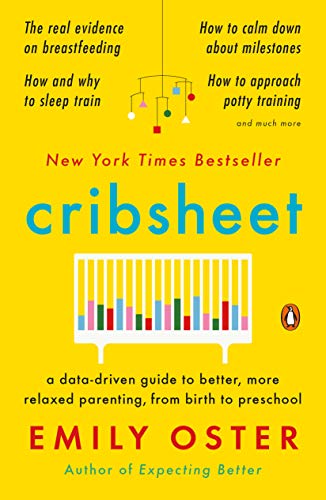
Inhaltsangabe
From the author of Expecting Better, The Family Firm, and The Unexpected an economist's guide to the early years of parenting.
“Both refreshing and useful. With so many parenting theories driving us all a bit batty, this is the type of book that we need to help calm things down.” —LA Times
“The book is jampacked with information, but it’s also a delightful read because Oster is such a good writer.” —NPR
With Expecting Better, award-winning economist Emily Oster spotted a need in the pregnancy market for advice that gave women the information they needed to make the best decision for their own pregnancies. By digging into the data, Oster found that much of the conventional pregnancy wisdom was wrong. In Cribsheet, she now tackles an even greater challenge: decision-making in the early years of parenting.
As any new parent knows, there is an abundance of often-conflicting advice hurled at you from doctors, family, friends, and strangers on the internet. From the earliest days, parents get the message that they must make certain choices around feeding, sleep, and schedule or all will be lost. There's a rule—or three—for everything. But the benefits of these choices can be overstated, and the trade-offs can be profound. How do you make your own best decision?
Armed with the data, Oster finds that the conventional wisdom doesn't always hold up. She debunks myths around breastfeeding (not a panacea), sleep training (not so bad!), potty training (wait until they're ready or possibly bribe with M&Ms), language acquisition (early talkers aren't necessarily geniuses), and many other topics. She also shows parents how to think through freighted questions like if and how to go back to work, how to think about toddler discipline, and how to have a relationship and parent at the same time.
Economics is the science of decision-making, and Cribsheet is a thinking parent's guide to the chaos and frequent misinformation of the early years. Emily Oster is a trained expert—and mom of two—who can empower us to make better, less fraught decisions—and stay sane in the years before preschool.
Die Inhaltsangabe kann sich auf eine andere Ausgabe dieses Titels beziehen.
Über die Autorin bzw. den Autor
Emily Oster is a professor of economics at Brown University and the author of Expecting Better, Cribsheet, and The Family Firm. She writes the newsletter ParentData and her work has been featured in The New York Times, The Wall Street Journal, The Washington Post, The Atlantic, and Bloomberg. She has two children.
Auszug. © Genehmigter Nachdruck. Alle Rechte vorbehalten.
Introduction
As infants, both my children loved to be swaddled— wrapped up tightly in blankets to sleep. Our blanket of choice was something called the Miracle Blanket, which involved a complicated wrap-ping procedure that only Houdini himself could have escaped. We had about nine of these blankets, since we feared we would run out and have to use a swaddle covered in poop.
Swaddling is great, and it can help your infant sleep. But there is a downside: you can’t use it forever. At some point, your kid will get too big and you’ll have to stop. Now, a first- time parent might not assume that this is a problem, but breaking the swaddle habit is no easy task.
With our daughter, Penelope (kid number one), breaking the swaddle led to worse sleep habits, followed by a long reliance on a product called the Rock ’n Play Sleeper, which I still have nightmares about. Other parents have told me stories of seeking secret online sources for larger-size swaddles. There are women on Etsy who will create a swaddle blanket for your eighteen- month- old. Please note: Just because there is a secret market for something on Etsy doesn’t necessarily mean it’s a good idea. One of the features of having a second child is you can have a do-over on all your perceived mistakes. As an “experienced parent,” you can make sure that anything you look back on with regret you’ll fix on this round. At least, that’s what I thought. Breaking the swaddle was at the top of my list. I was going to do it right this time.
As Finn (kid number two) approached four or five months old, I made a plan. First, for a few days I’d swaddle Finn as usual, but leave one arm uncovered. Then, a few days later, after he adjusted to that, I’d take the other arm out. Then I’d uncover his legs. Finally, I’d dispense with the whole swaddle. The internet assured me that this way we’d lose the swaddle without also losing any (hard-won) sleeping skills.
I was ready to start. I put a date on the calendar and informed my husband, Jesse.
Then, one extremely hot day shortly before the assigned start date, the power went out, and with it the air conditioning. Finn’s room was 95 degrees. It was approaching bedtime. I panicked. When fully deployed, the swaddle blanket was many layers of fabric. Finn would roast.
Should I keep him awake in the hopes the power would come back on? It could be days. Should I just swaddle him and figure he’d be hot? This seemed irresponsible and also kind of mean. Should I just hold him while he slept and not put him in the crib at all until it cooled down? This was also very hot, and experience suggested he wouldn’t sleep for long in my arms.
My best-laid plans set aside, I put him to bed in a diaper and onesie. No swaddle. I explained it to him as I nursed him to sleep, drenched in sweat.
“Finn, I’m sorry, but it’s so hot out! We can’t use the swaddle. But don’t worry, you can still sleep. I know you can do it! Now you’ll be able to suck on your fingers! Won’t that be nice?”
With a big smile, I put him in his crib, unswaddled, and left the room. I prepared for the worst. Penelope would have screamed bloody murder. Finn, though, just made a few surprised noises and fell asleep.
Obviously, an hour later the power came back on. By then Finn was sleeping. I asked Jesse if I should go in and swaddle him now. Jesse told me I was nuts, and collected all the Miracle Blankets for the charity bin. As I lay in bed that night, I wondered if Finn would sleep worse now, if I should go dig the blankets out of the bin and wrap him in one. I was tempted to jump on the computer and read stories of swaddle- induced sleep regression, or lack thereof. In the end, I was too hot to follow through, and our swaddle days were over.
As a parent, you want nothing more than to do the right thing for your children, to make the best choices for them. At the same time, it can be impossible to know what those best choices are. Things crop up that you never thought about— even with a second kid, probably even with a fifth kid. The world, and your child, surprise you all the time. It is hard not to second- guess yourself, even on the small things.
The swaddle breaking was, of course, a tiny incident. But it illustrates what will be one of the great themes of your parenting life: you have way less control than you think you do. You might ask why, if I know this to be true, have I written a guide to parenting in the early years? The answer is that you do have choices, even if not control, and these choices are important. The problem is that the atmosphere around parenting rarely frames these choices in a way that gives parents autonomy.
We can do better, and data and economics, surprisingly, can help. My goal with this book is to take some of the stress out of the early years by arming you with good information and a method for making the best decisions for your family.
I also hope Cribsheet will offer a basic, data- derived map of the big issues that come up in the first three years of being a parent. I found that_hard to come by in my own experience.
Most of us are parenting later than our parents did; we’ve been functional adults a lot longer than any previous generation of new parents. That’s not just a neat demographic fact. It means we’re used to autonomy, and thanks to technology, we are used to having pretty much limitless information in our decision-making.
We’d like to approach parenting the same way, but the sheer number of decisions causes information overload. Especially early on, every day seems to have another challenge, and when you look for advice, everyone says something different. And, frankly, they all seem like experts relative to you. It’s daunting even before you factor in your depleted postpartum state and the tiny new resident of your home who won’t latch onto your breast, sleep, or stop screaming. Take a deep breath.
There are many big decisions: Should you breastfeed? Should you sleep train, and with what method? What about allergies? Some people say avoid peanuts, others say give them to your child as soon as possible— which is right? Should you vaccinate, and if so, when? And there are smaller ones: Is swaddling actually a good idea? Does your baby need a schedule right away?
These questions don’t die out as your child ages, either. Sleeping and eating just start to stabilize, and then you’ll get your first tantrum. What on earth do you do with that? Should you discipline your kid? How? Exorcism? Sometimes it seems like it. You may just need a break for a minute. Is it okay to let the kid watch TV? Maybe one time the internet told you watching TV will turn your child into a serial killer. It’s difficult to re-member the details— but maybe don’t risk it? But, boy, a break would be nice.
And on top of these questions is the endless worrying, “Is my kid nor-mal?” When your baby is just a few weeks old, “normal” is whether they are_peeing enough, crying too much, gaining enough weight. Then it’s how much they sleep, whether they roll over, whether they smile. Then do they crawl, do they walk, when do they run? And can they talk? Do they say enough different words?
How can we get the answers to these questions? How do we know the “right” way to parent? Does such a thing even exist? Your pediatrician will be helpful, but they tend to (correctly) focus on areas of actual medical concern. When my daughter showed no interest in walking at fifteen...
„Über diesen Titel“ kann sich auf eine andere Ausgabe dieses Titels beziehen.
Suchergebnisse für Cribsheet: A Data-Driven Guide to Better, More Relaxed...

Beispielbild für diese ISBN
Cribsheet: A Data-Driven Guide to Better, More Relaxed Parenting, from Birth to Preschool
Anbieter: World of Books (was SecondSale), Montgomery, IL, USA
Verkäuferbewertung 5 von 5 Sternen

Paperback. Zustand: Fair. The New York Times bestseller From the author of Expecting Better, The Family Firm, and The Unexpected an economist's guide to the early years of parenting. "Both refreshing and useful. With so many parenting theories driving us all a bit batty, this is the type of book that we need to help calm things down." --LA Times "The book is jampacked with information, but it's also a delightful read because Oster is such a good writer." --NPR With Expecting Better, award-winning economist Emily Oster spotted a need in the pregnancy market for advice that gave women the information they needed to make the best decision for their own pregnancies. By digging into the data, Oster found that much of the conventional pregnancy wisdom was wrong. In Cribsheet, she now tackles an even greater challenge: decision-making in the early years of parenting. As any new parent knows, there is an abundance of often-conflicting advice hurled at you from doctors, family, friends, and strangers on the internet. From the earliest days, parents get the message that they must make certain choices around feeding, sleep, and schedule or all will be lost. There's a rule--or three--for everything. But the benefits of these choices can be overstated, and the trade-offs can be profound. How do you make your own best decision? Armed with the data, Oster finds that the conventional wisdom doesn't always hold up. She debunks myths around breastfeeding (not a panacea), sleep training (not so bad!), potty training (wait until they're ready or possibly bribe with M&Ms), language acquisition (early talkers aren't necessarily geniuses), and many other topics. She also shows parents how to think through freighted questions like if and how to go back to work, how to think about toddler discipline, and how to have a relationship and parent at the same time. Economics is the science of decision-making, and Cribsheet is a thinking parent's guide to the chaos and frequent misinformation of the early years. Emily Oster is a trained expert--and mom of two--who can empower us to make better, less fraught decisions--and stay sane in the years before preschool. Artikel-Nr. 00108712703
Gebraucht kaufen
EUR 3,92
Versand gratis
Versand innerhalb von USA
Versand innerhalb von USA
Anzahl: 7 verfügbar
Foto des Verkäufers
Cribsheet: A Data-Driven Guide to Better, More Relaxed Parenting, from Birth to Preschool (The ParentData Series)
Anbieter: Dream Books Co., Denver, CO, USA
Verkäuferbewertung 5 von 5 Sternen
Zustand: good. Gently used with minimal wear on the corners and cover. A few pages may contain light highlighting or writing, but the text remains fully legible. Dust jacket may be missing, and supplemental materials like CDs or codes may not be included. May be ex-library with library markings. Ships promptly! Artikel-Nr. DBV.0525559272.G
Gebraucht kaufen
EUR 3,93
Versand gratis
Versand innerhalb von USA
Versand innerhalb von USA
Anzahl: 4 verfügbar
Foto des Verkäufers
Cribsheet: A Data-Driven Guide to Better, More Relaxed Parenting, from Birth to Preschool (The ParentData Series)
Anbieter: Dream Books Co., Denver, CO, USA
Verkäuferbewertung 5 von 5 Sternen
Zustand: acceptable. This copy has clearly been enjoyedâ"expect noticeable shelf wear and some minor creases to the cover. Binding is strong, and all pages are legible. May contain previous library markings or stamps. Artikel-Nr. DBV.0525559272.A
Gebraucht kaufen
EUR 3,93
Versand gratis
Versand innerhalb von USA
Versand innerhalb von USA
Anzahl: 5 verfügbar
Beispielbild für diese ISBN
Cribsheet: A Data-Driven Guide to Better, More Relaxed Parenting, from Birth to Preschool
Anbieter: ThriftBooks-Atlanta, AUSTELL, GA, USA
Verkäuferbewertung 5 von 5 Sternen
Paperback. Zustand: Fair. No Jacket. Former library book; Readable copy. Pages may have considerable notes/highlighting. ~ ThriftBooks: Read More, Spend Less. Artikel-Nr. G0525559272I5N10
Gebraucht kaufen
EUR 5,87
Versand gratis
Versand innerhalb von USA
Versand innerhalb von USA
Anzahl: 1 verfügbar
Beispielbild für diese ISBN
Cribsheet: A Data-Driven Guide to Better, More Relaxed Parenting, from Birth to Preschool
Anbieter: ThriftBooks-Atlanta, AUSTELL, GA, USA
Verkäuferbewertung 5 von 5 Sternen
Paperback. Zustand: Fair. No Jacket. Readable copy. Pages may have considerable notes/highlighting. ~ ThriftBooks: Read More, Spend Less. Artikel-Nr. G0525559272I5N00
Gebraucht kaufen
EUR 5,87
Versand gratis
Versand innerhalb von USA
Versand innerhalb von USA
Anzahl: 20 verfügbar
Beispielbild für diese ISBN
Cribsheet: A Data-Driven Guide to Better, More Relaxed Parenting, from Birth to Preschool
Anbieter: ThriftBooks-Dallas, Dallas, TX, USA
Verkäuferbewertung 5 von 5 Sternen
Paperback. Zustand: Fair. No Jacket. Readable copy. Pages may have considerable notes/highlighting. ~ ThriftBooks: Read More, Spend Less. Artikel-Nr. G0525559272I5N00
Gebraucht kaufen
EUR 5,87
Versand gratis
Versand innerhalb von USA
Versand innerhalb von USA
Anzahl: 20 verfügbar
Beispielbild für diese ISBN
Cribsheet: A Data-Driven Guide to Better, More Relaxed Parenting, from Birth to Preschool
Anbieter: ThriftBooks-Dallas, Dallas, TX, USA
Verkäuferbewertung 5 von 5 Sternen
Paperback. Zustand: Fair. No Jacket. Former library book; Readable copy. Pages may have considerable notes/highlighting. ~ ThriftBooks: Read More, Spend Less. Artikel-Nr. G0525559272I5N10
Gebraucht kaufen
EUR 5,87
Versand gratis
Versand innerhalb von USA
Versand innerhalb von USA
Anzahl: 1 verfügbar
Beispielbild für diese ISBN
Cribsheet: A Data-Driven Guide to Better, More Relaxed Parenting, from Birth to Preschool
Anbieter: ThriftBooks-Phoenix, Phoenix, AZ, USA
Verkäuferbewertung 5 von 5 Sternen
Paperback. Zustand: Fair. No Jacket. Former library book; Readable copy. Pages may have considerable notes/highlighting. ~ ThriftBooks: Read More, Spend Less. Artikel-Nr. G0525559272I5N10
Gebraucht kaufen
EUR 5,87
Versand gratis
Versand innerhalb von USA
Versand innerhalb von USA
Anzahl: 1 verfügbar
Beispielbild für diese ISBN
Cribsheet: A Data-Driven Guide to Better, More Relaxed Parenting, from Birth to Preschool
Anbieter: ThriftBooks-Phoenix, Phoenix, AZ, USA
Verkäuferbewertung 5 von 5 Sternen
Paperback. Zustand: Fair. No Jacket. Readable copy. Pages may have considerable notes/highlighting. ~ ThriftBooks: Read More, Spend Less. Artikel-Nr. G0525559272I5N00
Gebraucht kaufen
EUR 5,87
Versand gratis
Versand innerhalb von USA
Versand innerhalb von USA
Anzahl: 20 verfügbar
Beispielbild für diese ISBN
Cribsheet: A Data-Driven Guide to Better, More Relaxed Parenting, from Birth to Preschool
Anbieter: ThriftBooks-Phoenix, Phoenix, AZ, USA
Verkäuferbewertung 5 von 5 Sternen
Paperback. Zustand: Good. No Jacket. Pages can have notes/highlighting. Spine may show signs of wear. ~ ThriftBooks: Read More, Spend Less. Artikel-Nr. G0525559272I3N00
Gebraucht kaufen
EUR 5,87
Versand gratis
Versand innerhalb von USA
Versand innerhalb von USA
Anzahl: Mehr als 20 verfügbar