
Verwandte Artikel zu Here We Are: My Friendship with Philip Roth
Inhaltsangabe
Finalist for the National Jewish Book Award
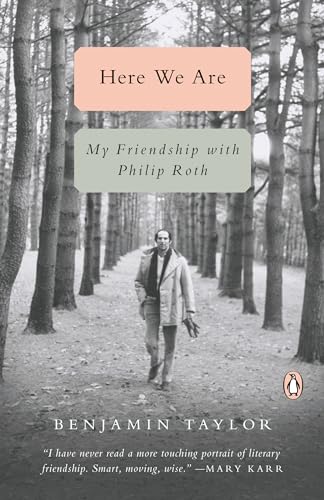
A deeply felt, beautifully crafted meditation on friendship and loss in the vein of A Year of Magical Thinking, and a touching portrait of Philip Roth from his closest friend.
I had a baseball question on the tip of my tongue: What was the name of "the natural," the player shot by a stalker in a Chicago hotel room? He gave me an amused look that darkened in-to puzzlement, then fear. Then he pitched forward into the soup, unconscious. When I entered the examining room twenty minutes after our arrival at Charlotte Hungerford Hospital, Philip said, "No more books." Thus he announced his retirement.
So begins Benjamin Taylor's Here We Are, the unvarnished portrait of his best friend and one of America's greatest writers. Needless to say, Philip Roth's place in the canon is secure, but what is less clear is what the man himself was like. In Here We Are, Benjamin Taylor's beautifully constructed memoir, we see him as a mortal man, experiencing the joys and sorrows of aging, reflecting on his own writing, and doing something we all love to do: passing the time in the company of his closest friend.
Here We Are is an ode to friendship and its wondrous ability to brighten our lives in unexpected ways. Benjamin Taylor is one of the most talented writers working today, and this new memoir pays tribute to his friend, in the way that only a writer can. Roth encouraged him to write this book, giving Taylor explicit instructions not to sugarcoat anything and not to publish it until after his death. Unvarnished and affectionately true to life, Taylor's memoir will be the definitive account of Philip Roth as he lived for years to come.
Die Inhaltsangabe kann sich auf eine andere Ausgabe dieses Titels beziehen.
Über die Autorin bzw. den Autor
Benjamin Taylor's family memoir, The Hue and Cry at Our House, received the 2018 Los Angeles Times/Christopher Isherwood Prize and was named a New York Times Editors' Choice; his Proust: The Search was named a Best Book of 2016 by Thomas Mallon in The New York Times Book Review; and his Naples Declared: A Walk Around the Bay was named a Best Book of 2012 by Judith Thurman in The New Yorker. He is also the author of two novels, Tales Out of School, winner of the 1996 Harold Ribalow Prize, and The Book of Getting Even, winner of a Barnes & Noble Discover Award. He edited Saul Bellow: Letters, named a Best Book of 2010 by Michiko Kakutani in The New York Times and Jonathan Yardley in The Washington Post, and Bellow's There Is Simply Too Much to Think About: Collected Nonfiction, also a New York Times Editors' Choice. His edition of the collected stories of Susan Sontag, Debriefing, was published by Farrar, Straus & Giroux in 2017. Taylor is a founding faculty member in the New School’s Graduate School of Writing and teaches also in the Columbia University School of the Arts. He is a past fellow and current trustee of the John Simon Guggenheim Memorial Foundation and serves as president of the Edward F. Albee Foundation.
Auszug. © Genehmigter Nachdruck. Alle Rechte vorbehalten.
Chapter One
No Model but Itself
Die in your prime and it is tragic. Die in your ninth decade and it is the debt paid, the quittance. Grief for those struck down too soon goes on and on. We are helplessly haunted by what might have been; a penumbra of vanished possibilities surrounds untimely death. But grief for the elderly is formal, stately. Most of all it is end-oriented.
You roll a boulder across the mouth of the cave.
You move on.
In The Ghost Writer, Nathan Zuckerman says of Felix Abravanel that the master's charm was "a moat so oceanic that you could not even see the great turreted and buttressed thing it had been dug to protect." Philip too could seem a beguiling but remote citadel: august, many-towered, lavishly defended. Those who reached the inner keep met there someone quite different from the persona devised for public purposes. Still vitally present at home was the young man he'd remained all along, full of satirical hijinks and gleeful ventriloquisms and antic fun building to crescendos. Imaginary relatives were a specialty. I recall for example Paprika Roth, a retired stripper living in the Florida Panhandle. A glint in the eye told you hilarity was on the road.
"Ben, do you remember when Mrs. Fischbein was on The $64,000 Question?"
"A little before my time, Philip."
"Well, Mrs. Fischbein had walloped the competition. She'd advanced to the sixty-four-thousand-dollar question itself. Came the drum roll and the announcer said, 'For sixty-four thousand dollars, Mrs. Fischbein, who was-the first man?' 'I wouldn't tell you for a million dollars!' cried Mrs. Fischbein."
The place of origin, Newark's Weequahic section, was his Great Code and Rosetta stone. I mean Weequahic as endlessly rediscovered through alchemical imagination, that flame turned up under experience for the smelting of novels. "Ours was not a neighborhood steeped in darkness," says Zuckerman in American Pastoral. "The place was bright with industriousness. There was a big belief in life and we were steered relentlessly in the direction of success: a better existence was going to be ours . . . Am I wrong to think we delighted in living there? No delusions are more familiar than those inspired in the elderly by nostalgia, but am I completely mistaken to think that living as well-born children in Renaissance Florence could not have held a candle to growing up within aromatic range of Tabachnik's pickle barrels? Am I mistaken to think that even back then, in the vivid present, the fullness of life stirred our emotions to an extraordinary extent? Has anywhere since so engrossed you in its ocean of details? The detail, the immensity of the detail, the force of the detail, the weight of the detail-the rich endlessness of detail surrounding you in your young life like the six feet of dirt that'll be packed on your grave when you're dead."
Philip spent his final three weeks in the cardiac intensive-care unit at New York-Presbyterian Hospital. A lot of women and a smattering of men surrounded him. We were friends, lovers, protŽgŽs, relatives, employees, representing every decade of his adult life. (This I know: When my time comes, the waiting room will not be crowded with ex-lovers.)
On the twenty-first day, the attending came out of Philip's room and said: "He is philosopher, no?"
"Yes," I said. And so it really was. Amid the general weeping, Philip was Socratic, as if instructing us, his loved ones, in how to die. He even remembered, like Socrates, a small debt owed-to Mrs. Solano, his housekeeper.
Near the end he asked for a moment alone with me and said something I wrote down as soon as I decently could: "I have been to see the great enemy, and walked around him, and talked to him, and he is not to be feared. I promise."
There had been earlier brushes with the great enemy, any one of which might have proved fatal. One occurred on August 22, 2012. Canadian geese were starting south. We'd gone to Litchfield for dinner and dressed up a bit for the occasion. Philip was in a sports jacket he claimed to have bought with the earnings from Goodbye, Columbus. (It may nearly have been so; he cared nothing for clothes.) Seated in our usual booth at the West Street Grill, we ordered the special soup, their gazpacho, sweet and crunchy with the local beefsteaks and cucumbers. I had a baseball question on the tip of my tongue: What was the name of "the natural," the player shot by a lady stalker in a Chicago hotel room? He gave me an amused look that darkened into puzzlement, then fear.
Then he pitched forward into the soup, unconscious. Too astounded for anything but composure, I summoned the management. Medics appeared almost immediately. As if by further magic, a stretcher sprang up from the floor to receive him, who though all but comatose was saying something: an attempt, entirely characteristic, at telling the medics how to do their job.
Moments later I was in the front seat of the ambulance beside the driver, with Philip and the two medics behind us. "Thready pulse," said one to the other. And then, to the driver: "Better turn on the siren." I thought, here is how it ends, and considered whom I would contact first. Thomas Mann's Aschenbach and the last line of Death in Venice came to mind, proving literature matters even in an emergency: "Before nightfall," writes Mann, "a shocked and respectful world received the news of his decease." Philip had equipped several of us with detailed instructions on how every aspect of his burial and memorial service should be handled. My mind veered to these.
Twenty minutes after our arrival at Charlotte Hungerford Hospital in Torrington, the ER physician explained that what Philip had suffered was an accumulated reaction to one of the drugs he'd been taking. When I entered the examining room Philip said, "No more books." At first I didn't know what he meant. What he meant, I shortly realized, was that Nemesis, his thirty-first, published two years earlier, would be his last. Thus he announced his retirement.
"You look right good for back from the dead," I told him.
"Just so we're clear," he said, "I did die." He had the sweetest smile sometimes. Now he took up the story he hadn't got to at dinner: In the summer of 1949, Eddie Waitkus, lefty All-Star with the Cubs, the Phillies, the Orioles and the Phillies again, was shot by a deranged admirer, Ruth Ann Steinhagen, in her room at the Edgewater Beach Hotel, to which she'd coaxed him with a letter: "Please come soon. I won't take much of your time. I promise."
Good as her word, she plugged him when he came through the door. Ruth Ann's plan had evidently been to shoot herself too in a Mayerling-style bloodbath, but she told the cops afterward that she couldn't find another bullet.
Eddie survived but never got his game back. Ruth Ann reported that after she shot him he'd said: "What'd you do that for, baby?" He spent the rest of his days wondering and died at fifty-three of esophageal cancer. Ruth Ann served a year in the madhouse at Kankakee and, released to the care of family, lived uneventfully for decades on Chicago's North Side, waiving off all queries.
What proved evergreen was "What'd you do that for, baby?"-endlessly applicable and between Philip and me a fresh source of laughter each time one of us said it. Is the quick of friendship here, in finding the same things lastingly funny? Because it was he, because it was I? "Such a friendship has no model but itself," says Montaigne, "and can only be compared to itself . . . And is some mysterious quintessence." Because it...
„Über diesen Titel“ kann sich auf eine andere Ausgabe dieses Titels beziehen.
Suchergebnisse für Here We Are: My Friendship with Philip Roth

Beispielbild für diese ISBN
Here We Are: My Friendship with Philip Roth
Anbieter: World of Books (was SecondSale), Montgomery, IL, USA
Verkäuferbewertung 5 von 5 Sternen

Hardback. Zustand: Good. Finalist for the National Jewish Book Award A deeply felt, beautifully crafted meditation on friendship and loss in the vein of A Year of Magical Thinking, and a touching portrait of Philip Roth from his closest friend. I had a baseball question on the tip of my tongue: What was the name of "the natural," the player shot by a stalker in a Chicago hotel room? He gave me an amused look that darkened in-to puzzlement, then fear. Then he pitched forward into the soup, unconscious. When I entered the examining room twenty minutes after our arrival at Charlotte Hungerford Hospital, Philip said, "No more books." Thus he announced his retirement. So begins Benjamin Taylor's Here We Are, the unvarnished portrait of his best friend and one of America's greatest writers. Needless to say, Philip Roth's place in the canon is secure, but what is less clear is what the man himself was like. In Here We Are, Benjamin Taylor's beautifully constructed memoir, we see him as a mortal man, experiencing the joys and sorrows of aging, reflecting on his own writing, and doing something we all love to do: passing the time in the company of his closest friend. Here We Are is an ode to friendship and its wondrous ability to brighten our lives in unexpected ways. Benjamin Taylor is one of the most talented writers working today, and this new memoir pays tribute to his friend, in the way that only a writer can. Roth encouraged him to write this book, giving Taylor explicit instructions not to sugarcoat anything and not to publish it until after his death. Unvarnished and affectionately true to life, Taylor's memoir will be the definitive account of Philip Roth as he lived for years to come. Artikel-Nr. 00096999655
Gebraucht kaufen
EUR 5,99
Versand gratis
Versand innerhalb von USA
Versand innerhalb von USA
Anzahl: 4 verfügbar
Beispielbild für diese ISBN
Here We Are: My Friendship with Philip Roth
Anbieter: ThriftBooks-Atlanta, AUSTELL, GA, USA
Verkäuferbewertung 5 von 5 Sternen
Hardcover. Zustand: As New. No Jacket. Pages are clean and are not marred by notes or folds of any kind. ~ ThriftBooks: Read More, Spend Less. Artikel-Nr. G0525505245I2N00
Gebraucht kaufen
EUR 6,19
Versand gratis
Versand innerhalb von USA
Versand innerhalb von USA
Anzahl: 1 verfügbar
Beispielbild für diese ISBN
Here We Are: My Friendship with Philip Roth
Anbieter: ThriftBooks-Dallas, Dallas, TX, USA
Verkäuferbewertung 5 von 5 Sternen
Hardcover. Zustand: Very Good. No Jacket. Former library book; May have limited writing in cover pages. Pages are unmarked. ~ ThriftBooks: Read More, Spend Less. Artikel-Nr. G0525505245I4N10
Gebraucht kaufen
EUR 6,19
Versand gratis
Versand innerhalb von USA
Versand innerhalb von USA
Anzahl: 1 verfügbar
Beispielbild für diese ISBN
Here We Are: My Friendship with Philip Roth
Anbieter: ThriftBooks-Atlanta, AUSTELL, GA, USA
Verkäuferbewertung 5 von 5 Sternen
Hardcover. Zustand: Very Good. No Jacket. Former library book; May have limited writing in cover pages. Pages are unmarked. ~ ThriftBooks: Read More, Spend Less. Artikel-Nr. G0525505245I4N10
Gebraucht kaufen
EUR 6,19
Versand gratis
Versand innerhalb von USA
Versand innerhalb von USA
Anzahl: 1 verfügbar
Beispielbild für diese ISBN
Here We Are : My Friendship with Philip Roth
Verlag:
Penguin Publishing Group, 2020
ISBN 10: 0525505245
ISBN 13: 9780525505242
Gebraucht
Hardcover
Anbieter: Better World Books, Mishawaka, IN, USA
Verkäuferbewertung 5 von 5 Sternen
Zustand: Good. Former library copy. Pages intact with minimal writing/highlighting. The binding may be loose and creased. Dust jackets/supplements are not included. Includes library markings. Stock photo provided. Product includes identifying sticker. Better World Books: Buy Books. Do Good. Artikel-Nr. 40641751-6
Gebraucht kaufen
EUR 6,60
Versand gratis
Versand innerhalb von USA
Versand innerhalb von USA
Anzahl: 1 verfügbar
Beispielbild für diese ISBN
Here We Are : My Friendship with Philip Roth
Verlag:
Penguin Publishing Group, 2020
ISBN 10: 0525505245
ISBN 13: 9780525505242
Gebraucht
Hardcover
Anbieter: Better World Books, Mishawaka, IN, USA
Verkäuferbewertung 5 von 5 Sternen
Zustand: Very Good. Former library copy. Pages intact with possible writing/highlighting. Binding strong with minor wear. Dust jackets/supplements may not be included. Includes library markings. Stock photo provided. Product includes identifying sticker. Better World Books: Buy Books. Do Good. Artikel-Nr. 39206788-6
Gebraucht kaufen
EUR 6,60
Versand gratis
Versand innerhalb von USA
Versand innerhalb von USA
Anzahl: 2 verfügbar
Beispielbild für diese ISBN
Here We Are : My Friendship with Philip Roth
Verlag:
Penguin Publishing Group, 2020
ISBN 10: 0525505245
ISBN 13: 9780525505242
Gebraucht
Hardcover
Anbieter: Better World Books Ltd, Dunfermline, Vereinigtes Königreich
Verkäuferbewertung 5 von 5 Sternen
Zustand: Very Good. Pages intact with possible writing/highlighting. Binding strong with minor wear. Dust jackets/supplements may not be included. Stock photo provided. Product includes identifying sticker. Better World Books: Buy Books. Do Good. Artikel-Nr. 38321608-6
Gebraucht kaufen
EUR 5,97
EUR 5,92 Versand
Versand von Vereinigtes Königreich nach USA
Versand von Vereinigtes Königreich nach USA
Anzahl: 1 verfügbar
Foto des Verkäufers
Here We Are: My Friendship with Philip Roth
Verlag:
Penguin Books, 2020
ISBN 10: 0525505245
ISBN 13: 9780525505242
Gebraucht
Hardcover
Erstausgabe
Anbieter: Southampton Books, Sag Harbor, NY, USA
Verkäuferbewertung 5 von 5 Sternen
Hardcover. Zustand: Like New. First Edition. First Edition, First Printing. Published by Penguin Books, 2020. Octavo. Hardcover. Book is like new. Dust jacket is like new. Artikel-Nr. 525600
Gebraucht kaufen
EUR 13,84
EUR 4,47 Versand
Versand innerhalb von USA
Versand innerhalb von USA
Anzahl: 1 verfügbar
Foto des Verkäufers
Here We Are (First Printing) ; My Friendship with Philip Roth
Verlag:
Penguin Books, New York, NY, 2020
ISBN 10: 0525505245
ISBN 13: 9780525505242
Gebraucht
Hardcover
Erstausgabe
Anbieter: True Oak Books, Highland, NY, USA
Verkäuferbewertung 5 von 5 Sternen
Hardcover. Zustand: Very Good+. Zustand des Schutzumschlags: Very Good+. First Edition; First Printing. 5.4 X 0.73 X 8.1 inches; 171 pages; B&W illustrations. Very Good condition. No noteworthy defects. No markings. DJ is not price-clipped.; - Your satisfaction is our priority. We offer free returns and respond promptly to all inquiries. Your item will be packaged with care and ship on the same or next business day. Buy with confidence. Artikel-Nr. HVD-66091-A-0
Gebraucht kaufen
EUR 27,68
Versand gratis
Versand innerhalb von USA
Versand innerhalb von USA
Anzahl: 1 verfügbar
Beispielbild für diese ISBN
Here We Are: My Friendship with Philip Roth
Anbieter: Kennys Bookstore, Olney, MD, USA
Verkäuferbewertung 5 von 5 Sternen
Zustand: New. 2020. Hardcover. . . . . . Books ship from the US and Ireland. Artikel-Nr. V9780525505242
Neu kaufen
EUR 31,51
EUR 9,41 Versand
Versand innerhalb von USA
Versand innerhalb von USA
Anzahl: 15 verfügbar