
Verwandte Artikel zu Interpreting Probability: Controversies and Developments...
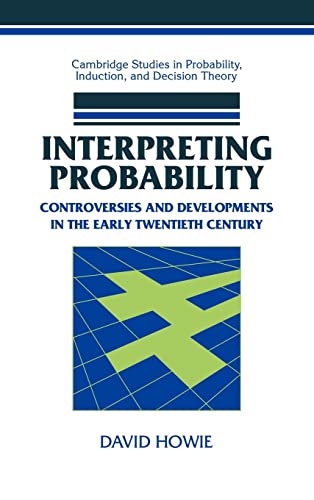
Interpreting Probability: Controversies and Developments in the Early Twentieth Century (Cambridge Studies in Probability, Induction, and Decision Theory) - Hardcover
Inhaltsangabe
This 2002 book investigates how Bayesianism as one theory of probability was discredited in the 1920s and 1930s.
Die Inhaltsangabe kann sich auf eine andere Ausgabe dieses Titels beziehen.
Suchergebnisse für Interpreting Probability: Controversies and Developments...

Beispielbild für diese ISBN
Interpreting Probability: Controversies and Developments in the Early Twentieth Century (Cambridge Studies in Probability, Induction and Decision Theory)
Verlag:
Cambridge University Press, 2002
ISBN 10: 0521812518
ISBN 13: 9780521812511
Gebraucht
Hardcover
Anbieter: Anybook.com, Lincoln, Vereinigtes Königreich
Verkäuferbewertung 5 von 5 Sternen

Zustand: Poor. This is an ex-library book and may have the usual library/used-book markings inside.This book has hardback covers. Book contains pen & pencil markings. In poor condition, suitable as a reading copy. No dust jacket. Please note the Image in this listing is a stock photo and may not match the covers of the actual item,650grams, ISBN:0521812518. Artikel-Nr. 3728039
Gebraucht kaufen
EUR 50,45
EUR 15,41 Versand
Versand von Vereinigtes Königreich nach USA
Versand von Vereinigtes Königreich nach USA
Anzahl: 1 verfügbar
Beispielbild für diese ISBN
Interpreting Probability: Controversies and Developments in the Early Twentieth Century (Cambridge Studies in Probability, Induction and Decision Theory)
Anbieter: Ria Christie Collections, Uxbridge, Vereinigtes Königreich
Verkäuferbewertung 5 von 5 Sternen
Zustand: New. In English. Artikel-Nr. ria9780521812511_new
Neu kaufen
EUR 143,59
EUR 13,34 Versand
Versand von Vereinigtes Königreich nach USA
Versand von Vereinigtes Königreich nach USA
Anzahl: Mehr als 20 verfügbar
Beispielbild für diese ISBN
Interpreting Probability: Controversies and Developments in the Early Twentieth Century (Cambridge Studies in Probability, Induction and Decision Theory)
Anbieter: Kennys Bookstore, Olney, MD, USA
Verkäuferbewertung 5 von 5 Sternen
Zustand: New. This 2002 book investigates how Bayesianism as one theory of probability was discredited in the 1920s and 1930s. Series: Cambridge Studies in Probability, Induction and Decision Theory. Num Pages: 276 pages, black & white illustrations. BIC Classification: HPCF; HPK. Category: (P) Professional & Vocational. Dimension: 228 x 152 x 19. Weight in Grams: 584. . 2002. hardcover. . . . . Books ship from the US and Ireland. Artikel-Nr. V9780521812511
Neu kaufen
EUR 178,56
EUR 9,37 Versand
Versand innerhalb von USA
Versand innerhalb von USA
Anzahl: Mehr als 20 verfügbar
Foto des Verkäufers
Interpreting Probability : Controversies and Developments in the Early Twentieth Century
Anbieter: AHA-BUCH GmbH, Einbeck, Deutschland
Verkäuferbewertung 5 von 5 Sternen
Buch. Zustand: Neu. Druck auf Anfrage Neuware - Printed after ordering - The term probability can be used in two main senses. In the frequency interpretation it is a limiting ratio in a sequence of repeatable events. In the Bayesian view, probability is a mental construct representing uncertainty. This 2002 book is about these two types of probability and investigates how, despite being adopted by scientists and statisticians in the eighteenth and nineteenth centuries, Bayesianism was discredited as a theory of scientific inference during the 1920s and 1930s. Through the examination of a dispute between two British scientists, the author argues that a choice between the two interpretations is not forced by pure logic or the mathematics of the situation, but depends on the experiences and aims of the individuals involved. The book should be of interest to students and scientists interested in statistics and probability theories and to general readers with an interest in the history, sociology and philosophy of science. Artikel-Nr. 9780521812511
Neu kaufen
EUR 180,49
EUR 35,00 Versand
Versand von Deutschland nach USA
Versand von Deutschland nach USA
Anzahl: 1 verfügbar