
Verwandte Artikel zu A Unified Theory of Voting: Directional And Proximity...
Inhaltsangabe
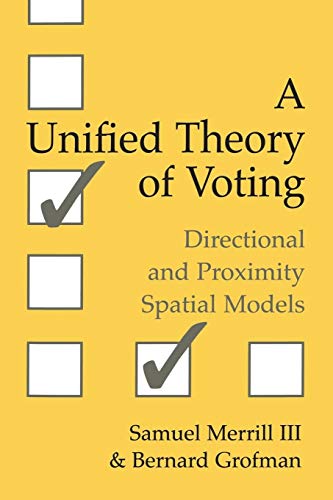
The authors develop a unified model that incorporates voter motivations and assess its empirical predictions in the US, Norway, and France.
Die Inhaltsangabe kann sich auf eine andere Ausgabe dieses Titels beziehen.
Suchergebnisse für A Unified Theory of Voting: Directional And Proximity...

Beispielbild für diese ISBN
A Unified Theory of Voting : Directional and Proximity Spatial Models
Verlag:
Cambridge University Press, 1999
ISBN 10: 0521665493
ISBN 13: 9780521665490
Gebraucht
Softcover
Anbieter: Better World Books, Mishawaka, IN, USA
Verkäuferbewertung 5 von 5 Sternen

Zustand: Good. Pages intact with minimal writing/highlighting. The binding may be loose and creased. Dust jackets/supplements are not included. Stock photo provided. Product includes identifying sticker. Better World Books: Buy Books. Do Good. Artikel-Nr. 12001925-6
Gebraucht kaufen
EUR 13,79
Versand gratis
Versand innerhalb von USA
Versand innerhalb von USA
Anzahl: 2 verfügbar
Foto des Verkäufers
Unified Theory of Voting : Directional and Proximity Spatial Models
Verlag:
Cambridge University Press, 1999
ISBN 10: 0521665493
ISBN 13: 9780521665490
Gebraucht
Softcover
Anbieter: GreatBookPricesUK, Woodford Green, Vereinigtes Königreich
Verkäuferbewertung 5 von 5 Sternen
Zustand: As New. Unread book in perfect condition. Artikel-Nr. 701409
Gebraucht kaufen
EUR 44,86
EUR 18,00 Versand
Versand von Vereinigtes Königreich nach USA
Versand von Vereinigtes Königreich nach USA
Anzahl: Mehr als 20 verfügbar
Beispielbild für diese ISBN
A Unified Theory of Voting: Directional and Proximity Spatial Models
Anbieter: Revaluation Books, Exeter, Vereinigtes Königreich
Verkäuferbewertung 5 von 5 Sternen
Paperback. Zustand: Brand New. 213 pages. 9.00x6.00x0.75 inches. In Stock. Artikel-Nr. x-0521665493
Neu kaufen
EUR 55,29
EUR 12,00 Versand
Versand von Vereinigtes Königreich nach USA
Versand von Vereinigtes Königreich nach USA
Anzahl: 2 verfügbar
Beispielbild für diese ISBN
A Unified Theory of Voting: Directional And Proximity Spatial Models
Anbieter: Kennys Bookstore, Olney, MD, USA
Verkäuferbewertung 5 von 5 Sternen
Zustand: New. The authors develop a unified model that incorporates voter motivations and assess its empirical predictions in the US, Norway, and France. Num Pages: 230 pages, 33 b/w illus. 40 tables. BIC Classification: JPHF. Category: (P) Professional & Vocational. Dimension: 228 x 152 x 13. Weight in Grams: 320. . 1999. Illustrated. paperback. . . . . Books ship from the US and Ireland. Artikel-Nr. V9780521665490
Neu kaufen
EUR 74,70
EUR 9,41 Versand
Versand innerhalb von USA
Versand innerhalb von USA
Anzahl: Mehr als 20 verfügbar
Foto des Verkäufers
A Unified Theory of Voting : Directional and Proximity Spatial Models
Anbieter: AHA-BUCH GmbH, Einbeck, Deutschland
Verkäuferbewertung 5 von 5 Sternen
Taschenbuch. Zustand: Neu. Druck auf Anfrage Neuware - Printed after ordering - This book addresses the questions: how do voters use their own issue positions and those of candidates to decide how to vote Does a voter tend to choose the candidate who most closely shares the views of the voter or rather a candidate who holds more extreme views due to the fact that the voters discount the candidates' abilities to implement policy. The authors develop a unified model that incorporates these and other voter motivations and assess its empirical predictions - for both voter choice and candidate strategy - in the US, Norway, and France. The analyses show that a combination of proximity, direction, discounting, and party ID are compatible with the mildly but not extremely divergent policies that are characteristic of many two-party and multiparty electorates. All of these motivations are necessary to understand the linkage between candidate issue positions and voter preferences. Artikel-Nr. 9780521665490
Neu kaufen
EUR 61,58
EUR 35,00 Versand
Versand von Deutschland nach USA
Versand von Deutschland nach USA
Anzahl: 1 verfügbar