
Verwandte Artikel zu Information Sampling and Adaptive Cognition
Inhaltsangabe
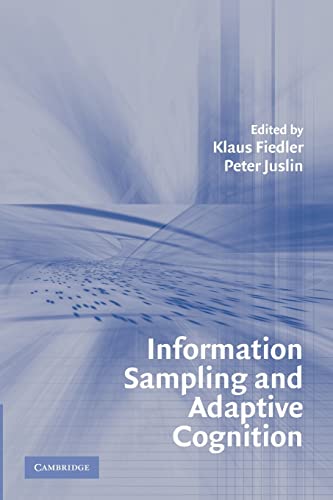
This book proposes that environmental information samples are biased and cognitive processes are not.
Die Inhaltsangabe kann sich auf eine andere Ausgabe dieses Titels beziehen.
Über die Autorinnen und Autoren
Klaus Fiedler is Professor of Psychology at University of Heidelberg in Germany. Among his main research interests are cognitive social psychology, language and communication, social memory, inductive cognitive processes in judgment and decision making, and computer modeling of the human mind. Professor Fiedler was the winner of the 2000 Leibniz Award.
Peter Juslin is Professor of Psychology at Uppsala University in Sweden. He received the Brunswik New Scientist Award in 1994 and the Oscar's Award at Uppsala University in 1996 for young distinguished scientists. He has published a large number of scientific papers in many journals including many articles in the main APA-journals such as Psychology Review.
„Über diesen Titel“ kann sich auf eine andere Ausgabe dieses Titels beziehen.
Suchergebnisse für Information Sampling and Adaptive Cognition

Foto des Verkäufers
Information Sampling and Adaptive Cognition
Verlag:
Cambridge University Press, 2005
ISBN 10: 0521539331
ISBN 13: 9780521539333
Gebraucht
Softcover
Anbieter: Bookbot, Prague, Tschechien
Verkäuferbewertung 5 von 5 Sternen

Softcover. Zustand: Fine. Leichte Kratzer / Abnutzungen / Druckstellen; Leichte Gebrauchsspuren; Leichte Verschmutzung / Farbtonveränderung. Even the most intelligent and informed judges and decision makers have been shown to be prone to errors and biases with potentially serious consequences. Previous scientific attempts to explain the causes of wrong decisions have mainly focused on shortcomings in the cognitive processing of the information given. The recent research reviewed in the present volume offers an intriguing alternative for consideration. Although the input of environmental information samples may be biased, the cognitive processing of information samples is often unbiased and remarkably accurate. Artikel-Nr. 6f56841c-8994-4516-bb99-46b1eeb74f78
Gebraucht kaufen
EUR 9,17
EUR 18,99 Versand
Versand von Tschechien nach USA
Versand von Tschechien nach USA
Anzahl: 1 verfügbar
Foto des Verkäufers
Information Sampling and Adaptive Cognition.
Verlag:
Cambridge University Press, 2006
ISBN 10: 0521539331
ISBN 13: 9780521539333
Gebraucht
Broschiert
Anbieter: books4less (Versandantiquariat Petra Gros GmbH & Co. KG), Welling, Deutschland
Verkäuferbewertung 5 von 5 Sternen
Broschiert. Zustand: Gut. 488 Seiten Das hier angebotene Buch stammt aus einer teilaufgelösten Bibliothek und kann die entsprechenden Kennzeichnungen aufweisen (Rückenschild, Instituts-Stempel.); der Buchzustand ist ansonsten ordentlich und dem Alter entsprechend gut. Stellenweise Anstreichungen im Text. In ENGLISCHER Sprache. Sprache: Englisch Gewicht in Gramm: 680. Artikel-Nr. 2310909
Gebraucht kaufen
EUR 13,95
EUR 15,95 Versand
Versand von Deutschland nach USA
Versand von Deutschland nach USA
Anzahl: 1 verfügbar
Beispielbild für diese ISBN
Information Sampling and Adaptive Cognition
Verlag:
Cambridge University Press, 2005
ISBN 10: 0521539331
ISBN 13: 9780521539333
Gebraucht
Softcover
Erstausgabe
Anbieter: Better World Books: West, Reno, NV, USA
Verkäuferbewertung 5 von 5 Sternen
Zustand: Very Good. 1st Edition. Former library copy. Pages intact with possible writing/highlighting. Binding strong with minor wear. Dust jackets/supplements may not be included. Includes library markings. Stock photo provided. Product includes identifying sticker. Better World Books: Buy Books. Do Good. Artikel-Nr. 68667675-75
Gebraucht kaufen
EUR 38,29
Versand gratis
Versand innerhalb von USA
Versand innerhalb von USA
Anzahl: 1 verfügbar
Foto des Verkäufers
Information sampling and adaptive cognition.
Verlag:
Cambridge University Press, 2005
ISBN 10: 0521539331
ISBN 13: 9780521539333
Gebraucht
Softcover
Anbieter: Kloof Booksellers & Scientia Verlag, Amsterdam, Niederlande
Verkäuferbewertung 4 von 5 Sternen

Zustand: very good. Cambridge ; New York : Cambridge University Press, 2006. Paperback. Remainder mark. vii, 488 p. : ill. ; 24 cm. Edited by Klaus Fiedler, Peter Juslin. - A 'sample' is not only a concept from statistics that has penetrated common sense but also a metaphor that has inspired much research and theorizing in current psychology. The sampling approach emphasizes the selectivity and the biases that are inherent in the samples of information input with which judges and decision makers are fed. As environmental samples are rarely random, or representative of the world as a whole, decision making calls for censorship and critical evaluation of the data given. However, even the most intelligent decision makers tend to behave like 'naive intuitive statisticians': quite sensitive to the data given but uncritical concerning the source of the data. Thus, the vicissitudes of sampling information in the environment together with the failure to monitor and control sampling effects adequately provide a key to re-interpreting findings obtained in the last two decades of research on judgment and decision making. Condition : very good copy. ISBN 9780521539333. Keywords : PSYCHOLOGY, Artikel-Nr. 136761
Gebraucht kaufen
EUR 16,95
EUR 30,00 Versand
Versand von Niederlande nach USA
Versand von Niederlande nach USA
Anzahl: 1 verfügbar
Beispielbild für diese ISBN
Information Sampling And Adaptive Cognition
Anbieter: Romtrade Corp., STERLING HEIGHTS, MI, USA
Verkäuferbewertung 5 von 5 Sternen
Zustand: New. This is a Brand-new US Edition. This Item may be shipped from US or any other country as we have multiple locations worldwide. Artikel-Nr. ABBB-141061
Beispielbild für diese ISBN
Information Sampling and Adaptive Cognition
Verlag:
Cambridge University Press, 2005
ISBN 10: 0521539331
ISBN 13: 9780521539333
Gebraucht
Softcover
Anbieter: Phatpocket Limited, Waltham Abbey, HERTS, Vereinigtes Königreich
Verkäuferbewertung 5 von 5 Sternen
Zustand: Good. Your purchase helps support Sri Lankan Children's Charity 'The Rainbow Centre'. Ex-library, so some stamps and wear, but in good overall condition. Our donations to The Rainbow Centre have helped provide an education and a safe haven to hundreds of children who live in appalling conditions. Artikel-Nr. Z1-K-026-02609
Gebraucht kaufen
EUR 40,73
EUR 12,64 Versand
Versand von Vereinigtes Königreich nach USA
Versand von Vereinigtes Königreich nach USA
Anzahl: 1 verfügbar
Beispielbild für diese ISBN
Information Sampling and Adaptive Cognition
Verlag:
Cambridge University Press, 2005
ISBN 10: 0521539331
ISBN 13: 9780521539333
Gebraucht
Softcover
Anbieter: Majestic Books, Hounslow, Vereinigtes Königreich
Verkäuferbewertung 4 von 5 Sternen
Zustand: Used. pp. 498 23:B&W 6 x 9 in or 229 x 152 mm Perfect Bound on White w/Gloss Lam. Artikel-Nr. 7638917
Gebraucht kaufen
EUR 50,22
EUR 7,72 Versand
Versand von Vereinigtes Königreich nach USA
Versand von Vereinigtes Königreich nach USA
Anzahl: 1 verfügbar
Beispielbild für diese ISBN
Information Sampling and Adaptive Cognition
Verlag:
Cambridge University Press, 2005
ISBN 10: 0521539331
ISBN 13: 9780521539333
Gebraucht
Softcover
Anbieter: Biblios, Frankfurt am main, HESSE, Deutschland
Verkäuferbewertung 4 von 5 Sternen
Zustand: Used. pp. 498 61 Diagrams. Artikel-Nr. 18208976
Gebraucht kaufen
EUR 50,01
EUR 9,95 Versand
Versand von Deutschland nach USA
Versand von Deutschland nach USA
Anzahl: 1 verfügbar
Beispielbild für diese ISBN
Information Sampling and Adaptive Cognition
Anbieter: Ria Christie Collections, Uxbridge, Vereinigtes Königreich
Verkäuferbewertung 5 von 5 Sternen
Zustand: New. In English. Artikel-Nr. ria9780521539333_new
Neu kaufen
EUR 61,57
EUR 13,41 Versand
Versand von Vereinigtes Königreich nach USA
Versand von Vereinigtes Königreich nach USA
Anzahl: Mehr als 20 verfügbar
Beispielbild für diese ISBN
Information Sampling and Adaptive Cognition
Anbieter: Kennys Bookstore, Olney, MD, USA
Verkäuferbewertung 5 von 5 Sternen
Zustand: New. This book proposes that environmental information samples are biased and cognitive processes are not. Editor(s): Fiedler, Klaus; Juslin, Peter. Num Pages: 498 pages, 61 b/w illus. 38 tables. BIC Classification: JMR. Category: (P) Professional & Vocational; (U) Tertiary Education (US: College). Dimension: 228 x 152 x 25. Weight in Grams: 655. . 2006. Illustrated. paperback. . . . . Books ship from the US and Ireland. Artikel-Nr. V9780521539333
Neu kaufen
EUR 78,18
EUR 9,35 Versand
Versand innerhalb von USA
Versand innerhalb von USA
Anzahl: Mehr als 20 verfügbar