
Verwandte Artikel zu Islamic History: A New Interpretation: A New Interpretation...
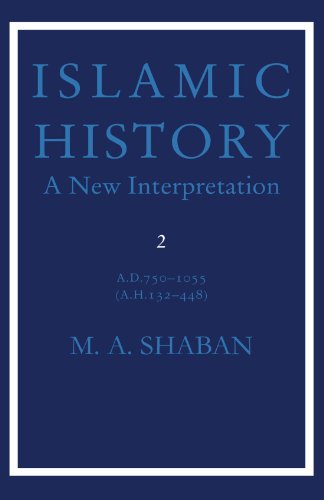
Islamic History: A New Interpretation: A New Interpretation 2 A.D. 750-1055, (A.H. 132-448) - Softcover
Inhaltsangabe
This book is a sequel to the author's Islamic History A.D. 600-750 (A.H. 132). A New Interpretation. It presents for the first time a clear narrative analysis of the central events in the Islamic domains between the rise of the 'Abbasids and the Saljuq invasion (A.D. 750-1055/A.H. 132-448). This period witnessed the establishment of a new regime, its failure to live up to its revolutionary ideals and the gradual dissolution of a vast empire into lesser political entities. The task of creating a political structure supported by viable institutions to rule their territories proved beyond the 'Abbasids. Nor were they able to accomplish the economic integration of the empire, largely because they could not reconcile the economic interests of the rapidly expanding urban centres with those of the rural communities. The result was endemic revolts in rural areas, notably those of Babak, the Zanj and the Qaramita. The wealth of the 'Abbasid empire attracted vast volumes of international trade. Each region in the empire wished to pursue its own interest in this trade, and competition for an ever-larger share soon developed into uncontrollable interregional strife. Lacking political and economic organization to maintain the integrity of their empire, the 'Abbasids resorted to military power. Consequently military leaders established their own rule in the regions and became powerful adversaries to central government. On the other hand the local populations in the outer provinces rose under their chiefs and also became aggressive opponents. It is these developments that explain the rise of the Tahirids, Samanids, Saffarids, Buyids, Ghaznavids, Tulunids, Hamdanids, and other regional powergroups. Dr Shaban also studies the rise to power of the Fatimids, who established themselves in power in Tunisia and later in Egypt, replacing the crumbling rule of military dynasties in both provinces. The revolutionary idealism of the Fatimids, however, failed to win the s
Die Inhaltsangabe kann sich auf eine andere Ausgabe dieses Titels beziehen.
Von der hinteren Coverseite
This book is a sequel to the author's Islamic History A.D. 600-750 (A.H. 132). A New Interpretation. It presents for the first time a clear narrative analysis of the central events in the Islamic domains between the rise of the 'Abbasids and the Saljuq invasion (A.D. 750-1055/A.H. 132-448).
This period witnessed the establishment of a new regime, its failure to live up to its revolutionary ideals and the gradual dissolution of a vast empire into lesser political entities. The task of creating a political structure supported by viable institutions to rule their territories proved beyond the 'Abbasids. Nor were they able to accomplish the economic integration of the empire, largely because they could not reconcile the economic interests of the rapidly expanding urban centres with those of the rural communities. The result was endemic revolts in rural areas, notably those of Babak, the Zanj and the Qaramita.
The wealth of the 'Abbasid empire attracted vast volumes of international trade. Each region in the empire wished to pursue its own interest in this trade, and competition for an ever-larger share soon developed into uncontrollable interregional strife. Lacking political and economic organization to maintain the integrity of their empire, the 'Abbasids resorted to military power. Consequently military leaders established their own rule in the regions and became powerful adversaries to central government. On the other hand the local populations in the outer provinces rose under their chiefs and also became aggressive opponents. It is these developments that explain the rise of the Tahirids, Samanids, Saffarids, Buyids, Ghaznavids, Tulunids, Hamdanids, and other regional powergroups.
Dr Shaban also studies the rise to power of the Fatimids, who established themselves in power in Tunisia and later in Egypt, replacing the crumbling rule of military dynasties in both provinces. The revolutionary idealism of the Fatimids, however, failed to win the support of their subject populations, and their economic policies led to the ruination of their regime.
The arrival of the Saljuqs on the scene marks the beginning of a new epoch in Islamic history.
Dr Shaban has based his book on a fresh study of the original sources, and he offers many new and challenging insights into the historical account of the period. He has kept in view the needs of the reader who might be bewildered by the mass of proper names involved and has deliberately concentrated on the main outlines of the period as a whole.
„Über diesen Titel“ kann sich auf eine andere Ausgabe dieses Titels beziehen.
Suchergebnisse für Islamic History: A New Interpretation: A New Interpretation...

Beispielbild für diese ISBN
Islamic History: Volume 2, AD 750â"1055 (AH 132â"448): A New Interpretation
Verlag:
Cambridge University Press, 1978
ISBN 10: 0521294533
ISBN 13: 9780521294539
Gebraucht
paperback
Anbieter: Visible Voice Books, Cleveland, OH, USA
Verkäuferbewertung 5 von 5 Sternen

paperback. Zustand: Good. Cambridge University Press 1978 8vo. 221 pages. wraps slightly creased and rubbed. sparse highlighting to text pages. Artikel-Nr. 198918
Gebraucht kaufen
EUR 10,15
EUR 4,03 Versand
Versand innerhalb von USA
Versand innerhalb von USA
Anzahl: 1 verfügbar
Beispielbild für diese ISBN
Islamic History: Volume 2, AD 750â"1055 (AH 132â"448): A New Interpretation
Verlag:
Cambridge University Press, 1978
ISBN 10: 0521294533
ISBN 13: 9780521294539
Gebraucht
Paperback
Anbieter: WorldofBooks, Goring-By-Sea, WS, Vereinigtes Königreich
Verkäuferbewertung 5 von 5 Sternen
Paperback. Zustand: Good. The book has been read but remains in clean condition. All pages are intact and the cover is intact. Some minor wear to the spine. Artikel-Nr. GOR004838706
Gebraucht kaufen
EUR 14,39
EUR 6,69 Versand
Versand von Vereinigtes Königreich nach USA
Versand von Vereinigtes Königreich nach USA
Anzahl: 1 verfügbar
Beispielbild für diese ISBN
Islamic History: A New Interpretation: D.750-1055 (A.H.132-448) v. 2
Verlag:
Cambridge University Press, 1978
ISBN 10: 0521294533
ISBN 13: 9780521294539
Gebraucht
Paperback
Anbieter: AwesomeBooks, Wallingford, Vereinigtes Königreich
Verkäuferbewertung 5 von 5 Sternen
Paperback. Zustand: Very Good. Islamic History: A New Interpretation: D.750-1055 (A.H.132-448) v. 2 This book is in very good condition and will be shipped within 24 hours of ordering. The cover may have some limited signs of wear but the pages are clean, intact and the spine remains undamaged. This book has clearly been well maintained and looked after thus far. Money back guarantee if you are not satisfied. See all our books here, order more than 1 book and get discounted shipping. . Artikel-Nr. 7719-9780521294539
Gebraucht kaufen
EUR 16,93
EUR 4,92 Versand
Versand von Vereinigtes Königreich nach USA
Versand von Vereinigtes Königreich nach USA
Anzahl: 1 verfügbar
Beispielbild für diese ISBN
Islamic History: A New Interpretation: D.750-1055 (A.H.132-448) v. 2
Verlag:
Cambridge University Press 07/12/1978, 1978
ISBN 10: 0521294533
ISBN 13: 9780521294539
Gebraucht
Paperback
Anbieter: Bahamut Media, Reading, Vereinigtes Königreich
Verkäuferbewertung 4 von 5 Sternen

Paperback. Zustand: Very Good. Shipped within 24 hours from our UK warehouse. Clean, undamaged book with no damage to pages and minimal wear to the cover. Spine still tight, in very good condition. Remember if you are not happy, you are covered by our 100% money back guarantee. Artikel-Nr. 6545-9780521294539
Gebraucht kaufen
EUR 16,93
EUR 8,34 Versand
Versand von Vereinigtes Königreich nach USA
Versand von Vereinigtes Königreich nach USA
Anzahl: 1 verfügbar
Beispielbild für diese ISBN
Islamic History: Volume 2, AD 750-1055 (AH 132-448) A New Interpretation
Verlag:
Cambridge University Press, 1978
ISBN 10: 0521294533
ISBN 13: 9780521294539
Gebraucht
Paperback
Anbieter: Powell's Bookstores Chicago, ABAA, Chicago, IL, USA
Verkäuferbewertung 5 von 5 Sternen
Paperback. Zustand: Very Good. Minimal shelf wear, clean internals. May have remainder mark. Artikel-Nr. 2048526
Gebraucht kaufen
EUR 25,81
EUR 4,47 Versand
Versand innerhalb von USA
Versand innerhalb von USA
Anzahl: 3 verfügbar
Foto des Verkäufers
Islamic History: Volume 2, AD 750-1055 (AH 132-448) - A New Interpretation
Verlag:
Cambridge University Press, 1986
ISBN 10: 0521294533
ISBN 13: 9780521294539
Gebraucht
Softcover
Anbieter: Hadwebutknown, Birnam, PERTH, Vereinigtes Königreich
Verkäuferbewertung 5 von 5 Sternen
Academic study. 221pp. Softcovers, protected by non removable patterned adhesive cover (see scans). Spine a little faded otherwise VG. Artikel-Nr. 14607
Gebraucht kaufen
EUR 4,92
EUR 29,86 Versand
Versand von Vereinigtes Königreich nach USA
Versand von Vereinigtes Königreich nach USA
Anzahl: 1 verfügbar
Beispielbild für diese ISBN
Islamic History: A New Interpretation
Anbieter: Labyrinth Books, Princeton, NJ, USA
Verkäuferbewertung 4 von 5 Sternen
Zustand: New. Artikel-Nr. 119565
Neu kaufen
EUR 35,93
EUR 4,03 Versand
Versand innerhalb von USA
Versand innerhalb von USA
Anzahl: 4 verfügbar
Foto des Verkäufers
Islamic History. A New Interpretation. Volume 2, A.D. 750-1055 (A.H. 132-448).
Verlag:
Cambridge University Press, Cambridge, 1978
ISBN 10: 0521294533
ISBN 13: 9780521294539
Gebraucht
Soft cover
Anbieter: FOLIOS LIMITED, Oxford, Vereinigtes Königreich
Verkäuferbewertung 5 von 5 Sternen
Soft cover. Zustand: Very Good. ix, 221 pp., 3 maps, biblio, index, previous owner's name inscribed verso front & lower covers, lightly faded spine, otherwise copy clean & in very good condition. This book is a sequel to the author's Islamic History A.D. 600-750 (A.H. 132). A New Interpretation. It presents for the first time a clear narrative analysis of the central events in the Islamic domains between the rise of the 'Abbasids and the Saljuq invasion (A.D. 750-1055/ A.H. 132-448). This period witnessed the establishment of a new regime, its failure to live up to its revolutionary ideals and the gradual dissolution of a vast empire into lesser political entitles. The task of creating a political structure supported by viable institutions to rule their territories proved beyond the 'Abbasids. Nor were they able to accomplish the economic integration of the empire, largely expanding urban centres with those of the rural communities. The result was endemic revolts in rural areas, notably those of Babak, the Zanj and the Qaramita. The wealth of the 'Abbasid empire attracted vast volumes of international trade. Each region in the empire wished to pursue its own interest in this trade, and competition for an ever-larger share soon developed into uncontrollable interregional strife. Lacking political and economic organization to maintain the integrity of their empire, the 'Abbasids resorted to military power. Consequently military leaders established their own rule in the regions and became powerful adversaries to central government. On the other hand the local populations in the outer provinces rose under their chiefs and also became aggressive opponents. It is these developments that explain the rise of the Tahirids, Samanids, Saffarids, Buyids, Ghaznavids, Tulunids, Hamdanids, and other regional power groups. Dr Shaban also studies the rise to power in Tunisia and later in Egypt, replacing the crumbling rule of military dynasties in both provinces. The revolutionary idealism of the Fatimids, however, failed to win the support of their subject populations, and their economic policies led to the ruination of their regime. The arrival of the Saljuqs on the scene marks the beginning of a new epoch in Islamic history. Dr Shaban has based his book on a fresh study of the original sources, and he offers many new and challenging insights into the historical account of the period. He has kept in view the needs of the reader who might be bewildered by the mass of proper names involved and has deliberately concentrated on the main outlines of the period as a whole. #2033. Artikel-Nr. 012853
Gebraucht kaufen
EUR 14,76
EUR 41,80 Versand
Versand von Vereinigtes Königreich nach USA
Versand von Vereinigtes Königreich nach USA
Anzahl: 1 verfügbar
Foto des Verkäufers
Islamic History _ A New Interpretation Ad 750 - 1055 (Ah 132 - 448) _ Volume 2
Verlag:
Cambridge University Press, Cambridge, 1978
ISBN 10: 0521294533
ISBN 13: 9780521294539
Gebraucht
Paperback
Anbieter: San Francisco Book Company, Paris, Frankreich
Verkäuferbewertung 5 von 5 Sternen
Paperback. Zustand: Very good. Paperback Octavo. wraps, 221 pp, spine sunned, foxing to edges. Artikel-Nr. 110294
Gebraucht kaufen
EUR 17,00
EUR 45,00 Versand
Versand von Frankreich nach USA
Versand von Frankreich nach USA
Anzahl: 1 verfügbar
Beispielbild für diese ISBN
Islamic History: Volume 2, AD 750-1055 (AH 132-448): A New Interpretation
Anbieter: Ria Christie Collections, Uxbridge, Vereinigtes Königreich
Verkäuferbewertung 5 von 5 Sternen
Zustand: New. In English. Artikel-Nr. ria9780521294539_new
Neu kaufen
EUR 71,56
EUR 11,19 Versand
Versand von Vereinigtes Königreich nach USA
Versand von Vereinigtes Königreich nach USA
Anzahl: Mehr als 20 verfügbar