
Verwandte Artikel zu When Christians First Met Muslims: A Sourcebook of...
When Christians First Met Muslims: A Sourcebook of the Earliest Syriac Writings on Islam - Softcover
Inhaltsangabe
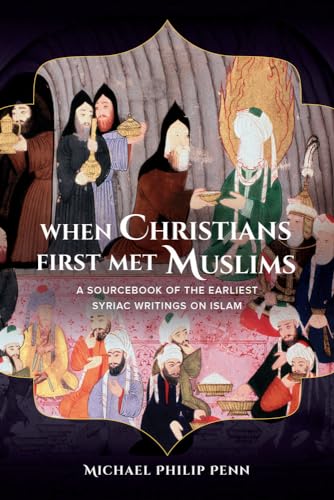
The first Christians to meet Muslims were not Latin-speaking Christians from the western Mediterranean or Greek-speaking Christians from Constantinople but rather Christians from northern Mesopotamia who spoke the Aramaic dialect of Syriac. Living under Muslim rule from the seventh century to the present, Syriac Christians wrote the first and most extensive accounts of Islam, describing a complicated set of religious and cultural exchanges not reducible to the solely antagonistic.
Through its critical introductions and new translations of this invaluable historical material, When Christians First Met Muslims allows scholars, students, and the general public to explore the earliest interactions between what eventually became the world's two largest religions, shedding new light on Islamic history and Christian-Muslim relations.Die Inhaltsangabe kann sich auf eine andere Ausgabe dieses Titels beziehen.
Über die Autorin bzw. den Autor
Michael Philip Penn is William R. Kenan, Jr. Professor of Religion at Mount Holyoke College and the author of Envisioning Islam: Syriac Christians in the Early Muslim World and Kissing Christians: Ritual and Community in the Late Ancient Church.
Von der hinteren Coverseite
"Michael Philip Penn’s When Christians First Met Muslims is an extremely important text. The sources Penn collated in Syriac are among some of the earliest reports we have about the emerging community there. Scholars of the latest of 'late antiquity,' of early Byzantium, and of the early community of believers around Muhammad will benefit from having these sources in English. Penn's scholarship is truly superior.” —Ellen Muehlberger, author of Angels in Late Ancient Christianity
“Syriac sources preserve our earliest historical information for Christian-Muslim encounters, written by Christian contemporaries who experienced firsthand the massive changes brought by the Arab conquests of the seventh century and thereafter in the Middle East. This volume offers a new collection of vivid and lucid translations that open to the reader new vistas on how religions interact, adapt, and flourish, even under circumstances of inexorable change. Michael Penn is a religion scholar of rare dexterity in handling primary sources, secondary scholarship, and cutting-edge critical theory, all with equal command. Here is a volume for scholars and students of religion, history, and culture. It will matter enormously for all who share an interest in Christianity or Islam.”—Susan Harvey, Willard Prescott and Annie McClelland Smith Professor of Religious Studies at Brown University
"As a source for the early Islamic period and for the earliest responses of Christians to the new historical conditions of the post-conquest period this collection is a useful tool for both scholarly research and classroom teaching. Even those few of us who work on Syriac sources do not commonly have an immediate grasp of the range of texts covered in When Christians First Met Muslims. This handy book will contribute to a further appreciation for the unique variety of perspectives Syriac Christians had on early Islam."—Adam H. Becker, Associate Professor of Classics and Religious Studies at New York University
“Syriac sources preserve our earliest historical information for Christian-Muslim encounters, written by Christian contemporaries who experienced firsthand the massive changes brought by the Arab conquests of the seventh century and thereafter in the Middle East. This volume offers a new collection of vivid and lucid translations that open to the reader new vistas on how religions interact, adapt, and flourish, even under circumstances of inexorable change. Michael Penn is a religion scholar of rare dexterity in handling primary sources, secondary scholarship, and cutting-edge critical theory, all with equal command. Here is a volume for scholars and students of religion, history, and culture. It will matter enormously for all who share an interest in Christianity or Islam.”—Susan Harvey, Willard Prescott and Annie McClelland Smith Professor of Religious Studies at Brown University
"As a source for the early Islamic period and for the earliest responses of Christians to the new historical conditions of the post-conquest period this collection is a useful tool for both scholarly research and classroom teaching. Even those few of us who work on Syriac sources do not commonly have an immediate grasp of the range of texts covered in When Christians First Met Muslims. This handy book will contribute to a further appreciation for the unique variety of perspectives Syriac Christians had on early Islam."—Adam H. Becker, Associate Professor of Classics and Religious Studies at New York University
Aus dem Klappentext
"Michael Philip Penn s When Christians First Met Muslims is an extremely important text. The sources Penn collated in Syriac are among some of the earliest reports we have about the emerging community there. Scholars of the latest of 'late antiquity,' of early Byzantium, and of the early community of believers around Muhammad will benefit from having these sources in English. Penn's scholarship is truly superior. Ellen Muehlberger, author of Angels in Late Ancient Christianity
Syriac sources preserve our earliest historical information for Christian-Muslim encounters, written by Christian contemporaries who experienced firsthand the massive changes brought by the Arab conquests of the seventh century and thereafter in the Middle East. This volume offers a new collection of vivid and lucid translations that open to the reader new vistas on how religions interact, adapt, and flourish, even under circumstances of inexorable change. Michael Penn is a religion scholar of rare dexterity in handling primary sources, secondary scholarship, and cutting-edge critical theory, all with equal command. Here is a volume for scholars and students of religion, history, and culture. It will matter enormously for all who share an interest in Christianity or Islam. Susan Harvey, Willard Prescott and Annie McClelland Smith Professor of Religious Studies at Brown University
"As a source for the early Islamic period and for the earliest responses of Christians to the new historical conditions of the post-conquest period this collection is a useful tool for both scholarly research and classroom teaching. Even those few of us who work on Syriac sources do not commonly have an immediate grasp of the range of texts covered in When Christians First Met Muslims. This handy book will contribute to a further appreciation for the unique variety of perspectives Syriac Christians had on early Islam." Adam H. Becker, Associate Professor of Classics and Religious Studies at New York University
Syriac sources preserve our earliest historical information for Christian-Muslim encounters, written by Christian contemporaries who experienced firsthand the massive changes brought by the Arab conquests of the seventh century and thereafter in the Middle East. This volume offers a new collection of vivid and lucid translations that open to the reader new vistas on how religions interact, adapt, and flourish, even under circumstances of inexorable change. Michael Penn is a religion scholar of rare dexterity in handling primary sources, secondary scholarship, and cutting-edge critical theory, all with equal command. Here is a volume for scholars and students of religion, history, and culture. It will matter enormously for all who share an interest in Christianity or Islam. Susan Harvey, Willard Prescott and Annie McClelland Smith Professor of Religious Studies at Brown University
"As a source for the early Islamic period and for the earliest responses of Christians to the new historical conditions of the post-conquest period this collection is a useful tool for both scholarly research and classroom teaching. Even those few of us who work on Syriac sources do not commonly have an immediate grasp of the range of texts covered in When Christians First Met Muslims. This handy book will contribute to a further appreciation for the unique variety of perspectives Syriac Christians had on early Islam." Adam H. Becker, Associate Professor of Classics and Religious Studies at New York University
Auszug. © Genehmigter Nachdruck. Alle Rechte vorbehalten.
When Christians First Met Muslims
A Sourcebook of the Earliest Syriac Writings on Islam
By Michael Philip PennUNIVERSITY OF CALIFORNIA PRESS
Copyright © 2015 The Regents of the University of California
All rights reserved.
ISBN: 978-0-520-28494-4All rights reserved.
Contents
Acknowledgments,
Prologue: The Year 630,
Introduction,
Account ad 637,
Chronicle ad 640,
Letters, Isho'yahb III,
Apocalypse of Pseudo-Ephrem,
Khuzistan Chronicle,
Maronite Chronicle,
Syriac Life of Maximus the Confessor,
Canons, George I,
Colophon of British Library Additional 14,666,
Letter, Athanasius of Balad,
Book of Main Points, John bar Penkaye,
Apocalypse of Pseudo-Methodius,
Edessene Apocalypse,
Exegesis of the Pericopes of the Gospel, Hnanisho' I,
Life of Theodute,
Colophon of British Library Additional 14,448,
Apocalypse of John the Little,
Chronicle ad 705,
Letters, Jacob of Edessa,
Chronicle, Jacob of Edessa,
Scholia, Jacob of Edessa,
Against the Armenians, Jacob of Edessa,
Kamed Inscriptions,
Chronicle of Disasters,
Chronicle ad 724,
Disputation of John and the Emir,
Exegetical Homilies, Mar Abba II,
Disputation of Bet Hale,
Bibliography,
Index,
CHAPTER 1
Account ad 637
Most likely Miaphysite
Most likely ca. 637 C.E.
Probably the earliest, clearly the most dramatic, and arguably the most frustratingly incomplete of early Syriac references to the rise of Islam was likely written in 637. At that time, an anonymous author used a blank page in the front of his Bible to jot down a brief commemoration of the events he had just seen. Like most ancient books, at some point this one lost its cover, leaving the note unprotected. As a result, the opening page has been substantially damaged, and the ink is often unreadable. Nevertheless, this five-by-nine-inch piece of parchment with poorly preserved jottings constitutes the world's oldest surviving artifact to mention Muhammad and likely refers to the most important battle of the Islamic conquests.
MANUSCRIPT AND EDITIONS
British Library Additional 14,461 contains a Syriac translation of the Gospels of Matthew and Mark. On paleographic grounds, William Wright dated the original manuscript to the sixth century. The Gospel of Matthew begins on the codex's second page and thus left the first page blank. On this flyleaf appears the brief Account ad 637. Because of its fragmentary state of preservation, several scholars have produced editions of the text, including Theodor Nöldeke in 1875 and Ernest Walter Brooks in 1904. In 1993, Andrew Palmer published a partially transliterated version based on notes made by Sebastian Brock.
AUTHORSHIP AND DATE OF COMPOSITION
British Library Additional 14,461 appears to be a Miaphysite Bible, and the scribblings on its flyleaf most likely came from a Miaphysite. The note refers to a battle that took place near the town of Gabitha in August of the year ——seven (the first two numbers are not fully preserved but most likely were nine and four). The year 947 in the Seleucid calendar that most Syriac Christians used corresponds to 636 C.E. Indeed, in August 636, just south of Gabitha, Arab troops decisively defeated Byzantine forces in an engagement more commonly known as the Battle of Yarmuk. The author claims to have been an eyewitness to some of the events he describes, and at one point he explicitly uses the first person to state that "we saw...." By the seventh century, Syriac Christians already had a tradition of using the opening blank pages in a Bible for writing commemorative notices. The combination of biblical flyleaf and messy handwriting lends credence to the text's authorial claims. Because the last line of partially preserved text refers to the year following the battle near Gabitha, most modern scholars date the note's composition to circa 637.
* * *
Because of its extremely poor state of preservation, the Account ad 637 remains quite fragmentary. Below are two translations of the same text. The first more stringently reflects the manuscript's current state. This translation includes only those words that remain clear in the manuscript or are very easily reconstructed.
... Muhammad ... [p]riest, Mar Elijah ... and they came ... and ... and from ... strong ... month ... and the Romans ... And in January... of Emesa received assurances for their lives. Many villages were destroyed through the killing by ... Muhammad and many people were killed. And captives ... from the Galilee to Bet ... Those Arabs camped by ... we saw ... everywhe[re] ... and the ... that they ... and ... them. On the tw[enty-si]xth of May, ... went ... from Emesa. The Romans pursued them ... on the tenth ... the Romans fled from Damascus ... many, about ten thousand. The following [ye]ar, the Romans came. On the twentieth of August in the year n[ine hundred and forty-]seven [636 C.E.] there assembled in Gabitha ... the Romans and many people were ki[lled], from the R[omans] about fifty thousand ... In the year nine hundred and for[ty-] ...
This second translation of the same text attempts to fill in a few of the lacunae. It includes in braces those words that other scholars have conjectured as likely to have been in the document prior to its decay.
... Muhammad ... priest, Mar Elijah ... and they came ... and ... and from ... strong ... month ... and the Romans {fled} ... And in January {the people} of Emesa received assurances for their lives. Many villages were destroyed through the killing by {the Arabs of} Muhammad and many people were killed. And captives {were taken} from the Galilee to Bet ... Those Arabs camped by {Damascus}. We saw ... everywhere ... and the {olive oil} that they {had brought} and ... them. On the twenty-sixth of May, {the sacellarius} went ... from Emesa. The Romans pursued them ... On the tenth {of August} ... the Romans fled from Damascus ... many, about ten thousand. The following year, the Romans came. On the twentieth of August in the year nine hundred and forty-seven [636 C.E.] there assembled in Gabitha ... the Romans and many people were killed, from the Romans about fifty thousand ... In the year nine hundred and forty-{eight} ...
CHAPTER 2Chronicle ad 640
Miaphysite
ca. 640 C.E.
The Chronicle ad 640 is a lengthy Miaphysite text that starts with the birth of Adam and continues to the opening years of the Islamic conquests. It does not present these events in anything close to chronological order, even though it often refers to specific years or indictions, fifteen-year periods that Byzantine chroniclers often used. Its rapid transitions between disparate lists of disasters, bishops, biblical characters, ecclesiastical councils, topography, and military campaigns have led some scholars to characterize its author as completely insane and others to hypothesize an ingenious method to his madness. Regardless of their view on how he organized the Chronicle ad 640, most scholars have been impressed with the author's knowledge of the early seventh century. For example, in regard to the Byzantine-Persian wars, Byzantine and Armenian sources corroborate the majority of the early seventh-century battles and dates that the Chronicle ad 640 lists.
This makes it particularly unfortunate that the author devoted only a few sentences to the Arabs and their conquests. Nevertheless, because these lines come from a man...
„Über diesen Titel“ kann sich auf eine andere Ausgabe dieses Titels beziehen.
Suchergebnisse für When Christians First Met Muslims: A Sourcebook of...

Beispielbild für diese ISBN
When Christians First Met Muslims
Anbieter: PBShop.store US, Wood Dale, IL, USA
Verkäuferbewertung 5 von 5 Sternen

PAP. Zustand: New. New Book. Shipped from UK. Established seller since 2000. Artikel-Nr. WF-9780520284944
Beispielbild für diese ISBN
When Christians First Met Muslims
Anbieter: PBShop.store UK, Fairford, GLOS, Vereinigtes Königreich
Verkäuferbewertung 5 von 5 Sternen
PAP. Zustand: New. New Book. Shipped from UK. Established seller since 2000. Artikel-Nr. WF-9780520284944
Neu kaufen
EUR 33,07
EUR 4,84 Versand
Versand von Vereinigtes Königreich nach USA
Versand von Vereinigtes Königreich nach USA
Anzahl: 15 verfügbar
Beispielbild für diese ISBN
When Christians First Met Muslims - A Sourcebook of the Earliest Syriac Writings on Islam
Verlag:
University of California Press, 2015
ISBN 10: 0520284941
ISBN 13: 9780520284944
Neu
Softcover
Anbieter: Majestic Books, Hounslow, Vereinigtes Königreich
Verkäuferbewertung 4 von 5 Sternen

Zustand: New. pp. 274. Artikel-Nr. 373664556
Neu kaufen
EUR 39,17
EUR 7,56 Versand
Versand von Vereinigtes Königreich nach USA
Versand von Vereinigtes Königreich nach USA
Anzahl: 3 verfügbar
Beispielbild für diese ISBN
When Christians First Met Muslims: A Sourcebook of the Earliest Syriac Writings on Islam
Verlag:
University of California Press, 2015
ISBN 10: 0520284941
ISBN 13: 9780520284944
Neu
Softcover
Anbieter: Kennys Bookstore, Olney, MD, USA
Verkäuferbewertung 5 von 5 Sternen
Zustand: New. 2015. Paperback. Through its introductions and translations of this book allows scholars, students, and the general public to explore the earliest interactions between what eventually became the world's two largest religions, shedding new light on Islamic history and Christian-Muslim relations. Num Pages: 280 pages. BIC Classification: HRAF; HRAX; HRC; HRH. Category: (G) General (US: Trade). Dimension: 140 x 212 x 23. Weight in Grams: 334. . . . . . Books ship from the US and Ireland. Artikel-Nr. V9780520284944
Neu kaufen
EUR 40,32
EUR 9,22 Versand
Versand innerhalb von USA
Versand innerhalb von USA
Anzahl: 16 verfügbar
Beispielbild für diese ISBN
When Christians First Met Muslims: A Sourcebook of the Earliest Syriac Writings on Islam
Verlag:
University of California Press, 2015
ISBN 10: 0520284941
ISBN 13: 9780520284944
Neu
Softcover
Anbieter: Ria Christie Collections, Uxbridge, Vereinigtes Königreich
Verkäuferbewertung 5 von 5 Sternen
Zustand: New. In English. Artikel-Nr. ria9780520284944_new
Neu kaufen
EUR 41,68
EUR 10,90 Versand
Versand von Vereinigtes Königreich nach USA
Versand von Vereinigtes Königreich nach USA
Anzahl: Mehr als 20 verfügbar
Beispielbild für diese ISBN
When Christians First Met Muslims A Sourcebook of the Earliest Syriac Writings on Islam
Anbieter: Revaluation Books, Exeter, Vereinigtes Königreich
Verkäuferbewertung 5 von 5 Sternen
Paperback. Zustand: Brand New. 273 pages. 9.50x5.75x0.75 inches. In Stock. Artikel-Nr. x-0520284941
Neu kaufen
EUR 56,95
EUR 11,63 Versand
Versand von Vereinigtes Königreich nach USA
Versand von Vereinigtes Königreich nach USA
Anzahl: 2 verfügbar
Foto des Verkäufers
When Christians First Met Muslims : A Sourcebook of the Earliest Syriac Writings on Islam
Anbieter: AHA-BUCH GmbH, Einbeck, Deutschland
Verkäuferbewertung 5 von 5 Sternen
Taschenbuch. Zustand: Neu. Neuware - The first Christians to meet Muslims were not Latin-speaking Christians from the western Mediterranean or Greek-speaking Christians from Constantinople but rather Christians from northern Mesopotamia who spoke the Aramaic dialect of Syriac. Living under Muslim rule from the seventh century to the present, Syriac Christians wrote the first and most extensive accounts of Islam, describing a complicated set of religious and cultural exchanges not reducible to the solely antagonistic. Through its critical introductions and new translations of this invaluable historical material, When Christians First Met Muslims explores the earliest interactions between what eventually became the worlds two largest religions, shedding new light on Islamic history and Christian-Muslim relations. Artikel-Nr. 9780520284944
Neu kaufen
EUR 58,70
EUR 35,00 Versand
Versand von Deutschland nach USA
Versand von Deutschland nach USA
Anzahl: 2 verfügbar
Foto des Verkäufers
When Christians First Met Muslims
Verlag:
University of California Press, 2015
ISBN 10: 0520284941
ISBN 13: 9780520284944
Neu
Softcover
Anbieter: moluna, Greven, Deutschland
Verkäuferbewertung 5 von 5 Sternen
Zustand: New. Through its introductions and translations of this book allows scholars, students, and the general public to explore the earliest interactions between what eventually became the world s two largest religions, shedding new light on Islamic history and Christ. Artikel-Nr. 23577130
Neu kaufen
EUR 45,00
EUR 48,99 Versand
Versand von Deutschland nach USA
Versand von Deutschland nach USA
Anzahl: Mehr als 20 verfügbar