
Verwandte Artikel zu Civil War Wests: Testing the Limits of the United States
Inhaltsangabe
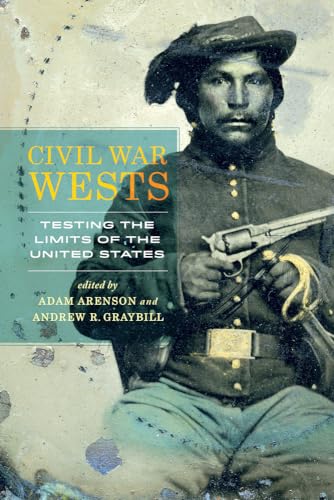
This innovative study presents a new, integrated view of the Civil War and Reconstruction and the history of the western United States.
Award-winning historians such as Steven Hahn, Martha Sandweiss, William Deverell, Virginia Scharff, and Stephen Kantrowitz offer original essays on lives, choices, and legacies in the American West, discussing the consequences for American Indian nations, the link between Reconstruction and suffrage movements, and cross-border interactions with Canada and Mexico. In the West, Civil War battlefields and Civil War politics engaged a wide range of ethnic and racial distinctions, raising questions that would arise only later in places farther east. Histories of Reconstruction in the South ignore the connections to previous occupation efforts and citizenship debates in the West. The stories contained in this volume complicate our understanding of the paths from slavery to freedom for white as well as non-white Americans. By placing the histories of the American West and the Civil War and Reconstruction period within one sustained conversation, this volume expands the limits of both by emphasizing how struggles over land, labor, sovereignty, and citizenship shaped the U.S. nation-state in this tumultuous era. This volume highlights significant moments and common concerns of this continuous conflict, as it stretched across the continent and throughout the nineteenth century. Publishing on the 150th anniversary of the end of the Civil War, this collection brings eminent historians into conversation, looking at the Civil War from several Western perspectives, and delivers a refreshingly disorienting view intended for scholars, general readers, and students. Published in Cooperation with the William P. Clements Center for Southwest Studies, Southern Methodist University.Die Inhaltsangabe kann sich auf eine andere Ausgabe dieses Titels beziehen.
Über die Autorin bzw. den Autor
Adam Arenson is Associate Professor of History and Director of Urban Studies at Manhattan College, author of The Great Heart of the Republic: St. Louis and the Cultural Civil War (2011), and coeditor of Frontier Cities: Encounters at the Crossroads of Empire (2013).
Andrew R. Graybill is Professor of History and Director of the William P. Clements Center for Southwest Studies at Southern Methodist University, author of Policing the Great Plains: Rangers, Mounties, and the North American Frontier, 1875-1910 (2007), and coeditor of Bridging National Borders in North America: Transnational and Comparative Histories (2010).Von der hinteren Coverseite
"The Civil War was fought in the West, over the West; and Reconstruction took place, also, in and because of the West. The war's meanings moved across geography and time in surprising ways. Assembling a stellar group of scholars, Arenson and Graybill have produced a first-of-its-kind collection of original essays on an enduring American conflict about race, place, sovereignty, citizenship, and memory. The parts make a whole here that should alter the way we teach the Civil War and Reconstruction era."—David W. Blight, Yale University, author of Race and Reunion: The Civil War in American Memory
"General Sherman, Frederick Douglass, Kit Carson, General Custer, Calamity Jane, camels, and an infamous pig all keep company in this illuminating collection in which the too-often separate narratives of Civil War, Reconstruction, and western history are shown to be intertwined. In these interlocking chapters, readers will find hidden gems that illuminate ways in which the federal government sought to enforce its authority across the American landscape and to limit the meanings of citizenship for African Americans, Native Americans, and Chinese Americans. Civil War Wests ably demonstrates that the Civil War was a national war and Reconstruction a far-reaching project that extended beyond the boundaries of the U.S. South."—Tiya Miles, author of Ties That Bind and The House on Diamond Hill
"This superb collection of wide-ranging, beautifully researched essays should startle every American historian into seeing just how much we have missed by leaving the American West too much out of the story of the traumatic, transformative middle years of the nineteenth century."—Elliott West, author of The Last Indian War: The Nez Perce Story
"Marked by vivid storytelling and provocative insights, Civil War Wests deepens our understanding of the conflict that sits at the center of the nation's history. No Civil War library can be considered complete without a copy of this volume."—Ari Kelman, author of A Misplaced Massacre: Struggling over the Memory of Sand Creek
Aus dem Klappentext
"The Civil War was fought in the West, over the West; and Reconstruction took place, also, in and because of the West. The war's meanings moved across geography and time in surprising ways. Assembling a stellar group of scholars, Arenson and Graybill have produced a first-of-its-kind collection of original essays on an enduring American conflict about race, place, sovereignty, citizenship, and memory. The parts make a whole here that should alter the way we teach the Civil War and Reconstruction era." David W. Blight, Yale University, author of Race and Reunion: The Civil War in American Memory
"General Sherman, Frederick Douglass, Kit Carson, General Custer, Calamity Jane, camels, and an infamous pig all keep company in this illuminating collection in which the too-often separate narratives of Civil War, Reconstruction, and western history are shown to be intertwined. In these interlocking chapters, readers will find hidden gems that illuminate ways in which the federal government sought to enforce its authority across the American landscape and to limit the meanings of citizenship for African Americans, Native Americans, and Chinese Americans. Civil War Wests ably demonstrates that the Civil War was a national war and Reconstruction a far-reaching project that extended beyond the boundaries of the U.S. South." Tiya Miles, author of Ties That Bind and The House on Diamond Hill
"This superb collection of wide-ranging, beautifully researched essays should startle every American historian into seeing just how much we have missed by leaving the American West too much out of the story of the traumatic, transformative middle years of the nineteenth century." Elliott West, author of The Last Indian War: The Nez Perce Story
"Marked by vivid storytelling and provocative insights, Civil War Wests deepens our understanding of the conflict that sits at the center of the nation's history. No Civil War library can be considered complete without a copy of this volume." Ari Kelman, author of A Misplaced Massacre: Struggling over the Memory of Sand Creek
Auszug. © Genehmigter Nachdruck. Alle Rechte vorbehalten.
Civil War Wests
Testing the Limits of the United States
By Adam Arenson, Andrew R. GraybillUNIVERSITY OF CALIFORNIA PRESS
Copyright © 2015 The Regents of the University of California
All rights reserved.
ISBN: 978-0-520-28379-4All rights reserved.
Contents
Introduction Adam Arenson, 1,
PART ONE BORDERLANDS IN CONFLICT,
1 • Thwarting Southern Schemes and British Bluster in the Pacific Northwest James Robbins Jewell, 15,
2 • Death in the Distance: Confederate Manifest Destiny and the Campaign for New Mexico, 1861–1862 Megan Kate Nelson, 33,
3 • Kit Carson and the War for the Southwest: Separation and Survival along the Rio Grande, 1862–1868 Lance R. Blyth, 53,
4 • Scattered People: The Long History of Forced Eviction in the Kansas-Missouri Borderlands Diane Mutti Burke, 71,
PART TWO THE CIVIL WAR IS NOT OVER,
5 • "The Future Empire of Our Freedmen": Republican Colonization Schemes in Texas and Mexico, 1861–1865 Nicholas Guyatt, 95,
6 • Three Faces of Sovereignty: Governing Confederate, Mexican, and Indian Texas in the Civil War Era Gregory P. Downs, 118,
7 • Redemption Falls Short: Soldier and Surgeon in the Post-Civil War Far West William Deverell, 139,
8 • Still Picture, Moving Stories: Reconstruction Comes to Indian Country Martha A. Sandweiss, 158,
PART THREE BORDERS OF CITIZENSHIP,
9 • Race, Religion, and Naturalization: How the West Shaped Citizenship Debates in the Reconstruction Congress Joshua Paddison, 181,
10 • Broadening the Battlefield: Conflict, Contingency, and the Mystery of Woman Suffrage in Wyoming, 1869 Virginia Scharff, 202,
11 • "Dis Land Which Jines Dat of Ole Master's": The Meaning of Citizenship for the Choctaw Freedpeople Fay A. Yarbrough, 224,
12 • "Citizen's Clothing": Reconstruction, Ho-Chunk Persistence, and the Politics of Dress Stephen Kantrowitz, 242,
Epilogue Steven Hahn, 265,
Acknowledgments, 275,
Secondary Bibliography, 279,
Contributor Affiliations, 307,
Index, 000,
CHAPTER 1
Thwarting Southern Schemes and British Bluster in the Pacific Northwest
James Robbins Jewell
FOUR MONTHS BEFORE JOHN BROWN seized the armory at Harpers Ferry, Virginia, events in the far northwestern corner of the United States also brought the nation to the brink of war—not with itself, but with England. The blood spilled in June 1859 belonged to a pig, leading to one of the most bizarre episodes in U.S. diplomatic history. After Abraham Lincoln's election as president, the tensions from decades of mutual suspicions between the United States and its northern neighbor, compounded by the presence of a vocal group of southerners in the regional capital of Victoria, took on overtones of the Civil War.
As the Civil War began, the Pacific Northwest presented very real concerns for the Union government. Royal Governor James Douglas was openly belligerent toward the United States. Therefore, he might have ignored British neutrality and launched preemptive strikes into Washington Territory, or ignored attempts by southern sympathizers on Vancouver Island trying to outfit a raider with which to attack U.S. commerce in the Pacific. Miners in the Fraser River region with Confederate sympathies might have launched paramilitary attacks into Washington Territory.
A new northern front of the Civil War opened in December 1863 when Confederate agents seized the S.S. Chesapeake off Cape Cod and sailed it to Nova Scotia. A second cross-border operation occurred in September 1864 when twenty Confederate agents attempted to capture the U.S.S. Michigan, the sole Union warship patrolling the Great Lakes. The attempt was foiled when one of the conspirators was captured and revealed the plot. Most famously, on October 19, 1864, a Confederate lieutenant and twenty men crossed from Quebec into Vermont, robbing three banks in the small town of St. Albans, making off with $200,000 before fleeing back across the border. That no military (or paramilitary) operations emerged in the Pacific Northwest during the Civil War demonstrates how effectively Union officials in the region controlled the situation and avoided another front of the war breaking out on the Pacific Slope.
Long before the outbreak of the Civil War, however, U.S. officials wrestled with the dilemmas posed by their uncertain northwestern border. Political maneuvering between the two countries had dominated the "Oregon question" ever since Lewis and Clark spent the winter of 1805 at Fort Clatsop, Oregon. In 1818, the United States and England agreed to the joint occupation of the disputed Oregon lands (essentially from 54°40' latitude south to the present-day California–Oregon border, and west of the Continental Divide). Failure to work out a satisfactory division of those lands in 1827 led to an extension of the joint occupancy agreement, a policy that was still in place in the 1840s. Growing U.S. expansionist sentiments in the Pacific Northwest rekindled British distrust and led to rising tension between the British and Americans, reaching a critical level during the 1844 presidential campaign. James K. Polk based his enthusiastic expansionist candidacy on American braggadocio, political rhetoric, and Manifest Destiny. Polk's campaign platform called for the "reannexation of Texas and the reoccupation of Oregon." The British took the hostile political language quite seriously, and prepared to defend the farthest western region of British North America from U.S. expansionism.
Despite the heated rhetoric, which served its purpose in helping to get Polk elected, the president-elect softened his demands. Although in his inaugural address he spoke boldly about pursuing all of Oregon, Polk's initial offer to the British was more restrained. Like his predecessors, Polk's first official proposal to settle the nagging Oregon question was to extend the 49th parallel as a boundary line all the way to the Pacific Ocean. When British officials refused the offer, Polk asked Congress to terminate the 1827 joint occupation agreement. The expansionist House quickly complied, but the measure was shot down in the Senate. In response to the rapidly deteriorating situation, one British official suggested sending naval vessels both to the Puget Sound region and to the mouth of the Columbia River. In March 1845 it appeared the two nations might go to war over the unsettled Oregon question.
By then, with the annexation of Texas underway and war with Mexico looming, the vigor of President Polk's expansionism was evident. Fortunately, the British ambassador returned with a new offer: England agreed to the 49th parallel line, excluding Vancouver Island, with the details regarding the San Juan Islands (between Vancouver Island and the mainland) to be worked out in arbitration. In April 1846, with General Zachary Taylor's forces already south of the Rio Nueces, provoking war with Mexico, Congress agreed to arbitration with Britain and averted war on two fronts.
Relations between the two nations improved after 1846 but remained precarious, as the dispute over San Juan Island made obvious in 1859. Both U.S. and British citizens had settled the island, repeating the pattern of joint occupancy and uncertain ownership. Then came a military showdown that commenced with the death of a pig.
The British inhabitants, who outnumbered the Americans until May 1859, were employees of the Hudson's Bay Company (HBC), and they did not recognize U.S. claims to any part...
„Über diesen Titel“ kann sich auf eine andere Ausgabe dieses Titels beziehen.
Suchergebnisse für Civil War Wests: Testing the Limits of the United States

Beispielbild für diese ISBN
Civil War Wests
Anbieter: PBShop.store UK, Fairford, GLOS, Vereinigtes Königreich
Verkäuferbewertung 5 von 5 Sternen

PAP. Zustand: New. New Book. Shipped from UK. Established seller since 2000. Artikel-Nr. WF-9780520283794
Neu kaufen
EUR 30,42
EUR 4,99 Versand
Versand von Vereinigtes Königreich nach USA
Versand von Vereinigtes Königreich nach USA
Anzahl: 9 verfügbar
Beispielbild für diese ISBN
Civil War Wests
Anbieter: PBShop.store US, Wood Dale, IL, USA
Verkäuferbewertung 5 von 5 Sternen
PAP. Zustand: New. New Book. Shipped from UK. Established seller since 2000. Artikel-Nr. WF-9780520283794
Beispielbild für diese ISBN
Civil War Wests - Testing the Limits of the United States
Verlag:
University of California Press, 2015
ISBN 10: 0520283791
ISBN 13: 9780520283794
Neu
Softcover
Anbieter: Majestic Books, Hounslow, Vereinigtes Königreich
Verkäuferbewertung 4 von 5 Sternen

Zustand: New. 338. Artikel-Nr. 373748283
Neu kaufen
EUR 34,21
EUR 7,80 Versand
Versand von Vereinigtes Königreich nach USA
Versand von Vereinigtes Königreich nach USA
Anzahl: 3 verfügbar
Beispielbild für diese ISBN
Civil War Wests: Testing the Limits of the United States
Verlag:
University of California Press, 2015
ISBN 10: 0520283791
ISBN 13: 9780520283794
Neu
Softcover
Anbieter: Kennys Bookstore, Olney, MD, USA
Verkäuferbewertung 5 von 5 Sternen
Zustand: New. Presents an integrated view of the Civil War and Reconstruction and the history of the western United States. This book includes, essays on lives, choices, and legacies in the American West, discussing the consequences for American Indian nations, the link between Reconstruction and suffrage movements, and cross-border interactions with Canada. Editor(s): Arenson, Adam; Graybill, Andrew R. Num Pages: 336 pages, 9 maps, 10 b/w photos. BIC Classification: 1KBB; 3JH; HBJK; HBLL; HBWJ; JWL. Category: (G) General (US: Trade). Dimension: 231 x 151 x 22. Weight in Grams: 470. . 2015. Paperback. . . . . Books ship from the US and Ireland. Artikel-Nr. V9780520283794
Neu kaufen
EUR 35,96
EUR 9,41 Versand
Versand innerhalb von USA
Versand innerhalb von USA
Anzahl: 1 verfügbar
Beispielbild für diese ISBN
Civil War Wests: Testing the Limits of the United States
Verlag:
University of California Press, 2015
ISBN 10: 0520283791
ISBN 13: 9780520283794
Neu
Softcover
Anbieter: Ria Christie Collections, Uxbridge, Vereinigtes Königreich
Verkäuferbewertung 5 von 5 Sternen
Zustand: New. In English. Artikel-Nr. ria9780520283794_new
Neu kaufen
EUR 36,86
EUR 13,55 Versand
Versand von Vereinigtes Königreich nach USA
Versand von Vereinigtes Königreich nach USA
Anzahl: 9 verfügbar
Beispielbild für diese ISBN
Civil War Wests Testing the Limits of the United States
Anbieter: Revaluation Books, Exeter, Vereinigtes Königreich
Verkäuferbewertung 5 von 5 Sternen
Paperback. Zustand: Brand New. 321 pages. 9.00x6.00x0.50 inches. In Stock. Artikel-Nr. x-0520283791
Neu kaufen
EUR 51,95
EUR 12,00 Versand
Versand von Vereinigtes Königreich nach USA
Versand von Vereinigtes Königreich nach USA
Anzahl: 2 verfügbar
Foto des Verkäufers
Arenson, A: Civil War Wests - Testing the Limits of the Unit
Verlag:
University of California Press, 2015
ISBN 10: 0520283791
ISBN 13: 9780520283794
Neu
Softcover
Anbieter: moluna, Greven, Deutschland
Verkäuferbewertung 5 von 5 Sternen
Zustand: New. Presents an integrated view of the Civil War and Reconstruction and the history of the western United States. This book includes, essays on lives, choices, and legacies in the American West, discussing the consequences for American Indian nations, the link . Artikel-Nr. 594724167
Neu kaufen
EUR 40,83
EUR 48,99 Versand
Versand von Deutschland nach USA
Versand von Deutschland nach USA
Anzahl: Mehr als 20 verfügbar
Foto des Verkäufers
Civil War Wests : Testing the Limits of the United States
Anbieter: AHA-BUCH GmbH, Einbeck, Deutschland
Verkäuferbewertung 5 von 5 Sternen
Taschenbuch. Zustand: Neu. Neuware - This innovative study presents a new, integrated view of the Civil War and Reconstruction and the history of the western United States. Award-winning historians such as Steven Hahn, Martha Sandweiss, William Deverell, Virginia Scharff, and Stephen Kantrowitz offer original essays on lives, choices, and legacies in the American West, discussing the consequences for American Indian nations, the link between Reconstruction and suffrage movements, and cross-border interactions with Canada and Mexico. In the West, Civil War battlefields and Civil War politics engaged a wide range of ethnic and racial distinctions, raising questions that would arise only later in places farther east. Histories of Reconstruction in the South ignore the connections to previous occupation efforts and citizenship debates in the West. The stories contained in this volume complicate our understanding of the paths from slavery to freedom for white as well as non-white Americans. By placing the histories of the American West and the Civil War and Reconstruction period within one sustained conversation, this volume expands the limits of both by emphasizing how struggles over land, labor, sovereignty, and citizenship shaped the U.S. nation-state in this tumultuous era. This volume highlights significant moments and common concerns of this continuous conflict, as it stretched across the continent and throughout the nineteenth century. Publishing on the 150th anniversary of the end of the Civil War, this collection brings eminent historians into conversation, looking at the Civil War from several Western perspectives, and delivers a refreshingly disorienting view intended for scholars, general readers, and students. Published in Cooperation with the William P. Clements Center for Southwest Studies, Southern Methodist University. Artikel-Nr. 9780520283794
Neu kaufen
EUR 56,41
EUR 35,00 Versand
Versand von Deutschland nach USA
Versand von Deutschland nach USA
Anzahl: 2 verfügbar