
Verwandte Artikel zu Closing the Rights Gap: From Human Rights to Social...
Inhaltsangabe
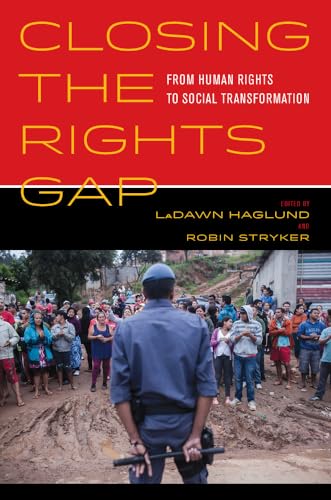
Do "human rights"--as embodied in constitutions, national laws, and international agreements--foster improvements in the lives of the poor or otherwise marginalized populations? When, where, how, and under what conditions? Closing the Rights Gap: From Human Rights to Social Transformation systematically compares a range of case studies from around the world in order to clarify the conditions under which--and institutions through which--economic, social, and cultural rights are progressively realized in practice. It concludes with testable hypotheses regarding how significant transformative change might occur, as well as an agenda for future research to facilitate rights realization worldwide.
Die Inhaltsangabe kann sich auf eine andere Ausgabe dieses Titels beziehen.
Über die Autorin bzw. den Autor
LaDawn Haglund is Associate Professor of Justice and Social Inquiry at Arizona State University and author of Limiting Resources: Market-Led Reform and the Transformation of Public Goods.
Robin Stryker is Professor of Sociology, Affiliated Professor of Law, Affiliated Professor of Government and Public Policy, and Research Director, National Institute for Civil Discourse, at the University of Arizona. She publishes regularly in journals including American Journal of Sociology, American Sociological Review, Law & Social Inquiry, Sociological Methods and Research, Socio-Economic Review, Research in the Sociology of Organizations, and Social Politics.Von der hinteren Coverseite
"In recent years, global movements fighting ills—from hunger to inequality to pollution—have taken up the language of human rights. Haglund and Stryker assemble a dynamic interdisciplinary team to build rubrics for assessing movement effects and a rich theoretical toolkit for understanding how human rights claims are translated into positive policy changes. This book will set the standard for global studies of human rights for years to come."—Frank Dobbin, Professor of Sociology, Harvard University
"Few volumes can claim to accomplish so much. This book not only theorizes what is likely to be general about rights realization in civil/political domains and across economic, social, and cultural domains, but also highlights what is likely to be specific within these domains. This volume marks a major advance in the social science of human rights."—John Hagan, John D. MacArthur Professor, Northwestern University
"Haglund and Stryker have assembled a powerful set of chapters that analyze diverse aspects of the challenges of and possibilities for transforming the aspirational promises of human rights principles into meaningful social change for immiserated and marginalized people around the globe. The diversity of contributors’ perspectives underscores the point that human rights scholarship has moved beyond the legal domain and is deeply enriched by multidisciplinary engagement and initiatives."—Alicia Ely Yamin, Lecturer on Global Health, Policy Director, FXB Center for Health and Human Rights, Harvard University
"This volume helps us understand in very concrete ways how rights are adopted in practice. By focusing on a range of mechanisms and a variety of actors, it offers a compelling analysis of the pathways through which the progressive realization of social and economic rights can take place."—Ariel Fiszbein, Policy Director, Inter-American Dialogue
"Goes beyond critique to identify the key contextual factors, actors, and strategic pathways that account for how and when human rights advocacy does or does not contribute to transformative economic and social justice. This ambitious volume is a very welcome and important contribution."—Michael McCann, Gordon Hirabayashi Professor for Advancement of Citizenship, University of Washington
"Few volumes can claim to accomplish so much. This book not only theorizes what is likely to be general about rights realization in civil/political domains and across economic, social, and cultural domains, but also highlights what is likely to be specific within these domains. This volume marks a major advance in the social science of human rights."—John Hagan, John D. MacArthur Professor, Northwestern University
"Haglund and Stryker have assembled a powerful set of chapters that analyze diverse aspects of the challenges of and possibilities for transforming the aspirational promises of human rights principles into meaningful social change for immiserated and marginalized people around the globe. The diversity of contributors’ perspectives underscores the point that human rights scholarship has moved beyond the legal domain and is deeply enriched by multidisciplinary engagement and initiatives."—Alicia Ely Yamin, Lecturer on Global Health, Policy Director, FXB Center for Health and Human Rights, Harvard University
"This volume helps us understand in very concrete ways how rights are adopted in practice. By focusing on a range of mechanisms and a variety of actors, it offers a compelling analysis of the pathways through which the progressive realization of social and economic rights can take place."—Ariel Fiszbein, Policy Director, Inter-American Dialogue
"Goes beyond critique to identify the key contextual factors, actors, and strategic pathways that account for how and when human rights advocacy does or does not contribute to transformative economic and social justice. This ambitious volume is a very welcome and important contribution."—Michael McCann, Gordon Hirabayashi Professor for Advancement of Citizenship, University of Washington
Aus dem Klappentext
"In recent years, global movements fighting ills from hunger to inequality to pollution have taken up the language of human rights. Haglund and Stryker assemble a dynamic interdisciplinary team to build rubrics for assessing movement effects and a rich theoretical toolkit for understanding how human rights claims are translated into positive policy changes. This book will set the standard for global studies of human rights for years to come." Frank Dobbin, Professor of Sociology, Harvard University
"Few volumes can claim to accomplish so much. This book not only theorizes what is likely to be general about rights realization in civil/political domains and across economic, social, and cultural domains, but also highlights what is likely to be specific within these domains. This volume marks a major advance in the social science of human rights." John Hagan, John D. MacArthur Professor, Northwestern University
"Haglund and Stryker have assembled a powerful set of chapters that analyze diverse aspects of the challenges of and possibilities for transforming the aspirational promises of human rights principles into meaningful social change for immiserated and marginalized people around the globe. The diversity of contributors perspectives underscores the point that human rights scholarship has moved beyond the legal domain and is deeply enriched by multidisciplinary engagement and initiatives." Alicia Ely Yamin, Lecturer on Global Health, Policy Director, FXB Center for Health and Human Rights, Harvard University
"This volume helps us understand in very concrete ways how rights are adopted in practice. By focusing on a range of mechanisms and a variety of actors, it offers a compelling analysis of the pathways through which the progressive realization of social and economic rights can take place." Ariel Fiszbein, Policy Director, Inter-American Dialogue
"Goes beyond critique to identify the key contextual factors, actors, and strategic pathways that account for how and when human rights advocacy does or does not contribute to transformative economic and social justice. This ambitious volume is a very welcome and important contribution." Michael McCann, Gordon Hirabayashi Professor for Advancement of Citizenship, University of Washington
"Few volumes can claim to accomplish so much. This book not only theorizes what is likely to be general about rights realization in civil/political domains and across economic, social, and cultural domains, but also highlights what is likely to be specific within these domains. This volume marks a major advance in the social science of human rights." John Hagan, John D. MacArthur Professor, Northwestern University
"Haglund and Stryker have assembled a powerful set of chapters that analyze diverse aspects of the challenges of and possibilities for transforming the aspirational promises of human rights principles into meaningful social change for immiserated and marginalized people around the globe. The diversity of contributors perspectives underscores the point that human rights scholarship has moved beyond the legal domain and is deeply enriched by multidisciplinary engagement and initiatives." Alicia Ely Yamin, Lecturer on Global Health, Policy Director, FXB Center for Health and Human Rights, Harvard University
"This volume helps us understand in very concrete ways how rights are adopted in practice. By focusing on a range of mechanisms and a variety of actors, it offers a compelling analysis of the pathways through which the progressive realization of social and economic rights can take place." Ariel Fiszbein, Policy Director, Inter-American Dialogue
"Goes beyond critique to identify the key contextual factors, actors, and strategic pathways that account for how and when human rights advocacy does or does not contribute to transformative economic and social justice. This ambitious volume is a very welcome and important contribution." Michael McCann, Gordon Hirabayashi Professor for Advancement of Citizenship, University of Washington
Auszug. © Genehmigter Nachdruck. Alle Rechte vorbehalten.
Closing the Rights Gap
From Human Rights to Social Transformation
By LaDawn Haglund, Robin StrykerUNIVERSITY OF CALIFORNIA PRESS
Copyright © 2015 The Regents of the University of California
All rights reserved.
ISBN: 978-0-520-28309-1All rights reserved.
Contents
List of Figures,
List of Maps,
List of Tables and Boxes,
List of Contributors,
Preface,
Introduction: Making Sense of the Multiple and Complex Pathways by which Human Rights Are Realized LaDawn Haglund and Robin Stryker,
PART ONE: PROMISES AND CHALLENGES OF ECONOMIC, SOCIAL, AND CULTURAL RIGHTS (ESCR) REALIZATION AT THE INTERNATIONAL LEVEL,
1. Do Non–Human Rights Regimes Undermine the Achievement of Economic and Social Rights? M. Rodwan Abouharb, David L. Cingranelli, and Mikhail Filippov,
2. Linking Law and Economics: Translating Economic and Social Human Rights Norms into Public Policy William F. Felice,
3. Advances and Ongoing Challenges in the Protection of Indigenous Peoples' Rights within the Inter-American System and the United Nations Special Procedures System Leonardo J. Alvarado,
PART TWO: THE ROLE OF DOMESTIC LAW AND COURTS IN ESCR REALIZATION,
4. The Impact of Legal Strategies for Claiming Economic and Social Rights Varun Gauri and Daniel Brinks,
5. The Role of Human Rights Law in Protecting Environmental Rights in South Asia Sumudu Atapattu,
6. The Morality of Law: The Case against Deportation of Settled Immigrants Doris Marie Provine,
PART THREE: BEYOND JUDICIAL MECHANISMS AS MEANS TO ESCR REALIZATION,
7. Social Movements and the Expansion of Economic and Social Human Rights Advocacy among International NGOs Paul J. Nelson,
8. The Challenge of Ensuring Food Security: Global Perspectives and Evidence from India Shareen Hertel and Susan Randolph,
9. Achieving Rights to Land, Water, and Health in Post-Apartheid South Africa Heinz Klug,
10. Social Accountability in the World Bank: How Does It Overlap with Human Rights? Hans-Otto Sano,
PART FOUR: MEASURING ESCR REALIZATION,
11. Making the Principle of Progressive Realization Operational: The SERF Index, an Index for Monitoring State Fulfillment of Economic and Social Rights Obligations Sakiko Fukuda-Parr, Terra Lawson-Remer, and Susan Randolph,
12. Deepening Our Understanding of Rights Realization through Disaggregation and Mapping: Integrating Census Data and Participatory GIS Rimjhim Aggarwal and LaDawn Haglund,
13. Studying Courts in Context: The Role of Nonjudicial Institutional and Socio-Political Realities Siri Gloppen,
Conclusion: Emerging Possibilities for Social Transformation Robin Stryker and LaDawn Haglund,
Index,
CHAPTER 1
Do Non–Human Rights Regimes Undermine the Achievement of Economic and Social Rights?
M. Rodwan Abouharb, David L. Cingranelli, and Mikhail Filippov
There is little systematic research examining the international factors that make governments more or less willing to make efforts to protect the economic and social rights (ESR) of their citizens (Cardenas 2007; Bauhr and Nasiritousi 2012; Hafner-Burton 2012; Goodman and Jinks 2013; Minkler 2013). In this chapter we demonstrate for the first time that the longer a government's participation in the International Covenant on Economic, Social and Cultural Rights (ICESCR) (United Nations 1966), the greater its level of respect for ESR. This finding is consistent with the "mechanisms, actors, and pathways" (MAPs) framework of human rights realization outlined in the introduction of this book. That model emphasizes that a variety of domestic and international forces help hold states accountable for their violations of human rights norms. Participation in the ICESCR engages states in a give-and-take process that promotes human rights accountability. However, it is not simply ratification of human rights treaties that leads to greater protection of human rights; it is engagement with transnational networks and the iterative use of both instrumental and communicative strategies that drives the gradual incorporation of human rights norms into state practices and structures. Consistent with our previous research (Abouharb and Cingranelli 2006, 2007, 2009), statistical analysis confirms that the longer a government's participation in International Monetary Fund (IMF) and World Bank program lending, the worse its record of respect for ESR. Moreover, we find that the greater the number of international regimes in which a government participates, the worse its respect for ESR.
In order to explain theoretically the difference in the effects of participation in different international regimes, we adopt a principal–agent approach, focusing on the accountability of politicians to citizens (Haglund and Aggarwal 2011; Cingranelli, Fajardo-Hayward, and Filippov, 2014). We emphasize the agency losses that can occur when international regimes compete with citizens for the attention of policy makers. As national governments become responsible to more international regimes they sometimes become less accountable to their own populations. This is particularly damaging to human rights realization when some of these international regimes, like the program-lending regime, ask governments to prioritize policies which come at the expense of domestic demands to realize ESR. In contrast, membership in other international regimes like the ICESCR reinforces domestic demands for better realization of ESR by increasing international pressure on governments to realize these rights.
Our argument contrasts with the traditional account and underlying assumption in much of the international relations literature that participation in international regimes is only beneficial to national governments and that they serve various purposes which improve governance, lock in good behavior, and advance economic and social outcomes. We argue that the ESR benefits of international regimes are far more conditional on the mix of international regimes that countries join, that is, whether these regimes help reinforce domestic preferences for better ESR outcomes or divert governments to prioritize other goals instead. One of the implications of our research is that membership in multiple regimes has contrasting and often contradictory effects on the domestic realization of ESR.
Our account of the problems created when multiple principals direct the activities of a single agent is consistent with a growing literature that points to similar problems in many substantive policy areas—especially environmental and economic development policy (Oberthür and Gehring 2006; McNeill and St. Clair 2009). States are joining intergovernmental organizations (IGOs) at an increasing rate. Each organization joined has its own set of norms and rules. Governments that participate in many IGOs can choose how to allocate their attention among the demands of their citizens, the demands of particular international regimes, and among the various tasks required by any particular international regime. They can play one regime off against another, and they can also choose to interpret particular regime norms in a variety of ways (Raustiala and Victor 2004). Such choices maximize the discretion of agents, increase agency loss from citizen preferences to politicians, and, in general, lead to less-than-optimal social and economic outcomes. An important lesson that emerges from the study of the interplay of international regimes, therefore, is that international regimes are not self-contained entities (Young et al. 2008). The...
„Über diesen Titel“ kann sich auf eine andere Ausgabe dieses Titels beziehen.
Suchergebnisse für Closing the Rights Gap: From Human Rights to Social...

Beispielbild für diese ISBN
Closing the Rights Gap : From Human Rights to Social Transformation
Verlag:
University of California Press, 2015
ISBN 10: 0520283090
ISBN 13: 9780520283091
Gebraucht
Hardcover
Anbieter: Better World Books, Mishawaka, IN, USA
Verkäuferbewertung 5 von 5 Sternen

Zustand: Very Good. Pages intact with possible writing/highlighting. Binding strong with minor wear. Dust jackets/supplements may not be included. Stock photo provided. Product includes identifying sticker. Better World Books: Buy Books. Do Good. Artikel-Nr. 57798975-6
Gebraucht kaufen
EUR 67,29
Versand gratis
Versand innerhalb von USA
Versand innerhalb von USA
Anzahl: 1 verfügbar
Beispielbild für diese ISBN
Closing the Rights Gap
Verlag:
University of California Press, 2015
ISBN 10: 0520283090
ISBN 13: 9780520283091
Neu
Hardcover
Anbieter: PBShop.store UK, Fairford, GLOS, Vereinigtes Königreich
Verkäuferbewertung 5 von 5 Sternen
HRD. Zustand: New. New Book. Shipped from UK. Established seller since 2000. Artikel-Nr. WF-9780520283091
Neu kaufen
EUR 67,47
EUR 5,86 Versand
Versand von Vereinigtes Königreich nach USA
Versand von Vereinigtes Königreich nach USA
Anzahl: 1 verfügbar
Beispielbild für diese ISBN
Closing the Rights Gap
Verlag:
University of California Press, 2015
ISBN 10: 0520283090
ISBN 13: 9780520283091
Neu
Hardcover
Anbieter: PBShop.store US, Wood Dale, IL, USA
Verkäuferbewertung 5 von 5 Sternen
HRD. Zustand: New. New Book. Shipped from UK. Established seller since 2000. Artikel-Nr. WF-9780520283091
Beispielbild für diese ISBN
Closing the Rights Gap: From Human Rights to Social Transformation
Verlag:
University of California Press, 2015
ISBN 10: 0520283090
ISBN 13: 9780520283091
Neu
Hardcover
Anbieter: Ria Christie Collections, Uxbridge, Vereinigtes Königreich
Verkäuferbewertung 5 von 5 Sternen
Zustand: New. In English. Artikel-Nr. ria9780520283091_new
Neu kaufen
EUR 73,51
EUR 13,17 Versand
Versand von Vereinigtes Königreich nach USA
Versand von Vereinigtes Königreich nach USA
Anzahl: Mehr als 20 verfügbar
Beispielbild für diese ISBN
Closing the Rights Gap: From Human Rights to Social Transformation
Verlag:
University of California Press, 2015
ISBN 10: 0520283090
ISBN 13: 9780520283091
Neu
Hardcover
Anbieter: Kennys Bookstore, Olney, MD, USA
Verkäuferbewertung 5 von 5 Sternen
Zustand: New. Compares a range of case studies from around the world in order to clarify the conditions under which and institutions through which economic, social, and cultural rights are progressively realized in practice. Editor(s): Haglund, LaDawn; Stryker, Robin. Num Pages: 392 pages, 13 Tables, 7 Maps, 15 Charts/Figures, 6 Appendix, 1 Box. BIC Classification: JFFM; JHB; JPVH. Category: (UP) Postgraduate, Research & Scholarly; (UU) Undergraduate. Dimension: 163 x 237 x 32. Weight in Grams: 674. . 2015. Hardcover. . . . . Books ship from the US and Ireland. Artikel-Nr. V9780520283091
Neu kaufen
EUR 80,27
EUR 9,15 Versand
Versand innerhalb von USA
Versand innerhalb von USA
Anzahl: 1 verfügbar
Beispielbild für diese ISBN
Closing the Rights Gap From Human Rights to Social Transformation
Anbieter: Revaluation Books, Exeter, Vereinigtes Königreich
Verkäuferbewertung 5 von 5 Sternen
Hardcover. Zustand: Brand New. 404 pages. 9.50x6.50x1.50 inches. In Stock. Artikel-Nr. x-0520283090
Neu kaufen
EUR 121,28
EUR 14,58 Versand
Versand von Vereinigtes Königreich nach USA
Versand von Vereinigtes Königreich nach USA
Anzahl: 2 verfügbar
Foto des Verkäufers
Haglund, L: Closing the Rights Gap - From Human Rights to So
Verlag:
University of California Press, 2015
ISBN 10: 0520283090
ISBN 13: 9780520283091
Neu
Hardcover
Anbieter: moluna, Greven, Deutschland
Verkäuferbewertung 5 von 5 Sternen
Zustand: New. Compares a range of case studies from around the world in order to clarify the conditions under which and institutions through which economic, social, and cultural rights are progressively realized in practice.KlappentextrnrnCompares a range. Artikel-Nr. 594724116
Neu kaufen
EUR 92,19
EUR 48,99 Versand
Versand von Deutschland nach USA
Versand von Deutschland nach USA
Anzahl: Mehr als 20 verfügbar
Foto des Verkäufers
Closing the Rights Gap : From Human Rights to Social Transformation
Anbieter: AHA-BUCH GmbH, Einbeck, Deutschland
Verkäuferbewertung 5 von 5 Sternen
Buch. Zustand: Neu. Neuware - Do 'human rights'--as embodied in constitutions, national laws, and international agreements--foster improvements in the lives of the poor or otherwise marginalized populations When, where, how, and under what conditions Closing the Rights Gap: From Human Rights to Social Transformation systematically compares a range of case studies from around the world in order to clarify the conditions under which--and institutions through which--economic, social, and cultural rights are progressively realized in practice. It concludes with testable hypotheses regarding how significant transformative change might occur, as well as an agenda for future research to facilitate rights realization worldwide. Artikel-Nr. 9780520283091
Neu kaufen
EUR 174,93
EUR 30,50 Versand
Versand von Deutschland nach USA
Versand von Deutschland nach USA
Anzahl: 2 verfügbar