
Verwandte Artikel zu Tokyo Vernacular: Common Spaces, Local Histories, Found...
Tokyo Vernacular: Common Spaces, Local Histories, Found Objects (Philip E. Lilienthal Books) - Softcover
Inhaltsangabe
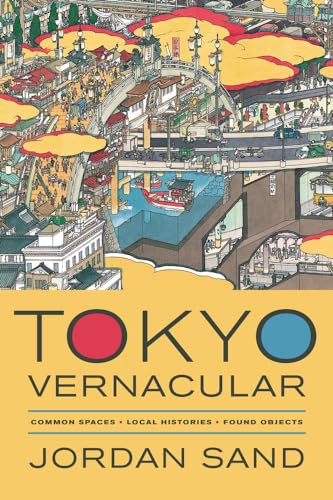
Preserved buildings and historic districts, museums and reconstructions have become an important part of the landscape of cities around the world. Beginning in the 1970s, Tokyo participated in this trend. However, repeated destruction and rapid redevelopment left the city with little building stock of recognized historical value. Late twentieth-century Tokyo thus presents an illuminating case of the emergence of a new sense of history in the city's physical environment, since it required both a shift in perceptions of value and a search for history in the margins and interstices of a rapidly modernizing cityscape. Scholarship to date has tended to view historicism in the postindustrial context as either a genuine response to loss, or as a cynical commodification of the past. The historical process of Tokyo's historicization suggests other interpretations. Moving from the politics of the public square to the invention of neighborhood community, to oddities found and appropriated in the streets, to the consecration of everyday scenes and artifacts as heritage in museums, Tokyo Vernacular traces the rediscovery of the past--sometimes in unlikely forms--in a city with few traditional landmarks. Tokyo's rediscovered past was mobilized as part of a new politics of the everyday after the failure of mass politics in the 1960s. Rather than conceiving the city as national center and claiming public space as national citizens, the post-1960s generation came to value the local places and things that embodied the vernacular language of the city, and to seek what could be claimed as common property outside the spaces of corporate capitalism and the state.
Die Inhaltsangabe kann sich auf eine andere Ausgabe dieses Titels beziehen.
Über die Autorin bzw. den Autor
Jordan Sand teaches Japanese history at Georgetown University and has written widely on urbanism and material culture in East Asia.
Von der hinteren Coverseite
"With precision and elegance, Jordan Sand examines some of Tokyo's liminal spaces and objects, and in the process gives us not just a new urban history but a new political and intellectual history of Japan from the 1960's to today. He maps abstract debates over citizenship, property, and memory onto physical places: the public square, the street, and the museum. Tokyo Vernacular is a stunning achievement." —Julia Adeney Thomas, Department of History at University of Notre Dame
"Tokyo Vernacular identifies an ordinary language of history and memory in late twentieth-century Tokyo. With great subtlety and sharp insights, Sand traces the turn to vernacular forms in the flux of the city’s everyday life, analyzing and historicizing it as part of a global concern with the ordinary in the era of consumer capitalism. The result is a set of brilliant and scholarly deep reflections on the roots of historical consciousness in urban and global history."
—Gyan Prakash, author of Mumbai Fables
"Tokyo Vernacular identifies an ordinary language of history and memory in late twentieth-century Tokyo. With great subtlety and sharp insights, Sand traces the turn to vernacular forms in the flux of the city’s everyday life, analyzing and historicizing it as part of a global concern with the ordinary in the era of consumer capitalism. The result is a set of brilliant and scholarly deep reflections on the roots of historical consciousness in urban and global history."
—Gyan Prakash, author of Mumbai Fables
Aus dem Klappentext
"With precision and elegance, Jordan Sand examines some of Tokyo's liminal spaces and objects, and in the process gives us not just a new urban history but a new political and intellectual history of Japan from the 1960's to today. He maps abstract debates over citizenship, property, and memory onto physical places: the public square, the street, and the museum. Tokyo Vernacular is a stunning achievement." Julia Adeney Thomas, Department of History at University of Notre Dame
"Tokyo Vernacular identifies an ordinary language of history and memory in late twentieth-century Tokyo. With great subtlety and sharp insights, Sand traces the turn to vernacular forms in the flux of the city s everyday life, analyzing and historicizing it as part of a global concern with the ordinary in the era of consumer capitalism. The result is a set of brilliant and scholarly deep reflections on the roots of historical consciousness in urban and global history."
Gyan Prakash, author of Mumbai Fables
"Tokyo Vernacular identifies an ordinary language of history and memory in late twentieth-century Tokyo. With great subtlety and sharp insights, Sand traces the turn to vernacular forms in the flux of the city s everyday life, analyzing and historicizing it as part of a global concern with the ordinary in the era of consumer capitalism. The result is a set of brilliant and scholarly deep reflections on the roots of historical consciousness in urban and global history."
Gyan Prakash, author of Mumbai Fables
Auszug. © Genehmigter Nachdruck. Alle Rechte vorbehalten.
Tokyo Vernacular
Common Spaces, Local Histories, Found Objects
By Jordan SandUNIVERSITY OF CALIFORNIA PRESS
Copyright © 2013 The Regents of the University of California
All rights reserved.
ISBN: 978-0-520-28037-3All rights reserved.
Contents
List of Illustrations, ix,
Acknowledgments, xi,
Introduction: Rediscovering Tokyo's Vernacular, 1,
1. Hiroba: The Public Square and the Boundaries of the Commons, 25,
2. Yanesen: Writing Local Community, 54,
3. Deviant Properties: Street Observation Studies, 88,
4. Museums, Heritage, and Everyday Life, 110,
Conclusion: History and Memory in a City without Monuments, 142,
Notes, 167,
Index, 201,
CHAPTER 1
Hiroba
The Public Square and the Boundaries of the Commons
POLITICS AND THE PIAZZA
In 1939, as the war in Asia escalated and Japanese authorities increasingly repressed dissent at home, Marxist historian Hani Goro published a small paperback about Michelangelo. The book opened with a photo and description of Michelangelo's "David." Hani portrayed the artist himself as an underdog fighter for justice like the subject of his sculpture. He described Florence's central Piazza della Signoria, where the "David" stands, in the following way:
This was the piazza [hiroba] where several thousand representatives of the citizen masses [shimin minshu] of the free city and independent state of Florence gathered in an atmosphere filled with energy to debate and pass resolutions and translate them to action, in order for the people of the nation [karera kokumin] to manage the politics of their beloved country [karera no ai suru kokka] themselves, and in order to protect and develop their autonomous politics, creating no gap for autocrats to arise from within and protecting themselves from invaders from without.
These words express in a nutshell the ideal that Hani propounded of the piazza, public square, or—in the modern Japanese translation term—hiroba. This term, which literally means simply "broad open space," here represented a universal ideal. In Toshi (The city), a work published a decade later, Hani would call this ideal jiyu naru kotsu—a free traffic or intercourse among citizens. Although Hani's Michelangelo was not censored, the author was later lionized for speaking out against militarism during the war, and the book came to be revered as a classic. As postwar Japanese rejected what they called their "feudal" past, along with the emperor worship and militarism of the war years, and pursued the language and action of a democratic polity, Hani's portrait of a self-governing urban citizenry acquired a utopian appeal.
Postwar intellectuals feared, however, that Japan lacked not only a tradition of democratic citizen politics but also a tradition of urban spaces suited to such politics. Writing in the journal Toshi mondai in 1956, urban geographer Sugimura Nobuji surveyed plaza types in the cities of European countries and their colonies, noting that plazas marked these cities apart, because Japan—and indeed all of the Orient with the exception of countries that had been European colonies—lacked them. He theorized that plazas had been built in the West in part because when large numbers of people gathered, a sense of citizenship formed. Sugimura thus understood plazas as instruments of citizen making. Without them, civic participation in Japan was naturally hindered.
The absence of plazas was felt particularly acutely by architects. In the urban studies volume of Kenchikugaku taikei (Compendium of architectural studies), a standard multivolume architectural reference work published in 1960, architects Yoshizaka Takamasa and Tonuma Koichi contrasted the cities of ancient Greece, where the agora revealed "a healthy interpretation of humanity within the community of citizens, however limited," with Japan's ancient capitals, whose urban form expressed "Oriental despotic rule lacking communal solidarity." This trait, they wrote, became yet more pronounced in the feudal cities that emerged in Japan during the subsequent medieval and Tokugawa periods.
To compensate, postwar architects designed "citizens' plazas" (shimin hiroba), most often adjacent to new municipal and prefectural office buildings. Later architects observed critically that these plazas were seldom used by ordinary citizens. Meanwhile, civic aspirations invested in the hiroba were reflected in the term's popularity in journalism and policy circles, along with the term "citizen" (shimin). Newspapers sometimes printed readers' contributions in columns called "readers' plazas." The long-term plan for Tokyo published by the progressive Minobe administration in 1971 was called "Plan for a Tokyo of Plazas and Blue Skies," although it did not in fact propose the construction of new plazas. Like the blue skies—a metonym for antipollution policy—the plaza here was notional, pointing toward a democratic civil society.
Yet as Hani's characterization of Florence's Piazza della Signoria reveals in its promiscuity of terms for the urban citizenry and the national citizenry, popular sovereignty and public authority, the citizens who gathered in the public square were conceived as much in the terms of modern nation-state citizenship as in the frame of an urban public sphere. And although Hani spoke of "free intercourse," suggesting the interaction of multiple subjects and opinions, Japanese advocates of the urban plaza in the 1950s and 1960s were as likely to emphasize its importance as a site of solidarity and of the expression of a unified national voice.
A conception of the plaza or public square as an open commons—the site of a public formed through spontaneous and unorchestrated interaction, where universal access but not universal consensus is guaranteed—thus stood in tension with a conception of the plaza as the instrument of citizen solidarity, the site of a public formed through unified mass action. This tension between different ways of figuring the public politically had its architectural counterpart in the problem of monumentality. In addition to providing space for citizens to gather, trade, and exchange opinions, public squares and plazas have historically been built to enhance vistas of buildings and sculptures, making them monuments bearing symbolic or commemorative meaning. Monumental space symbolically aggrandizes the power of the people who occupy it, too. Much like the excess beyond mere function that a monumental setting imparts to a structure, the space of unified mass action acquires a significance beyond the mere capacity to hold large numbers of people. As a space of politics writ large, the hiroba becomes a monumental site, where the collective will exceeds the will of the individual. The public square in Japan's early postwar decades embodied in unresolved form both the grand political idea of popular sovereignty and an emergent space for the traffic of ideas, the unified voice of the people and a cacophony of people's voices, the monumental and the everyday.
OPEN SPACES IN THE CITY'S HISTORY
Japanese cities had possessed open spaces, and crowds had gathered in them, for centuries. After Edo was destroyed by fire in 1657, the Tokugawa shogunate created broad avenues and open spaces around bridges to serve as fire breaks. Over time, these spaces were transformed into informal markets and entertainment districts. In addition, some Buddhist temples opened their...
„Über diesen Titel“ kann sich auf eine andere Ausgabe dieses Titels beziehen.
Suchergebnisse für Tokyo Vernacular: Common Spaces, Local Histories, Found...

Beispielbild für diese ISBN
Tokyo Vernacular: Common Spaces, Local Histories, Found Objects
Verlag:
University of California Press, 2013
ISBN 10: 0520280377
ISBN 13: 9780520280373
Neu
Paperback
Anbieter: GridFreed, San Diego, CA, USA
Verkäuferbewertung 5 von 5 Sternen

Paperback. Zustand: New. In shrink wrap. Artikel-Nr. COD-02100
Neu kaufen
EUR 26,47
EUR 6,20 Versand
Versand innerhalb von USA
Versand innerhalb von USA
Anzahl: 1 verfügbar
Beispielbild für diese ISBN
Tokyo Vernacular
Anbieter: PBShop.store US, Wood Dale, IL, USA
Verkäuferbewertung 5 von 5 Sternen
PAP. Zustand: New. New Book. Shipped from UK. Established seller since 2000. Artikel-Nr. WF-9780520280373
Beispielbild für diese ISBN
Tokyo Vernacular
Anbieter: PBShop.store UK, Fairford, GLOS, Vereinigtes Königreich
Verkäuferbewertung 5 von 5 Sternen
PAP. Zustand: New. New Book. Shipped from UK. Established seller since 2000. Artikel-Nr. WF-9780520280373
Neu kaufen
EUR 37,51
EUR 4,90 Versand
Versand von Vereinigtes Königreich nach USA
Versand von Vereinigtes Königreich nach USA
Anzahl: 1 verfügbar
Beispielbild für diese ISBN
Tokyo Vernacular: Common Spaces, Local Histories, Found Objects
Verlag:
University of California Press, 2013
ISBN 10: 0520280377
ISBN 13: 9780520280373
Neu
Softcover
Anbieter: Kennys Bookstore, Olney, MD, USA
Verkäuferbewertung 5 von 5 Sternen
Zustand: New. 2013. 1st Edition. Paperback. Moving from the politics of the public square to the invention of neighborhood community, to oddities found and appropriated in the streets, to the consecration of everyday scenes and artifacts as heritage in museums, this title traces the rediscovery of the past - sometimes in unlikely forms - in a city with few traditional landmarks. Num Pages: 224 pages, baseline scatter. BIC Classification: 1FPJ; HBJF. Category: (P) Professional & Vocational. Dimension: 227 x 155 x 14. Weight in Grams: 318. . . . . . Books ship from the US and Ireland. Artikel-Nr. V9780520280373
Neu kaufen
EUR 41,85
EUR 9,36 Versand
Versand innerhalb von USA
Versand innerhalb von USA
Anzahl: 1 verfügbar
Beispielbild für diese ISBN
Tokyo Vernacular: Common Spaces, Local Histories, Found Objects (Philip E. Lilienthal Books)
Verlag:
University of California Press, 2013
ISBN 10: 0520280377
ISBN 13: 9780520280373
Neu
Softcover
Anbieter: Ria Christie Collections, Uxbridge, Vereinigtes Königreich
Verkäuferbewertung 5 von 5 Sternen
Zustand: New. In English. Artikel-Nr. ria9780520280373_new
Neu kaufen
EUR 42,25
EUR 11,04 Versand
Versand von Vereinigtes Königreich nach USA
Versand von Vereinigtes Königreich nach USA
Anzahl: Mehr als 20 verfügbar
Beispielbild für diese ISBN
Tokyo Vernacular Common Spaces, Local Histories, Found Objects
Anbieter: Revaluation Books, Exeter, Vereinigtes Königreich
Verkäuferbewertung 5 von 5 Sternen
Paperback. Zustand: Brand New. 1st edition. 208 pages. 9.25x5.75x0.75 inches. In Stock. Artikel-Nr. x-0520280377
Neu kaufen
EUR 57,59
EUR 11,78 Versand
Versand von Vereinigtes Königreich nach USA
Versand von Vereinigtes Königreich nach USA
Anzahl: 2 verfügbar
Foto des Verkäufers
Tokyo Vernacular : Common Spaces, Local Histories, Found Objects
Anbieter: AHA-BUCH GmbH, Einbeck, Deutschland
Verkäuferbewertung 5 von 5 Sternen
Taschenbuch. Zustand: Neu. Neuware - Preserved buildings and historic districts, museums and reconstructions have become an important part of the landscape of cities around the world. Beginning in the 1970s, Tokyo participated in this trend. However, repeated destruction and rapid redevelopment left the city with little building stock of recognized historical value. Late twentieth-century Tokyo thus presents an illuminating case of the emergence of a new sense of history in the city's physical environment, since it required both a shift in perceptions of value and a search for history in the margins and interstices of a rapidly modernizing cityscape. Scholarship to date has tended to view historicism in the postindustrial context as either a genuine response to loss, or as a cynical commodification of the past. The historical process of Tokyo's historicization suggests other interpretations. Moving from the politics of the public square to the invention of neighborhood community, to oddities found and appropriated in the streets, to the consecration of everyday scenes and artifacts as heritage in museums, Tokyo Vernacular traces the rediscovery of the past--sometimes in unlikely forms--in a city with few traditional landmarks. Tokyo's rediscovered past was mobilized as part of a new politics of the everyday after the failure of mass politics in the 1960s. Rather than conceiving the city as national center and claiming public space as national citizens, the post-1960s generation came to value the local places and things that embodied the vernacular language of the city, and to seek what could be claimed as common property outside the spaces of corporate capitalism and the state. Artikel-Nr. 9780520280373
Neu kaufen
EUR 59,71
EUR 35,00 Versand
Versand von Deutschland nach USA
Versand von Deutschland nach USA
Anzahl: 2 verfügbar
Foto des Verkäufers
Sand, J: Tokyo Vernacular
Verlag:
University Of California Press, 2013
ISBN 10: 0520280377
ISBN 13: 9780520280373
Neu
Softcover
Anbieter: moluna, Greven, Deutschland
Verkäuferbewertung 5 von 5 Sternen
Zustand: New. Moving from the politics of the public square to the invention of neighborhood community, to oddities found and appropriated in the streets, to the consecration of everyday scenes and artifacts as heritage in museums, this title traces the rediscovery of th. Artikel-Nr. 594723953
Neu kaufen
EUR 45,86
EUR 48,99 Versand
Versand von Deutschland nach USA
Versand von Deutschland nach USA
Anzahl: Mehr als 20 verfügbar