
Verwandte Artikel zu Reimagining Global Health: An Introduction (California...
Reimagining Global Health: An Introduction (California Series in Public Anthropology, 26, Band 26) - Softcover
Buch 20 von 50: California Series in Public Anthropology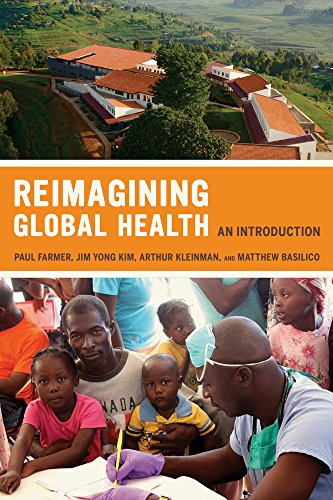
Inhaltsangabe
Bringing together the experience, perspective and expertise of Paul Farmer, Jim Yong Kim, and Arthur Kleinman, Reimagining Global Health provides an original, compelling introduction to the field of global health. Drawn from a Harvard course developed by their student Matthew Basilico, this work provides an accessible and engaging framework for the study of global health. Insisting on an approach that is historically deep and geographically broad, the authors underline the importance of a transdisciplinary approach, and offer a highly readable distillation of several historical and ethnographic perspectives of contemporary global health problems. The case studies presented throughout Reimagining Global Health bring together ethnographic, theoretical, and historical perspectives into a wholly new and exciting investigation of global health. The interdisciplinary approach outlined in this text should prove useful not only in schools of public health, nursing, and medicine, but also in undergraduate and graduate classes in anthropology, sociology, political economy, and history, among others.
Die Inhaltsangabe kann sich auf eine andere Ausgabe dieses Titels beziehen.
Über die Autorin bzw. den Autor
Paul Farmer is co-founder of Partners In Health and Chair of the Department of Global Health and Social Medicine at Harvard Medical School. His most recent book is Haiti After the Earthquake. Jim Yong Kim is a co-founder of Partners In Health and the current President of the World Bank Group. He served as President of Dartmouth College from 2009 to 2012 and is a former Director of the World Health Organization's HIV/AIDS Department. Arthur Kleinman is Professor of Anthropology at Harvard University and Professor of Social Medicine at Harvard Medical School. A pioneering figure in medical anthropology, he is the author of numerous influential works including The Illness Narratives, Patients and Healers in the Context of Culture, and What Really Matters. Matthew Basilico is a medical student at Harvard Medical School and a PhD candidate in economics at Harvard University, where he is also a Resident Tutor in Adams House. He was a Fulbright Scholar in Malawi and is a graduate of Harvard's Social Studies program.
Von der hinteren Coverseite
"It is a challenging task to provide a novel and comprehensive view of global health -a dynamic arena for action and an increasingly attractive academic field. Reimagining Global Health does this with scholarly rigor and political courage. This book will become essential reading for all those working in clinical, public health, and policy roles to address the daunting health disparities of our times."—Julio Frenk, Dean of the Harvard School of Public Health, T & G Angelopoulos Professor of Public Health and International Development, Former Minister of Health of Mexico (2000-2006)
"The past decade has seen an unprecedented explosion of interest in the health and welfare of marginalized communities around the world. Reimagining Global Health offers a critical approach to the contemporary global health landscape, while also tracing its historical antecedents and suggesting a way forward. This seminal work by leading figures in the field is a crucial next step for those interested in grappling with the modern reality of global health inequity. Without question, Reimagining Global Health is a salient volume that will shape global health research, practice, and knowledge for many years to come."—Ambassador Mark Dybul, Executive Director of the Global Fund to Fight AIDS
“Inspired by practicing physicians like two of the authors of this book, Paul Farmer and Jim Kim, who won't take no for an answer when it comes to the universal right to health, many undergraduates, medical students and professional have turned to global health as their specialty and their calling. Until now, this nascent field did not have a unifying conceptual approach, let alone a text. This book, based on decades of practice and years of successfully teaching global health at Harvard, masterfully fills this gap. It presents a strong vision of health as a biological and social phenomenon, and illustrates how academics from different disciplines, and practitioners, must work together to understand not only what works, but how it can be sustainably delivered. Avoiding both cynicism or blind optimism, this book, like the authors in their work, is hopeful, practical, and demanding. It will become an unavoidable reference in the field.” –Esther Duflo, Department of Economics, MIT and author of Poor Economics
"With its unwavering commitment to social justice and refreshingly lucid sense of possibility, Reimagining Global Health is an essential antidote to the deadly and inexcusable health disparities of our times. Combining deep social analysis and visceral human and institutional engagements, the authors of this momentous book re-socialize and politicize disease and health and, in the process, create a distinct and innovative grammar that will surely inspire and shape the work of generations of global health scholars and practitioners."—João Biehl, Princeton University
"From the interstices of medical knowledge and practices and the social sciences a new academic field of "global health" is emerging. While economists worship their methodology, and political scientists their great thinkers, global health has outflanked them all in the quest for real explanations and real solutions to the most pressing problem of the world's poor people. With this book, written by some of the field's pioneers, you can take the first step in orienting yourself in this fluid and inter-disciplinary endeavor. Iconoclastic and passionate in equal measure."—James Robinson, David Florence Professor of Government at Harvard University
"Lucky Harvard students! Having these teachers. And lucky students elsewhere when they have the chance to read this important book. I was familiar in one way or another with most of the material covered by this book and I could not put it down."—Michael Marmot, University College, London, Institute of Healthy Equity
“When I first invited Paul Farmer and Jim Kim to Rwanda ten years ago, it was not for business as usual. The partnership they committed to was working to break the cycle of poverty and disease in some of Rwanda’s poorest districts. Together, through the leadership of the Rwandan public sector and the steadfast accompaniment of global visionaries including many co-authors of chapters in this book, we are redefining what is possible in health care delivery. Reimagining Global Health asks how the hard-won lessons learned along the way might be shared most widely and usefully. In these pages, students and practitioners across disciplines and contexts will find crucial questions for all those who would advance the human right to health. Rich case studies and incisive biosocial analysis throw the central importance of humility, constancy, and imagination into bold relief.”—Dr. Agnes Binagwaho, Minister of Health of Rwanda; Senior Lecturer, Harvard Medical School; Clinical Professor of Pediatrics, Geisel School of Medicine at Dartmouth
"This inspiring book transforms the field of global health into a revolutionary global movement for human rights to combat the useless suffering imposed by North/South social inequality. The authors' historical, practice-based and theoretical arguments wrench the field out of its colonial-missionary roots and attack the contemporary greedy behemoths of Bio-Tech, Big Pharma, for-profit healthcare, and cost-benefit neoliberal triage logics to make "Health for All" a real possibility--as well as a universal human right to be enforced by political will, funding and democratic access to technology."—Philippe Bourgois author of Righteous Dopefiend and of In Search of Respect: Selling Crack in El Barrio.
"Reimagining Global Health is a well written text based on extensive research, teaching and practical experience. The fact that it is based on three years of teaching a course implies that it has been finely honed by responses from students. It is superbly researched and written and provides many new angles and fresh perspectives."—Solly Benatar, Professor, Dalla School of Public Health and Joint Centre for Bioethics, University of Toronto
"The past decade has seen an unprecedented explosion of interest in the health and welfare of marginalized communities around the world. Reimagining Global Health offers a critical approach to the contemporary global health landscape, while also tracing its historical antecedents and suggesting a way forward. This seminal work by leading figures in the field is a crucial next step for those interested in grappling with the modern reality of global health inequity. Without question, Reimagining Global Health is a salient volume that will shape global health research, practice, and knowledge for many years to come."—Ambassador Mark Dybul, Executive Director of the Global Fund to Fight AIDS
“Inspired by practicing physicians like two of the authors of this book, Paul Farmer and Jim Kim, who won't take no for an answer when it comes to the universal right to health, many undergraduates, medical students and professional have turned to global health as their specialty and their calling. Until now, this nascent field did not have a unifying conceptual approach, let alone a text. This book, based on decades of practice and years of successfully teaching global health at Harvard, masterfully fills this gap. It presents a strong vision of health as a biological and social phenomenon, and illustrates how academics from different disciplines, and practitioners, must work together to understand not only what works, but how it can be sustainably delivered. Avoiding both cynicism or blind optimism, this book, like the authors in their work, is hopeful, practical, and demanding. It will become an unavoidable reference in the field.” –Esther Duflo, Department of Economics, MIT and author of Poor Economics
"With its unwavering commitment to social justice and refreshingly lucid sense of possibility, Reimagining Global Health is an essential antidote to the deadly and inexcusable health disparities of our times. Combining deep social analysis and visceral human and institutional engagements, the authors of this momentous book re-socialize and politicize disease and health and, in the process, create a distinct and innovative grammar that will surely inspire and shape the work of generations of global health scholars and practitioners."—João Biehl, Princeton University
"From the interstices of medical knowledge and practices and the social sciences a new academic field of "global health" is emerging. While economists worship their methodology, and political scientists their great thinkers, global health has outflanked them all in the quest for real explanations and real solutions to the most pressing problem of the world's poor people. With this book, written by some of the field's pioneers, you can take the first step in orienting yourself in this fluid and inter-disciplinary endeavor. Iconoclastic and passionate in equal measure."—James Robinson, David Florence Professor of Government at Harvard University
"Lucky Harvard students! Having these teachers. And lucky students elsewhere when they have the chance to read this important book. I was familiar in one way or another with most of the material covered by this book and I could not put it down."—Michael Marmot, University College, London, Institute of Healthy Equity
“When I first invited Paul Farmer and Jim Kim to Rwanda ten years ago, it was not for business as usual. The partnership they committed to was working to break the cycle of poverty and disease in some of Rwanda’s poorest districts. Together, through the leadership of the Rwandan public sector and the steadfast accompaniment of global visionaries including many co-authors of chapters in this book, we are redefining what is possible in health care delivery. Reimagining Global Health asks how the hard-won lessons learned along the way might be shared most widely and usefully. In these pages, students and practitioners across disciplines and contexts will find crucial questions for all those who would advance the human right to health. Rich case studies and incisive biosocial analysis throw the central importance of humility, constancy, and imagination into bold relief.”—Dr. Agnes Binagwaho, Minister of Health of Rwanda; Senior Lecturer, Harvard Medical School; Clinical Professor of Pediatrics, Geisel School of Medicine at Dartmouth
"This inspiring book transforms the field of global health into a revolutionary global movement for human rights to combat the useless suffering imposed by North/South social inequality. The authors' historical, practice-based and theoretical arguments wrench the field out of its colonial-missionary roots and attack the contemporary greedy behemoths of Bio-Tech, Big Pharma, for-profit healthcare, and cost-benefit neoliberal triage logics to make "Health for All" a real possibility--as well as a universal human right to be enforced by political will, funding and democratic access to technology."—Philippe Bourgois author of Righteous Dopefiend and of In Search of Respect: Selling Crack in El Barrio.
"Reimagining Global Health is a well written text based on extensive research, teaching and practical experience. The fact that it is based on three years of teaching a course implies that it has been finely honed by responses from students. It is superbly researched and written and provides many new angles and fresh perspectives."—Solly Benatar, Professor, Dalla School of Public Health and Joint Centre for Bioethics, University of Toronto
Aus dem Klappentext
"It is a challenging task to provide a novel and comprehensive view of global health -a dynamic arena for action and an increasingly attractive academic field. Reimagining Global Health does this with scholarly rigor and political courage. This book will become essential reading for all those working in clinical, public health, and policy roles to address the daunting health disparities of our times." Julio Frenk, Dean of the Harvard School of Public Health, T & G Angelopoulos Professor of Public Health and International Development, Former Minister of Health of Mexico (2000-2006)
"The past decade has seen an unprecedented explosion of interest in the health and welfare of marginalized communities around the world. Reimagining Global Health offers a critical approach to the contemporary global health landscape, while also tracing its historical antecedents and suggesting a way forward. This seminal work by leading figures in the field is a crucial next step for those interested in grappling with the modern reality of global health inequity. Without question, Reimagining Global Health is a salient volume that will shape global health research, practice, and knowledge for many years to come." Ambassador Mark Dybul, Executive Director of the Global Fund to Fight AIDS
Inspired by practicing physicians like two of the authors of this book, Paul Farmer and Jim Kim, who won't take no for an answer when it comes to the universal right to health, many undergraduates, medical students and professional have turned to global health as their specialty and their calling. Until now, this nascent field did not have a unifying conceptual approach, let alone a text. This book, based on decades of practice and years of successfully teaching global health at Harvard, masterfully fills this gap. It presents a strong vision of health as a biological and social phenomenon, and illustrates how academics from different disciplines, and practitioners, must work together to understand not only what works, but how it can be sustainably delivered. Avoiding both cynicism or blind optimism, this book, like the authors in their work, is hopeful, practical, and demanding. It will become an unavoidable reference in the field. Esther Duflo, Department of Economics, MIT and author of Poor Economics
"With its unwavering commitment to social justice and refreshingly lucid sense of possibility, Reimagining Global Health is an essential antidote to the deadly and inexcusable health disparities of our times. Combining deep social analysis and visceral human and institutional engagements, the authors of this momentous book re-socialize and politicize disease and health and, in the process, create a distinct and innovative grammar that will surely inspire and shape the work of generations of global health scholars and practitioners." João Biehl, Princeton University
"From the interstices of medical knowledge and practices and the social sciences a new academic field of "global health" is emerging. While economists worship their methodology, and political scientists their great thinkers, global health has outflanked them all in the quest for real explanations and real solutions to the most pressing problem of the world's poor people. With this book, written by some of the field's pioneers, you can take the first step in orienting yourself in this fluid and inter-disciplinary endeavor. Iconoclastic and passionate in equal measure." James Robinson, David Florence Professor of Government at Harvard University
"Lucky Harvard students! Having these teachers. And lucky students elsewhere when they have the chance to read this important book. I was familiar in one way or another with most of the material covered by this book and I could not put it down." Michael Marmot, University College, London, Institute of Healthy Equity
When I first invited Paul Farmer and Jim Kim to Rwanda ten years ago, it was not for business as usual. The partnership they committed to was working to break the cycle of poverty and disease in some of Rwanda s poorest districts. Together, through the leadership of the Rwandan public sector and the steadfast accompaniment of global visionaries including many co-authors of chapters in this book, we are redefining what is possible in health care delivery. Reimagining Global Health asks how the hard-won lessons learned along the way might be shared most widely and usefully. In these pages, students and practitioners across disciplines and contexts will find crucial questions for all those who would advance the human right to health. Rich case studies and incisive biosocial analysis throw the central importance of humility, constancy, and imagination into bold relief. Dr. Agnes Binagwaho, Minister of Health of Rwanda; Senior Lecturer, Harvard Medical School; Clinical Professor of Pediatrics, Geisel School of Medicine at Dartmouth
"This inspiring book transforms the field of global health into a revolutionary global movement for human rights to combat the useless suffering imposed by North/South social inequality. The authors' historical, practice-based and theoretical arguments wrench the field out of its colonial-missionary roots and attack the contemporary greedy behemoths of Bio-Tech, Big Pharma, for-profit healthcare, and cost-benefit neoliberal triage logics to make "Health for All" a real possibility--as well as a universal human right to be enforced by political will, funding and democratic access to technology." Philippe Bourgois author of Righteous Dopefiend and of In Search of Respect: Selling Crack in El Barrio.
"Reimagining Global Health is a well written text based on extensive research, teaching and practical experience. The fact that it is based on three years of teaching a course implies that it has been finely honed by responses from students. It is superbly researched and written and provides many new angles and fresh perspectives." Solly Benatar, Professor, Dalla School of Public Health and Joint Centre for Bioethics, University of Toronto
"The past decade has seen an unprecedented explosion of interest in the health and welfare of marginalized communities around the world. Reimagining Global Health offers a critical approach to the contemporary global health landscape, while also tracing its historical antecedents and suggesting a way forward. This seminal work by leading figures in the field is a crucial next step for those interested in grappling with the modern reality of global health inequity. Without question, Reimagining Global Health is a salient volume that will shape global health research, practice, and knowledge for many years to come." Ambassador Mark Dybul, Executive Director of the Global Fund to Fight AIDS
Inspired by practicing physicians like two of the authors of this book, Paul Farmer and Jim Kim, who won't take no for an answer when it comes to the universal right to health, many undergraduates, medical students and professional have turned to global health as their specialty and their calling. Until now, this nascent field did not have a unifying conceptual approach, let alone a text. This book, based on decades of practice and years of successfully teaching global health at Harvard, masterfully fills this gap. It presents a strong vision of health as a biological and social phenomenon, and illustrates how academics from different disciplines, and practitioners, must work together to understand not only what works, but how it can be sustainably delivered. Avoiding both cynicism or blind optimism, this book, like the authors in their work, is hopeful, practical, and demanding. It will become an unavoidable reference in the field. Esther Duflo, Department of Economics, MIT and author of Poor Economics
"With its unwavering commitment to social justice and refreshingly lucid sense of possibility, Reimagining Global Health is an essential antidote to the deadly and inexcusable health disparities of our times. Combining deep social analysis and visceral human and institutional engagements, the authors of this momentous book re-socialize and politicize disease and health and, in the process, create a distinct and innovative grammar that will surely inspire and shape the work of generations of global health scholars and practitioners." João Biehl, Princeton University
"From the interstices of medical knowledge and practices and the social sciences a new academic field of "global health" is emerging. While economists worship their methodology, and political scientists their great thinkers, global health has outflanked them all in the quest for real explanations and real solutions to the most pressing problem of the world's poor people. With this book, written by some of the field's pioneers, you can take the first step in orienting yourself in this fluid and inter-disciplinary endeavor. Iconoclastic and passionate in equal measure." James Robinson, David Florence Professor of Government at Harvard University
"Lucky Harvard students! Having these teachers. And lucky students elsewhere when they have the chance to read this important book. I was familiar in one way or another with most of the material covered by this book and I could not put it down." Michael Marmot, University College, London, Institute of Healthy Equity
When I first invited Paul Farmer and Jim Kim to Rwanda ten years ago, it was not for business as usual. The partnership they committed to was working to break the cycle of poverty and disease in some of Rwanda s poorest districts. Together, through the leadership of the Rwandan public sector and the steadfast accompaniment of global visionaries including many co-authors of chapters in this book, we are redefining what is possible in health care delivery. Reimagining Global Health asks how the hard-won lessons learned along the way might be shared most widely and usefully. In these pages, students and practitioners across disciplines and contexts will find crucial questions for all those who would advance the human right to health. Rich case studies and incisive biosocial analysis throw the central importance of humility, constancy, and imagination into bold relief. Dr. Agnes Binagwaho, Minister of Health of Rwanda; Senior Lecturer, Harvard Medical School; Clinical Professor of Pediatrics, Geisel School of Medicine at Dartmouth
"This inspiring book transforms the field of global health into a revolutionary global movement for human rights to combat the useless suffering imposed by North/South social inequality. The authors' historical, practice-based and theoretical arguments wrench the field out of its colonial-missionary roots and attack the contemporary greedy behemoths of Bio-Tech, Big Pharma, for-profit healthcare, and cost-benefit neoliberal triage logics to make "Health for All" a real possibility--as well as a universal human right to be enforced by political will, funding and democratic access to technology." Philippe Bourgois author of Righteous Dopefiend and of In Search of Respect: Selling Crack in El Barrio.
"Reimagining Global Health is a well written text based on extensive research, teaching and practical experience. The fact that it is based on three years of teaching a course implies that it has been finely honed by responses from students. It is superbly researched and written and provides many new angles and fresh perspectives." Solly Benatar, Professor, Dalla School of Public Health and Joint Centre for Bioethics, University of Toronto
Auszug. © Genehmigter Nachdruck. Alle Rechte vorbehalten.
Reimagining Global Health
An Introduction
By Paul Farmer, Jim Yong Kim, Arthur Kleinman, Matthew BasilicoUNIVERSITY OF CALIFORNIA PRESS
Copyright © 2013 The Regents of the University of California
All rights reserved.
ISBN: 978-0-520-27199-9All rights reserved.
Contents
List of Illustrations and Tables, vii,
Preface by Paul Farmer, xiii,
1 Introduction: A Biosocial Approach to Global Health Paul Farmer, Jim Yong Kim, Arthur Kleinman, Matthew Basilico, 1,
2 Unpacking Global Health: Theory and Critique Bridget Hanna, Arthur Kleinman, 15,
3 Colonial Medicine and Its Legacies Jeremy Greene, Marguerite Thorp Basilico, Heidi Kim, Paul Farmer, 33,
4 Health for All? Competing Theories and Geopolitics Matthew Basilico, Jonathan Weigel, Anjali Motgi, Jacob Bor, Salmaan Keshavjee, 74,
5 Redefining the Possible: The Global AIDS Response Luke Messac, Krishna Prabhu, 111,
6 Building an Effective Rural Health Delivery Model in Haiti and Rwanda Peter Drobac, Matthew Basilico, Luke Messac, David Walton, Paul Farmer, 133,
7 Scaling Up Effective Delivery Models Worldwide Jim Yong Kim, Michael Porter, Joseph Rhatigan, Rebecca Weintraub, Matthew Basilico, Cassia van der Hoof Holstein, Paul Farmer, 184,
8 The Unique Challenges of Mental Health and MDRTB: Critical Perspectives on Metrics of Disease Anne Becker, Anjali Motgi, Jonathan Weigel, Giuseppe Raviola, Salmaan Keshavjee, Arthur Kleinman, 212,
9 Values and Global Health Arjun Suri, Jonathan Weigel, Luke Messac, Marguerite Thorp Basilico, Matthew Basilico, Bridget Hanna, Salmaan Keshavjee, Arthur Kleinman, 245,
10 Taking Stock of Foreign Aid Jonathan Weigel, Matthew Basilico, Paul Farmer, 287,
11 Global Health Priorities for the Early Twenty-First Century Paul Farmer, Matthew Basilico, Vanessa Kerry, Madeleine Ballard, Anne Becker, Gene Bukhman, Ophelia Dahl, Andy Ellner, Louise Ivers, David Jones, John Meara, Joia Mukherjee, Amy Sievers, Alyssa Yamamoto, 302,
12 A Movement for Global Health Equity? A Closing Reflection Matthew Basilico, Vanessa Kerry, Luke Messac, Arjun Suri, Jonathan Weigel, Marguerite Thorp Basilico, Joia Mukherjee, Paul Farmer, 340,
Appendix: Declaration of Alma-Ata, 355,
Notes, 359,
List of Contributors, 453,
Acknowledgments, 459,
Index, 463,
CHAPTER 1
Introduction
A Biosocial Approach to Global Health
PAUL FARMER, JIM YONG KIM, ARTHUR KLEINMAN, MATTHEW BASILICO
A VIEW FROM THE FIELD
Mpatso has been coughing for months. Coughing consumes his energy and his appetite, and he loses weight with every passing week. When his skin begins to sag, he takes the advice of his relatives and makes the two-hour journey to a health center. There Mpatso learns that he has AIDS and tuberculosis. In his village in rural Malawi—an agrarian, landlocked nation in Southern Africa, hard hit by both diseases—Mpatso's diagnosis carries a very poor prognosis. Malawi, like most of the countries in sub-Saharan Africa, faces the combined challenges of poverty, high burden of disease, and limited health services in the public sector. But Mpatso's case is an exception: shortly after he arrives at the Neno District Hospital—a public hospital built with the help of NGOs in a small town in the rural reaches of southern Malawi—he is seen by a team of clinicians. That same afternoon, Mpatso is diagnosed and begins treatment for both diseases. The treatment involves a dizzying number of pills, but his are delivered daily by a community health worker who also helps him follow his therapeutic regimen. His life will likely be prolonged by decades.
Down the hall from Mpatso's exam room, a neighbor gives birth with the support of a nurse-midwife. In an adjacent room, six women are in labor under the watchful eye of the clinical staff and within a few yards of a clean, modern operating room. In this and in many other respects, Neno District Hospital differs from most health facilities in the region (and throughout rural sub-Saharan Africa). The hospital is a comprehensive primary care facility, providing ambulatory care for hundreds of patients each day. It has one hundred and twenty beds, a tuberculosis ward, a well-stocked pharmacy, and an electronic medical records system. The facility is staffed by doctors and nurses from the Ministry of Health and from Partners In Health. In one of the poorest and most isolated areas in Malawi, a robust local health system is delivering high-quality care, free of charge to the patients, as a public good for public health.
How was this system put in place in a country where effective health services are typically unavailable, and how can comprehensive health systems be built across the "developing world" (perhaps better labeled the "majority world")? How is the double burden of poverty and disease experienced by individuals like Mpatso or his neighbors across the border in Mozambique? How can history and political economy help us understand the skewed distributions of wealth and illness around the globe? These are a few of the questions that motivate our investigation of global health equity.
BIOSOCIAL ANALYSIS
As the preface notes, global health is not yet a discipline but rather a collection of problems. The authors of this volume believe that the process of rigorously analyzing these problems, of working to solve them, and of transforming the field of global health into a coherent discipline demands an interdisciplinary approach. Describing the forces that led Mpatso to fall ill with tuberculosis—a treatable infectious disease that has been banished to history books in most of the rich world yet continues to claim some 1.4 million lives per year worldwide—requires an intrinsically biosocial analytic endeavor. The roots of the limited health care infrastructure in rural Neno District, a former British colony long on the periphery of the global economy, are historically deep and geographically broad.
Most textbooks of public health have been written by epidemiologists, and we of course draw heavily from this field, relying as well on insights from clinical medicine and from public health disciplines such as health economics. But the course we teach at Harvard College (like the courses we have long taught at Harvard Medical School and the hospitals with which we're affiliated) is not the same as those taught by public health specialists. We who have developed this course and edited this book are jointly trained in clinical medicine and in anthropology or political economy. Thus we also seek to critique prevailing global health discourse with what we have termed the resocializing disciplines—anthropology, sociology, history, political economy. Our approach hinges on social theory, explored in the second chapter, and aims to interrogate claims of causality widely stated in the literature on global health.
Our experience as medical practitioners has also shaped our approach to this volume. As we demonstrate in chapter 6, adapting a fully interdisciplinary investigation to basic questions—how did Mpatso become ill, and why?—has directly informed our practice. We see this close coupling of inquiry and implementation—the "vitality of praxis"—as central to our work: traversing the space between reflection and pragmatic engagement is necessary in any attempt to distill a core body of information about global health. Limitations exist in any team's knowledge of a particular field, and this book is of course based on material with which we are...
„Über diesen Titel“ kann sich auf eine andere Ausgabe dieses Titels beziehen.
Suchergebnisse für Reimagining Global Health: An Introduction (California...

Beispielbild für diese ISBN
Reimagining Global Health: An Introduction
Verlag:
University of California Press, 2013
ISBN 10: 0520271998
ISBN 13: 9780520271999
Gebraucht
Paperback
Anbieter: World of Books (was SecondSale), Montgomery, IL, USA
Verkäuferbewertung 5 von 5 Sternen

Paperback. Zustand: Good. Provides an introduction to the field of global health. This title is suitable for schools of public health, nursing, and medicine, and also in undergraduate and graduate classes in anthropology, sociology, political economy, and history, among others. Artikel-Nr. 00106251428
Gebraucht kaufen
EUR 6,03
Versand gratis
Versand innerhalb von USA
Versand innerhalb von USA
Anzahl: 2 verfügbar
Beispielbild für diese ISBN
Reimagining Global Health: An Introduction
Verlag:
University of California Press, 2013
ISBN 10: 0520271998
ISBN 13: 9780520271999
Gebraucht
Paperback
Anbieter: World of Books (was SecondSale), Montgomery, IL, USA
Verkäuferbewertung 5 von 5 Sternen
Paperback. Zustand: Fair. Provides an introduction to the field of global health. This title is suitable for schools of public health, nursing, and medicine, and also in undergraduate and graduate classes in anthropology, sociology, political economy, and history, among others. Artikel-Nr. 00110281705
Gebraucht kaufen
EUR 6,03
Versand gratis
Versand innerhalb von USA
Versand innerhalb von USA
Anzahl: 1 verfügbar
Beispielbild für diese ISBN
Reimagining Global Health: An Introduction
Verlag:
University of California Press, 2013
ISBN 10: 0520271998
ISBN 13: 9780520271999
Gebraucht
Paperback
Anbieter: World of Books (was SecondSale), Montgomery, IL, USA
Verkäuferbewertung 5 von 5 Sternen
Paperback. Zustand: Very Good. Provides an introduction to the field of global health. This title is suitable for schools of public health, nursing, and medicine, and also in undergraduate and graduate classes in anthropology, sociology, political economy, and history, among others. Artikel-Nr. 00110198562
Gebraucht kaufen
EUR 6,03
Versand gratis
Versand innerhalb von USA
Versand innerhalb von USA
Anzahl: 1 verfügbar
Beispielbild für diese ISBN
Reimagining Global Health: An Introduction Volume 26
Verlag:
University of California Press, 2013
ISBN 10: 0520271998
ISBN 13: 9780520271999
Gebraucht
Paperback
Anbieter: ThriftBooks-Phoenix, Phoenix, AZ, USA
Verkäuferbewertung 5 von 5 Sternen
Paperback. Zustand: Good. No Jacket. Pages can have notes/highlighting. Spine may show signs of wear. ~ ThriftBooks: Read More, Spend Less. Artikel-Nr. G0520271998I3N00
Gebraucht kaufen
EUR 7,53
Versand gratis
Versand innerhalb von USA
Versand innerhalb von USA
Anzahl: 2 verfügbar
Beispielbild für diese ISBN
Reimagining Global Health: An Introduction Volume 26
Verlag:
University of California Press, 2013
ISBN 10: 0520271998
ISBN 13: 9780520271999
Gebraucht
Paperback
Anbieter: ThriftBooks-Phoenix, Phoenix, AZ, USA
Verkäuferbewertung 5 von 5 Sternen
Paperback. Zustand: Fair. No Jacket. Readable copy. Pages may have considerable notes/highlighting. ~ ThriftBooks: Read More, Spend Less. Artikel-Nr. G0520271998I5N00
Gebraucht kaufen
EUR 7,53
Versand gratis
Versand innerhalb von USA
Versand innerhalb von USA
Anzahl: 1 verfügbar
Beispielbild für diese ISBN
Reimagining Global Health: An Introduction Volume 26
Verlag:
University of California Press, 2013
ISBN 10: 0520271998
ISBN 13: 9780520271999
Gebraucht
Paperback
Anbieter: ThriftBooks-Reno, Reno, NV, USA
Verkäuferbewertung 5 von 5 Sternen
Paperback. Zustand: Good. No Jacket. Pages can have notes/highlighting. Spine may show signs of wear. ~ ThriftBooks: Read More, Spend Less. Artikel-Nr. G0520271998I3N00
Gebraucht kaufen
EUR 7,53
Versand gratis
Versand innerhalb von USA
Versand innerhalb von USA
Anzahl: 2 verfügbar
Beispielbild für diese ISBN
Reimagining Global Health: An Introduction Volume 26
Verlag:
University of California Press, 2013
ISBN 10: 0520271998
ISBN 13: 9780520271999
Gebraucht
Paperback
Anbieter: ThriftBooks-Atlanta, AUSTELL, GA, USA
Verkäuferbewertung 5 von 5 Sternen
Paperback. Zustand: Fair. No Jacket. Readable copy. Pages may have considerable notes/highlighting. ~ ThriftBooks: Read More, Spend Less. Artikel-Nr. G0520271998I5N00
Gebraucht kaufen
EUR 7,55
Versand gratis
Versand innerhalb von USA
Versand innerhalb von USA
Anzahl: 1 verfügbar
Beispielbild für diese ISBN
Reimagining Global Health: An Introduction Volume 26
Verlag:
University of California Press, 2013
ISBN 10: 0520271998
ISBN 13: 9780520271999
Gebraucht
Paperback
Anbieter: ThriftBooks-Atlanta, AUSTELL, GA, USA
Verkäuferbewertung 5 von 5 Sternen
Paperback. Zustand: Fair. No Jacket. Former library book; Readable copy. Pages may have considerable notes/highlighting. ~ ThriftBooks: Read More, Spend Less. Artikel-Nr. G0520271998I5N10
Gebraucht kaufen
EUR 7,55
Versand gratis
Versand innerhalb von USA
Versand innerhalb von USA
Anzahl: 1 verfügbar
Beispielbild für diese ISBN
Reimagining Global Health: An Introduction Volume 26
Verlag:
University of California Press, 2013
ISBN 10: 0520271998
ISBN 13: 9780520271999
Gebraucht
Paperback
Anbieter: ThriftBooks-Atlanta, AUSTELL, GA, USA
Verkäuferbewertung 5 von 5 Sternen
Paperback. Zustand: Good. No Jacket. Former library book; Pages can have notes/highlighting. Spine may show signs of wear. ~ ThriftBooks: Read More, Spend Less. Artikel-Nr. G0520271998I3N10
Gebraucht kaufen
EUR 7,55
Versand gratis
Versand innerhalb von USA
Versand innerhalb von USA
Anzahl: 1 verfügbar
Beispielbild für diese ISBN
Reimagining Global Health: An Introduction Volume 26
Verlag:
University of California Press, 2013
ISBN 10: 0520271998
ISBN 13: 9780520271999
Gebraucht
Paperback
Anbieter: ThriftBooks-Dallas, Dallas, TX, USA
Verkäuferbewertung 5 von 5 Sternen
Paperback. Zustand: Good. No Jacket. Pages can have notes/highlighting. Spine may show signs of wear. ~ ThriftBooks: Read More, Spend Less. Artikel-Nr. G0520271998I3N00
Gebraucht kaufen
EUR 7,61
Versand gratis
Versand innerhalb von USA
Versand innerhalb von USA
Anzahl: 3 verfügbar