
Verwandte Artikel zu Autobiography of Mark Twain.Vol.1: The Complete and...
Autobiography of Mark Twain.Vol.1: The Complete and Authoritative Edition Volume 10 (The Mark Twain Papers, Band 1) - Hardcover
Buch 1 von 3: Autobiography of Mark Twain Series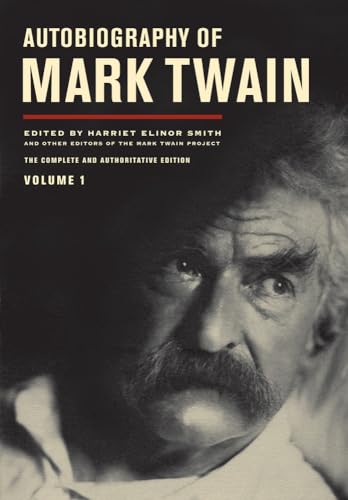
Inhaltsangabe
'I've struck it!' Mark Twain wrote in a 1904 letter to a friend. 'And I will give it away - to you. You will never know how much enjoyment you have lost until you get to dictating your autobiography.' Thus, after dozens of false starts and hundreds of pages, Twain embarked on his 'Final (and Right) Plan' for telling the story of his life. His innovative notion - to 'talk only about the thing which interests you for the moment' - meant that his thoughts could range freely. The strict instruction that many of these texts remain unpublished for 100 years meant that when they came out, he would be 'dead, and unaware, and indifferent,' and that he was therefore free to speak his 'whole frank mind.' The year 2010 marks the 100th anniversary of Twain's death. In celebration of this important milestone and in honor of the cherished tradition of publishing Mark Twain's works, "UC Press" is proud to offer for the first time Mark Twain's uncensored autobiography in its entirety and exactly as he left it. This major literary event brings to readers, admirers, and scholars the first of three volumes and presents Mark Twain's authentic and unsuppressed voice, brimming with humor, ideas, and opinions, and speaking clearly from the grave as he intended.
Die Inhaltsangabe kann sich auf eine andere Ausgabe dieses Titels beziehen.
Über die Autorin bzw. den Autor
Harriet Elinor Smith is an editor at the Mark Twain Project, which is housed within the Mark Twain Papers, the world's largest archive of primary materials by this major American writer. Under the direction of General Editor Robert H. Hirst, the Project's editors are producing the first comprehensive edition of all of Mark Twain's writings.
Von der hinteren Coverseite
"Mark Twain dictated much of this book—now it is a book at last—from a big rumpled bed. Reading it is a bit like climbing in there with him."—Roy Blount, Jr.
"To say that the editors have done an extremely good job is a little like saying the ceiling of the Sistine Chapel does a good job of keeping the rain off the Pope's head. It is true but it doesn't give even a whiff of the grandeur of the thing."—Robert D. Richardson, author of Emerson: The Mind on Fire
"Mark Twain, always so blithely ahead of his time, has just outdone himself: he's brought us an Autobiography from beyond the grave: a hundred-year-old relic that yet manages to accomplish something new. It anticipates the Cubism just taking form in Samuel Clemens's last years, by exploding the confines of orderliness, sequence, the dutiful march of this-then-that. In so doing, it gives us not simply Mark Twain's life—that is the prosaic work of biographers—but the ways in which he thought of his life: in all the fragmented recollection, distraction, creation, revision and dreaming that make up the true, divinely jumbled devices we all use to recapture experience and feeling. If this prodigious and prodigal pastiche were a machine, it would be the Paige typesetter—except that it works."—Ron Powers, author of Mark Twain: A Life
Aus dem Klappentext
"Mark Twain dictated much of this book now it is a book at last from a big rumpled bed. Reading it is a bit like climbing in there with him." Roy Blount, Jr.
"To say that the editors have done an extremely good job is a little like saying the ceiling of the Sistine Chapel does a good job of keeping the rain off the Pope's head. It is true but it doesn't give even a whiff of the grandeur of the thing." Robert D. Richardson, author of Emerson: The Mind on Fire
"Mark Twain, always so blithely ahead of his time, has just outdone himself: he's brought us an Autobiography from beyond the grave: a hundred-year-old relic that yet manages to accomplish something new. It anticipates the Cubism just taking form in Samuel Clemens's last years, by exploding the confines of orderliness, sequence, the dutiful march of this-then-that. In so doing, it gives us not simply Mark Twain's life that is the prosaic work of biographers but the ways in which he thought of his life: in all the fragmented recollection, distraction, creation, revision and dreaming that make up the true, divinely jumbled devices we all use to recapture experience and feeling. If this prodigious and prodigal pastiche were a machine, it would be the Paige typesetter except that it works." Ron Powers, author of Mark Twain: A Life
Auszug. © Genehmigter Nachdruck. Alle Rechte vorbehalten.
Autobiography of Mark Twain
Volume 1 | Reader's Edition
By HARRIET ELINOR SMITHUNIVERSITY OF CALIFORNIA PRESS
Copyright © 2012 Mark Twain Foundation
All rights reserved.
ISBN: 978-0-520-26719-0All rights reserved.
Contents
Acknowledgments, xv,
Introduction, 1,
AUTOBIOGRAPHY OF MARK TWAIN,
An Early Attempt, 21,
My Autobiography [Random Extracts from It], 21,
The Latest Attempt, 43,
The Final (and Right) Plan, 44,
Preface. As from the Grave, 44,
The Florentine Dictations, 46,
Autobiographical Dictations, January–March 1906, 83,
Appendix: Preliminary Manuscripts and Dictations, 369,
Samuel L. Clemens: A Brief Chronology, 397,
Family Biographies, 401,
References, 407,
Excerpt from Autobiography of Mark Twain, Volume 2, 411,
CHAPTER 1
An Early Attempt
The chapters which immediately follow constitute a fragment of one of my many attempts (after I was in my forties) to put my life on paper.
It starts out with good confidence, but suffers the fate of its brethren—is presently abandoned for some other and newer interest. This is not to be wondered at, for its plan is the old, old, old unflexible and difficult one—the plan that starts you at the cradle and drives you straight for the grave, with no side-excursions permitted on the way. Whereas the side-excursions are the life of our life-voyage, and should be, also, of its history.
My Autobiography [Random Extracts from It]
* * * * So much for the earlier days, and the New England branch of the Clemenses. The other brother settled in the South, and is remotely responsible for me. He has collected his reward generations ago, whatever it was. He went South with his particular friend Fairfax, and settled in Maryland with him, but afterward went further and made his home in Virginia. This is the Fairfax whose descendants were to enjoy a curious distinction—that of being American-born English earls. The founder of the house was Lord General Fairfax of the Parliamentary army, in Cromwell's time. The earldom, which is of recent date, came to the American Fairfaxes through the failure of male heirs in England. Old residents of San Francisco will remember "Charley," the American earl of the mid-'60s—tenth Lord Fairfax according to Burke's Peerage, and holder of a modest public office of some sort or other in the new mining town of Virginia City, Nevada. He was never out of America. I knew him, but not intimately. He had a golden character, and that was all his fortune. He laid his title aside, and gave it a holiday until his circumstances should improve to a degree consonant with its dignity; but that time never came, I think. He was a manly man, and had fine generosities in his make-up. A prominent and pestilent creature named Ferguson, who was always picking quarrels with better men than himself, picked one with him, one day, and Fairfax knocked him down. Ferguson gathered himself up and went off mumbling threats. Fairfax carried no arms, and refused to carry any now, though his friends warned him that Ferguson was of a treacherous disposition and would be sure to take revenge by base means sooner or later. Nothing happened for several days; then Ferguson took the earl by surprise and snapped a revolver at his breast. Fairfax wrenched the pistol from him and was going to shoot him, but the man fell on his knees and begged, and said "Don't kill me—I have a wife and children." Fairfax was in a towering passion, but the appeal reached his heart, and he said, "They have done me no harm," and he let the rascal go.
Back of the Virginian Clemenses is a dim procession of ancestors stretching back to Noah's time. According to tradition, some of them were pirates and slavers in Elizabeth's time. But this is no discredit to them, for so were Drake and Hawkins and the others. It was a respectable trade, then, and monarchs were partners in it. In my time I have had desires to be a pirate myself. The reader—if he will look deep down in his secret heart, will find—but never mind what he will find there: I am not writing his Autobiography, but mine. Later, according to tradition, one of the procession was Ambassador to Spain in the time of James I, or of Charles I, and married there and sent down a strain of Spanish blood to warm us up. Also, according to tradition, this one or another—Geoffrey Clement, by name—helped to sentence Charles to death. I have not examined into these traditions myself, partly because I was indolent, and partly because I was so busy polishing up this end of the line and trying to make it showy; but the other Clemenses claim that they have made the examination and that it stood the test. Therefore I have always taken for granted that I did help Charles out of his troubles, by ancestral proxy. My instincts have persuaded me, too. Whenever we have a strong and persistent and ineradicable instinct, we may be sure that it is not original with us, but inherited—inherited from away back, and hardened and perfected by the petrifying influence of time. Now I have been always and unchangingly bitter against Charles, and I am quite certain that this feeling trickled down to me through the veins of my forebears from the heart of that judge; for it is not my disposition to be bitter against people on my own personal account. I am not bitter against Jeffreys. I ought to be, but I am not. It indicates that my ancestors of James II's time were indifferent to him; I do not know why; I never could make it out; but that is what it indicates. And I have always felt friendly toward Satan. Of course that is ancestral; it must be in the blood, for I could not have originated it.
... And so, by the testimony of instinct, backed by the assertions of Clemenses who said they had examined the records, I have always been obliged to believe that Geoffrey Clement the martyr-maker was an ancestor of mine, and to regard him with favor, and in fact pride. This has not had a good effect upon me, for it has made me vain, and that is a fault. It has made me set myself above people who were less fortunate in their ancestry than I, and has moved me to take them down a peg, upon occasion, and say things to them which hurt them before company.
A case of the kind happened in Berlin several years ago. William Walter Phelps was our Minister at the Emperor's Court, then, and one evening he had me to dinner to meet Count S., a cabinet minister. This nobleman was of long and illustrious descent. Of course I wanted to let out the fact that I had some ancestors, too; but I did not want to pull them out of their graves by the ears, and I never could seem to get a chance to work them in in a way that would look sufficiently casual. I suppose Phelps was in the same difficulty. In fact he looked distraught, now and then—just as a person looks who wants to uncover an ancestor purely by accident, and cannot think of a way that will seem accidental enough. But at last, after dinner, he made a try. He took us about his drawing-room, showing us the pictures, and finally stopped before a rude and ancient engraving. It was a picture of the court that tried Charles I. There was a pyramid of judges in Puritan slouch hats, and below them three bare-headed secretaries seated at a table. Mr. Phelps put his finger upon one of the three, and said with exulting indifference—
"An ancestor of mine."
I put my finger on a judge, and retorted with scathing languidness—
"Ancestor of mine. But it is a small matter. I have...
„Über diesen Titel“ kann sich auf eine andere Ausgabe dieses Titels beziehen.
Suchergebnisse für Autobiography of Mark Twain.Vol.1: The Complete and...

Beispielbild für diese ISBN
Autobiography of Mark Twain, Volume 1: The Complete and Authoritative Edition Volume 10
Verlag:
University of California Press, 2010
ISBN 10: 0520267192
ISBN 13: 9780520267190
Gebraucht
Hardcover
Anbieter: ThriftBooks-Atlanta, AUSTELL, GA, USA
Verkäuferbewertung 5 von 5 Sternen

Hardcover. Zustand: Very Good. No Jacket. May have limited writing in cover pages. Pages are unmarked. ~ ThriftBooks: Read More, Spend Less. Artikel-Nr. G0520267192I4N00
Gebraucht kaufen
EUR 6,73
Versand gratis
Versand innerhalb von USA
Versand innerhalb von USA
Anzahl: 2 verfügbar
Beispielbild für diese ISBN
Autobiography of Mark Twain, Volume 1: The Complete and Authoritative Edition Volume 10
Verlag:
University of California Press, 2010
ISBN 10: 0520267192
ISBN 13: 9780520267190
Gebraucht
Hardcover
Anbieter: ThriftBooks-Reno, Reno, NV, USA
Verkäuferbewertung 5 von 5 Sternen
Hardcover. Zustand: Very Good. No Jacket. Missing dust jacket; May have limited writing in cover pages. Pages are unmarked. ~ ThriftBooks: Read More, Spend Less. Artikel-Nr. G0520267192I4N01
Gebraucht kaufen
EUR 6,73
Versand gratis
Versand innerhalb von USA
Versand innerhalb von USA
Anzahl: 3 verfügbar
Beispielbild für diese ISBN
Autobiography of Mark Twain, Volume 1: The Complete and Authoritative Edition Volume 10
Verlag:
University of California Press, 2010
ISBN 10: 0520267192
ISBN 13: 9780520267190
Gebraucht
Hardcover
Anbieter: ThriftBooks-Dallas, Dallas, TX, USA
Verkäuferbewertung 5 von 5 Sternen
Hardcover. Zustand: Very Good. No Jacket. Former library book; May have limited writing in cover pages. Pages are unmarked. ~ ThriftBooks: Read More, Spend Less. Artikel-Nr. G0520267192I4N10
Gebraucht kaufen
EUR 6,73
Versand gratis
Versand innerhalb von USA
Versand innerhalb von USA
Anzahl: 1 verfügbar
Beispielbild für diese ISBN
Autobiography of Mark Twain, Volume 1: The Complete and Authoritative Edition Volume 10
Verlag:
University of California Press, 2010
ISBN 10: 0520267192
ISBN 13: 9780520267190
Gebraucht
Hardcover
Anbieter: ThriftBooks-Phoenix, Phoenix, AZ, USA
Verkäuferbewertung 5 von 5 Sternen
Hardcover. Zustand: Very Good. No Jacket. Missing dust jacket; May have limited writing in cover pages. Pages are unmarked. ~ ThriftBooks: Read More, Spend Less. Artikel-Nr. G0520267192I4N01
Gebraucht kaufen
EUR 6,73
Versand gratis
Versand innerhalb von USA
Versand innerhalb von USA
Anzahl: 3 verfügbar
Beispielbild für diese ISBN
Autobiography of Mark Twain, Volume 1: The Complete and Authoritative Edition Volume 10
Verlag:
University of California Press, 2010
ISBN 10: 0520267192
ISBN 13: 9780520267190
Gebraucht
Hardcover
Anbieter: ThriftBooks-Atlanta, AUSTELL, GA, USA
Verkäuferbewertung 5 von 5 Sternen
Hardcover. Zustand: Very Good. No Jacket. Former library book; May have limited writing in cover pages. Pages are unmarked. ~ ThriftBooks: Read More, Spend Less. Artikel-Nr. G0520267192I4N10
Gebraucht kaufen
EUR 6,73
Versand gratis
Versand innerhalb von USA
Versand innerhalb von USA
Anzahl: 2 verfügbar
Beispielbild für diese ISBN
Autobiography of Mark Twain, Volume 1: The Complete and Authoritative Edition Volume 10
Verlag:
University of California Press, 2010
ISBN 10: 0520267192
ISBN 13: 9780520267190
Gebraucht
Hardcover
Anbieter: ThriftBooks-Phoenix, Phoenix, AZ, USA
Verkäuferbewertung 5 von 5 Sternen
Hardcover. Zustand: Very Good. No Jacket. May have limited writing in cover pages. Pages are unmarked. ~ ThriftBooks: Read More, Spend Less. Artikel-Nr. G0520267192I4N00
Gebraucht kaufen
EUR 6,73
Versand gratis
Versand innerhalb von USA
Versand innerhalb von USA
Anzahl: 1 verfügbar
Beispielbild für diese ISBN
Autobiography of Mark Twain, Volume 1: The Complete and Authoritative Edition Volume 10
Verlag:
University of California Press, 2010
ISBN 10: 0520267192
ISBN 13: 9780520267190
Gebraucht
Hardcover
Anbieter: ThriftBooks-Reno, Reno, NV, USA
Verkäuferbewertung 5 von 5 Sternen
Hardcover. Zustand: Very Good. No Jacket. May have limited writing in cover pages. Pages are unmarked. ~ ThriftBooks: Read More, Spend Less. Artikel-Nr. G0520267192I4N00
Gebraucht kaufen
EUR 6,73
Versand gratis
Versand innerhalb von USA
Versand innerhalb von USA
Anzahl: 2 verfügbar
Beispielbild für diese ISBN
Autobiography of Mark Twain, Volume 1: The Complete and Authoritative Edition Volume 10
Verlag:
University of California Press, 2010
ISBN 10: 0520267192
ISBN 13: 9780520267190
Gebraucht
Hardcover
Anbieter: ThriftBooks-Reno, Reno, NV, USA
Verkäuferbewertung 5 von 5 Sternen
Hardcover. Zustand: Very Good. No Jacket. Former library book; May have limited writing in cover pages. Pages are unmarked. ~ ThriftBooks: Read More, Spend Less. Artikel-Nr. G0520267192I4N10
Gebraucht kaufen
EUR 6,73
Versand gratis
Versand innerhalb von USA
Versand innerhalb von USA
Anzahl: 1 verfügbar
Beispielbild für diese ISBN
Autobiography of Mark Twain, Volume 1: The Complete and Authoritative Edition Volume 10
Verlag:
University of California Press, 2010
ISBN 10: 0520267192
ISBN 13: 9780520267190
Gebraucht
Hardcover
Anbieter: ThriftBooks-Dallas, Dallas, TX, USA
Verkäuferbewertung 5 von 5 Sternen
Hardcover. Zustand: Very Good. No Jacket. May have limited writing in cover pages. Pages are unmarked. ~ ThriftBooks: Read More, Spend Less. Artikel-Nr. G0520267192I4N00
Gebraucht kaufen
EUR 6,73
Versand gratis
Versand innerhalb von USA
Versand innerhalb von USA
Anzahl: 2 verfügbar