
Verwandte Artikel zu Funky Nassau: Roots, Routes, and Representation in...
Funky Nassau: Roots, Routes, and Representation in Bahamian Popular Music (Music of the African Diaspora, 15, Band 15) - Hardcover
Buch 12 von 17: Music of the African Diaspora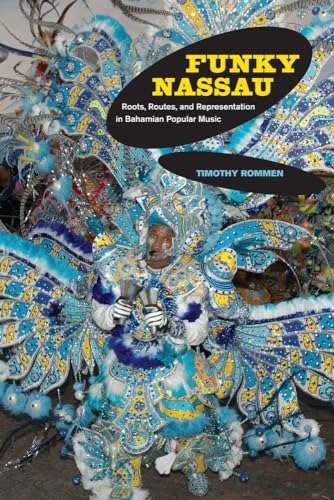
Inhaltsangabe
This book examines the role music has played in the formation of the political and national identity of the Bahamas. Timothy Rommen analyzes Bahamian musical life as it has been influenced and shaped by the islands' location between the United States and the rest of the Caribbean; tourism; and Bahamian colonial and postcolonial history. Focusing on popular music in the second half of the twentieth and early twenty-first centuries, in particular rake-n-scrape and Junkanoo, Rommen finds a Bahamian music that has remained culturally rooted in the local even as it has undergone major transformations. Highlighting the ways entertainers have represented themselves to Bahamians and to tourists, Funky Nassau illustrates the shifting terrain that musicians navigated during the rapid growth of tourism and in the aftermath of independence.
Die Inhaltsangabe kann sich auf eine andere Ausgabe dieses Titels beziehen.
Über die Autorin bzw. den Autor
Timothy Rommen is Associate Professor in the Department of Music at the University of Pennsylvania. He is the author of Mek Some Noise: Gospel Music and the Ethics of Style in Trinidad (UC Press), which in 2008 was awarded the Alan Merriam Prize from the Society for Ethnomusicology.
Von der hinteren Coverseite
“Timothy Rommen has done it again. After the success of his earlier award-winning study of gospel music in Trinidad and the ethics of style, Rommen turns his attention to the complex and conflicted history of music in the Bahamas. Drawing upon extensive ethnographic and historical research, Rommen explores the interrelationships between rake-n-scrape, goombay, and Junkanoo performance, and shows how such ‘local’ musics are implicated in Bahamian understandings of national identity. In Funky Nassau, Timothy Rommen confirms his status as one of the best scholars of Caribbean music today.”
—Michael Largey, author of Vodou Nation: Haitian Art Music and Cultural Nationalism
"This sensitive, bittersweet account of music-making in the Bahamas shows how a small, fragmented country that has been buffeted by powerful currents emanating from both the United States and the Caribbean has managed to produce a vibrant popular music of its own. Rommen carefully maps the political and cultural economies that are integral to this story, but he keeps the musicians themselves, their aesthetics and strategies, at the center where they belong. The result is a vivid and finely nuanced portrait of a unique musical culture that deserves to be better known."
—Kenneth Bilby, Center for Black Music Research, Columbia College Chicago
—Michael Largey, author of Vodou Nation: Haitian Art Music and Cultural Nationalism
"This sensitive, bittersweet account of music-making in the Bahamas shows how a small, fragmented country that has been buffeted by powerful currents emanating from both the United States and the Caribbean has managed to produce a vibrant popular music of its own. Rommen carefully maps the political and cultural economies that are integral to this story, but he keeps the musicians themselves, their aesthetics and strategies, at the center where they belong. The result is a vivid and finely nuanced portrait of a unique musical culture that deserves to be better known."
—Kenneth Bilby, Center for Black Music Research, Columbia College Chicago
Aus dem Klappentext
Timothy Rommen has done it again. After the success of his earlier award-winning study of gospel music in Trinidad and the ethics of style, Rommen turns his attention to the complex and conflicted history of music in the Bahamas. Drawing upon extensive ethnographic and historical research, Rommen explores the interrelationships between rake-n-scrape, goombay, and Junkanoo performance, and shows how such local musics are implicated in Bahamian understandings of national identity. In Funky Nassau, Timothy Rommen confirms his status as one of the best scholars of Caribbean music today.
Michael Largey, author of Vodou Nation: Haitian Art Music and Cultural Nationalism
"This sensitive, bittersweet account of music-making in the Bahamas shows how a small, fragmented country that has been buffeted by powerful currents emanating from both the United States and the Caribbean has managed to produce a vibrant popular music of its own. Rommen carefully maps the political and cultural economies that are integral to this story, but he keeps the musicians themselves, their aesthetics and strategies, at the center where they belong. The result is a vivid and finely nuanced portrait of a unique musical culture that deserves to be better known."
Kenneth Bilby, Center for Black Music Research, Columbia College Chicago
Michael Largey, author of Vodou Nation: Haitian Art Music and Cultural Nationalism
"This sensitive, bittersweet account of music-making in the Bahamas shows how a small, fragmented country that has been buffeted by powerful currents emanating from both the United States and the Caribbean has managed to produce a vibrant popular music of its own. Rommen carefully maps the political and cultural economies that are integral to this story, but he keeps the musicians themselves, their aesthetics and strategies, at the center where they belong. The result is a vivid and finely nuanced portrait of a unique musical culture that deserves to be better known."
Kenneth Bilby, Center for Black Music Research, Columbia College Chicago
Auszug. © Genehmigter Nachdruck. Alle Rechte vorbehalten.
Funky Nassau
Roots, Routes, and Representation in Bahamian Popular Music
By Timothy RommenUNIVERSITY OF CALIFORNIA PRESS
Copyright © 2011 The Regents of the University of California
All rights reserved.
ISBN: 978-0-520-26568-4All rights reserved.
Contents
List of Illustrations, ix,
Preface, xi,
Acknowledgments, xv,
Map of the Bahamas, xvii,
1. Nassau's Gone Funky: Sounding Some Themes in Bahamian Music, 1,
2. "Muddy da Water": Provincializing the Center, or Recentering the Periphery through Rake-n-Scrape, 32,
3. "Calypso Island": Exporting the Local, Particularizing the Region, and Developing the Sounds of Goombay, 79,
4. "Gone ta Bay": Institutionalizing Junkanoo, Festivalizing the Nation, 115,
5. "A New Day Dawning": Cosmopolitanism, Roots, and Identity in the Postcolony, 168,
6. "Back to the Island": Travels in Paradox—Creating the Future-Past, 216,
Epilogue, 265,
Notes, 269,
Bibliography, 291,
Index, 305,
CHAPTER 1
Nassau's Gone Funky
Sounding Some Themes in Bahamian Music
Just last week, a few Ca rib be an nationals joked that The Bahamas is the 51st state of the United States of America. As you can imagine, I was not amused and jumped to the defensive in true Bahamian fashion. Although I would never admit it to my regional brethren, I must reluctantly confess that there was a bit of truth to their satirical claims. For someone who loves The Bahamas and our culture (or what remains of it) like myself, there is nothing that hurts more than the truth. —ANDREW EDWARDS, NASSAU GUARDIAN WEEKENDER, MAY 19, 2006
It's rake-n-scrape. It's rhyming, the way we Bahamians do it. It's rushing, both in the streets, and around our churches. It's the double-rack, the heel-and-toe, the anthem, the story-song that we use to keep one another entertained. It's that real Bahamian guitar riff , it's the way the stomach jumps when a real bass rhythm is played. It's the rescuing of trash, the conversion of ordinary, undervalued objects like cardboard and paper into works of art. It's the way we laugh when the cowbells start, the way we dance when we hear the beat. What "the world" wants is stuff that's raw, that isn't over-processed. What "the world" wants is something that makes "the world" remember its own humanity. And what "the world" wants we have.... We must listen to our music, not just to the people who are popular now, but to our fathers and grandfathers and their fathers, to draw upon all the richness that is ours. And then we must take what we learn from both, and create—and package to sell—our own. —NICOLETTE BETHEL, BAHAMIAN DIRECTOR OF CULTURE, IN THE NASSAU GUARDIAN, MAY 20, 2004
From the Arawaks right down to the Bahamians of the present, Bahamian culture and literature [have] been produced under a situation of de pen den cy, in the sense that the needs and hopes of the Bahamian people to chart and direct our own economic and political destinies, to create societies which responded to our way of being and developed according to our own ideas ... have constantly been sidetracked by the imposition on Bahamians of the ideas, plans, and needs of forces that have come from outside the area. —ANTHONY DAHL, LITERATURE OF THE BAHAMAS, 1724–1992, 2
The epigraphs opening this chapter combine to paint a picture of several pressures facing the Bahamas—pressures that continue to shape dilemmas and challenges for which solutions have not been readily forthcoming. The first of these epigraphs succinctly illustrates the interposition of the Bahamas between the United States and the rest of the Ca rib be an, a space in-between that serves to highlight and intensify questions of cultural identity, raising the specter of the nation—and of nationalism in particular—in the process. Nicolette Bethel, a former director of culture for the Bahamas, transposes these questions of cultural identity neatly onto the "national" product that the Bahamas presents and sells to the world. According to Bethel, however, that export product stands in need of a bit of an overhaul, one that can be realized by understanding that the power of cultural identity and cultural production rests in the past to be recovered for use in the present. The comments of Anthony Dahl, for their part, suggest that the nation's colonial and postcolonial histories have powerfully affected and continue to affect the conditions of possibility for pursuing the project that Nicolette Bethel proposes.
Throughout this book, I suggest that Bahamian musical life has been deeply influenced and shaped by three separate but deeply interrelated themes embedded in these epigraphs: the physical interposition of the Bahamas between the United States and the rest of the Ca rib be an, tourism, and the nation's colonial and postcolonial histories. These geographic, economic, and political influences, moreover, are unthinkable without considering the ways that travel is implicated in each of them—that is, the centrifugal and centripetal routes that are taken through them. For travel operates at several registers in the Bahamian context, including human itineraries, musical migrations and media flows, and journeys related to time and nostalgia.
The physical travels I explore in the chapters that follow include the journeys of Bahamians within and outside the nation; the influx of Ca rib be an migrants from places such as Haiti, Trinidad, and Jamaica; and the itineraries of tourists who flock to places like Paradise Island and Freeport, enjoying (or consuming) the sun, sea, and sand of the Ca rib be an (Sheller 2003). The musical migrations and media flows I trace here, moreover, highlight the internal center-periphery migrations attendant to Bahamian music (Nassau/Freeport–Family Islands) while also illustrating the long-standing and intimate relationships instantiated between Bahamian musics and the musics of the islands' Ca rib be an neighbors (Trinidad, Jamaica, Cuba, and Haiti in particular). In addition, Florida-based radio stations, and more recently cable television, have instantiated other networks of musical and cultural relationships—other journeys that continue to powerfully affect musical production and reception in the Bahamas.
Leading up to and in the wake of independence in 1973, Bahamians increasingly found themselves considering what it sounds, looks, and feels like to be Bahamian, resulting in a concerted attempt by those concerned with cultural politics to explore the riches of the Bahamian past for answers to these questions. The narratives that emerge from these constructions of Bahamianness, from the process of what Svetlana Boym (2002) has called "prospective nostalgia," have resulted in a dynamic by virtue of which the "Real Bahamas" is (re)located in the past to be recovered in the present.? These journeys of memory, time, and nostalgia, then, constitute the third register of travel with which I think about Bahamian musics throughout the book.
These registers of travel, furthermore, are all complicated exponentially by the geopolitical structure of the Bahamas itself, not least because the geography of the archipelago marks the center-periphery relationships always attendant to the nation-state in the starkest of terms. Citizens who live on New Providence or Grand Bahama are located in the center. Those who do not are separated from the center not only in terms of the diminished resources and infrastructure available to them but also by virtue of...
„Über diesen Titel“ kann sich auf eine andere Ausgabe dieses Titels beziehen.
Suchergebnisse für Funky Nassau: Roots, Routes, and Representation in...

Beispielbild für diese ISBN
Funky Nassau: Roots, Routes, and Representation in Bahamian Popular Music (Music of the African Diaspora) (Volume 15)
Verlag:
University of California Press, 2011
ISBN 10: 0520265688
ISBN 13: 9780520265684
Neu
Hardcover
Anbieter: Ria Christie Collections, Uxbridge, Vereinigtes Königreich
Verkäuferbewertung 5 von 5 Sternen

Zustand: New. In English. Artikel-Nr. ria9780520265684_new
Neu kaufen
EUR 103,44
EUR 13,48 Versand
Versand von Vereinigtes Königreich nach USA
Versand von Vereinigtes Königreich nach USA
Anzahl: Mehr als 20 verfügbar
Foto des Verkäufers
Rommen, T: Funky Nassau - Roots, Routes, and Representation
Verlag:
University of California Press, 2011
ISBN 10: 0520265688
ISBN 13: 9780520265684
Neu
Hardcover
Anbieter: moluna, Greven, Deutschland
Verkäuferbewertung 5 von 5 Sternen
Gebunden. Zustand: New. Examines the role music has played in the formation of the political and national identity of the Bahamas. This title examines the role music has played in the formation of the political and national identity of the Bahamas.Über den Autor. Artikel-Nr. 594723075
Neu kaufen
EUR 103,38
EUR 48,99 Versand
Versand von Deutschland nach USA
Versand von Deutschland nach USA
Anzahl: Mehr als 20 verfügbar
Beispielbild für diese ISBN
Funky Nassau Roots, Routes, and Representation in Bahamian Popular Music
Anbieter: Revaluation Books, Exeter, Vereinigtes Königreich
Verkäuferbewertung 5 von 5 Sternen
Hardcover. Zustand: Brand New. 1st edition. 332 pages. 9.25x6.25x1.00 inches. In Stock. Artikel-Nr. x-0520265688
Neu kaufen
EUR 153,99
EUR 14,93 Versand
Versand von Vereinigtes Königreich nach USA
Versand von Vereinigtes Königreich nach USA
Anzahl: 2 verfügbar
Foto des Verkäufers
Funky Nassau : Roots, Routes, and Representation in Bahamian Popular Music
Anbieter: AHA-BUCH GmbH, Einbeck, Deutschland
Verkäuferbewertung 5 von 5 Sternen
Buch. Zustand: Neu. Neuware - This book examines the role music has played in the formation of the political and national identity of the Bahamas. Timothy Rommen analyzes Bahamian musical life as it has been influenced and shaped by the islands' location between the United States and the rest of the Caribbean; tourism; and Bahamian colonial and postcolonial history. Focusing on popular music in the second half of the twentieth and early twenty-first centuries, in particular rake-n-scrape and Junkanoo, Rommen finds a Bahamian music that has remained culturally rooted in the local even as it has undergone major transformations. Highlighting the ways entertainers have represented themselves to Bahamians and to tourists, Funky Nassau illustrates the shifting terrain that musicians navigated during the rapid growth of tourism and in the aftermath of independence. Artikel-Nr. 9780520265684
Neu kaufen
EUR 139,22
EUR 35,00 Versand
Versand von Deutschland nach USA
Versand von Deutschland nach USA
Anzahl: 2 verfügbar