
Verwandte Artikel zu History and the Testimony of Language: Volume 16 (California...
History and the Testimony of Language: Volume 16 (California World History Library, 16, Band 16) - Softcover
Buch 11 von 27: California World History Library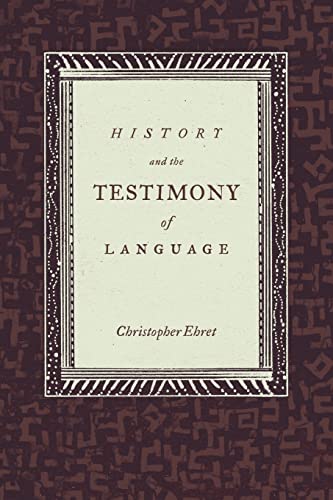
Inhaltsangabe
This book is about history and the practical power of language to reveal historical change. Christopher Ehret offers a methodological guide to applying language evidence in historical studies. He demonstrates how these methods allow us not only to recover the histories of time periods and places poorly served by written documentation, but also to enrich our understanding of well-documented regions and eras. A leading historian as well as historical linguist of Africa, Ehret provides in-depth examples from the language phyla of Africa, arguing that his comprehensive treatment can be applied by linguistically trained historians and historical linguists working with any language and in any area of the world.
Die Inhaltsangabe kann sich auf eine andere Ausgabe dieses Titels beziehen.
Über die Autorin bzw. den Autor
Christopher Ehret is Distinguished Professor of History at the University of California, Los Angeles. He is the author of many books, including Reconstructing Proto-Afroasiatic (UC Press), An African Classical Age, and, most recently, The Civilizations of Africa.
Auszug. © Genehmigter Nachdruck. Alle Rechte vorbehalten.
History and the Testimony of Language
By Christopher EhretUNIVERSITY OF CALIFORNIA PRESS
Copyright © 2011 Christopher Ehret
All rights reserved.
ISBN: 978-0-520-26205-8All rights reserved.
Contents
List of Illustrations, viii,
Acknowledgments, xi,
PART ONE. EVIDENCE AND METHOD,
1. Methods and Myths, 3,
2. Writing History from Linguistic Evidence, 22,
3. Historical Inference from Transformations in the Vocabularies of Culture, 51,
4. Historical Inference from Word Borrowing, 82,
5. Linguistic Dating, 105,
PART TWO. APPLICATIONS,
6. History in the Sahara: Society and Economy in the Early Holocene, 135,
7. Social Transformation in the Horn of Africa, 500 BCE to 500 CE, 170,
8. Recovering the History of Extinct Societies: A Case Study from East Africa, 185,
9. Cultural Diffusion in the Atlantic Age: American Crops in Eastern Africa, 221,
Appendix 1. Outline Classification of Afrasian (Afroasiatic): Diagnostic Branch Innovations, 249,
Appendix 2. Proto-Afrasian and Proto-Erythraic Subsistence, 251,
Appendix 3. Development of Nilo-Saharan Lexicons of Herding and Cultivation, 253,
Appendix 4. Interpreting the Ethiosemitic Cognation Matrix, 256,
Appendix 5. Cushitic Loanwords in Ethiosemitic Core Vocabulary, 261,
Index, 265,
CHAPTER 1
Methods and Myths
GLOBAL HISTORY AND LANGUAGE EVIDENCE
This book is about history and the practical power of language to reveal history. Though it speaks to the disciplines of anthropology and historical linguistics, which pioneered many of the approaches depicted here, it is a book above all for readers and students of history.
It aims to demystify the application of language evidence to history. It is not a treatise on theory, and debating issues of theory is not its brief. Theory receives due attention when it explains or validates method, but method and technique hold the foreground. And it is not a historical linguistics manual. It is a practical book on writing human history from the documentation of language.
The writing of history from language evidence begins with a fact, simple in statement but complex in its implications: every language is an archive. Its documents are the thousands of words that make up its lexicon. Each development of a new word, each shift in meaning or change in usage of an existing word, takes place for a human historical reason. Sometimes the reason may have been an ephemeral factor of taste or fashion no longer recoverable. But more often that not, word histories have practical and discernable causes. New words come into use, and old words change meaning or add new meanings, because change takes place in the particular elements of human knowledge, belief, custom, or livelihood to which they refer.
Word histories directly register the cultural events of human history. From each word's history we can infer different individual elements of the human history that lies behind the changes the word has undergone. From the histories of many words together we can build up a complex understanding of the history of the society as a whole. And from applying this kind of research to regional collections of societies and their languages, we can construct intricate regional histories of the longue durée.
Recovering history from the evidence of language is no new enterprise. Scholars of indo-European studies have drawn on this kind of evidence from the beginnings of their field two centuries ago, and students of American Indian cultural history have pursued studies of this type over an almost equally long span. Edward Sapir's Time Perspective in Aboriginal American Culture, the classic presentation of the methods of historical inference from ethnographic as well as linguistic evidence, was published over nine decades ago, in 1916. For most parts of the world, culture historians, ethnologists, and linguists have long produced works applying linguistic evidence in one fashion or another to the uncovering of new knowledge about past human lives and cultures. Historians have not been entirely oblivious to these instruments, but they have wielded them rarely and have tended to put them to only limited use.
From the late 1960s onward, a small group of historians of Africa have taken the lead as practitioners and innovators in the application of linguistic methods and documentation. For this reason, in the chapters that follow, African history provides the primary models for undertaking this kind of work. The scholars who carried the work forward for Africa have repeatedly broken new ground methodologically while deepening and broadening our understanding of early history and bringing to light complex and nuanced regional stories of the longue durée in Africa.
Their techniques and methods have global utility. Oceania, interior Asia, southern and southeastern Asia, and pre-Columbian America are prime regions for the application of these approaches in the coming decades, as world history studies expand their reach. For any period or region of history where the written documentation is scanty or simply highly uneven in its coverage, these approaches can fill out the overall historical picture and, often, allow us to finally make sense of ambiguous written testimonies. Medieval European as well as Classical Mediterranean history—and not just premodern non-Western history—would be well served by such endeavors. Even when the written documentation seems extensive, language evidence can open windows into otherwise obscure or inaccessible aspects of the histories of those written about.
The most important feature of the pioneering African studies is that they present history as historians write it. They differ fundamentally from most previous works by anthropologists and ethnographers and by Indo-Europeanists, who have used linguistic evidence and comparative ethnography principally to trace population movements or to reconstruct the origins, development, and spread of particular ideas, rituals, institutions, customs, or elements of material culture. The new African histories have sought, in contrast, to build integrated regional stories of the past. The issues they raise and the questions they seek to answer speak to historians' concerns and historians' sensibilities.
BUILDING THE LIBRARY: LINGUISTICS IN AFRICAN HISTORY
Introducing the Methods to Historians
The rise, long overdue, of African history to academic standing in the 1960s brought new attention to linguistic, and secondarily to ethnographic, resources for reconstructing the past. This new interest took hold even as the traditional disciplinary homes of this kind of study—in north America, departments of anthropology, and in Europe, departments of ethnology—had begun to lose interest in them. In 1964 and 1968 Jan vansina introduced historians of Africa to historical inference from comparative ethnography in two articles, "The Uses of Process Models in African History" and "The Uses of Ethnographic data as sources for History." in these articles he recapitulated in compact and accessible fashion the principles and procedures of this kind of study. In 1968 I performed a parallel service for linguistic method in history with an article entitled "Linguistics as a Tool for Historians," following this up with a second article in the 1970s, "Linguistic Evidence and Its Correlation with Archaeology." The latter article once again presented the methods of historical inference from language evidence, but it did so in the context of showing how these findings...
„Über diesen Titel“ kann sich auf eine andere Ausgabe dieses Titels beziehen.
Suchergebnisse für History and the Testimony of Language: Volume 16 (California...

Beispielbild für diese ISBN
History and the Testimony of Language
Verlag:
University of California Press, 2010
ISBN 10: 0520262050
ISBN 13: 9780520262058
Gebraucht
Softcover
Anbieter: Better World Books, Mishawaka, IN, USA
Verkäuferbewertung 5 von 5 Sternen

Zustand: Fine. Used book that is in almost brand-new condition. May contain a remainder mark. Better World Books: Buy Books. Do Good. Artikel-Nr. 55313806-6
Gebraucht kaufen
EUR 9,09
Versand gratis
Versand innerhalb von USA
Versand innerhalb von USA
Anzahl: 3 verfügbar
Beispielbild für diese ISBN
History and the Testimony of Language (California World History Library) (Volume 16)
Verlag:
University of California Press, 2010
ISBN 10: 0520262050
ISBN 13: 9780520262058
Neu
Softcover
Anbieter: Ria Christie Collections, Uxbridge, Vereinigtes Königreich
Verkäuferbewertung 5 von 5 Sternen
Zustand: New. In English. Artikel-Nr. ria9780520262058_new
Neu kaufen
EUR 42,36
EUR 13,34 Versand
Versand von Vereinigtes Königreich nach USA
Versand von Vereinigtes Königreich nach USA
Anzahl: Mehr als 20 verfügbar
Beispielbild für diese ISBN
History and the Testimony of Language
Anbieter: Revaluation Books, Exeter, Vereinigtes Königreich
Verkäuferbewertung 5 von 5 Sternen
Paperback. Zustand: Brand New. 1st edition. 288 pages. 8.75x5.75x0.75 inches. In Stock. Artikel-Nr. x-0520262050
Neu kaufen
EUR 58,83
EUR 11,82 Versand
Versand von Vereinigtes Königreich nach USA
Versand von Vereinigtes Königreich nach USA
Anzahl: 2 verfügbar
Foto des Verkäufers
Ehret, C: History and the Testimony of Language
Verlag:
University of California Press, 2011
ISBN 10: 0520262050
ISBN 13: 9780520262058
Neu
Kartoniert / Broschiert
Anbieter: moluna, Greven, Deutschland
Verkäuferbewertung 5 von 5 Sternen
Kartoniert / Broschiert. Zustand: New. A guide to applying language evidence in historical studies. It demonstrates how these methods allow us not only to recover the histories of time periods and places poorly served by written documentation, but also to enrich our understanding of well-documen. Artikel-Nr. 594722979
Neu kaufen
EUR 44,70
EUR 48,99 Versand
Versand von Deutschland nach USA
Versand von Deutschland nach USA
Anzahl: Mehr als 20 verfügbar
Foto des Verkäufers
History and the Testimony of Language
Anbieter: AHA-BUCH GmbH, Einbeck, Deutschland
Verkäuferbewertung 5 von 5 Sternen
Taschenbuch. Zustand: Neu. Neuware - This book is about history and the practical power of language to reveal historical change. Christopher Ehret offers a methodological guide to applying language evidence in historical studies. He demonstrates how these methods allow us not only to recover the histories of time periods and places poorly served by written documentation, but also to enrich our understanding of well-documented regions and eras. A leading historian as well as historical linguist of Africa, Ehret provides in-depth examples from the language phyla of Africa, arguing that his comprehensive treatment can be applied by linguistically trained historians and historical linguists working with any language and in any area of the world. Artikel-Nr. 9780520262058
Neu kaufen
EUR 59,61
EUR 35,00 Versand
Versand von Deutschland nach USA
Versand von Deutschland nach USA
Anzahl: 2 verfügbar