
Verwandte Artikel zu Docks
Inhaltsangabe
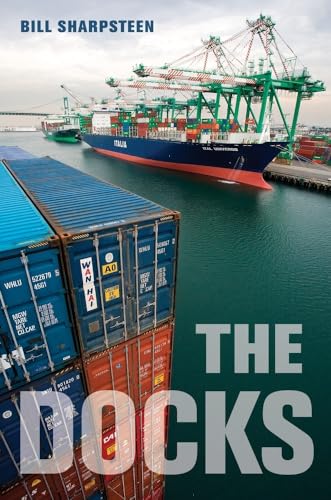
The Docks is an eye-opening journey into a giant madhouse of activity that few outsiders ever see: the Port of Los Angeles. In a book woven throughout with riveting novelist detail and illustrated with photographs that capture the frenetic energy of the place, Bill Sharpsteen tells the story of the people who have made this port, the largest in the country, one of the nation’s most vital economic enterprises. Among others, we meet a pilot who parks ships, one of the first women longshoremen, union officials and employers at odds over almost everything, an environmental activist fighting air pollution in the “diesel death zone,” and those with the nearly impossible job of enforcing security. Together these stories paint a compelling picture of a critical entryway for goods coming into the country—the Port of Los Angeles is part of a complex that brings in 40% of all our waterborne cargo and 70% of all Asian imports—yet one that is also extremely vulnerable. The Docks is a rare look at a world within our world in which we find a microcosm of the labor, environmental, and security issues we collectively face.
Die Inhaltsangabe kann sich auf eine andere Ausgabe dieses Titels beziehen.
Über die Autorin bzw. den Autor
Bill Sharpsteen is a writer and photographer based in Los Angeles. He is the author of Dirty Water: One Man’s Fight to Clean Up One of the World’s Most Polluted Bays (UC Press), and his articles have appeared in the Los Angeles Times Magazine, Los Angeles Magazine, and The Washington Post. He is also an award-winning documentary producer.
Von der hinteren Coverseite
"The Docks delivers a raw and poignant behind-the-scenes view of our port through the eyes of workers, shippers, executives and sideline critics. Sharpsteen pieces together an unvarnished mosaic that reveals the enormity of the operations and its workforce, amidst a perennial maelstrom of debates and competing interests."—Geraldine Knatz, Executive Director, Port of Los Angeles
"An engaging page turner. Sharpsteen captures the feeling and interconnectedness of the Los Angeles Waterfront, the noise, the excitement, the joys, the tensions, the complexities and conflicts. I found it difficult to put down."—David Wellman, author of Whitewashing Race
"Sharpsteen has almost a novelist's talent for using human interest profiles to engage an audience and present a non-fiction narrative. Here is working knowledge not only of how the Port of Los Angeles functions, but of its crucial importance to the region, nation, and world economy, and what its loss would mean."—Gray Brechin, author of Imperial San Francisco: Urban Power, Earthly Ruin
"An engaging page turner. Sharpsteen captures the feeling and interconnectedness of the Los Angeles Waterfront, the noise, the excitement, the joys, the tensions, the complexities and conflicts. I found it difficult to put down."—David Wellman, author of Whitewashing Race
"Sharpsteen has almost a novelist's talent for using human interest profiles to engage an audience and present a non-fiction narrative. Here is working knowledge not only of how the Port of Los Angeles functions, but of its crucial importance to the region, nation, and world economy, and what its loss would mean."—Gray Brechin, author of Imperial San Francisco: Urban Power, Earthly Ruin
Aus dem Klappentext
"The Docks delivers a raw and poignant behind-the-scenes view of our port through the eyes of workers, shippers, executives and sideline critics. Sharpsteen pieces together an unvarnished mosaic that reveals the enormity of the operations and its workforce, amidst a perennial maelstrom of debates and competing interests."—Geraldine Knatz, Executive Director, Port of Los Angeles
"An engaging page turner. Sharpsteen captures the feeling and interconnectedness of the Los Angeles Waterfront, the noise, the excitement, the joys, the tensions, the complexities and conflicts. I found it difficult to put down."—David Wellman, author of Whitewashing Race
"Sharpsteen has almost a novelist's talent for using human interest profiles to engage an audience and present a non-fiction narrative. Here is working knowledge not only of how the Port of Los Angeles functions, but of its crucial importance to the region, nation, and world economy, and what its loss would mean."—Gray Brechin, author of Imperial San Francisco: Urban Power, Earthly Ruin
"An engaging page turner. Sharpsteen captures the feeling and interconnectedness of the Los Angeles Waterfront, the noise, the excitement, the joys, the tensions, the complexities and conflicts. I found it difficult to put down."—David Wellman, author of Whitewashing Race
"Sharpsteen has almost a novelist's talent for using human interest profiles to engage an audience and present a non-fiction narrative. Here is working knowledge not only of how the Port of Los Angeles functions, but of its crucial importance to the region, nation, and world economy, and what its loss would mean."—Gray Brechin, author of Imperial San Francisco: Urban Power, Earthly Ruin
Auszug. © Genehmigter Nachdruck. Alle Rechte vorbehalten.
The Docks
By Bill SharpsteenUNIVERSITY OF CALIFORNIA PRESS
Copyright © 2011 The Regents of the University of California
All rights reserved.
ISBN: 978-0-520-26193-8All rights reserved.
Contents
List of Illustrations, ix,
Preface, xi,
Introduction, 1,
1. Valet Parking, 5,
2. A Carpet of Containers, 24,
3. Moving Cans, 33,
4. The Landlord, 52,
5. The Diesel Death Zone, 60,
6. The Union, 92,
7. The Employers, 125,
8. The Importer, 142,
9. The Shipper, 155,
10. Los Troqueros, 164,
11. The Hold Men, 185,
12. The Women, 204,
13. The Clerk, 220,
14. Security, 230,
15. The New Normal, 254,
16. Hawse Piper, 264,
References, 279,
Index, 303,
CHAPTER 1
Valet Parking
A SHIP ARRIVES
Most people board a cargo ship on a gangway, a safe, though perhaps steep, ramp that goes from dock to ship's deck with just enough metallic, rickety sounds to make it feel unique and even romantic in a nautical sort of way. Then there's how I'm about to board a ship with port pilot Captain Ron Rogers: we'll do it, like pirates, by climbing up a ship's hull on a wet rope ladder dangling above a sloshing ocean 2 miles from shore. And, oh, by the way, I'm told it's kind of dangerous.
This has me a little distracted when I walk into the port pilots dispatch office. As busy as the Port of Los Angeles is on paper, I'm a little surprised at the sleepy calm here. I had expected the chaotic charm of an air traffic controllers' tower—after all, the office oversees the six thousand ships that enter the port each year, sending out its cadre of fifteen captains to guide the vessels into their appointed berths. But on this day it might as well be a doctor's waiting room.
Dispatcher Beth Adamik, a tall, middle-aged woman with a friendly, grandmotherly voice, stands to shake my hand and then sinks back in her chair before a computer monitor that displays a jagged graphic of the California coast, the port, and a constant line of rectangular ship icons stuttering through a designated shipping lane. Instead of being made to feel like an intrusion, I'm told to relax, as if I'm a guest in Adamik's living room and we're here to hang out over coffee.
Sitting between two sets of living quarters for pilots, the two-story dispatch office looks through a wall of windows over the entrance to the port's Main Channel, a bright, glary view that's less informative than it first seems. Even on clear days such as this, the air has a translucent quality, so Adamik and the other dispatchers instead watch their monitors for the ships entering the harbor and look out only if they have a moment to check the weather while listening to the Sirius Radio Love Songs channel that plays off a television in a back corner.
The port requires all deep-draft vessels (any ship needing 55 feet of water to float) to be guided from open water to final docking by a port pilot. Nearly all ports in the world do this, and the reason is simple: for someone in a large ship accustomed to navigating the open seas, approaching the unfamiliar Port of Los Angeles is like driving a bus from an empty stadium parking lot into a narrow, dark alley full of unknown, hidden obstructions. Without a port pilot's local expertise to direct the ship through the harbor's unique currents and park it at the correct dock, the world's fleet would probably be dented and mangled (and the world's ports in far worse shape). For this expertise, port pilots are paid $150,000 to $300,000 a year.
Adamik points at the computer monitor and tells me that they've chosen the Wan Hai 312 as the ship I'll be boarding. It's going to the back end of the port, she says, and that'll give me a long ride to soak up all the details I can. At the moment, the Wan Hai 312 is easing down the California coast at 9.5 knots. We know this because information on each vessel is radioed from the ship via a mandatory Auto Identification System to the Marine Exchange, a nondescript building on a hill above the harbor, and then relayed to the dispatch office. On the computer monitor, each ship icon jerks in short steps down the grayed-out shipping lane, the traffic sometimes so heavy that vessel names overlay one another. Adamik can select any ship on the screen and with two mouse clicks determine its speed and distance from the port.
Just then, the captain of the Wan Hai 312 radios to the dispatch office as required when the ship is 25 miles from the port entrance.
"Please prepare ladder on the starboard side," Adamik says crisply into a large microphone, referring to the Jacob's ladder constructed of rope and wooden rungs that Captain Rogers and I will use to board the ship. "Starboard side ladder one meter above the water, and call us again as soon as you enter the Precautionary Area." The captain repeats the instructions.
"Also, are your bow thrusters in good working condition?" Adamik asks. The Wan Hai 312 is small enough that it will need only one tugboat to steer it through the port complex if the bow thrusters (water jets used for maneuvering) are operational.
"They're in good working condition, over."
"Thank you for that, captain."
I don't want to seem too concerned about this rope ladder business, so I ease into the subject as if I'm talking about the weather. Adamik plays along and implies that this is like a rite of passage for some at the port. Board a ship by scampering up its hull, and you've got the kind of minor bragging rights that impress just about everyone outside of the Coast Guard. That it has that kind of cachet has me a little worried.
I'm here for one main reason: I want to see what it's like for a ship to enter the Port of Los Angeles, slowly sailing past the dozens of piers and docked ships. I figure if I'm writing a book about the country's largest port, I need to know what a ship captain sees for the first time as he (not many women captains out there) leaves the comfortable open water off the California coast and snuggles into a berth for two days. The experience should give me a picture to paint that involves people and not just tons of steel.
Unfortunately, the carriers—the companies whose ships take cargo from point A to point B—weren't interested in letting me ride for awhile on one of their ships. Come to think of it, just about everybody in the ultra-competitive shipping industry, from the carriers to the shippers (those who hire the carriers to move their cargo) to the railroads who haul the cargo to the rest of the country, stiff-armed me every time I humbly asked for a little access. Seems they were worried I might inadvertently reveal to their competitors some profitable technique that had saved them a penny or two in costs per container. If that sounds like a flimsy excuse, they also threw out the security rationale, which these days seems to trump all else. While no one accused me of wanting to enter a restricted area (pretty much the entire port) with explosives strapped to my body, they politely treated the request for a visit as though as I were indeed a terrorist. In truth, most companies rarely give access to reporters unless there's a commercial or public relations angle, and apparently neither need jumped out at them when I called.
Finally, with help from the Port of Los Angeles communications department—which indeed saw a PR angle—I was able to arrange to ride with a port pilot and get the sailor's view of entering the world of the port. Attaching myself to Captain Rogers gave me an end-around on all the...
„Über diesen Titel“ kann sich auf eine andere Ausgabe dieses Titels beziehen.
Suchergebnisse für Docks

Beispielbild für diese ISBN
The Docks
Verlag:
University of California Press, 2011
ISBN 10: 0520261933
ISBN 13: 9780520261938
Gebraucht
Hardcover
Anbieter: ThriftBooks-Dallas, Dallas, TX, USA
Verkäuferbewertung 5 von 5 Sternen

Hardcover. Zustand: Very Good. No Jacket. May have limited writing in cover pages. Pages are unmarked. ~ ThriftBooks: Read More, Spend Less. Artikel-Nr. G0520261933I4N00
Gebraucht kaufen
EUR 6,23
Versand gratis
Versand innerhalb von USA
Versand innerhalb von USA
Anzahl: 1 verfügbar
Beispielbild für diese ISBN
The Docks
Verlag:
University of California Press, 2011
ISBN 10: 0520261933
ISBN 13: 9780520261938
Gebraucht
Hardcover
Anbieter: Books From California, Simi Valley, CA, USA
Verkäuferbewertung 4 von 5 Sternen

hardcover. Zustand: Good. Artikel-Nr. mon0003731605
Gebraucht kaufen
EUR 15,73
EUR 4,33 Versand
Versand innerhalb von USA
Versand innerhalb von USA
Anzahl: 1 verfügbar
Foto des Verkäufers
THE DOCKS
Verlag:
University of California Press, 2011
ISBN 10: 0520261933
ISBN 13: 9780520261938
Gebraucht
Hardcover
Erstausgabe
Signiert
Anbieter: Champ & Mabel Collectibles, San Pedro, CA, USA
Verkäuferbewertung 5 von 5 Sternen
Hardcover. Zustand: Very Good. Zustand des Schutzumschlags: Very Good. 1st Edition. xiv, 310p. 1st printing. Signed by author on title page. Jacket corners lightly worn. A look at the Port of Los Angeles, part of the largest port complex in the United States, through the workers who are employed at all levels. Includes bibliographical references. Jacket design by Sandy Drooker. B&w photographs. (9-1/8"x6-1/4"). Signed by Author(s). Artikel-Nr. H13207
Gebraucht kaufen
EUR 21,43
EUR 4,33 Versand
Versand innerhalb von USA
Versand innerhalb von USA
Anzahl: 1 verfügbar
Beispielbild für diese ISBN
The Docks
Verlag:
University of California Press, 2011
ISBN 10: 0520261933
ISBN 13: 9780520261938
Neu
Hardcover
Anbieter: PBShop.store US, Wood Dale, IL, USA
Verkäuferbewertung 5 von 5 Sternen
HRD. Zustand: New. New Book. Shipped from UK. Established seller since 2000. Artikel-Nr. L2-9780520261938
Neu kaufen
EUR 87,61
Versand gratis
Versand innerhalb von USA
Versand innerhalb von USA
Anzahl: Mehr als 20 verfügbar
Beispielbild für diese ISBN
The Docks
Verlag:
University of California Press, 2011
ISBN 10: 0520261933
ISBN 13: 9780520261938
Neu
Hardcover
Anbieter: PBShop.store UK, Fairford, GLOS, Vereinigtes Königreich
Verkäuferbewertung 5 von 5 Sternen
HRD. Zustand: New. New Book. Shipped from UK. Established seller since 2000. Artikel-Nr. L2-9780520261938
Neu kaufen
EUR 83,33
EUR 5,86 Versand
Versand von Vereinigtes Königreich nach USA
Versand von Vereinigtes Königreich nach USA
Anzahl: Mehr als 20 verfügbar
Beispielbild für diese ISBN
Docks
Verlag:
University of California Press, 2011
ISBN 10: 0520261933
ISBN 13: 9780520261938
Neu
Hardcover
Anbieter: Ria Christie Collections, Uxbridge, Vereinigtes Königreich
Verkäuferbewertung 5 von 5 Sternen
Zustand: New. In English. Artikel-Nr. ria9780520261938_new
Neu kaufen
EUR 82,20
EUR 13,18 Versand
Versand von Vereinigtes Königreich nach USA
Versand von Vereinigtes Königreich nach USA
Anzahl: Mehr als 20 verfügbar
Beispielbild für diese ISBN
The Docks
Anbieter: Revaluation Books, Exeter, Vereinigtes Königreich
Verkäuferbewertung 5 von 5 Sternen
Hardcover. Zustand: Brand New. 1st edition. 328 pages. 9.25x6.25x0.75 inches. In Stock. Artikel-Nr. x-0520261933
Neu kaufen
EUR 134,22
EUR 14,60 Versand
Versand von Vereinigtes Königreich nach USA
Versand von Vereinigtes Königreich nach USA
Anzahl: 2 verfügbar
Foto des Verkäufers
Sharpsteen, B: Docks
Verlag:
University of California Press, 2010
ISBN 10: 0520261933
ISBN 13: 9780520261938
Neu
Hardcover
Anbieter: moluna, Greven, Deutschland
Verkäuferbewertung 5 von 5 Sternen
Gebunden. Zustand: New. Offers a journey into a giant madhouse of activity that few outsiders ever see: the Port of Los Angeles. This book tells the story of the people who have made this port, the largest in the country, one of the nation s most vital economic enterprises. Artikel-Nr. 594722975
Neu kaufen
EUR 101,80
EUR 48,99 Versand
Versand von Deutschland nach USA
Versand von Deutschland nach USA
Anzahl: Mehr als 20 verfügbar
Foto des Verkäufers
The Docks
Verlag:
University Of California Press Jan 2011, 2011
ISBN 10: 0520261933
ISBN 13: 9780520261938
Neu
Hardcover
Anbieter: AHA-BUCH GmbH, Einbeck, Deutschland
Verkäuferbewertung 5 von 5 Sternen
Buch. Zustand: Neu. Neuware - Offers a journey into a giant madhouse of activity that few outsiders ever see: the Port of Los Angeles. This book tells the story of the people who have made this port, the largest in the country, one of the nation's most vital economic enterprises. Artikel-Nr. 9780520261938
Neu kaufen
EUR 194,03
EUR 30,50 Versand
Versand von Deutschland nach USA
Versand von Deutschland nach USA
Anzahl: 2 verfügbar