
Verwandte Artikel zu The Copernican Question: Prognostication, Skepticism,...
Inhaltsangabe
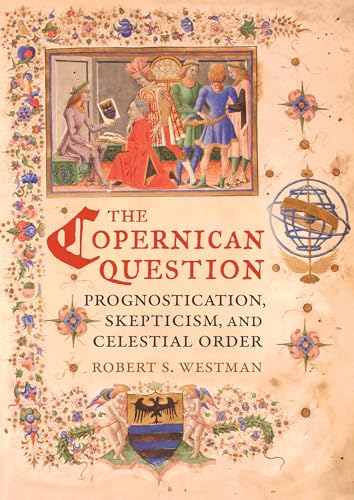
In 1543, Nicolaus Copernicus publicly defended his hypothesis that the earth is a planet and the sun a body resting near the center of a finite universe. But why did Copernicus make this bold proposal? And why did it matter? The Copernican Question reframes this pivotal moment in the history of science, centering the story on a conflict over the credibility of astrology that erupted in Italy just as Copernicus arrived in 1496. Copernicus engendered enormous resistance when he sought to protect astrology by reconstituting its astronomical foundations. Robert S. Westman shows that efforts to answer the astrological skeptics became a crucial unifying theme of the early modern scientific movement. His interpretation of this "long sixteenth century," from the 1490s to the 1610s, offers a new framework for understanding the great transformations in natural philosophy in the century that followed.
Die Inhaltsangabe kann sich auf eine andere Ausgabe dieses Titels beziehen.
Über die Autorin bzw. den Autor
Robert S. Westman is Professor Emeritus of History of Science and a founding member of the Science Studies Program at the University of California, San Diego. He was the 2018–2019 Sarton Chair and recipient of the Sarton Medal in the History of Science at the University of Ghent, Belgium, awarded for lifetime achievement.
Von der hinteren Coverseite
"Westman's profound understanding of his subject informs every page of this magisterial book. The Copernican Question provides a new road map to one of the central episodes in the history of science, in all its cultural, social, and philosophical complexity." —Peter Dear, author of Revolutionizing the Sciences: European Knowledge and Its Ambitions, 1500-1700
“The Copernican Question is a truly astonishing work. Westman writes with the authority of someone who has really done his homework; he tells a fascinating story and tells it exceedingly well." —Ernan McMullin, editor of The Church and Galileo
“Robert Westman’s engrossing book—the fruit of many years’ research—offers the best answer given so far to the question of Copernicus. The Polish astronomer was an enigma to his contemporaries and to many who later struggled to understand his ideas. Westman shows that astrological prediction provides the missing key to his work and to its interpretation by astronomers in the subsequent decades. He sets the Copernican tradition against a backdrop of tumultuous religious conflict, apocalyptic prophecies, and the explosive growth of printed publications. This book is a magnificent scholarly achievement. Everyone who is seriously interested in the science and culture of early-modern Europe will want to read it.” —Jan Golinski, author of British Weather and the Climate of Enlightenment
"Robert Westman's The Copernican Question is a magnificent achievement. It is a comprehensive, nuanced, and fascinating reinterpretation of the Copernican century and the transformation of astronomy. This book will be of interest to anyone who wants a new understanding of the history of the heliocentric hypothesis and the complex problems facing Copernicus and his contemporaries and followers." —Carolyn Merchant, author of The Death of Nature: Women, Ecology, and the Scientific Revolution
“The Copernican Question is a richly detailed, extensively researched, and engagingly written book that radically recontextualizes major figures in the “science of the stars” from Copernicus to Galileo, revealing new connections and motivations for their work and ideas. It will be required reading for historians and philosophers of science and for anyone interested in how and why we came to know what we do about the heavens.” —Lawrence M. Principe, author of The Scientific Revolution: A Very Short Introduction
“The Copernican Question is a truly astonishing work. Westman writes with the authority of someone who has really done his homework; he tells a fascinating story and tells it exceedingly well." —Ernan McMullin, editor of The Church and Galileo
“Robert Westman’s engrossing book—the fruit of many years’ research—offers the best answer given so far to the question of Copernicus. The Polish astronomer was an enigma to his contemporaries and to many who later struggled to understand his ideas. Westman shows that astrological prediction provides the missing key to his work and to its interpretation by astronomers in the subsequent decades. He sets the Copernican tradition against a backdrop of tumultuous religious conflict, apocalyptic prophecies, and the explosive growth of printed publications. This book is a magnificent scholarly achievement. Everyone who is seriously interested in the science and culture of early-modern Europe will want to read it.” —Jan Golinski, author of British Weather and the Climate of Enlightenment
"Robert Westman's The Copernican Question is a magnificent achievement. It is a comprehensive, nuanced, and fascinating reinterpretation of the Copernican century and the transformation of astronomy. This book will be of interest to anyone who wants a new understanding of the history of the heliocentric hypothesis and the complex problems facing Copernicus and his contemporaries and followers." —Carolyn Merchant, author of The Death of Nature: Women, Ecology, and the Scientific Revolution
“The Copernican Question is a richly detailed, extensively researched, and engagingly written book that radically recontextualizes major figures in the “science of the stars” from Copernicus to Galileo, revealing new connections and motivations for their work and ideas. It will be required reading for historians and philosophers of science and for anyone interested in how and why we came to know what we do about the heavens.” —Lawrence M. Principe, author of The Scientific Revolution: A Very Short Introduction
Aus dem Klappentext
"Westman's profound understanding of his subject informs every page of this magisterial book. The Copernican Question provides a new road map to one of the central episodes in the history of science, in all its cultural, social, and philosophical complexity." Peter Dear, author of Revolutionizing the Sciences: European Knowledge and Its Ambitions, 1500-1700
The Copernican Question is a truly astonishing work. Westman writes with the authority of someone who has really done his homework; he tells a fascinating story and tells it exceedingly well." Ernan McMullin, editor of The Church and Galileo
Robert Westman s engrossing book the fruit of many years research offers the best answer given so far to the question of Copernicus. The Polish astronomer was an enigma to his contemporaries and to many who later struggled to understand his ideas. Westman shows that astrological prediction provides the missing key to his work and to its interpretation by astronomers in the subsequent decades. He sets the Copernican tradition against a backdrop of tumultuous religious conflict, apocalyptic prophecies, and the explosive growth of printed publications. This book is a magnificent scholarly achievement. Everyone who is seriously interested in the science and culture of early-modern Europe will want to read it. Jan Golinski, author of British Weather and the Climate of Enlightenment
"Robert Westman's The Copernican Question is a magnificent achievement. It is a comprehensive, nuanced, and fascinating reinterpretation of the Copernican century and the transformation of astronomy. This book will be of interest to anyone who wants a new understanding of the history of the heliocentric hypothesis and the complex problems facing Copernicus and his contemporaries and followers." Carolyn Merchant, author of The Death of Nature: Women, Ecology, and the Scientific Revolution
The Copernican Question is a richly detailed, extensively researched, and engagingly written book that radically recontextualizes major figures in the science of the stars from Copernicus to Galileo, revealing new connections and motivations for their work and ideas. It will be required reading for historians and philosophers of science and for anyone interested in how and why we came to know what we do about the heavens. Lawrence M. Principe, author of The Scientific Revolution: A Very Short Introduction
The Copernican Question is a truly astonishing work. Westman writes with the authority of someone who has really done his homework; he tells a fascinating story and tells it exceedingly well." Ernan McMullin, editor of The Church and Galileo
Robert Westman s engrossing book the fruit of many years research offers the best answer given so far to the question of Copernicus. The Polish astronomer was an enigma to his contemporaries and to many who later struggled to understand his ideas. Westman shows that astrological prediction provides the missing key to his work and to its interpretation by astronomers in the subsequent decades. He sets the Copernican tradition against a backdrop of tumultuous religious conflict, apocalyptic prophecies, and the explosive growth of printed publications. This book is a magnificent scholarly achievement. Everyone who is seriously interested in the science and culture of early-modern Europe will want to read it. Jan Golinski, author of British Weather and the Climate of Enlightenment
"Robert Westman's The Copernican Question is a magnificent achievement. It is a comprehensive, nuanced, and fascinating reinterpretation of the Copernican century and the transformation of astronomy. This book will be of interest to anyone who wants a new understanding of the history of the heliocentric hypothesis and the complex problems facing Copernicus and his contemporaries and followers." Carolyn Merchant, author of The Death of Nature: Women, Ecology, and the Scientific Revolution
The Copernican Question is a richly detailed, extensively researched, and engagingly written book that radically recontextualizes major figures in the science of the stars from Copernicus to Galileo, revealing new connections and motivations for their work and ideas. It will be required reading for historians and philosophers of science and for anyone interested in how and why we came to know what we do about the heavens. Lawrence M. Principe, author of The Scientific Revolution: A Very Short Introduction
Auszug. © Genehmigter Nachdruck. Alle Rechte vorbehalten.
The Copernican Question
Prognostication, Skepticism, and Celestial Order
By Robert S. WestmanUNIVERSITY OF CALIFORNIA PRESS
Copyright © 2011 The Regents of the University of California
All rights reserved.
ISBN: 978-0-520-25481-7All rights reserved.
Contents
List of Illustrations, xi,
Preface and Acknowledgments, xv,
INTRODUCTION, 1,
I Copernicus's Space of Possibilities,
1. THE LITERATURE OF THE HEAVENS AND THE SCIENCE OF THE STARS, 25,
2. CONSTRUCTING THE FUTURE, 62,
3. COPERNICUS AND THE CRISIS OF THE BOLOGNA PROGNOSTICATORS, 1496–1500, 76,
II Confessional and Interconfessional Spaces of Prophecy and Prognostication,
4. BETWEEN WITTENBERG AND ROME The New System, Astrology, and the End of the World, 109,
5. THE WITTENBERG INTERPRETATION OF COPERNICUS'S THEORY, 141,
6. Varieties OF ASTROLOGICAL credibility, 171,
7. FOREKNOWLEDGE, SKEPTICISM, AND CELESTIAL ORDER IN ROME, 194,
III Accommodating Unanticipated, Singular Novelties,
8. Planetary ORDER, ASTRONOMICAL REFORM, AND THE extraordinary COURSE OF NATURE, 223,
9. THE SECOND-GENERATION COPERNICANS Maestlin and Digges, 259,
10. A PROLIFERATION OF READINGS, 281,
IV Securing the Divine Plan,
11. THE EMERGENCE OF KEPLER'S COPERNICAN REPRESENTATION, 309,
12. KEPLER'S EARLY AUDIENCES, 1596–1600, 336,
V Conflicted Modernizers at the Turn of the Century,
13. THE THIRD-GENERATION COPERNICANS Galileo and Kepler, 353,
14. THE NATURALIST TURN AND CELESTIAL ORDER Constructing the Nova of 1604, 382,
15. HOW KEPLER'S NEW STAR TRAVELED TO ENGLAND, 403,
VI The Modernizers, Recurrent Novelties, and Celestial Order,
16. THE STRUGGLE FOR ORDER, 419,
17. MODERNIZING THEORETICAL KNOWLEDGE Patronage, Reputation, Learned Sociability, Gentlemanly Veracity, 434,
18. HOW GALILEO'S RECURRENT NOVELTIES TRAVELED, 455,
CONCLUSION. THE GREAT CONTROVERSY, 485,
Notes, 515,
Bibliography, 605,
Index, 649,
CHAPTER 1
The Literature of the Heavens and the Science of the Stars
PRINTING, PLANETARY THEORY, AND THE GENRES OF FORECAST
In the fifteenth century, a vast and complex literature described, explained, and invoked the motions of the heavens and their influences on the Earth. From the 1470s onward, the learning of the heavens, much of it inherited from the ancient and medieval worlds, began to acquire a new sort of accessibility as it was reproduced in the medium of print. This chapter describes the broad contours of that literature and its various classifications. It shows how those categories evolved, how it worked as a body of knowledge, and the peculiar forms that it took in the sixteenth century. This corpus of writings—rather than an exclusive and autonomous stream of planetary theory—constituted the foundational categories of the intellectual world in which Copernicus was educated at Krakow and Bologna in the 1490s and in which his work took form and was later evaluated.
Interest in astrological prognosticating had begun to catch on in the Latin West as far back as the twelfth century, with the arrival of sophisticated Arabic astrological writings. Among the most influential of such works was the Great Introduction to Astrology of Albumasar (Abu'Mashar), which emphasized the preeminent effects of great planetary conjunctions. Soon, a good many medieval practitioners were attracted by the prospect of using the heavens in medical prognosis as well as retrospective diagnosis. The popular "zodiac man," representations of which abounded by the fourteenth century, mapped signs of the zodiac onto the body parts that they ruled: it assisted surgeons in deciding when to bleed the patient and guided physicians in prescribing a diet that would counteract a specific disease. The Black Death (or bubonic plague) of 1347–51, which killed one-quarter to one-third of Europe's inhabitants, greatly accelerated a sense of loss of social control and, with it, augmented the special credibility of Albumasarian causal explanations grounded in the power of planetary conjunctions. In the last decade of the fifteenth century, another new and frightening disease entity appeared, accompanying the massive movement of French armies into Italy. It too killed, but first by attacking the genitals. Was this "French disease," as many non-Frenchmen called it, caused by a conjunction of Saturn and Jupiter on 25 November 1484? Was it, soon afterward, augmented by a "horrible" solar eclipse on 25 March 1485? Or did God act directly, without need of celestial influence, to punish men for their sins? Whatever the preferred explanation, "astrology had come to stay," as Olaf Pedersen has aptly observed, "and many scholars came to regard astronomy principally as a theoretical introduction to astrological practice."
It is difficult to generalize with confidence about the full range of astrological works that were composed before the era of print. The extant remains of the considerable library of Simon de Phares, astrologer to the French king Charles VIII, may be a useful indicator; it was principally a collection devoted to the destinies of individuals. Insofar as medical astrology concerned individual patients, that would partly account for such a focus. However, the arrival of syphilis with Charles's marauding armies spawned a genre of writing about the new plague that applied not just to individuals but to groups. Ptolemy had already classified prognostications into two kinds—those concerning "whole races, countries and cities" (general) and those relating to individuals (specific). Print technology made possible the first kind in a way that had not previously existed. Just over twenty years after Gutenberg published the first book in the West, an almanac for the year 1448, the urban or regional forecast became a standard part of the literature of the heavens and soon dwarfed all other types. Although these annual prognostications occasionally circulated in manuscript, by the 1470s they appeared regularly in print and gradually began to displace hand-produced predictions.
Annual astrological prognostications were part of a larger pattern. Overwhelmingly, the celestial productions that the early printers chose to put on their trade lists were short works intended for practical use: single-leaf wall calendars, almanacs, ephemerides (tables of daily planetary positions), lunar tables, and eclipse forecasts. Ernst zinner's bibliography of "astronomical literature" published in "Deutschland" over the period 1448–1630, comprising more than five thousand items, illustrates this contention by enabling a gross count of different sorts of writings produced by publishers in the domains of the Holy Roman Empire. One can only guess at bibliometric patterns for the rest of Europe, and it is impossible to determine absolute numbers of copies.
Gradually the emerging culture of print dressed up its products. It used a variety of new techniques to encode already existing literatures of heavenly representation, such as visually compelling title pages; epistolary dedications to a patron or general dedications to the general reader; and didactic woodcuts displaying spheres, circles, angles, and movable planetary discs, or volvelles. Regiomontanus, the earliest printer of celestial works, pioneered techniques of setting type for astronomical woodcuts, including those that he used to illustrate the models for Peurbach's New Theorics of the Planets. Print technology also had undeniable consequences for the conditions of...
„Über diesen Titel“ kann sich auf eine andere Ausgabe dieses Titels beziehen.
Suchergebnisse für The Copernican Question: Prognostication, Skepticism,...

Foto des Verkäufers
The Copernican Question: Prognostication, Skepticism, and Celestial Order
Verlag:
University of California Press, Berkeley, CA, 2011
ISBN 10: 0520254813
ISBN 13: 9780520254817
Gebraucht
Hardcover
Erstausgabe
Anbieter: Capitol Hill Books, ABAA, Washington, DC, USA
Verkäuferbewertung 5 von 5 Sternen

Zustand: Near Fine. Zustand des Schutzumschlags: Near Fine. First Edition. Berkeley, CA: University of California Press, 2011. First Edition with full number line. Large, thick octavo; publisher's cloth in pictorial dust jacket; xviii,681pp.; halftone illus. throughout, text printed in double columns. Light shelf wear, else Very Good to Near Fine. Artikel-Nr. 48761
Gebraucht kaufen
EUR 67,39
EUR 3,93 Versand
Versand innerhalb von USA
Versand innerhalb von USA
Anzahl: 1 verfügbar
Beispielbild für diese ISBN
The Copernican Question: Prognostication, Skepticism, and Celestial Order
Verlag:
University of California Press, 2011
ISBN 10: 0520254813
ISBN 13: 9780520254817
Gebraucht
Hardcover
Anbieter: Anybook.com, Lincoln, Vereinigtes Königreich
Verkäuferbewertung 5 von 5 Sternen
Zustand: Good. This is an ex-library book and may have the usual library/used-book markings inside.This book has hardback covers. In good all round condition. No dust jacket. Please note the Image in this listing is a stock photo and may not match the covers of the actual item,1450grams, ISBN:9780520254817. Artikel-Nr. 5837567
Gebraucht kaufen
EUR 68,44
EUR 15,86 Versand
Versand von Vereinigtes Königreich nach USA
Versand von Vereinigtes Königreich nach USA
Anzahl: 1 verfügbar
Foto des Verkäufers
The Copernican Question: Prognostication, Skepticism, and Celestial Order.
Verlag:
California University Press, 2011
ISBN 10: 0520254813
ISBN 13: 9780520254817
Gebraucht
Paperback
Erstausgabe
Anbieter: Plurabelle Books Ltd, Cambridge, Vereinigtes Königreich
Verkäuferbewertung 5 von 5 Sternen
Paperback. Zustand: Good. 681p large hardback volume with colourful dustjacket, tight copy, binding very solid, text printed in two columns, but introduction has received a lot of ink underlining, introduction only, remaining text clean, first edition, partly ink underlined Language: English. Artikel-Nr. 245494
Gebraucht kaufen
EUR 72,07
EUR 13,99 Versand
Versand von Vereinigtes Königreich nach USA
Versand von Vereinigtes Königreich nach USA
Anzahl: 1 verfügbar
Beispielbild für diese ISBN
The Copernican Question
Verlag:
University of California Press, 2011
ISBN 10: 0520254813
ISBN 13: 9780520254817
Neu
Hardcover
Anbieter: PBShop.store UK, Fairford, GLOS, Vereinigtes Königreich
Verkäuferbewertung 5 von 5 Sternen
HRD. Zustand: New. New Book. Shipped from UK. Established seller since 2000. Artikel-Nr. WF-9780520254817
Neu kaufen
EUR 96,07
EUR 9,90 Versand
Versand von Vereinigtes Königreich nach USA
Versand von Vereinigtes Königreich nach USA
Anzahl: 1 verfügbar
Beispielbild für diese ISBN
The Copernican Question: Prognostication, Skepticism, and Celestial Order
Verlag:
University of California Press, 2011
ISBN 10: 0520254813
ISBN 13: 9780520254817
Neu
Hardcover
Anbieter: Ria Christie Collections, Uxbridge, Vereinigtes Königreich
Verkäuferbewertung 5 von 5 Sternen
Zustand: New. In English. Artikel-Nr. ria9780520254817_new
Neu kaufen
EUR 96,08
EUR 13,17 Versand
Versand von Vereinigtes Königreich nach USA
Versand von Vereinigtes Königreich nach USA
Anzahl: 1 verfügbar
Beispielbild für diese ISBN
The Copernican Question: Prognostication, Skepticism, and Celestial Order
Verlag:
University of California Press, 2011
ISBN 10: 0520254813
ISBN 13: 9780520254817
Neu
Hardcover
Anbieter: Kennys Bookstore, Olney, MD, USA
Verkäuferbewertung 5 von 5 Sternen
Zustand: New. In 1543, Nicolaus Copernicus publicly defended his hypothesis that the earth is a planet and the sun a body resting near the center of a finite universe. This title reframes this pivotal moment in the history of science, centering the story on a conflict over the credibility of astrology that erupted in Italy just as Copernicus arrived in 1496. Num Pages: 704 pages, 72 b/w photographs, 13 line illustrations, 7 tables. BIC Classification: 3JB; PDX; PG. Category: (P) Professional & Vocational. Dimension: 255 x 190 x 52. Weight in Grams: 1410. Prognostication, Skepticism, and Celestial Order. 704 pages, Illustrations. In 1543, Nicolaus Copernicus publicly defended his hypothesis that the earth is a planet and the sun a body resting near the center of a finite universe. This title reframes this pivotal moment in the history of science, centering the story on a conflict over the credibility of astrology that erupted in Italy just as Copernicus arrived in 1496. Cateogry: (P) Professional & Vocational. BIC Classification: 3JB; PDX; PG. Dimension: 255 x 190 x 52. Weight: 1410. . 2011. 0th Edition. Hardcover. . . . . Books ship from the US and Ireland. Artikel-Nr. V9780520254817
Neu kaufen
EUR 105,45
EUR 9,16 Versand
Versand innerhalb von USA
Versand innerhalb von USA
Anzahl: 1 verfügbar
Beispielbild für diese ISBN
The Copernican Question
Verlag:
University of California Press, 2011
ISBN 10: 0520254813
ISBN 13: 9780520254817
Neu
Hardcover
Anbieter: PBShop.store US, Wood Dale, IL, USA
Verkäuferbewertung 5 von 5 Sternen
HRD. Zustand: New. New Book. Shipped from UK. Established seller since 2000. Artikel-Nr. WF-9780520254817
Beispielbild für diese ISBN
The Copernican Question Prognostication, Skepticism, and Celestial Order
Anbieter: Revaluation Books, Exeter, Vereinigtes Königreich
Verkäuferbewertung 5 von 5 Sternen
Hardcover. Zustand: Brand New. 1st edition. 704 pages. 9.84x5.91x0.59 inches. In Stock. Artikel-Nr. __0520254813
Neu kaufen
EUR 112,32
EUR 17,49 Versand
Versand von Vereinigtes Königreich nach USA
Versand von Vereinigtes Königreich nach USA
Anzahl: 1 verfügbar