
Verwandte Artikel zu Our Distance from God: Studies of the Divine and the...
Inhaltsangabe
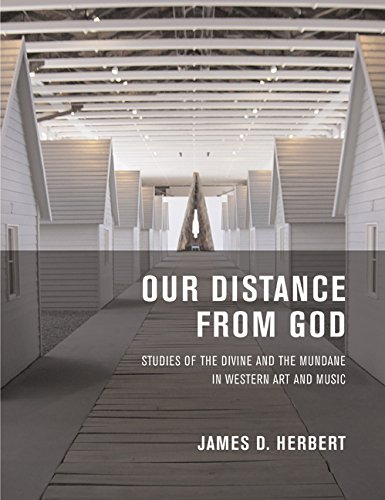
In this encounter between reflections on Christian theology and the history of art and music, James D. Herbert considers how specific works of art establish a relation between the divine and the earthbound audiences for whom the art was created. He looks at five case studies over four centuries: the architecture and artworks that glorified Louis XIV at Versailles, the interaction of libretto and music in Richard Wagner's Ring of the Nibelung, Claude Monet's enormous paintings of water lilies mounted at the Orangerie of Paris in 1927, the inaugural performance in 1962 of Benjamin Britten's War Requiem at the new Anglican cathedral in Coventry, and Robert Wilson's recent installation based on the Passion, 14 Stations.
Die Inhaltsangabe kann sich auf eine andere Ausgabe dieses Titels beziehen.
Über die Autorin bzw. den Autor
James D. Herbert is Professor of Art History and Visual Studies at the University of California, Irvine. He is the author of Paris 1937: Worlds on Exhibition (1998) and Fauve Painting: The Making of Cultural Politics (1992).
Von der hinteren Coverseite
"This is a very independent-minded book, wide-ranging in its examples and global in its ambitions. Our Distance from God goes its own way through point-by-point analyses of selected Christian artworks, in search of signs of the distance between the human and the divine. In the end, its broad reach does for the theology of visual monuments what David Summers's Real Spaces did for their phenomenology."—James Elkins, author of The Strange Place of Religion in Contemporary Art
"In clear and lucid prose, James Herbert offers a new perspective on several important artistic projects–pictorial, architectural, and musical–in the Western tradition, revealing the deep tension (sometimes productive, sometimes disabling) between representations of the world empirically known to human beings and of sacred realities not 'of this world' that figure 'our distance from God.' These sacred images engage and even express the immeasurable gap between humanity and God and help us traverse or transcend it; they work between literal spatial distances and metaphysical or spiritual distances. Herbert's deft and persuasive interpretations, which shed new light on interactions between art and theological speculation, will be highly informative for a wide range of readers–in art history, musicology, cultural history, aesthetics, and religious studies."—Whitney Davis, University of California, Berkeley
"In clear and lucid prose, James Herbert offers a new perspective on several important artistic projects–pictorial, architectural, and musical–in the Western tradition, revealing the deep tension (sometimes productive, sometimes disabling) between representations of the world empirically known to human beings and of sacred realities not 'of this world' that figure 'our distance from God.' These sacred images engage and even express the immeasurable gap between humanity and God and help us traverse or transcend it; they work between literal spatial distances and metaphysical or spiritual distances. Herbert's deft and persuasive interpretations, which shed new light on interactions between art and theological speculation, will be highly informative for a wide range of readers–in art history, musicology, cultural history, aesthetics, and religious studies."—Whitney Davis, University of California, Berkeley
Aus dem Klappentext
"This is a very independent-minded book, wide-ranging in its examples and global in its ambitions.Our Distance from God goes its own way through point-by-point analyses of selected Christian artworks, in search of signs of the distance between the human and the divine. In the end, its broad reach does for the theology of visual monuments what David Summers's Real Spaces did for their phenomenology."James Elkins, author ofThe Strange Place of Religion in Contemporary Art
"In clear and lucid prose, James Herbert offers a new perspective on several important artistic projectspictorial, architectural, and musicalin the Western tradition, revealing the deep tension (sometimes productive, sometimes disabling) between representations of the world empirically known to human beings and of sacred realities not 'of this world' that figure 'our distance from God.' These sacred images engage and even express the immeasurable gap between humanity and God and help us traverse or transcend it; they work between literal spatial distances and metaphysical or spiritual distances. Herbert's deft and persuasive interpretations, which shed new light on interactions between art and theological speculation, will be highly informative for a wide range of readersin art history, musicology, cultural history, aesthetics, and religious studies."Whitney Davis, University of California, Berkeley
"In clear and lucid prose, James Herbert offers a new perspective on several important artistic projectspictorial, architectural, and musicalin the Western tradition, revealing the deep tension (sometimes productive, sometimes disabling) between representations of the world empirically known to human beings and of sacred realities not 'of this world' that figure 'our distance from God.' These sacred images engage and even express the immeasurable gap between humanity and God and help us traverse or transcend it; they work between literal spatial distances and metaphysical or spiritual distances. Herbert's deft and persuasive interpretations, which shed new light on interactions between art and theological speculation, will be highly informative for a wide range of readersin art history, musicology, cultural history, aesthetics, and religious studies."Whitney Davis, University of California, Berkeley
„Über diesen Titel“ kann sich auf eine andere Ausgabe dieses Titels beziehen.
Suchergebnisse für Our Distance from God: Studies of the Divine and the...

Beispielbild für diese ISBN
Our Distance from God : Studies of the Divine and the Mundane in Western Art and Music
Verlag:
University of California Press, 2008
ISBN 10: 0520252136
ISBN 13: 9780520252134
Gebraucht
Hardcover
Anbieter: Better World Books, Mishawaka, IN, USA
Verkäuferbewertung 5 von 5 Sternen

Zustand: Very Good. Pages intact with possible writing/highlighting. Binding strong with minor wear. Dust jackets/supplements may not be included. Stock photo provided. Product includes identifying sticker. Better World Books: Buy Books. Do Good. Artikel-Nr. 3317903-6
Gebraucht kaufen
EUR 10,15
Versand gratis
Versand innerhalb von USA
Versand innerhalb von USA
Anzahl: 1 verfügbar
Beispielbild für diese ISBN
Our Distance from God: Studies of the Divine and the Mundane in Western Art and Music
Verlag:
University of California Pre, Berkeley, 2008
ISBN 10: 0520252136
ISBN 13: 9780520252134
Gebraucht
Hardcover
Erstausgabe
Anbieter: Abacus Bookshop, Pittsford, NY, USA
Verkäuferbewertung 5 von 5 Sternen
hardcover. Zustand: Fine copy in fine dust jacket. Well-illustrated (illustrator). 1st. Tall 8vo, 198 pp. Artikel-Nr. 079193
Gebraucht kaufen
EUR 13,79
EUR 3,57 Versand
Versand innerhalb von USA
Versand innerhalb von USA
Anzahl: 1 verfügbar
Beispielbild für diese ISBN
Our Distance From God: Studies of the Divine and the Mundane in Western Art and Music
Verlag:
University of California Press, Berkeley, 2008
ISBN 10: 0520252136
ISBN 13: 9780520252134
Gebraucht
Hardcover
Erstausgabe
Anbieter: Argosy Book Store, ABAA, ILAB, New York, NY, USA
Verkäuferbewertung 5 von 5 Sternen
hardcover. Zustand: fine. Zustand des Schutzumschlags: near fine. First. Illustrated in color and in black and white. xii, 198 pages. Small 4to, black cloth with gold spine lettering, d.w. Berkeley: University of California Press, (2008). Fine in a near fine dust wrapper. Artikel-Nr. 319061
Gebraucht kaufen
EUR 20,69
EUR 5,36 Versand
Versand innerhalb von USA
Versand innerhalb von USA
Anzahl: 1 verfügbar