
Verwandte Artikel zu Diaspora Conversions: Black Carib Religion and the...
Inhaltsangabe
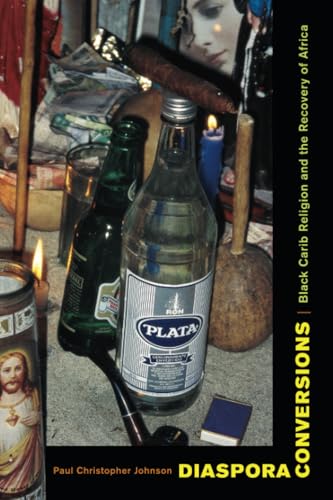
By joining a diaspora, a society may begin to change its religious, ethnic, and even racial identifications by rethinking its "pasts." This pioneering multisite ethnography explores how this phenomenon is affecting the remarkable religion of the Garifuna, historically known as the Black Caribs, from the Central American coast of the Caribbean. It is estimated that one-third of the Garifuna have migrated to New York City over the past fifty years. Paul Christopher Johnson compares Garifuna spirit possession rituals performed in Honduran villages with those conducted in New York, and what emerges is a compelling picture of how the Garifuna engage ancestral spirits across multiple diasporic horizons. His study sheds new light on the ways diasporic religions around the world creatively plot itineraries of spatial memory that at once recover and remold their histories.
Die Inhaltsangabe kann sich auf eine andere Ausgabe dieses Titels beziehen.
Über die Autorin bzw. den Autor
Paul Christopher Johnson is Associate Professor in the Department of History and the Center for Afroamerican and African Studies at the University of Michigan, and author of Secrets, Gossip and Gods: The Transformation of Brazilian Candomblé.
Von der hinteren Coverseite
"I'm extremely impressed by Johnson's book. Diaspora Conversions offers an outstanding combination of theoretical acuity, erudition, and ethnographic prowess. It is bound to become highly influential in the study of religion in motion."—Manuel A. Vasquez, co-author of Globalizing the Sacred: Religion Across the Americas
"Johnson's work bursts through the present conversations on African diaspora and brings us onto entirely new ground, shattering simplistic ideas and replacing them with critical distinctions. This smart and talented ethnographer succeeds in combining detailed and rich ethnographic fieldwork with an unrelentingly critical and sophisticated analysis. Johnson's work brings to life one of the most central, perhaps the most central, classic question of African American anthropology: "How is Black culture constituted, even through dislocation and displacement?"—Elizabeth McAlister, author of Rara! Vodou, Power, and Performance in Haiti and Its Diaspora
"Diasporic Conversions convincingly breaks new ground by showing how the meaning of 'homeland' is fundamentally a product of historically situated and contested forms of collective imagination. What will make Johnson's book a benchmark in the study of the African diaspora, and diasporic situations more generally, is that it is not just a richly documented and rigorously argued ethnography, but a genuine anthropology of historical consciousness."—Stephan Palmié, author of Wizards and Scientists: Explorations in Afro-Cuban Modernity and Tradition
"Johnson's work bursts through the present conversations on African diaspora and brings us onto entirely new ground, shattering simplistic ideas and replacing them with critical distinctions. This smart and talented ethnographer succeeds in combining detailed and rich ethnographic fieldwork with an unrelentingly critical and sophisticated analysis. Johnson's work brings to life one of the most central, perhaps the most central, classic question of African American anthropology: "How is Black culture constituted, even through dislocation and displacement?"—Elizabeth McAlister, author of Rara! Vodou, Power, and Performance in Haiti and Its Diaspora
"Diasporic Conversions convincingly breaks new ground by showing how the meaning of 'homeland' is fundamentally a product of historically situated and contested forms of collective imagination. What will make Johnson's book a benchmark in the study of the African diaspora, and diasporic situations more generally, is that it is not just a richly documented and rigorously argued ethnography, but a genuine anthropology of historical consciousness."—Stephan Palmié, author of Wizards and Scientists: Explorations in Afro-Cuban Modernity and Tradition
Aus dem Klappentext
"I'm extremely impressed by Johnson's book. Diaspora Conversions offers an outstanding combination of theoretical acuity, erudition, and ethnographic prowess. It is bound to become highly influential in the study of religion in motion." Manuel A. Vasquez, co-author of Globalizing the Sacred: Religion Across the Americas
"Johnson's work bursts through the present conversations on African diaspora and brings us onto entirely new ground, shattering simplistic ideas and replacing them with critical distinctions. This smart and talented ethnographer succeeds in combining detailed and rich ethnographic fieldwork with an unrelentingly critical and sophisticated analysis. Johnson's work brings to life one of the most central, perhaps the most central, classic question of African American anthropology: "How is Black culture constituted, even through dislocation and displacement?" Elizabeth McAlister, author of Rara! Vodou, Power, and Performance in Haiti and Its Diaspora
"Diasporic Conversions convincingly breaks new ground by showing how the meaning of 'homeland' is fundamentally a product of historically situated and contested forms of collective imagination. What will make Johnson's book a benchmark in the study of the African diaspora, and diasporic situations more generally, is that it is not just a richly documented and rigorously argued ethnography, but a genuine anthropology of historical consciousness." Stephan Palmié, author of Wizards and Scientists: Explorations in Afro-Cuban Modernity and Tradition
"Johnson's work bursts through the present conversations on African diaspora and brings us onto entirely new ground, shattering simplistic ideas and replacing them with critical distinctions. This smart and talented ethnographer succeeds in combining detailed and rich ethnographic fieldwork with an unrelentingly critical and sophisticated analysis. Johnson's work brings to life one of the most central, perhaps the most central, classic question of African American anthropology: "How is Black culture constituted, even through dislocation and displacement?" Elizabeth McAlister, author of Rara! Vodou, Power, and Performance in Haiti and Its Diaspora
"Diasporic Conversions convincingly breaks new ground by showing how the meaning of 'homeland' is fundamentally a product of historically situated and contested forms of collective imagination. What will make Johnson's book a benchmark in the study of the African diaspora, and diasporic situations more generally, is that it is not just a richly documented and rigorously argued ethnography, but a genuine anthropology of historical consciousness." Stephan Palmié, author of Wizards and Scientists: Explorations in Afro-Cuban Modernity and Tradition
Auszug. © Genehmigter Nachdruck. Alle Rechte vorbehalten.
Diaspora Conversions
Black Carib Religion and the Recovery of AfricaBy Paul Christopher JohnsonUniversity of California Press
Copyright © 2007 The Regents of the University of CaliforniaAll right reserved.
ISBN: 978-0-520-24970-7
Contents
List of Illustrations........................................................................ixAcknowledgments..............................................................................xiIntroduction.................................................................................11. What Is Diasporic Religion?...............................................................302. "These Sons of Freedom": Black Caribs across Three Diasporic Horizons.....................603. Shamans at Work in the Villages...........................................................994. Shamans at Work in New York...............................................................1255. Ritual in the Homeland; Or, Making the Land "Home" in Ritual..............................1466. Ritual in the Bronx.......................................................................1867. Finding Africa in New York................................................................205Conclusion...................................................................................227Appendix. Trajectory of a Moving Object, the Caldero.........................................247Notes........................................................................................251Glossary.....................................................................................287Bibliography.................................................................................291Index........................................................................................319
Chapter One
What Is Diasporic Religion?We can also say of every religion that it reproduces in more or less symbolic forms the history of migrations and fusions of race and tribes, of great events, wars, establishments, discoveries, and reforms. Maurice Halbwachs, On Collective Memory
We are not a diaspora, we are just trapped. Emeline Michel, Haitian singer
This chapter lays out the parameters for the central theoretical issues of the book, moving from the widest to the narrowest distinctions. I examine, in turn, diaspora, diasporic religion, African Diaspora, and African diasporic religions, the latter specifically in New York City. The attempt to establish a solid theoretical footing for the starring phrase among these, diasporic religion, may appear a fool's errand, since both diaspora and religion are highly conflicted terms. How can we cheerfully head for the mountains with only these two frayed ropes in our packs? I wager that the two ropes can be sufficiently rewoven, and woven together, to hold the needed weight.
That Shared Something: Defining Diaspora Analytically
The notion of diaspora has been progressively widened over the last century to include not only the dispersions of the Jewish, Greek, and Armenian populations but also diasporas as disparate as those of Calvinists (Weber 2002: 7), the Portuguese (Klimt and Lubkemann 2002), the Mormons (Smith and White 2004), and the New Orleans victims of Hurricane Katrina in 2005 (Gross 2006). The term has even been applied to the dispersion of individuals from a position of social valuation to one where little is accorded them, as in "the sexual diaspora of older women" (Merkin 2006: 18)-the experience of being sexually "in exile." Suddenly, it appears, everyone is in diaspora. Well, why not? We all came from somewhere else and are at least dimly enough aware of it to be able to call up sentiments about our origins. Ethnic revivals are at least in part a reactive move, a standard means of vying for a fair share of the socioeconomic pie (Barth 1969; Comaroff and Comaroff 1992; Rumbaut and Portes 2001: 5; Baumann 2000; Berking 2003), and diaspora has become their reliable vehicle. The practical, colloquial use of the word suggests affiliations by virtue of biological descent, which allegedly transmit blood continuity across space: The Jewish diaspora, from this perspective, is the set of people whose families were from, but then were exiled or otherwise departed from, Israel during dispersions under Babylonia, Rome, or other conquerors. The Irish diaspora is built of the descendants of the families that left Ireland during the potato famines of the nineteenth century, and so on.
This concept inspires groups and galvanizes political mobilizations, but for analytical and comparative purposes it falls short on at least two counts. First, in this view, there exist natural groupings of humans who, through emigration, inevitably become diasporas. But there are no such natural groups and, it follows, no natural diasporas, either. The second obvious problem with the everyday uses of diaspora is that the category is overly broad. It is true that if we go back far enough, all human beings have their origins in East Africa (Palmer 1998); but the assertion that we are all members of an East African diaspora is not useful. Although we all have ancestors from that region, that memory is not part of our conscious experience; nor is it constitutive, so far as we know, of our bodily habitus; nor is each of us seen by others as a member of that category. Folk invocations of diaspora fail to specify its cultural particularity: it depends not merely on having a family tree that sprouted in another place but also on having a double consciousness in relation to place. For members of a diaspora, that awareness is central, even actively conjured in their lived experience. They feel a gap between here and there, where they are "really from." They may even value that gap, seeing it not as a deficiency but as a resource or mark of distinction, and actively cultivate a sense of it (Malkki 1997: 62).
The prevalence of these confusing folk usages, not to mention the mixed approaches of analytical meanings-as social form, as type of consciousness, as mode of cultural production (Vertovec 2000: 142)-suggests that we need to spend some time giving boundaries to the notions of diaspora and diasporic religion.
DEFINITION BY ETYMOLOGY
The ascent of diaspora as an analytical term has taken several routes. One of these is the route of roots, the tracing of its etymology as a way to delimit its semantic range (e.g., Tllyan 1996; R. Cohen 1997; Baumann 2000; Sheffer 2003).
Diaspora comes from the Greek verb speirein (to sow, or scatter, as in seed) and the preposition dia (over); thus, "to scatter over." The same Indo-European root, sp-, appears in words like "spore," "spread," and "sperm." Diaspora was first used by Greeks to describe the colonization of Asia Minor and the Mediterranean world, and it probably connoted a sacrificial loss of the homeland for the cause of Greek expansion; hence irretrievable separation though not necessarily forced migration or enslavement (Tllyan 1996; Baumann 2000).
The word took on a different valence when applied to the Jewish experience, as a translation of the Hebrew term galut in the Greek version of Hebrew scripture, connoting severance and exile (Deuteronomy 28: 25, 58-68) and the Jewish dispersions (732 B.C.E., after conquest by Assyria; 586 B.C.E., after conquest by Babylonia; 70 C.E., after conquest by Rome). Yet, at least in the later context of rabbinic teaching, the notion also carried the promise of ultimate return (Cohen 1997;...
„Über diesen Titel“ kann sich auf eine andere Ausgabe dieses Titels beziehen.
Suchergebnisse für Diaspora Conversions: Black Carib Religion and the...

Beispielbild für diese ISBN
Diaspora Conversions: Black Carib Religion and the Recovery of Africa
Verlag:
University of California Press, 2007
ISBN 10: 0520249704
ISBN 13: 9780520249707
Gebraucht
Paperback
Anbieter: ThriftBooks-Dallas, Dallas, TX, USA
Verkäuferbewertung 5 von 5 Sternen

Paperback. Zustand: Good. No Jacket. Pages can have notes/highlighting. Spine may show signs of wear. ~ ThriftBooks: Read More, Spend Less. Artikel-Nr. G0520249704I3N00
Gebraucht kaufen
EUR 9,15
Versand gratis
Versand innerhalb von USA
Versand innerhalb von USA
Anzahl: 1 verfügbar
Beispielbild für diese ISBN
Diaspora Conversions : Black Carib Religion and the Recovery of Africa
Verlag:
University of California Press, 2007
ISBN 10: 0520249704
ISBN 13: 9780520249707
Gebraucht
Softcover
Anbieter: Better World Books, Mishawaka, IN, USA
Verkäuferbewertung 5 von 5 Sternen
Zustand: Good. Former library copy. Pages intact with minimal writing/highlighting. The binding may be loose and creased. Dust jackets/supplements are not included. Includes library markings. Stock photo provided. Product includes identifying sticker. Better World Books: Buy Books. Do Good. Artikel-Nr. 51120308-6
Gebraucht kaufen
EUR 13,00
Versand gratis
Versand innerhalb von USA
Versand innerhalb von USA
Anzahl: 1 verfügbar
Foto des Verkäufers
Diaspora Conversions Black Carib Religion and the Recovery of Africa
Verlag:
University of California Press, 2007
ISBN 10: 0520249704
ISBN 13: 9780520249707
Gebraucht
Paperback
Anbieter: True Oak Books, Highland, NY, USA
Verkäuferbewertung 5 von 5 Sternen
Paperback. Zustand: Good. Book contains markings and notes from previous owner. Otherwise in good condition. ; - We're committed to your satisfaction. We offer free returns and respond promptly to all inquiries. Your item will be carefully wrapped in bubble wrap and securely boxed. All orders ship on the same or next business day. Buy with confidence. Artikel-Nr. TOB184-17299-A-1
Gebraucht kaufen
EUR 22,99
Versand gratis
Versand innerhalb von USA
Versand innerhalb von USA
Anzahl: 1 verfügbar
Beispielbild für diese ISBN
Diaspora Conversions: Black Carib Religion and the Recovery of Africa
Verlag:
University of California Press, 2007
ISBN 10: 0520249704
ISBN 13: 9780520249707
Neu
Softcover
Anbieter: Ria Christie Collections, Uxbridge, Vereinigtes Königreich
Verkäuferbewertung 5 von 5 Sternen
Zustand: New. In English. Artikel-Nr. ria9780520249707_new
Neu kaufen
EUR 42,35
EUR 13,34 Versand
Versand von Vereinigtes Königreich nach USA
Versand von Vereinigtes Königreich nach USA
Anzahl: Mehr als 20 verfügbar
Beispielbild für diese ISBN
Diaspora Conversions
Verlag:
University of California Press, 2007
ISBN 10: 0520249704
ISBN 13: 9780520249707
Neu
Softcover
Anbieter: Majestic Books, Hounslow, Vereinigtes Königreich
Verkäuferbewertung 4 von 5 Sternen

Zustand: New. pp. 360. Artikel-Nr. 8102469
Neu kaufen
EUR 56,96
EUR 7,68 Versand
Versand von Vereinigtes Königreich nach USA
Versand von Vereinigtes Königreich nach USA
Anzahl: 1 verfügbar
Beispielbild für diese ISBN
Diaspora Conversions Black Carib Religion and the Recovery of Africa
Anbieter: Revaluation Books, Exeter, Vereinigtes Königreich
Verkäuferbewertung 5 von 5 Sternen
Paperback. Zustand: Brand New. 1st edition. 330 pages. 8.75x6.00x0.75 inches. In Stock. Artikel-Nr. x-0520249704
Neu kaufen
EUR 59,46
EUR 14,77 Versand
Versand von Vereinigtes Königreich nach USA
Versand von Vereinigtes Königreich nach USA
Anzahl: 2 verfügbar
Foto des Verkäufers
DIASPORA CONVERSIONS
Anbieter: moluna, Greven, Deutschland
Verkäuferbewertung 5 von 5 Sternen
Zustand: New. By joining a diaspora, a society may begin to change its religious, ethnic, and even racial identifications by rethinking its pasts. This book explores how this phenomenon affects the religion of the Garifuna. It compares Garifuna spirit possession ritual. Artikel-Nr. 594722400
Neu kaufen
EUR 45,81
EUR 48,99 Versand
Versand von Deutschland nach USA
Versand von Deutschland nach USA
Anzahl: Mehr als 20 verfügbar
Foto des Verkäufers
Diaspora Conversions : Black Carib Religion and the Recovery of Africa
Anbieter: AHA-BUCH GmbH, Einbeck, Deutschland
Verkäuferbewertung 5 von 5 Sternen
Taschenbuch. Zustand: Neu. Neuware - By joining a diaspora, a society may begin to change its religious, ethnic, and even racial identifications by rethinking its 'pasts.' This pioneering multisite ethnography explores how this phenomenon is affecting the remarkable religion of the Garifuna, historically known as the Black Caribs, from the Central American coast of the Caribbean. It is estimated that one-third of the Garifuna have migrated to New York City over the past fifty years. Paul Christopher Johnson compares Garifuna spirit possession rituals performed in Honduran villages with those conducted in New York, and what emerges is a compelling picture of how the Garifuna engage ancestral spirits across multiple diasporic horizons. His study sheds new light on the ways diasporic religions around the world creatively plot itineraries of spatial memory that at once recover and remold their histories. Artikel-Nr. 9780520249707
Neu kaufen
EUR 61,07
EUR 35,00 Versand
Versand von Deutschland nach USA
Versand von Deutschland nach USA
Anzahl: 2 verfügbar