
Verwandte Artikel zu Between Memory and Desire: The Middle East in a Troubled...
Inhaltsangabe
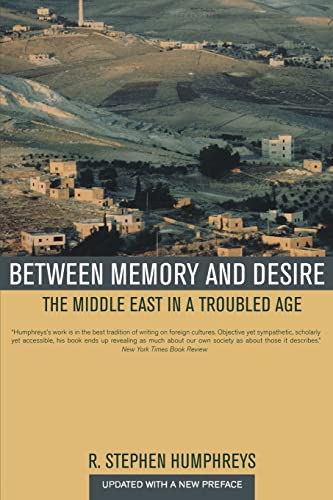
Middle Easterners today struggle to find solutions to crises of economic stagnation, political gridlock, and cultural identity. In recent decades Islam has become central to this struggle, and almost every issue involves fierce, sometimes violent debates over the role of religion in public life. In this post-9/11 updated edition R. Stephen Humphreys presents a thoughtful analysis of Islam's place in today's Middle East and integrates the medieval and modern history of the region to show how the sacred and secular are tightly interwoven in its political and intellectual life.
Die Inhaltsangabe kann sich auf eine andere Ausgabe dieses Titels beziehen.
Über die Autorin bzw. den Autor
R. Stephen Humphreys is Professor of History and Islamic Studies at the University of California, Santa Barbara, and author of Islamic History: A Framework for Inquiry (second edition, 1991) among other works.
Von der hinteren Coverseite
PRAISE FOR THE FIRST EDITION:
"Humphreys brings a historian’s deep and dispassionate perspective to the modern Middle East. In Between Memory and Desire, he poses incisive questions, elaborates convincing arguments and does not shy from tackling the prickliest of topics. All this is achieved with an eye for telling detail and a concise style that is rare in academic writing…. Humphreys’s work is in the best tradition of writing on foreign cultures. Objective yet sympathetic, scholarly yet accessible, his book ends up revealing as much about our own society as about those it describes."—Max Rodenbeck, New York Times Book Review
"In this sober and highly informative book, Humphreys introduces educated readers to the nuances of Middle Eastern political and social discourse. He goes behind the headlines and offers a sophisticated and yet accessible analysis of Islamic polity for Western readers."—Library Journal
"'People know a lot of things that aren't so,' warns Stephen Humphreys, and then he tells us all we should really know about the Middle East—a vast, complex, and frequently misunderstood universe. It is a rare achievement that combines erudition, compelling writing, and personal experience."—Meron Benvenisti, author of City of Stone
"Humphreys brings a historian’s deep and dispassionate perspective to the modern Middle East. In Between Memory and Desire, he poses incisive questions, elaborates convincing arguments and does not shy from tackling the prickliest of topics. All this is achieved with an eye for telling detail and a concise style that is rare in academic writing…. Humphreys’s work is in the best tradition of writing on foreign cultures. Objective yet sympathetic, scholarly yet accessible, his book ends up revealing as much about our own society as about those it describes."—Max Rodenbeck, New York Times Book Review
"In this sober and highly informative book, Humphreys introduces educated readers to the nuances of Middle Eastern political and social discourse. He goes behind the headlines and offers a sophisticated and yet accessible analysis of Islamic polity for Western readers."—Library Journal
"'People know a lot of things that aren't so,' warns Stephen Humphreys, and then he tells us all we should really know about the Middle East—a vast, complex, and frequently misunderstood universe. It is a rare achievement that combines erudition, compelling writing, and personal experience."—Meron Benvenisti, author of City of Stone
Aus dem Klappentext
PRAISE FOR THE FIRST EDITION:
"Humphreys brings a historian s deep and dispassionate perspective to the modern Middle East. In Between Memory and Desire, he poses incisive questions, elaborates convincing arguments and does not shy from tackling the prickliest of topics. All this is achieved with an eye for telling detail and a concise style that is rare in academic writing . Humphreys s work is in the best tradition of writing on foreign cultures. Objective yet sympathetic, scholarly yet accessible, his book ends up revealing as much about our own society as about those it describes." Max Rodenbeck, New York Times Book Review
"In this sober and highly informative book, Humphreys introduces educated readers to the nuances of Middle Eastern political and social discourse. He goes behind the headlines and offers a sophisticated and yet accessible analysis of Islamic polity for Western readers." Library Journal
"'People know a lot of things that aren't so,' warns Stephen Humphreys, and then he tells us all we should really know about the Middle East a vast, complex, and frequently misunderstood universe. It is a rare achievement that combines erudition, compelling writing, and personal experience." Meron Benvenisti, author of City of Stone
"Humphreys brings a historian s deep and dispassionate perspective to the modern Middle East. In Between Memory and Desire, he poses incisive questions, elaborates convincing arguments and does not shy from tackling the prickliest of topics. All this is achieved with an eye for telling detail and a concise style that is rare in academic writing . Humphreys s work is in the best tradition of writing on foreign cultures. Objective yet sympathetic, scholarly yet accessible, his book ends up revealing as much about our own society as about those it describes." Max Rodenbeck, New York Times Book Review
"In this sober and highly informative book, Humphreys introduces educated readers to the nuances of Middle Eastern political and social discourse. He goes behind the headlines and offers a sophisticated and yet accessible analysis of Islamic polity for Western readers." Library Journal
"'People know a lot of things that aren't so,' warns Stephen Humphreys, and then he tells us all we should really know about the Middle East a vast, complex, and frequently misunderstood universe. It is a rare achievement that combines erudition, compelling writing, and personal experience." Meron Benvenisti, author of City of Stone
Auszug. © Genehmigter Nachdruck. Alle Rechte vorbehalten.
Between Memory and Desire
The Middle East in a Troubled AgeBy R. Stephen HumphreysUniversity of California Press
Copyright © 2005 R. Stephen HumphreysAll right reserved.
ISBN: 9780520246911
Chapter One
HARD REALITIES
Population Growth and Economic Stagnation
First impressions can be desperately misleading, but revisited in thelight of longer experience, they often point to basic truths. When mywife and I got off the plane and walked across the tarmac into theCairo airport terminal for the first time on a hot spring night inApril 1966, we were immediately engulfed in a crush of would-beporters, all clamoring for the privilege of carrying our bags to thetaxi stand. We chose a likely prospect, who snatched up our stuffand carried it about fifty feet. There he passed it off to a second manand in the same motion stuck out his hand for the customary two-piastertip. The second porter repeated the same act, and then a thirdand a fourth. I am happy to say that our first taxi driver took us allthe way downtown without a break, but as soon as we stepped outof the cab a pack of boys materialized out of the shadows, all shoutingand grabbing for our luggage. It was only about twenty feet tothe door of our pension, so this time we fended them off with barkingand a bit of pushing. By some miracle the elevator was working(just how rare a miracle it was in the Cairo of 1966 we would soondiscover), and we were quickly and peaceably delivered to the doorof Mme Seoudi's fifth-story hotel-pension.
Our initial experience was repeated hundreds of times over inthe coming weeks. The simplest task required three or four or halfa dozen people. What we were dealing with, plainly, was too manypeople chasing too few jobs. The causes for this phenomenon wereby no means obvious to the superficial observer, but a bit of readingand talking to the right people told us more or less what wasgoing on. The countryside was jammed and could no longer provideany kind of living wage for agricultural workers, and so displacedpeasants were flowing into the cities to find whatever workthey could. In spite of a determined push toward industrializationby the Nasser government, there were still few factory jobs. In anycase, these rural immigrants were mostly illiterate and utterly withoutthe skills needed even for assembly-line labor; all they couldfind was pick-up work at minuscule wages. As for the boys whoswarmed around us wherever we went, they were supposed to bein school, but that was boring, irrelevant to any purpose they couldsee, and anyhow, their families desperately needed the pittances thatthey could scrounge from sympathetic or unwary tourists. Finally,however inadequate the high schools and universities may have beenin view of the number of teenagers and young adults who neededan education, they were still producing far more graduates than theEgyptian economy could find room for. To soak up the excess, Nasserhad decreed that the government would be the employer of lastresort?hence the five sullen tellers and cashiers needed to stamp thesextuplicate forms that authorized us to exchange dollars for Egyptianpounds.
To us the Cairo of thirty years ago seemed extraordinarily crowded.People were jammed into the buses, and it was common for a dozenor more boys to hitch a free ride by clinging to the outside of thesecareening contrivances. The buses were battered and had a perpetuallist, and it is amazing they held together as well as they did. Froma present-day perspective, however, the city was almost empty. Ithad a total population of only some 3 million, the medieval tombcities to the south and east still housed mostly the dead, and the Pyramidsstood alone in the bright, clear air, many miles from the smallmiddle-class suburb of Giza on the west bank of the Nile. The streetswere mostly narrow and ill designed for modern traffic, but thereweren't a lot of cars and most of these were of astonishing antiquity.When I went back seven years later, in 1973, Cairo had 6 millionpeople (many of them refugees from the Suez Canal cities, whichwere then inside a war zone), the buses were even more insanelypacked, the tomb cities had been commandeered by squatters, andurban sprawl had infected the Nile's western bank and was movingup toward the Pyramids. But even this falls far short of the realitiesof 1997. There are something like 15 million people (though noone knows for sure) in Greater Cairo. The city sprawls across at leastthree separate governorates, high-rise apartment buildings reach almostto the base of the Pyramids (which are often masked in densegray smog), and the traffic jams compete with any in the world. Overthe last decade Cairo has been outfitted with a good modern infrastructure,at least downtown; there is a complex throughway networkand a good subway system, the water runs, the telephoneswork, the electricity is reliable, faxes and copy shops are ubiquitous.But the schools and universities continue to pour out graduates bythe hundreds of thousands, and after four decades of policies aimedat making Egypt into a dynamic modern economy there are still notremotely enough jobs to go around. The university class of 1985, forexample, was awarded its guaranteed government jobs only in 1993.
Egypt is now and has always been a peculiar place, even withinthe Middle East. But its employment problems are quite typical ofmost countries in the region?Morocco, Tunisia, Turkey, to nameonly countries that have not been directly afflicted by war or politicalrevolution in recent decades. Istanbul (which has grown fromabout 1.5 to 10 million people over the past quarter century) andCasablanca are just as overgrown and congested as Cairo. Theseproblems are no doubt partly the result of bad policy: wanting amodern economy will not create one, especially if the goal is pursuedthrough contradictory, constantly shifting, and ill-administeredpolicies. (Americans familiar with the anomalies of their own healthand welfare systems will surely understand how situations like thiscan come about.) But Middle Eastern policy makers have been thevictims of paradox; some of their greatest successes?building comprehensivealbeit desperately overcrowded systems of higher educationor lowering the infant mortality rate by more than 50 percentin a decade?have only intensified the economic problems they mustcontend with. So we must ask, with genuine humility, how and whythey have fallen into their present quandary.
It is very common, and very misleading, to say that the modernMiddle East suffers from overpopulation. In fact the Middle Eastand North Africa as a whole possess approximately the same sizepopulation as the United States and a considerably larger land area?300million people in about 5 million square miles. The largest andmost populous countries in the region?Egypt, Iran, and Turkey?eachhave some 60 million people. That is, they have populationsequal to those of France, Italy, and the United Kingdom, all of whichare much smaller in area. So we cannot talk about "overpopulation"in an absolute sense, as if a given parcel of land could absorb somefixed number of people and that barrier had now been breached.The real problem is not the number of people in the Middle Eastbut how rapidly and recently they have appeared on the scene.
The first thing one needs to know about the contemporary MiddleEast is that the average age of the population is about sixteen?halfthe average age in the United...
„Über diesen Titel“ kann sich auf eine andere Ausgabe dieses Titels beziehen.
Suchergebnisse für Between Memory and Desire: The Middle East in a Troubled...

Beispielbild für diese ISBN
Between Memory and Desire: The Middle East in a Troubled Age
Verlag:
University of California Press, 2005
ISBN 10: 0520246918
ISBN 13: 9780520246911
Gebraucht
Softcover
Anbieter: World of Books (was SecondSale), Montgomery, IL, USA
Verkäuferbewertung 5 von 5 Sternen

Zustand: Good. Item in good condition. Textbooks may not include supplemental items i.e. CDs, access codes etc. Artikel-Nr. 00103918792
Gebraucht kaufen
EUR 4,30
Versand gratis
Versand innerhalb von USA
Versand innerhalb von USA
Anzahl: 1 verfügbar
Beispielbild für diese ISBN
Between Memory and Desire: The Middle East in a Troubled Age
ISBN 10: 0520246918
ISBN 13: 9780520246911
Gebraucht
Paperback
Anbieter: BooksRun, Philadelphia, PA, USA
Verkäuferbewertung 5 von 5 Sternen
Paperback. Zustand: Very Good. It's a well-cared-for item that has seen limited use. The item may show minor signs of wear. All the text is legible, with all pages included. It may have slight markings and/or highlighting. First Edition, Updated with a New Preface. Artikel-Nr. 0520246918-11-1
Gebraucht kaufen
EUR 5,39
Versand gratis
Versand innerhalb von USA
Versand innerhalb von USA
Anzahl: 1 verfügbar
Beispielbild für diese ISBN
Between Memory and Desire: The Middle East in a Troubled Age
Verlag:
University of California Press, 2005
ISBN 10: 0520246918
ISBN 13: 9780520246911
Gebraucht
Paperback
Anbieter: ThriftBooks-Dallas, Dallas, TX, USA
Verkäuferbewertung 5 von 5 Sternen
Paperback. Zustand: Very Good. No Jacket. May have limited writing in cover pages. Pages are unmarked. ~ ThriftBooks: Read More, Spend Less. Artikel-Nr. G0520246918I4N00
Gebraucht kaufen
EUR 5,85
Versand gratis
Versand innerhalb von USA
Versand innerhalb von USA
Anzahl: 1 verfügbar
Beispielbild für diese ISBN
Between Memory and Desire: The Middle East in a Troubled Age
Verlag:
University of California Press, 2005
ISBN 10: 0520246918
ISBN 13: 9780520246911
Gebraucht
Paperback
Anbieter: ThriftBooks-Atlanta, AUSTELL, GA, USA
Verkäuferbewertung 5 von 5 Sternen
Paperback. Zustand: Very Good. No Jacket. May have limited writing in cover pages. Pages are unmarked. ~ ThriftBooks: Read More, Spend Less. Artikel-Nr. G0520246918I4N00
Gebraucht kaufen
EUR 5,85
Versand gratis
Versand innerhalb von USA
Versand innerhalb von USA
Anzahl: 1 verfügbar
Beispielbild für diese ISBN
Between Memory and Desire : The Middle East in a Troubled Age
Verlag:
University of California Press, 2005
ISBN 10: 0520246918
ISBN 13: 9780520246911
Gebraucht
Softcover
Anbieter: Better World Books, Mishawaka, IN, USA
Verkäuferbewertung 5 von 5 Sternen
Zustand: Very Good. (rev)05 Edition. Pages intact with possible writing/highlighting. Binding strong with minor wear. Dust jackets/supplements may not be included. Stock photo provided. Product includes identifying sticker. Better World Books: Buy Books. Do Good. Artikel-Nr. 4338887-6
Gebraucht kaufen
EUR 5,98
Versand gratis
Versand innerhalb von USA
Versand innerhalb von USA
Anzahl: 1 verfügbar
Beispielbild für diese ISBN
Between Memory and Desire : The Middle East in a Troubled Age
Verlag:
University of California Press, 2005
ISBN 10: 0520246918
ISBN 13: 9780520246911
Gebraucht
Softcover
Anbieter: Better World Books, Mishawaka, IN, USA
Verkäuferbewertung 5 von 5 Sternen
Zustand: Good. (rev)05 Edition. Pages intact with minimal writing/highlighting. The binding may be loose and creased. Dust jackets/supplements are not included. Stock photo provided. Product includes identifying sticker. Better World Books: Buy Books. Do Good. Artikel-Nr. 612064-6
Gebraucht kaufen
EUR 5,98
Versand gratis
Versand innerhalb von USA
Versand innerhalb von USA
Anzahl: 1 verfügbar
Beispielbild für diese ISBN
Between Memory and Desire : The Middle East in a Troubled Age
Verlag:
University of California Press, 2005
ISBN 10: 0520246918
ISBN 13: 9780520246911
Gebraucht
Softcover
Anbieter: Better World Books: West, Reno, NV, USA
Verkäuferbewertung 5 von 5 Sternen
Zustand: Very Good. (rev)05 Edition. Former library copy. Pages intact with possible writing/highlighting. Binding strong with minor wear. Dust jackets/supplements may not be included. Includes library markings. Stock photo provided. Product includes identifying sticker. Better World Books: Buy Books. Do Good. Artikel-Nr. 6113184-75
Gebraucht kaufen
EUR 5,98
Versand gratis
Versand innerhalb von USA
Versand innerhalb von USA
Anzahl: 1 verfügbar
Beispielbild für diese ISBN
Between Memory and Desire
Verlag:
University of California Press, 2005
ISBN 10: 0520246918
ISBN 13: 9780520246911
Gebraucht
Softcover
Anbieter: Wonder Book, Frederick, MD, USA
Verkäuferbewertung 5 von 5 Sternen
Zustand: Good. Good condition. A copy that has been read but remains intact. May contain markings such as bookplates, stamps, limited notes and highlighting, or a few light stains. Artikel-Nr. N00A-03417
Gebraucht kaufen
EUR 6,91
Versand gratis
Versand innerhalb von USA
Versand innerhalb von USA
Anzahl: 1 verfügbar
Beispielbild für diese ISBN
Between Memory and Desire : The Middle East in a Troubled Age
Verlag:
University of California Press, 2005
ISBN 10: 0520246918
ISBN 13: 9780520246911
Gebraucht
Softcover
Anbieter: Better World Books Ltd, Dunfermline, Vereinigtes Königreich
Verkäuferbewertung 5 von 5 Sternen
Zustand: Good. (rev)05 Edition. Pages intact with minimal writing/highlighting. The binding may be loose and creased. Dust jackets/supplements are not included. Stock photo provided. Product includes identifying sticker. Better World Books: Buy Books. Do Good. Artikel-Nr. 612064-6
Gebraucht kaufen
EUR 6,78
EUR 5,83 Versand
Versand von Vereinigtes Königreich nach USA
Versand von Vereinigtes Königreich nach USA
Anzahl: 1 verfügbar
Beispielbild für diese ISBN
Between Memory and Desire: The Middle East in a Troubled Age
Verlag:
University of California Press, 2005
ISBN 10: 0520246918
ISBN 13: 9780520246911
Gebraucht
Soft cover
Erstausgabe
Anbieter: Dan Pope Books, West Hartford, CT, USA
Verkäuferbewertung 5 von 5 Sternen
Soft cover. Zustand: Near Fine. No Jacket. 1st Edition. Berkeley: Univ. of California, 2005. First edition. 2nd printing. Softbound. Trade apperback. Near Fine. A clean unmarked copy. Updated with a new perface in 2005. University press. Artikel-Nr. univ-125
Gebraucht kaufen
EUR 8,88
EUR 3,88 Versand
Versand innerhalb von USA
Versand innerhalb von USA
Anzahl: 1 verfügbar