
Verwandte Artikel zu Producing Desire: Changing Sexual Discourse in the...
Producing Desire: Changing Sexual Discourse in the Ottoman Middle East, 1500-1900 (Studies on the History of Society And Culture, 52, Band 52) - Softcover
Buch 17 von 17: Studies on the History of Society and Culture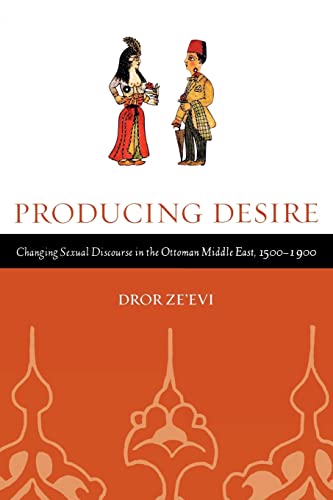
Inhaltsangabe
This highly original book brings into focus the sexual discourses manifest in a wealth of little-studied source material—medical texts, legal documents, religious literature, dream interpretation manuals, shadow theater, and travelogues—in a nuanced, wide-ranging, and powerfully analytic exploration of Ottoman sexual thought and practices from the heyday of the Ottoman Empire in the sixteenth century to the beginning of the twentieth. Following on the work of Foucault, Gagnon, Laqueur, and others, the premise of the book is that people shape their ideas of what is permissible, define boundaries of right and wrong, and imagine their sexual worlds through the set of discourses available to them. Dror Ze’evi finds that while some of these discourses were restrictive and others more permissive, all treated sex in its many manifestations as a natural human pursuit. And, he further argues that all these discourses were transformed and finally silenced in the last century, leaving very little to inform Middle Eastern societies in sexual matters. With its innovative approach toward the history of sexuality in the Middle East, Producing Desire sheds new light on the history of the Ottoman Empire, on the history of sexuality and gender, and on the Islamic Middle East today.
Die Inhaltsangabe kann sich auf eine andere Ausgabe dieses Titels beziehen.
Über die Autorin bzw. den Autor
Dror Ze’evi, Senior Lecturer in the Department of Middle Eastern Studies at Ben Gurion University, is author of An Ottoman Century: The District of Jerusalem in the 1600s (1996).
Von der hinteren Coverseite
“Producing Desire is a major, highly original, and often surprising presentation of sexual attitudes and practices in the Ottoman Middle East. The author uses a wide variety of contemporary sources to shed new light and draw original conclusions regarding changing attitudes toward sexuality in the Ottoman Empire before and after western influences. These influences are shown to have inhibited forms of male sexual expression that had occurred more freely in an earlier period. I recommend it enthusiastically for students, faculty, and the general public.”—Nikki R. Keddie, author of Modern Iran: Roots and Results of Revolution
“Using the concept of multiple scripts, Dror Ze'evi brings together into a powerfully analytical focus several sexual discourses to give us a historically grounded and nuanced story about Ottoman sexual thought and practices. No other work brings these 'scripts' together the way Ze'evi has attempted and successfully accomplished.”—Afsaneh Najmabadi, author of Women with Mustaches and Men without Beards: Gender and Sexual Anxieties of Iranian Modernity
“As a broad treatment of questions of sexuality over four centuries, Producing Desire not only takes up a topic that no one else has treated systematically, but also aims ambitiously to talk about change over time, and in particular to describe the ambiguous and uneasy outlook of the nineteenth century, when various discourses about sex were challenged.”—Leslie Peirce, author of Morality Tales: Law and Gender in the Ottoman Court of Aintab
“Using the concept of multiple scripts, Dror Ze'evi brings together into a powerfully analytical focus several sexual discourses to give us a historically grounded and nuanced story about Ottoman sexual thought and practices. No other work brings these 'scripts' together the way Ze'evi has attempted and successfully accomplished.”—Afsaneh Najmabadi, author of Women with Mustaches and Men without Beards: Gender and Sexual Anxieties of Iranian Modernity
“As a broad treatment of questions of sexuality over four centuries, Producing Desire not only takes up a topic that no one else has treated systematically, but also aims ambitiously to talk about change over time, and in particular to describe the ambiguous and uneasy outlook of the nineteenth century, when various discourses about sex were challenged.”—Leslie Peirce, author of Morality Tales: Law and Gender in the Ottoman Court of Aintab
Aus dem Klappentext
Producing Desire is a major, highly original, and often surprising presentation of sexual attitudes and practices in the Ottoman Middle East. The author uses a wide variety of contemporary sources to shed new light and draw original conclusions regarding changing attitudes toward sexuality in the Ottoman Empire before and after western influences. These influences are shown to have inhibited forms of male sexual expression that had occurred more freely in an earlier period. I recommend it enthusiastically for students, faculty, and the general public. Nikki R. Keddie, author of Modern Iran: Roots and Results of Revolution
Using the concept of multiple scripts, Dror Ze'evi brings together into a powerfully analytical focus several sexual discourses to give us a historically grounded and nuanced story about Ottoman sexual thought and practices. No other work brings these 'scripts' together the way Ze'evi has attempted and successfully accomplished. Afsaneh Najmabadi, author of Women with Mustaches and Men without Beards: Gender and Sexual Anxieties of Iranian Modernity
As a broad treatment of questions of sexuality over four centuries, Producing Desire not only takes up a topic that no one else has treated systematically, but also aims ambitiously to talk about change over time, and in particular to describe the ambiguous and uneasy outlook of the nineteenth century, when various discourses about sex were challenged. Leslie Peirce, author of Morality Tales: Law and Gender in the Ottoman Court of Aintab
Using the concept of multiple scripts, Dror Ze'evi brings together into a powerfully analytical focus several sexual discourses to give us a historically grounded and nuanced story about Ottoman sexual thought and practices. No other work brings these 'scripts' together the way Ze'evi has attempted and successfully accomplished. Afsaneh Najmabadi, author of Women with Mustaches and Men without Beards: Gender and Sexual Anxieties of Iranian Modernity
As a broad treatment of questions of sexuality over four centuries, Producing Desire not only takes up a topic that no one else has treated systematically, but also aims ambitiously to talk about change over time, and in particular to describe the ambiguous and uneasy outlook of the nineteenth century, when various discourses about sex were challenged. Leslie Peirce, author of Morality Tales: Law and Gender in the Ottoman Court of Aintab
Auszug. © Genehmigter Nachdruck. Alle Rechte vorbehalten.
Producing Desire
Changing Sexual Discourse in the Ottoman Middle East, 1500-1900By Dror Ze'eviUniversity of California Press
Copyright © 2006 The Regents of the University of CaliforniaAll right reserved.
ISBN: 978-0-520-24563-1
Contents
List of Illustrations..............................................................ixList of Tables.....................................................................xiAcknowledgments....................................................................xiiiNote on the Transliteration of Arabic and Turkish..................................xvIntroduction: Sex as Script........................................................11. The Body Sexual: Medicine and Physiognomy.......................................162. Regulating Desire: Shari'a and Kanun............................................483. Morality Wars: Orthodoxy, Sufism, and Beardless Youths..........................774. Dream Interpretation and the Unconscious........................................995. Boys in the Hood: Shadow Theater as a Sexual Counter-Script.....................1256. The View from Without: Sexuality in Travel Accounts.............................149Conclusion: Modernity and Sexual Discourse.........................................167Notes..............................................................................173Bibliography.......................................................................201Index..............................................................................213
Chapter One
The Body SexualMedicine and Physiognomy
Medicine, its conceptions of the human body, and the sexual script it produced provided the scientific basis for most sex-oriented discourses in Muslim Middle Eastern societies. Its injunctions and prohibitions, believed to originate in scientific knowledge, were subsumed by other discursive arenas, from literature to sacred law, almost intuitively, as part of their basic assumptions about the world. This was true as long as these discourses could maintain a common coherent basis, but the changes brought about by new medical knowledge at the end of the eighteenth and throughout the nineteenth centuries created a rift between this and other arenas in which sexual matters were discussed.
This chapter traces the basic theories and concepts of traditional Ottoman Middle Eastern medicine as they relate to male and female sexuality, to the sexual and asexual body, and to the mechanics of sex. Medical developments throughout the period, culminating in major changes in the nineteenth century, brought about a crisis of discourse. As I hope to demonstrate, the discrepancy between changes in medical knowledge and in other discourses created an unresolved tension in the array of sexual scripts, which resulted in confusion and a sense of foreboding.
MEDICINE'S AUTHORITATIVE VOICE
Medicine's image as a set of cosmologically anchored, almost divine scientific facts gave its texts, specifically those based on the Galenic tradition, a unique standing in society before the modern period. While other disciplines, such as dream interpretation lore, were believed to be inferior manifestations of the word of God as interpreted by the ulema, medicine had become a powerful discourse with an autonomous status. The period's authors recognized this status in their classifications of the sciences. In some respects, we can even say that medicine's standing rivaled that of religion. God's message was given in many different and contradictory voices. Orthodox sunna may have been the officially sanctioned norm in many cases, but Sufi sects of all hues, and other Islamic groups, proposed different, sometimes conflicting interpretations of religion, thus posing a constant challenge to orthodoxy's claim of axiomatic truth. Medicine, in contrast, seemed to the lay public almost unequivocal, despite outside challenges and arguments among physicians about medical methods. Tensions between common medicine and prophetic traditions, which never assumed center stage, were already resolved to a large extent by the fifteenth century. Thanks to the efforts of Ibn Qayyim al-Jawziyya, Jalal al-Din al-Suyuti, and their contemporaries in the fourteenth and fifteenth centuries, few voices of dissent or doubt disrupted medicine's authoritative voice. Its message, seemingly unconcerned with relative morality, commanded special authority, almost reverence. When looked at as a sexual script, pre-nineteenth-century medicine became a major voice in the discursive world of educated social groups.
Furthermore, since the dominant medical system throughout most of the period espoused a holistic view that created interdependence among the cosmos, the elements, the soul, the body, and its constituent parts, it was fully compatible with a religious view of the universe and man's place within it. While elements and humors were the prevalent theoretical currency, medical discourse also allocated limited space to divine intervention, through the several souls that animated the body and made it function. Thus it did not appear to counter religious knowledge or to threaten its standing, and over the years a clear modus vivendi was established to safeguard the boundaries between manmade science and God's absolute truth.
OTTOMAN MEDICINE AND ITS TRANSFORMATIONS
Throughout the centuries, incremental changes in the Islamicate world, notably by famous physicians such as al-Razi, Ibn Sina, and Ibn al-Nafis, along with many others, largely transformed the basic corpus of ancient Greek and Roman medical knowledge, changing practical aspects of diagnosis and treatment and making invaluable contributions to the development of medical sciences. With time, Galen's revised concepts became much more than a medical theory. In the manner of a paradigm in the Kuhnian sense, Galenic medicine had become a set of basic assumptions, ideologies and cosmologies, tools and methods, as well as a set of queries and a specific terminology, all of which created an enclosed medical world.
This is not to say that the theory was unchallenged. In the Ottoman world, curative knowledge was multifaceted and eclectic. Practitioners of medical systems prevalent in the Byzantine world and in Safavid Iran shared the stage with those specializing in Indian and Far Eastern methods. A place of honor was reserved for a set of vague medical ideas based on the Koran and the hadith (known in Arabic as al-tibb al-nabawi, prophetic medicine) alongside popular medical practices performed by Sufis and other mystics believed to be endowed with healing powers. Yet only humoral medicine enjoyed official support and privilege, as well as the endorsement of the intellectual elite. Such popular medical concepts may have held sway in the minds of many people or may have been preferred as methods for treating disease, but intellectually (and therefore textually) they remained on the cultural fringes, vying for right of entry but never quite achieving it. Only physicians proficient in Galenic medicine attended to the sultans' health, practiced their craft in major city hospitals, formed important guilds, and compiled most of the medical treatises.
We know little about the origins of the Ottoman medical tradition. The first Ottoman authors of medical texts were residents of Anatolia who found their way to other cultural centers in the Middle East, such as Cairo and Tabriz, and returned home as physicians. One of the earliest medical texts in Turkish was a pharmaceutical treatise, Khawas aladwiya, composed by a little-known author, Murad Ibn Ishaq. A later author, Celaleddin Hizir, known as Haci Paa (d. 1412), began his religious studies in Egypt, switched to medicine after an illness, and was later appointed head physician in Cairo's hospital (maristan). He wrote several books, including an original one on disease and cure (Shifa al-asqam wa-dawa' al-alam) around 1380. In addition to the basic tenets of Galenic medicine, this book contains many observations from the author's own experience, including a detailed study of pneumonia and its symptoms. Later, Haci Pasa wrote a few books in Turkish, including Teshil's-sifa, an abridged and simplified adaptation of Ibn Sina's Qanun, which became quite popular in the Ottoman Empire and was later translated into German. Ibn al-Nafis's great work, Al-mujiz (on which more later), was translated into Turkish around the same time as Hall al-shifa, by Cemalddin Aksarayi (d. 1388). These works placed Ottoman medicine squarely in the great ancient Roman-Islamicate tradition and set the stage for this scientific paradigm in following centuries. Even later works, such as Serefeddin Sabuncuglu's famous treatise on surgery, Cerrahiyyet'lhaniyye, are in fact translations or adaptations of earlier famous works in that tradition.
In Western Europe the paradigm had been gradually eroded in the sixteenth and seventeenth centuries, giving rise to the basic precepts of modern medicine in the eighteenth. But while such transformations occurred in Europe, the Ottoman world felt secure in its knowledge, and the paradigm was not deeply shaken. Humoral medicine remained paramount well into the nineteenth century.
Yet physicians and theorists in the Ottoman world never ceased to discuss, develop, and advance medical theories and empiric studies. True, their forays outside classical humoral medicine were few, short, and far between, but the period's physicians wrote sophisticated experimental tractates based on accumulated experience and knowledge gathered from other medical cultures both within and outside the borders of the Islamic world. Quite a few books of medicine were written in the Middle East from the fifteenth to the nineteenth centuries. They ranged from medical encyclopedias based on Ibn Sina's famous Qanun to special treatises on topics such as eye treatment, surgical operations, contraception, and sexology.
In the sixteenth century new medical knowledge was introduced, mainly in relation to the treatment of New World diseases such as syphilis, but these treatments were integrated with relative ease into the old system. A few decades later, several local physicians were influenced by the Swiss physician Paracelsus's ideas about experimentation in medicine, as well as by his critique of humoral concepts. Paracelsus (1493-1541) opposed humoral medicine and noted hereditary patterns. He also believed that the body was reducible to minerals (sulfur, salt, and mercury) and therefore curable by using chemical-based drugs. Another emphasis of Paracelsian medicine, perhaps more crucial to our investigation, was the study of bodily tissues that connect and separate body parts. At the time this did not amount to much as far as medical praxis was concerned, but it certainly gave physicians a new and challenging theory to debate. One such physician is Salih Ibn Nasrallah Ibn Salum (d. 1670), a native of Aleppo who was the head physician (hekimbasi) of the empire at the time of Sultan Mehmet IV (r. 1648-1687). His treatise Ghayat al-Itqan fi Tadbir Badan al-Insan, in which he devotes a chapter to the medical ideas of Paracelsus, gained some fame in the empire during the second half of the seventeenth century. A few years later, mer Sifai of Bursa (d. 1742), a devout Sufi and one of the greatest physicians of his time, wrote several innovative books. Most notably, he translated some of the writings of Paracelsus and wrote an eight-volume book titled Jawahir alfarid fi al-tibb al-jadid (Unique Gems of the New Medicine) describing some of the new discoveries of European medicine.
The outcome of these scholarly forays appears to have been a rejection of Paracelsian medicine, as is evident from the fact that Ibn Sallum's chapter on Paracelsus was not translated into Turkish and that few others developed the new concepts and practices described in Sifai's books. Further attempts to investigate the Paracelsian approach and other budding European medical ideas, such as translations into Turkish of treatises written by the Dutchman Herman Boerhaave (d. 1738), met with a similar fate. In his book on Ottoman science, Adnan Adivar suggests that while Galenic medicine was still officially supported and sanctioned, presumably by court officials, there was an awareness of new medical approaches in external medical circles. Later, in the eighteenth century, advances were made in the study of disease, mainly in Vesim Abbas's Dstu-i Vesim fi tibbi'l cedid ve'l-kadim, in which he reached the conclusion that certain diseases were infectious through contact. In another field, that of anatomy, Al-'Itaqi's Tashrih al-abdan, written around 1632, seems to have been modeled on the work of Andrea Vesalius (1514-1562) and his famous book, Fabrica. Indeed, several figures in copies of al- 'Itaqi's Tashrih seem to have been adapted from Vesalius, and some of the material on human anatomy is clearly the result of new Renaissance knowledge.
But by and large Ottoman medicine remained unconvinced of such new ideas and attached to its Galenic roots. Until well into the nineteenth century, most physicians theorized on this basis. Perhaps the clearest demonstration of this adherence is the fact that Ibn Sina's Qanun was fully translated into Ottoman Turkish only in the late eighteenth century, albeit with comments and several additions. If early modern European ideas influenced local medical knowledge, it had to do with breaking the holistic view of the body and its parts as a reflection of the cosmos and its elements. One of the possible outcomes of such a change may have been a stronger emphasis on the body, as opposed to the earlier emphasis on its constituent parts. Discoveries in anatomy and Paracelsian discussions about the attributes of common tissue and membrane, rather than singular organs such as the lungs, the heart, and the liver, may have assisted in transforming the view of the body from an assembly of organs into an integrated whole.
Real paradigmatic change began to appear only with the upheavals of nineteenth-century reforms, when translations and adaptations of new European knowledge made their way to the core of the medical profession. One of the first books to spark this revolution was Ataullah anizade's compendium Hamse-i sanizade, a series of five books published in Ottoman Turkish from 1820 onward, incorporating new medical knowledge from Europe. Sanizade (d. 1826) was a brilliant and innovative physician and theorist (as well as musician, astronomer, and historian) who did much to integrate new medical knowledge with the old. His views on medicine encountered much opposition, mainly because of his support for surgery-based study of anatomy. As a result his request to dedicate his chef d'oeuvre to Sultan Mahmud II was denied. In time, however, the compendium came to replace the earlier canonic texts, and was fondly named kanun-i sanizade (Sanizade's canon), referring, of course, to the old master's Qanun.
Although the compendium formally adhered to the humoral system and other concepts of ancient medicine, it was here that blood circulation was mentioned for the first time as a scientific concept and as part of a different medical theory. Some of the terminology included in this book formed the basis for a new medical profession that was beginning to take shape. At the same time (1827), the first school of medicine was established by Mahmud II in Istanbul, and it was reorganized several years later by a group of Viennese physicians invited to the Ottoman court. In Egypt, Clot Bey, Mehmet Ali's French chief physician, published books similar to those of Sanizade and brought modern medicine to readers of Arabic. Here too, a medical school was founded in 1828 under the tutelage of European physicians, to be followed a few years later by a similar school in Tehran.
In the 1840s, Charles White reported: "The Ottomans have now overcome their prejudices in other matters connected with the therapeutic and pathological sciences. Subjects are now freely furnished to the school of anatomy.... Abdullah Efendi proposed, and Tahir Pacha readily directed, that the bodies of all convicts, dying in the bagnio, should be sent to Galata Serai for the purposes of dissection, and this without distinction of creed." By the late nineteenth century, with most medical studies being undertaken in European languages (mainly French), the transformation, at least in the main centers, seemed to be well advanced.
UNDERSTANDING THE BODY
In certain cultures the body is understood to be simply the sum total of all its parts: eyes, hair, heart, limbs, and so on. In others, it is seen as a more complex entity, of which the soul or mind is an essential element. Assuming the existence of a sensual or "desiring soul" (Arabic al-nafs al-shahwaniyya, Turkish nefs-i sehevi), Islamicate medical tracts written in the Roman-Islamicate tradition assigned sexual attributes and libidinal urges not to a soul divorced from body, but to one that springs from the body's elemental composition (fire, air, water, and earth) and reflects its humoral balance. Thus the body, by virtue of its composing substances rather than any divinely appointed soul, would have a strong or weak sexual urge, a feminine or masculine, active or passive, penetrating or penetrated type of sexuality.
(Continues...)
Excerpted from Producing Desireby Dror Ze'evi Copyright © 2006 by The Regents of the University of California. Excerpted by permission.
All rights reserved. No part of this excerpt may be reproduced or reprinted without permission in writing from the publisher.
Excerpts are provided by Dial-A-Book Inc. solely for the personal use of visitors to this web site.
„Über diesen Titel“ kann sich auf eine andere Ausgabe dieses Titels beziehen.
Suchergebnisse für Producing Desire: Changing Sexual Discourse in the...

Foto des Verkäufers
Producing Desire (Studies on the History of Society and Culture) (Volume 52)
Verlag:
University of California Press, 2006
ISBN 10: 0520245636
ISBN 13: 9780520245631
Gebraucht
Trade Paperback
Anbieter: Arches Bookhouse, Portland, OR, USA
Verkäuferbewertung 5 von 5 Sternen

Trade Paperback. Zustand: FINE. Artikel-Nr. 500557
Gebraucht kaufen
EUR 22,03
EUR 6,24 Versand
Versand innerhalb von USA
Versand innerhalb von USA
Anzahl: 1 verfügbar
Beispielbild für diese ISBN
Producing Desire: Changing Sexual Discourse in the Ottoman Middle East, 1500-1900
Verlag:
University of California Press, 2006
ISBN 10: 0520245636
ISBN 13: 9780520245631
Neu
Softcover
Anbieter: Kennys Bookstore, Olney, MD, USA
Verkäuferbewertung 5 von 5 Sternen
Zustand: New. 2006. 0th Edition. Paperback. Based on the premise that people shape their ideas of what is permissible, define boundaries of right and wrong, and imagine sexual worlds through the discourses available, this book explores the Ottoman sexual thought and practices. It deals with the history of the Ottoman Empire, the history of sexuality and gender, and the Islamic Middle East. Series: Studies on the History of Society & Culture. Num Pages: 242 pages, 6 b/w photographs, 6 tables. BIC Classification: 1FB; 1QDT; 3J; HBTB; JHBK5. Category: (P) Professional & Vocational. Dimension: 229 x 152 x 16. Weight in Grams: 458. . . . . . Books ship from the US and Ireland. Artikel-Nr. V9780520245631
Neu kaufen
EUR 41,67
EUR 9,36 Versand
Versand innerhalb von USA
Versand innerhalb von USA
Anzahl: 1 verfügbar
Beispielbild für diese ISBN
Producing Desire: Changing Sexual Discourse in the Ottoman Middle East, 1500-1900 (Studies on the History of Society and Culture) (Volume 52)
Verlag:
University of California Press, 2006
ISBN 10: 0520245636
ISBN 13: 9780520245631
Neu
Softcover
Anbieter: Ria Christie Collections, Uxbridge, Vereinigtes Königreich
Verkäuferbewertung 5 von 5 Sternen
Zustand: New. In English. Artikel-Nr. ria9780520245631_new
Neu kaufen
EUR 42,82
EUR 11,19 Versand
Versand von Vereinigtes Königreich nach USA
Versand von Vereinigtes Königreich nach USA
Anzahl: Mehr als 20 verfügbar
Beispielbild für diese ISBN
Producing Desire: Changing Sexual Discourse in the Ottoman Middle East, 1500-1900
Anbieter: Revaluation Books, Exeter, Vereinigtes Königreich
Verkäuferbewertung 5 von 5 Sternen
Paperback. Zustand: Brand New. 1st edition. 223 pages. 8.75x5.75x0.75 inches. In Stock. Artikel-Nr. x-0520245636
Neu kaufen
EUR 58,21
EUR 11,94 Versand
Versand von Vereinigtes Königreich nach USA
Versand von Vereinigtes Königreich nach USA
Anzahl: 2 verfügbar
Foto des Verkäufers
Producing Desire
Verlag:
University of California Press, 2006
ISBN 10: 0520245636
ISBN 13: 9780520245631
Neu
Softcover
Anbieter: moluna, Greven, Deutschland
Verkäuferbewertung 5 von 5 Sternen
Zustand: New. Based on the premise that people shape their ideas of what is permissible, define boundaries of right and wrong, and imagine sexual worlds through the discourses available, this book explores the Ottoman sexual thought and practices. It deals with the histo. Artikel-Nr. 594722231
Neu kaufen
EUR 44,70
EUR 48,99 Versand
Versand von Deutschland nach USA
Versand von Deutschland nach USA
Anzahl: Mehr als 20 verfügbar
Foto des Verkäufers
Producing Desire : Changing Sexual Discourse in the Ottoman Middle East, 1500-1900
Anbieter: AHA-BUCH GmbH, Einbeck, Deutschland
Verkäuferbewertung 5 von 5 Sternen
Taschenbuch. Zustand: Neu. Neuware - This highly original book brings into focus the sexual discourses manifest in a wealth of little-studied source material--medical texts, legal documents, religious literature, dream interpretation manuals, shadow theater, and travelogues--in a nuanced, wide-ranging, and powerfully analytic exploration of Ottoman sexual thought and practices from the heyday of the Ottoman Empire in the sixteenth century to the beginning of the twentieth. Following on the work of Foucault, Gagnon, Laqueur, and others, the premise of the book is that people shape their ideas of what is permissible, define boundaries of right and wrong, and imagine their sexual worlds through the set of discourses available to them. Dror Ze'evi finds that while some of these discourses were restrictive and others more permissive, all treated sex in its many manifestations as a natural human pursuit. And, he further argues that all these discourses were transformed and finally silenced in the last century, leaving very little to inform Middle Eastern societies in sexual matters. With its innovative approach toward the history of sexuality in the Middle East, Producing Desire sheds new light on the history of the Ottoman Empire, on the history of sexuality and gender, and on the Islamic Middle East today. Artikel-Nr. 9780520245631
Neu kaufen
EUR 59,61
EUR 35,00 Versand
Versand von Deutschland nach USA
Versand von Deutschland nach USA
Anzahl: 1 verfügbar