
Verwandte Artikel zu Dinosaur Odyssey: Fossil Threads in the Web of Life
Inhaltsangabe
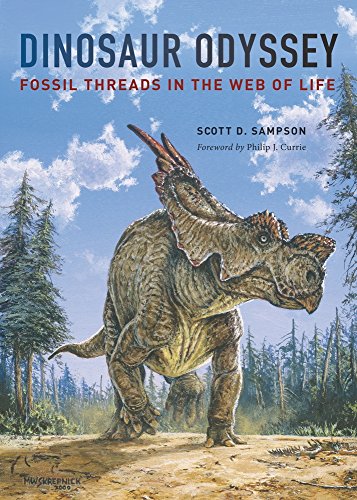
This captivating book, laced with evocative anecdotes from the field, gives the first holistic, up-to-date overview of dinosaurs and their world for a wide audience of readers. Situating these fascinating animals in a broad ecological and evolutionary context, leading dinosaur expert Scott D. Sampson fills us in on the exhilarating discoveries of the past twenty-five years, the most active period in the history of dinosaur paleontology, during which more “new” species were named than in all prior history. With these discoveries—and the most recent controversies—in mind, Sampson reconstructs the odyssey of the dinosaurs from their humble origins on the supercontinent Pangaea, to their reign as the largest animals the planet has ever known, and finally to their abrupt demise. Much more than the story of who ate whom way back when, Dinosaur Odyssey places dinosaurs in an expansive web of relationships with other organisms and demonstrates how they provide a powerful lens through which to observe the entire natural world. Addressing topics such as extinction, global warming, and energy flow, Dinosaur Odyssey finds that the dinosaurs' story is, in fact, a major chapter in our own story.
Die Inhaltsangabe kann sich auf eine andere Ausgabe dieses Titels beziehen.
Über die Autorin bzw. den Autor
Scott D. Sampson is a dinosaur paleontologist, evolutionary biologist, and educator. He serves as Research Curator at the Utah Museum of Natural History and Adjunct Associate Professor in the Department of Geology and Geophysics at the University of Utah. He now lives in the San Francisco Bay Area where he continues dinosaur research and actively pursues writing and consulting projects surrounding education reform and sustainability.
Von der hinteren Coverseite
"The best general-audience dinosaur book since the Dinosaur Renaissance began in the 1970s."—Philip J. Currie, coeditor of Encyclopedia of Dinosaurs, from the foreword
“Dinosaur Odyssey is not only a personable and highly accessible tour of the up-to-date discoveries about the gigantic and famous. It also builds on dinosaur paleontology to far-ranging topics like extinction, climate change, and the possibility of life on Mars. The gift to the reader is both fascination and enlightenment.”—Michael Novacek, author of Terra and Dinosaurs of the Flaming Cliffs
"An odyssey indeed! One of the world's leading dinosaur paleontologists, Sampson draws on a wide variety of sciences, from astronomy and cosmology to microbiology and ecology, in order to portray dinosaurs as living animals. The reader is in for a treat and will emerge with fresh and valuable insights."—Peter Dodson, author of The Horned Dinosaurs
“Dinosaur Odyssey is not only a personable and highly accessible tour of the up-to-date discoveries about the gigantic and famous. It also builds on dinosaur paleontology to far-ranging topics like extinction, climate change, and the possibility of life on Mars. The gift to the reader is both fascination and enlightenment.”—Michael Novacek, author of Terra and Dinosaurs of the Flaming Cliffs
"An odyssey indeed! One of the world's leading dinosaur paleontologists, Sampson draws on a wide variety of sciences, from astronomy and cosmology to microbiology and ecology, in order to portray dinosaurs as living animals. The reader is in for a treat and will emerge with fresh and valuable insights."—Peter Dodson, author of The Horned Dinosaurs
Aus dem Klappentext
"The best general-audience dinosaur book since the Dinosaur Renaissance began in the 1970s."Philip J. Currie, coeditor ofEncyclopedia of Dinosaurs, from the foreword
Dinosaur Odyssey is not only a personable and highly accessible tour of the up-to-date discoveries about the gigantic and famous. It also builds on dinosaur paleontology to far-ranging topics like extinction, climate change, and the possibility of life on Mars. The gift to the reader is both fascination and enlightenment. Michael Novacek, author ofTerra and Dinosaurs of the Flaming Cliffs
"An odyssey indeed! One of the world's leading dinosaur paleontologists, Sampson draws on a wide variety of sciences, from astronomy and cosmology to microbiology and ecology, in order to portray dinosaurs as living animals. The reader is in for a treat and will emerge with fresh and valuable insights."Peter Dodson, author of The Horned Dinosaurs
Dinosaur Odyssey is not only a personable and highly accessible tour of the up-to-date discoveries about the gigantic and famous. It also builds on dinosaur paleontology to far-ranging topics like extinction, climate change, and the possibility of life on Mars. The gift to the reader is both fascination and enlightenment. Michael Novacek, author ofTerra and Dinosaurs of the Flaming Cliffs
"An odyssey indeed! One of the world's leading dinosaur paleontologists, Sampson draws on a wide variety of sciences, from astronomy and cosmology to microbiology and ecology, in order to portray dinosaurs as living animals. The reader is in for a treat and will emerge with fresh and valuable insights."Peter Dodson, author of The Horned Dinosaurs
Auszug. © Genehmigter Nachdruck. Alle Rechte vorbehalten.
Dinosaur Odyssey
Fossil Threads in the Web of Life
By Scott D. SampsonUNIVERSITY OF CALIFORNIA PRESS
Copyright © 2009 the Regents of the University of California
All rights reserved.
ISBN: 978-0-520-24163-3All rights reserved.
Contents
Foreword, ix,
Preface, xiii,
Acknowledgments, xvii,
1. Treasure Island, 1,
2. Stardust Saurians, 19,
3. Dramatis Dinosaurae, 35,
4. Drifting Continents and Globe-Trotting Dinosaurs, 53,
5. Solar Eating, 71,
6. The River of Life, 87,
7. The Green Gradient, 103,
8. Panoply of Predators, 123,
9. Hidden Strands, 143,
10. Of Horn-Heads and Duck-Bills, 157,
11. The Goldilocks Hypothesis, 175,
12. Cinderellasaurus, 193,
13. Jurassic Park Dreams, 213,
14. West Side Story, 233,
15. The Way of All Creatures, 255,
Epilogue: Whispers from the Grave, 273,
Notes and References, 283,
Glossary, 305,
Art and Photograph Credits, 317,
Index, 319,
CHAPTER 1
TREASURE ISLAND
A SPONTANEOUS BARRAGE OF EXPLETIVES rang through the air, bringing my coworkers scrambling over the hill. Madagascar's sweltering midday heat no longer mattered. There before me, beneath a clod of freshly dislodged sediment, were four shining teeth, exposed to the light of day for the first time in more than 65 million years. Most kids could have confirmed that these sharp, recurved, chocolate brown objects, each topped with fine serrations, once lined the mouth of a meat-eating dinosaur, a theropod. Best of all, these teeth were still attached to a jawbone. Further digging revealed a complete and undistorted jaw, with every tooth in place. over the next couple of days we found more bones of the same, exceptionally preserved skull—part of the eye socket, another jaw with teeth, a gnarly bone from the nose region. Soon it became clear that most of the skull was buried here, although the individual bones had fallen apart and now lay strewn over several square meters. We could barely contain our excitement. Field paleontology relies as much on serendipity as on know-how and hard work, and the fates had smiled down upon us. Yet, as more and more bones of the ancient predator were unearthed, we began to get nervous. A key portion of the skull remained missing, leaving a mystery unsolved.
In Lewis Carroll's classic tale, Through the Looking-Glass and What Alice Found There, Alice gazes into a mirror to find a world similar to her own yet distinctly different. Her view of this reflected world varies dramatically depending on where she stands and how she holds the mirror. And Alice dreams of actually stepping through the looking glass to experience firsthand the wonders beyond. Like Alice, paleontologists attempt to gaze through the looking glass of time in order to catch glimpses of other, distant worlds. We, too, find that our perspective is always limited, changing considerably depending on how we hold the mirror and indeed which mirror we choose. And we, too, dream of witnessing these worlds firsthand. The ongoing efforts to open windows into ancient landscapes and their inhabitants comprise the science of PALEONTOLOGY, the study of ancient life.
Dinosaur paleontology, my particular specialty, is a peculiar profession. After all, how many people can claim to have a job that is the envy of most 6-year-olds? Telling others that you're a dinosaur paleontologist often results in the usual questions. "How do you know where to dig for them? What was the biggest dinosaur? Why do you think dinosaurs went extinct?" Of the most common queries, the one that I find most amazing and dismaying is "Don't we already know everything about dinosaurs?"
People tend to think of science as the gradual, steady accumulation of facts that has been ongoing for centuries. So it's often imagined that today we scientists are merely adding insignificant grains to an enormous, established mountain of knowledge. This view could hardly be further from the truth. The vast majority of nature's secrets have yet to be revealed. In the evocative words of biologist and environmentalist David Suzuki: "It is as if we are standing in a cave holding a candle; the flame barely penetrates the darkness, and we have no idea where the cave walls are, let alone how many caves there are beyond. Standing in the dark, cut off from time, and place, and from the rest of the universe, we struggle to understand what we are doing here alone." Rather than being daunted by our overwhelming ignorance, I am inspired by the multitude of new discoveries that patiently await us, entombed within the earth, carefully preserved in museum drawers, and tucked away in the corners of our imaginations. It's an exciting time to be a paleontologist.
If the overriding aim of science is to understand and describe as accurately as possible the workings of nature, certainty turns out to be a scarce commodity. To speak of "scientific facts" is to border on using an oxymoron. Most scientists would agree that there is a single, physical reality to comprehend. To borrow the slogan of a recent popular television show, "the truth is out there." Yet the best we can offer are successive approximations of that truth, formulated as alternative explanations, or HYPOTHESES. The scientific method involves sorting among these various alternatives. Consequently, testability is an integral part of the process, and only the strongest THEORIES, like gravity and EVOLUTION, withstand decades of testing and become accepted as fact.
But how can paleontologists test ideas? Like geology, paleontology is a historical science, concerned predominantly with understanding and interpreting past events. Historical sciences differ in at least one fundamental way from nonhistorical fields such as physics and chemistry. Paleontologists cannot test a hypothesis through direct experimentation for the simple reason that it is impossible to reproduce past events. For example, barring the highly unlikely cloning of a dinosaur from its DNA or the invention of a time machine (even less likely), we clearly can't investigate the metabolism of Tyrannosaurus rex directly. Similarly, geologists cannot observe the rifting and collisions of ancient continents. Given the strong emphasis on reproducibility—the ability to run the same experiment multiple times in order to test for similar results—some have even argued that the inability of historical sciences to reproduce results should disqualify them as scientific disciplines.
Yet the historical sciences are able to circumvent the conundrum of time's arrow, at least to some degree, through an elegant loophole. Although the inexorable march of time prohibits actual reproduction of past events, it's possible to observe multiple examples of such events. If these examples are consistent with a stated hypothesis, it gains support. If not, the hypothesis is falsified or at least brought under closer scrutiny.
Take evolution, for example. Darwin's theory states that all organisms past and present share common ancestry and that life evolved from simple, single-celled beginnings. Thus, we predict that the order of appearance of particular groups of organisms should mimic the branching pattern of evolution, with a trend toward increasing complexity through time. Convincing evidence against evolution would be the discovery of any animal that lived long before its supposed time of its origin—say, for example, the fossilized remains of a rabbit (or human or dinosaur, for that matter) dating to 400 million years ago. With hundreds of...
„Über diesen Titel“ kann sich auf eine andere Ausgabe dieses Titels beziehen.
Suchergebnisse für Dinosaur Odyssey: Fossil Threads in the Web of Life

Beispielbild für diese ISBN
Dinosaur Odyssey: Fossil Threads in the Web of Life
Verlag:
University of California Press, 2009
ISBN 10: 0520241630
ISBN 13: 9780520241633
Gebraucht
Hardcover
Anbieter: ThriftBooks-Atlanta, AUSTELL, GA, USA
Verkäuferbewertung 5 von 5 Sternen

Hardcover. Zustand: Good. No Jacket. Pages can have notes/highlighting. Spine may show signs of wear. ~ ThriftBooks: Read More, Spend Less. Artikel-Nr. G0520241630I3N00
Gebraucht kaufen
EUR 6,43
Versand gratis
Versand innerhalb von USA
Versand innerhalb von USA
Anzahl: 1 verfügbar
Beispielbild für diese ISBN
Dinosaur Odyssey: Fossil Threads in the Web of Life
Verlag:
University of California Press, 2009
ISBN 10: 0520241630
ISBN 13: 9780520241633
Gebraucht
Hardcover
Anbieter: ThriftBooks-Dallas, Dallas, TX, USA
Verkäuferbewertung 5 von 5 Sternen
Hardcover. Zustand: Good. No Jacket. Former library book; Pages can have notes/highlighting. Spine may show signs of wear. ~ ThriftBooks: Read More, Spend Less. Artikel-Nr. G0520241630I3N10
Gebraucht kaufen
EUR 6,43
Versand gratis
Versand innerhalb von USA
Versand innerhalb von USA
Anzahl: 1 verfügbar
Beispielbild für diese ISBN
Dinosaur Odyssey: Fossil Threads in the Web of Life
Verlag:
University of California Press, 2009
ISBN 10: 0520241630
ISBN 13: 9780520241633
Gebraucht
Hardcover
Anbieter: ThriftBooks-Dallas, Dallas, TX, USA
Verkäuferbewertung 5 von 5 Sternen
Hardcover. Zustand: Fair. No Jacket. Readable copy. Pages may have considerable notes/highlighting. ~ ThriftBooks: Read More, Spend Less. Artikel-Nr. G0520241630I5N00
Gebraucht kaufen
EUR 6,43
Versand gratis
Versand innerhalb von USA
Versand innerhalb von USA
Anzahl: 1 verfügbar
Beispielbild für diese ISBN
Dinosaur Odyssey: Fossil Threads in the Web of Life
Verlag:
University of California Press, 2009
ISBN 10: 0520241630
ISBN 13: 9780520241633
Gebraucht
Hardcover
Anbieter: ThriftBooks-Atlanta, AUSTELL, GA, USA
Verkäuferbewertung 5 von 5 Sternen
Hardcover. Zustand: Very Good. No Jacket. Former library book; May have limited writing in cover pages. Pages are unmarked. ~ ThriftBooks: Read More, Spend Less. Artikel-Nr. G0520241630I4N10
Gebraucht kaufen
EUR 6,43
Versand gratis
Versand innerhalb von USA
Versand innerhalb von USA
Anzahl: 1 verfügbar
Beispielbild für diese ISBN
Dinosaur Odyssey: Fossil Threads in the Web of Life
Verlag:
University of California Press, 2009
ISBN 10: 0520241630
ISBN 13: 9780520241633
Gebraucht
Hardcover
Anbieter: ThriftBooks-Atlanta, AUSTELL, GA, USA
Verkäuferbewertung 5 von 5 Sternen
Hardcover. Zustand: Very Good. No Jacket. Missing dust jacket; May have limited writing in cover pages. Pages are unmarked. ~ ThriftBooks: Read More, Spend Less. Artikel-Nr. G0520241630I4N01
Gebraucht kaufen
EUR 6,43
Versand gratis
Versand innerhalb von USA
Versand innerhalb von USA
Anzahl: 1 verfügbar
Beispielbild für diese ISBN
Dinosaur Odyssey : Fossil Threads in the Web of Life
Verlag:
University of California Press, 2009
ISBN 10: 0520241630
ISBN 13: 9780520241633
Gebraucht
Hardcover
Erstausgabe
Anbieter: Better World Books, Mishawaka, IN, USA
Verkäuferbewertung 5 von 5 Sternen
Zustand: Good. 1st Edition. Former library copy. Pages intact with minimal writing/highlighting. The binding may be loose and creased. Dust jackets/supplements are not included. Includes library markings. Stock photo provided. Product includes identifying sticker. Better World Books: Buy Books. Do Good. Artikel-Nr. 4223777-6
Gebraucht kaufen
EUR 6,69
Versand gratis
Versand innerhalb von USA
Versand innerhalb von USA
Anzahl: 1 verfügbar
Foto des Verkäufers
Dinosaur Odyssey: Fossil Threads in the Web of Life
Verlag:
University of California Press, 2009
ISBN 10: 0520241630
ISBN 13: 9780520241633
Gebraucht
Hardcover
Anbieter: MusicMagpie, Stockport, Vereinigtes Königreich
Verkäuferbewertung 5 von 5 Sternen
Zustand: Very Good. 1791465240. 10/8/2026 1:14:00 PM. Artikel-Nr. U9780520241633
Gebraucht kaufen
EUR 10,93
EUR 6,49 Versand
Versand von Vereinigtes Königreich nach USA
Versand von Vereinigtes Königreich nach USA
Anzahl: 1 verfügbar
Beispielbild für diese ISBN
Dinosaur Odyssey: Fossil Threads in the Web of Life
Verlag:
University of California Press, 2009
ISBN 10: 0520241630
ISBN 13: 9780520241633
Gebraucht
Paperback
Anbieter: WorldofBooks, Goring-By-Sea, WS, Vereinigtes Königreich
Verkäuferbewertung 5 von 5 Sternen
Paperback. Zustand: Very Good. The book has been read, but is in excellent condition. Pages are intact and not marred by notes or highlighting. The spine remains undamaged. Artikel-Nr. GOR005306820
Gebraucht kaufen
EUR 21,93
EUR 6,62 Versand
Versand von Vereinigtes Königreich nach USA
Versand von Vereinigtes Königreich nach USA
Anzahl: 1 verfügbar
Foto des Verkäufers
Dinosaur Odyssey
Verlag:
University of California Press, London, 2009
ISBN 10: 0520241630
ISBN 13: 9780520241633
Gebraucht
Hardcover
Erstausgabe
Anbieter: Garden City Books, Herts, Vereinigtes Königreich
Verkäuferbewertung 5 von 5 Sternen
Hardcover. Zustand: Fine. Zustand des Schutzumschlags: Fine. 1st Edition. 2009 first edition hardback with unclipped dustjacket. In excellent clean condition, appears hardly used. "Dinosaur Odyssey" places dinosaurs in an expansive web of relationships with other organisms and demonstrates how they provide a powerful lens through which to observe the entire natural world. Addressing topics such as extinction, global warming, and energy flow, "Dinosaur Odyssey" finds that the dinosaurs' story is, in fact, a major chapter in our own story. Artikel-Nr. 009598
Gebraucht kaufen
EUR 20,69
EUR 23,63 Versand
Versand von Vereinigtes Königreich nach USA
Versand von Vereinigtes Königreich nach USA
Anzahl: 1 verfügbar
Beispielbild für diese ISBN
Dinosaur Odyssey Fossil Threads in the Web of Life
Anbieter: Revaluation Books, Exeter, Vereinigtes Königreich
Verkäuferbewertung 5 von 5 Sternen
Hardcover. Zustand: Brand New. 1st edition. 352 pages. 10.25x7.50x1.25 inches. In Stock. Artikel-Nr. 0520241630
Neu kaufen
EUR 112,13
EUR 17,72 Versand
Versand von Vereinigtes Königreich nach USA
Versand von Vereinigtes Königreich nach USA
Anzahl: 1 verfügbar