
Verwandte Artikel zu The Body/Body Problem: Selected Essays
Inhaltsangabe
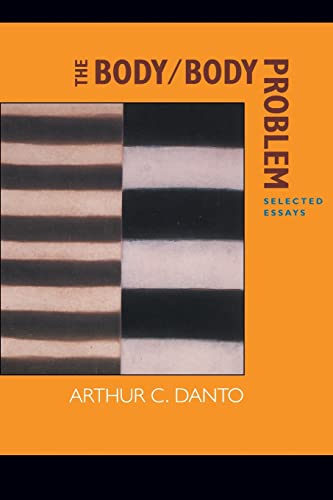
The overall subject of the essays in The Body/Body Problem is the traditional one of what our ultimate makeup is, as creatures with minds and bodies. The central thesis is that we are beings who represent--and misrepresent--actual and possible worlds. Addressing philosophical questions of mental representation, Danto presents his distinctive approach to some of the most enduring topics in philosophy. He is concerned with the nature of description, the status of the external world, action theory, the philosophy of history, and the philosophical status of psychoanalytic explanation. Representation is a central concept in philosophy, says Danto, with differences among philosophers arising in the ways they account for how representations connect to the world or to the individuals possessing them, and how they connect with one another to form systems of beliefs, feelings, and attitudes. In these essays Danto's own voice, with his arguments and speculations, provides rich philosophical pleasures that will endure, to borrow from Santayana, "under whatever sky."
Arthur C. Danto is one of the most original and multitalented philosophers writing today, a thinker whose interests traverse the boundaries of traditional understandings of philosophy. Best known for his contributions to the philosophy of art and aesthetics, Danto is also esteemed for his work in the history of philosophy, the philosophy of history, philosophical psychology, and action theory. These two volumes, each with an introduction by the author, contain essays spanning more than twenty-five years that have been selected to highlight the inseparability of philosophy and art in Danto's work. Together they present the thinking of Arthur C. Danto at his very best.
Die Inhaltsangabe kann sich auf eine andere Ausgabe dieses Titels beziehen.
Über die Autorin bzw. den Autor
Arthur C. Danto is Johnsonian Professor of Philosophy Emeritus at Columbia University. He is art critic for The Nation and the author of more than twenty books, including Playing with the Edge: The Photographic Achievement of Robert Mapplethorpe (California, 1996), Encounters and Reflections: Art in the Historical Present (California, 1995), and, now in paperback, Beyond the Brillo Box: The Visual Arts in Post-Historical Perspective (California, 1998).
Auszug. © Genehmigter Nachdruck. Alle Rechte vorbehalten.
The Body/Body Problem
Selected EssaysBy Arthur Coleman DantoUniversity of California Press
Copyright © 2001 Arthur Coleman DantoAll right reserved.
ISBN: 9780520229082
Introduction:
Philosophy, Representation, and History
George Santayana wrote of his philosophy that it would have been the same "under whatever sky I had been born." His view was that, so far as philosophy is concerned, one part or stage of the world is like any other, and that nothing properly philosophical belongs to one rather than another time or place. Santayana wrote a classic in the philosophy of art, The Sense of Beauty , in which he argued that beauty is pleasure objectified, by which he seems to have meant that the pleasure caused in us by art or nature, considered aesthetically, is unconsciously projected outward onto its causes and treated henceforward as among their objective properties. Beauty is a subjective state regarded as an objective presence. His philosophical model for this theory was David Hume, who famously argued that the concept of causal necessity is a projection outward of a habit, instilled in us by our experiencing constant conjunctions of like events with like. The necessity we believe connects cause to effect is but the force of habit objectified—a state of mind misread as a state of the world. Under whatever sky, Hume might have insisted, there is nothing more to causality than this, whatever may have been believed by philosophers trapped in earlier systems of thought. And although it can at least be questioned whether Santayana could have arrived at his view under a sky that did not include his great predecessor, Santayanasimilarly believed that there is no more to beauty than pleasure miscast as an objective property of what happens to give us pleasure, even if, under different skies, different orders of things may cause individuals to feel pleasure.
Santayana came to see his views of beauty as after all indexed to a certain historical moment. "You must remember," he wrote the aesthetician Thomas Munro in 1921, "that we were not very much later than Ruskin, Pater, Swinburne, and Matthew Arnold: our atmosphere was that of poets and persons touched with religious enthusiasm or religious madness. Beauty (which mustn't be mentioned now) was then a living presence, or an aching absence, day and night." His ingenious analysis of the sense of beauty might still hold good, wherever we take pleasure in things. But pleasure and beauty ("which mustn't be mentioned now") had become decreasingly relevant to the experience of art. Nothing in Ruskin, Pater, Swinburne, or Arnold would have prepared anyone for Cubism, or Dada, or German Expressionism. Notoriously, Ruskin was unable to assimilate Whistler to his idea of art, let alone his idea of beauty. Ruskin was so harsh and angry a critic that it is easy to suppose that what he said about the advanced art of his times, in which the connection between beauty and art was beginning to weaken, was the projection outward of the pain it caused him: Whistler's painting was irascibility misread as ugliness. In any case, a philosophy of art based on beauty and pleasure under European skies in the late nineteenth century would be entirely out of touch with art made under the skies of Modernism.
The thought that philosophy must be everywhere and always the same encounters some difficulty with the kinds of transformation exhibited in the change from traditional to modernist, and then post-modernist, art. Philosophies of art based on nineteenth-century artworks are nineteenth-century philosophies of art and cannot easily be exported into the twentieth century, when art is so different from, for example, the Pre-Raphaelite work that Ruskin so admired. The concept of art, which the philosophy of art aspires to understand, may indeed betimeless. But any familiarity with the history of art must make it plain that most actual philosophies of art were so constrained by their historical moment that they could not easily be applied when future artistic possibilities unfolded, ones so radically discontinuous with the works of art from which they were derived that an initial impulse is, as with Ruskin, to deny them the status of art at all. For to think of them as art means that what we thought was philosophical truth was restricted to a historical moment. One can be certain one's philosophy is indemnified against future history only if the belief can be justified that nothing the future brings will force abandonment of or adjustment in the concept we have arrived at. A truly timeless philosophy of art must be compatible with every possible artworld, as a timeless philosophy of causation must be true under every possible sky, however hidden it may be from thinkers blinded by the smoke of inadequate theories. The bird of wisdom, Hegel writes, takes flight only with the falling of the dusk. Philosophy paints its gray in gray only when the history of its subject will have run its course.
Hegel would not have supposed his philosophy would be the same "under whatever sky." Rather, he saw his philosophy as internally connected with the historical moment in which he arrived at it. His masterpiece, The Phenomenology of Spirit , was composed in the university town of Jena, just when the cannons of Napoleon were firing outside its gates. He saw Napoleon as fulfilling through action what he, Hegel, brought to self-consciousness in his writing. His philosophy, he makes plain, would not have been possible at any earlier phase of history. "Absolute knowledge became—objectively—possible," Hegel's great commentator, Alexandre Kojeve, wrote, "because in and by Napoleon the real process of historical evolution, in the course of which man created new worlds and transformed himself by creating them, came to its end."1 His view was that a true philosophy is internally connected with the history it culminates, the same way we understand what happened in a story only by reading the last page. A skyless philosophy is what philosophers aspire to, but their actual philosophies, like Santayana's aesthetics, are parochialreflections of specific moments in the history of their subjects. Even under Hellenic skies, in which mathematics was venerated, it would have been difficult to attain an adequate philosophy of numbers. Nothing the Greeks recognized as numbers—integers and fractions—could solve x2 = 2, so one had to invent a special kind of number—irrational numbers—whose relationship to rational numbers had to be reflected in philosophical representations of what numbers are. New kinds of numbers had similarly to be invented to solve equations beyond the reach of the numbers one knew about. To base one's concept of numbers merely on the natural numbers would be like basing one's conception of art on the work of Giotto, at the beginning of art's long development. And in the end the concept of number is astonishingly more abstract than anyone would have recognized whose paradigm was adding 2 and 2.
In his Lectures on Aesthetic , Hegel declared that the history of art was just such a story, and that it had come to an end. He based this in part on the view that art was no longer able to relate to society as it once had done, in Greek or in Gothic times, expressing the objective spirit of those eras. A gap had grown up between society and art, which had increasingly become a subject for intellectual judgment rather than, as beauty was felt to be in Santayana's rueful recollection, an object of sensuous or spiritual response. A philosophy of art was now...
„Über diesen Titel“ kann sich auf eine andere Ausgabe dieses Titels beziehen.
Suchergebnisse für The Body/Body Problem: Selected Essays

Beispielbild für diese ISBN
The Body/Body Problem: Selected Essays
Verlag:
University of California Press, 2001
ISBN 10: 0520229088
ISBN 13: 9780520229082
Gebraucht
Paperback
Anbieter: World of Books (was SecondSale), Montgomery, IL, USA
Verkäuferbewertung 5 von 5 Sternen

Paperback. Zustand: Good. Addressing philosophical questions of mental representation, this title presents a different approach to some of the most enduring topics in philosophy. This title deals with the nature of description, the status of the external world, action theory, the philosophy of history, and the philosophical status of psychoanalytic explanation. Artikel-Nr. 00107762817
Gebraucht kaufen
EUR 5,17
Versand gratis
Versand innerhalb von USA
Versand innerhalb von USA
Anzahl: 1 verfügbar
Beispielbild für diese ISBN
The Body/Body Problem: Selected Essays
Verlag:
University of California Press, 2001
ISBN 10: 0520229088
ISBN 13: 9780520229082
Gebraucht
Paperback
Anbieter: World of Books (was SecondSale), Montgomery, IL, USA
Verkäuferbewertung 5 von 5 Sternen
Paperback. Zustand: Very Good. Addressing philosophical questions of mental representation, this title presents a different approach to some of the most enduring topics in philosophy. This title deals with the nature of description, the status of the external world, action theory, the philosophy of history, and the philosophical status of psychoanalytic explanation. Artikel-Nr. 00100817539
Gebraucht kaufen
EUR 5,17
Versand gratis
Versand innerhalb von USA
Versand innerhalb von USA
Anzahl: 2 verfügbar
Beispielbild für diese ISBN
The Body/Body Problem: Selected Essays
Verlag:
University of California Press (edition First Edition), 2001
ISBN 10: 0520229088
ISBN 13: 9780520229082
Gebraucht
Paperback
Erstausgabe
Anbieter: BooksRun, Philadelphia, PA, USA
Verkäuferbewertung 5 von 5 Sternen
Paperback. Zustand: Very Good. First Edition. It's a well-cared-for item that has seen limited use. The item may show minor signs of wear. All the text is legible, with all pages included. It may have slight markings and/or highlighting. Artikel-Nr. 0520229088-11-1
Gebraucht kaufen
EUR 5,18
Versand gratis
Versand innerhalb von USA
Versand innerhalb von USA
Anzahl: 1 verfügbar
Beispielbild für diese ISBN
The Body/body Problem : Selected Essays
Verlag:
University of California Press, 2001
ISBN 10: 0520229088
ISBN 13: 9780520229082
Gebraucht
Softcover
Anbieter: Better World Books, Mishawaka, IN, USA
Verkäuferbewertung 5 von 5 Sternen
Zustand: Good. Pages intact with minimal writing/highlighting. The binding may be loose and creased. Dust jackets/supplements are not included. Stock photo provided. Product includes identifying sticker. Better World Books: Buy Books. Do Good. Artikel-Nr. 9994846-6
Gebraucht kaufen
EUR 10,11
Versand gratis
Versand innerhalb von USA
Versand innerhalb von USA
Anzahl: 1 verfügbar
Beispielbild für diese ISBN
The body/body problem : selected essays / Arthur C. Danto
Verlag:
Berkeley : University of Califor, 2000
ISBN 10: 0520229088
ISBN 13: 9780520229082
Gebraucht
Hardcover
Anbieter: Books From California, Simi Valley, CA, USA
Verkäuferbewertung 4 von 5 Sternen

Hardcover. Zustand: Good. Artikel-Nr. mon0003496670
Gebraucht kaufen
EUR 15,09
EUR 4,45 Versand
Versand innerhalb von USA
Versand innerhalb von USA
Anzahl: 1 verfügbar
Beispielbild für diese ISBN
The Body/Body Problem: Selected Essays
Verlag:
University of California Press, Berkeley, 2001
ISBN 10: 0520229088
ISBN 13: 9780520229082
Gebraucht
Soft cover
Erstausgabe
Anbieter: Salsus Books (P.B.F.A.), Kidderminster, Vereinigtes Königreich
Verkäuferbewertung 5 von 5 Sternen
Soft cover. Zustand: Very Good. 1st Edition. xi 262pp paperback, ownership signature. Artikel-Nr. 054315
Gebraucht kaufen
EUR 14,60
EUR 17,72 Versand
Versand von Vereinigtes Königreich nach USA
Versand von Vereinigtes Königreich nach USA
Anzahl: 1 verfügbar
Beispielbild für diese ISBN
The Body/Body Problem
Anbieter: PBShop.store UK, Fairford, GLOS, Vereinigtes Königreich
Verkäuferbewertung 5 von 5 Sternen
PAP. Zustand: New. New Book. Shipped from UK. Established seller since 2000. Artikel-Nr. WF-9780520229082
Neu kaufen
EUR 30,61
EUR 5,93 Versand
Versand von Vereinigtes Königreich nach USA
Versand von Vereinigtes Königreich nach USA
Anzahl: 2 verfügbar
Beispielbild für diese ISBN
The Body/Body Problem - Selected Essays
Anbieter: PBShop.store US, Wood Dale, IL, USA
Verkäuferbewertung 5 von 5 Sternen
PAP. Zustand: New. New Book. Shipped from UK. Established seller since 2000. Artikel-Nr. WF-9780520229082
Beispielbild für diese ISBN
The Body/Body Problem
Verlag:
University of California Press, 2001
ISBN 10: 0520229088
ISBN 13: 9780520229082
Neu
Softcover
Anbieter: Majestic Books, Hounslow, Vereinigtes Königreich
Verkäuferbewertung 4 von 5 Sternen
Zustand: New. pp. 273. Artikel-Nr. 5029888
Neu kaufen
EUR 33,41
EUR 7,68 Versand
Versand von Vereinigtes Königreich nach USA
Versand von Vereinigtes Königreich nach USA
Anzahl: 1 verfügbar
Beispielbild für diese ISBN
The Body/Body Problem: Selected Essays
Verlag:
University of California Press, 2001
ISBN 10: 0520229088
ISBN 13: 9780520229082
Neu
Softcover
Anbieter: Kennys Bookstore, Olney, MD, USA
Verkäuferbewertung 5 von 5 Sternen
Zustand: New. Addressing philosophical questions of mental representation, this title presents a different approach to some of the most enduring topics in philosophy. This title deals with the nature of description, the status of the external world, action theory, the philosophy of history, and the philosophical status of psychoanalytic explanation. Num Pages: 273 pages, black & white illustrations. BIC Classification: HPM. Category: (P) Professional & Vocational. Dimension: 229 x 152 x 19. Weight in Grams: 63. . 2001. New Ed. Paperback. . . . . Books ship from the US and Ireland. Artikel-Nr. V9780520229082
Neu kaufen
EUR 37,03
EUR 9,37 Versand
Versand innerhalb von USA
Versand innerhalb von USA
Anzahl: 1 verfügbar