
Verwandte Artikel zu Legitimate Differences: Interpretation in the Abortion...
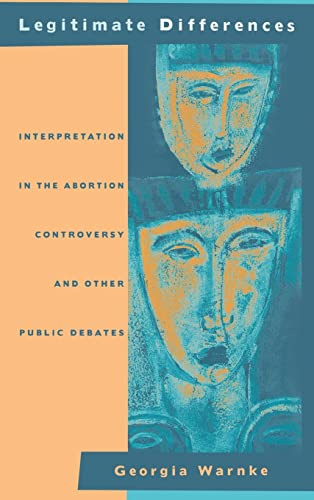
Legitimate Differences: Interpretation in the Abortion Controversy and Other Public Debates - Hardcover
Inhaltsangabe
Legitimate Differences challenges the usual portrayal of current debates over thorny social issues including abortion, pornography, affirmative action, and surrogate mothering as moral debates. How can it be said that our debates oppose principles of life to those of liberty, principles of liberty to those of equality, principles of equality to those of fairness, and principles of fairness to those of integrity, when we as Americans share all these principles?
Debates over such issues are not, Georgia Warnke argues, moral debates over which principles we should adopt. Rather, they are interpretive debates over the meanings of principles we already possess. Warnke traces the structure of these debates with reference to the work of Jane Austen, Hans-Georg Gadamer, Jürgen Habermas, and Bernard Williams. In separate chapters on surrogate mothering, affirmative action, abortion, and pornography she articulates new understandings of the meanings of some of our principles and shows the equal legitimacy of some different interpretations of the meanings of others. Finally, she suggests that the orientation of American public policy ought to be directed less at finding single canonical interpretations of our principles than at accommodating different legitimate understandings of them. The perspective offered by Legitimate Differences should have a significantly beneficial effect on public discussions.
Die Inhaltsangabe kann sich auf eine andere Ausgabe dieses Titels beziehen.
Über die Autorin bzw. den Autor
Georgia Warnke is Professor of Philosophy at the University of California, Riverside. She is the author of Gadamer: Hermeneutics, Tradition, and Reason (1987) and Justice and Interpretation (1993).
Von der hinteren Coverseite
"Warnke's analyses of various issues of public policy are sensible and illuminating. . . . While the practical issues with which she is concerned have been discussed endlessly, she articulates and elaborates in helpful detail a surprisingly fresh and invigorating point of view."—Harry Frankfurt, Princeton University
"Georgia Warnke has a genuine talent for arguing through very complex questions, addressing the strongest positions on both sides; she is a prime example of her own theory at work!"—Michael Walzer, Institute for Advanced Study
"Georgia Warnke has a genuine talent for arguing through very complex questions, addressing the strongest positions on both sides; she is a prime example of her own theory at work!"—Michael Walzer, Institute for Advanced Study
Aus dem Klappentext
"Warnke's analyses of various issues of public policy are sensible and illuminating. . . . While the practical issues with which she is concerned have been discussed endlessly, she articulates and elaborates in helpful detail a surprisingly fresh and invigorating point of view." Harry Frankfurt, Princeton University
"Georgia Warnke has a genuine talent for arguing through very complex questions, addressing the strongest positions on both sides; she is a prime example of her own theory at work!" Michael Walzer, Institute for Advanced Study
"Georgia Warnke has a genuine talent for arguing through very complex questions, addressing the strongest positions on both sides; she is a prime example of her own theory at work!" Michael Walzer, Institute for Advanced Study
Auszug. © Genehmigter Nachdruck. Alle Rechte vorbehalten.
Legitimate Differences: Interpretation in the Abortion Controversy and Other Public Debates
By Georgia WarnkeUniversity of California Press
Copyright 1999 Georgia WarnkeAll right reserved.
ISBN: 0520216334
Chapter One
Interpretation and Social Issues
Current public debates over social issues in the United States are often pursued and portrayed as though they were arguments over competing moral principles. Thus, the abortion debate is depicted by its participants and commentators as a struggle that opposes principles of life to principles of liberty. So-called pro-life groups argue against a woman's right to terminate a pregnancy on the basis that abortion violates a moral principle of respect for the sanctity of human life. Conversely, pro-choice groups support the right to an abortion on the basis that any restriction of abortion rights violates a moral principle of liberty insofar as it is also a restriction of woman's freedom to decide when or if she is to be a parent. Similarly, discussion over affirmative action is viewed as a debate setting principles of equality against those of fairness or diversity. Those who advocate an end to America's affirmative action policies argue that they violate the principle of equality in granting preferential treatment to certain groups on the basis of their ethnicity, race, or gender. Just as adamantly, those who advocate the continuation of affirmative action policies argue that principles of fairness require preferential treatment to compensate for the effects of past discrimination against certain groups while a principle of diversity requires the spreading of privileges and career opportunities over a wider spectrum of the American public.
Differences on moral principle also seem to divide those who defend the production and consumption of pornography as part of their defense
of the principle of free speech from those who attack pornography as a violation of the principle of equality with regard to women. And, finally, the moral principles involved in supporting the integrity of the family and denying the place of market values in it seems to pit those who criticize the practice of surrogate motherhood against those who defend it by appealing to principles involving the rational autonomy of women and the freedom of contract.1
Such apparently moral differences are particularly troubling to us Americans because we assume that we share moral principles. At least we assume that if we do not share all our moral principles, we share certain founding principles that speak to the sanctity of life and to the importance of liberty and equality. Moreover, we assume that we can appeal to our Constitution and ultimately to the Supreme Court's interpretation of it to resolve any disagreements we may have over how and whether disputed practices conform to our principles. Hence, we are dismayed when Supreme Court decisions only increase the acrimony and bitterness in our disagreements as they have in the controversy over abortion and in various cases involving affirmative action.
We are supposed to agree that individual human life is intrinsically valuable and that each individual is to be granted as much individual liberty as is compatible with a similar liberty on the part of all others. We are supposed to agree, then, that each person is to be guaranteed a right to life, the freedom of speech and contract (among other freedoms), and the liberty to pursue his or her own life's projects and conceptions of the good. Americans are also meant to agree that men, women, and children are to enjoy a right to equal concern and respect as well as to careers, offices, and opportunities that are equally open to all on the basis of individual merit and hard work. But if we so completely disagree at least on the four issues I have mentionedabortion, affirmative action, pornography, and surrogate motheringthen perhaps we only appear to agree on the validity of shared fundamental principles. Moreover, perhaps our presumption that we ought to share an allegiance to the same moral principles aggravates the hostility each side in our debates bears toward the other. Each uses the principles we are meant to share to convict the other side of violating ideals fundamental to our moral identity.
Attempts to resolve such conflicts often try either to narrow the scope of moral disagreement or to dig further down below the principles on which we seem to disagree to a deeper core of moral agreement. The idea here is that the contrasts I have sketched, those that oppose a principle of life to that of liberty, a principle of equality to those of fairness
and diversity, a principle of free speech to that of equality, and a principle of family integrity to that of freedom of contract, are all relatively superficial contrasts that can be resolved by uncovering a more fundamental ground of principled agreement. Lawrence Tribe has thus characterized the debate over abortion, for example, as only apparently a "clash of absolutes,"2 one that can be resolved by considering views Americans continue to share on the value of family life and the proper scope of technological intrusions into it. I want to look briefly at his resolution for two reasons: to support his effort to remove our conflicts from the domain of clashing absolutes and to indicate potential problems in all attempts to minimize our differences by simply invoking more fundamental or more widely shared principles. I shall be arguing that these attempts fail to recognize both the depth of our differences and what I shall be calling their interpretive character. Moreover, I shall argue that only by acknowledging their interpretive character can we begin to find ways to deal with them.
Tribe's Solution to the Debate over AbortionSuppose, as is likely, that technological advance makes it possible for doctors to remove fetuses from their mothers' wombs at an early point in their pregnancies and to grow the fetuses in surrogate mothers or test tubes. Such a procedure would seem to offer a solution to the conflict over abortion if that conflict pits a fetus's alleged right to life against a woman's alleged liberty to choose when and if she is to become a parent. Without causing the death of the fetus, a woman could liberate herself from both the need to endure a nine-month pregnancy and all responsibility for the fetus or child by simply allowing the fetus to be transferred from her womb to another woman's womb or to an artificial one. But suppose a pregnant woman decides she does not want either to bear a child at this point in her life or to have a fetus removed from her body and brought to term in another place. Does she still have the right to demand an abortion in circumstances in which technology can absolve her of all responsibility for bearing and raising the child she conceived? Can she insist that the life of the fetus be terminated if another woman or the state is willing to bring it to term? She would no longer be compelled to bear or raise the child. But does she have an additional right to insist not only that she be released from the necessity of bearing the fetus but, further, that the fetus's life be ended, that no child genetically related to her be born into the world at this time?
Tribe admits that a woman might reasonably object to the notion that she could...
„Über diesen Titel“ kann sich auf eine andere Ausgabe dieses Titels beziehen.
Suchergebnisse für Legitimate Differences: Interpretation in the Abortion...

Beispielbild für diese ISBN
Legitimate Differences: Interpretation in the Abortion Controversy and Other Public Debates
Verlag:
University of California Press, 1999
ISBN 10: 0520216334
ISBN 13: 9780520216334
Gebraucht
Hardcover
Anbieter: Books From California, Simi Valley, CA, USA
Verkäuferbewertung 4 von 5 Sternen

Hardcover. Zustand: Very Good. Artikel-Nr. mon0003514687
Gebraucht kaufen
EUR 27,45
EUR 4,45 Versand
Versand innerhalb von USA
Versand innerhalb von USA
Anzahl: 1 verfügbar
Foto des Verkäufers
Legitimate differences interpretation in the abortion controversy and other public debates.
Verlag:
University of California Press, 1999
ISBN 10: 0520216334
ISBN 13: 9780520216334
Gebraucht
Hardcover
Anbieter: Kloof Booksellers & Scientia Verlag, Amsterdam, Niederlande
Verkäuferbewertung 4 von 5 Sternen
Zustand: very good. Berkeley, CA. : University of California Press, [1999]. Reprint. Orig. halfcloth binding. Dustjacket. xi, 214 p. ; 24 cm. Includes bibliographical references (p. 195-210) and index. - Legitimate Differences challenges the usual portrayal of current debates over thorny social issues including abortion, pornography, affirmative action, and surrogate mothering as moral debates. How can it be said that our debates oppose principles of life to those of liberty, principles of liberty to those of equality, principles of equality to those of fairness, and principles of fairness to those of integrity, when we as Americans share all these principles? Debates over such issues are not, Georgia Warnke argues, moral debates over which principles we should adopt. Rather, they are interpretive debates over the meanings of principles we already possess. Warnke traces the structure of these debates with reference to the work of Jane Austen, Hans-Georg Gadamer, Jürgen Habermas, and Bernard Williams. In separate chapters on surrogate mothering, affirmative action, abortion, and pornography she articulates new understandings of the meanings of some of our principles and shows the equal legitimacy of some different interpretations of the meanings of others. Finally, she suggests that the orientation of American public policy ought to be directed less at finding single canonical interpretations of our principles than at accommodating different legitimate understandings of them. The perspective offered by Legitimate Differences should have a significantly beneficial effect on public discussions. Condition : very good copy. ISBN 9780520216334. Keywords : PHILOSOPHY, abortion *. Artikel-Nr. 172785
Gebraucht kaufen
EUR 16,95
EUR 30,00 Versand
Versand von Niederlande nach USA
Versand von Niederlande nach USA
Anzahl: 1 verfügbar
Beispielbild für diese ISBN
Legitimate Differences: Interpretation in the Abortion Controversy and Other Public Debates
Verlag:
University of California Press, 1999
ISBN 10: 0520216334
ISBN 13: 9780520216334
Neu
Hardcover
Anbieter: Ria Christie Collections, Uxbridge, Vereinigtes Königreich
Verkäuferbewertung 5 von 5 Sternen

Zustand: New. In English. Artikel-Nr. ria9780520216334_new
Neu kaufen
EUR 65,19
EUR 13,34 Versand
Versand von Vereinigtes Königreich nach USA
Versand von Vereinigtes Königreich nach USA
Anzahl: Mehr als 20 verfügbar
Beispielbild für diese ISBN
Legitimate Differences
Verlag:
University of California Press, 1999
ISBN 10: 0520216334
ISBN 13: 9780520216334
Neu
Hardcover
Anbieter: Majestic Books, Hounslow, Vereinigtes Königreich
Verkäuferbewertung 4 von 5 Sternen
Zustand: New. pp. 214. Artikel-Nr. 5033648
Neu kaufen
EUR 86,08
EUR 7,68 Versand
Versand von Vereinigtes Königreich nach USA
Versand von Vereinigtes Königreich nach USA
Anzahl: 1 verfügbar
Beispielbild für diese ISBN
Legitimate Differences: Interpretation in the Abortion Controversy and Other Public Debates
Anbieter: Revaluation Books, Exeter, Vereinigtes Königreich
Verkäuferbewertung 5 von 5 Sternen
Hardcover. Zustand: Brand New. 1st edition. 214 pages. 9.75x7.00x1.25 inches. In Stock. Artikel-Nr. x-0520216334
Neu kaufen
EUR 95,65
EUR 11,82 Versand
Versand von Vereinigtes Königreich nach USA
Versand von Vereinigtes Königreich nach USA
Anzahl: 2 verfügbar
Foto des Verkäufers
LEGITIMATE DIFFERENCES
Anbieter: moluna, Greven, Deutschland
Verkäuferbewertung 5 von 5 Sternen
Gebunden. Zustand: New. How can it be said that debates oppose principles of life to those of liberty, principles of liberty to those of equality, principles of equality to those of fairness, and principles of fairness to those of integrity, when we share these principles? This te. Artikel-Nr. 594721201
Neu kaufen
EUR 73,41
EUR 48,99 Versand
Versand von Deutschland nach USA
Versand von Deutschland nach USA
Anzahl: Mehr als 20 verfügbar
Foto des Verkäufers
Legitimate Differences : Interpretation in the Abortion Controversy and Other Public Debates
Anbieter: AHA-BUCH GmbH, Einbeck, Deutschland
Verkäuferbewertung 5 von 5 Sternen
Buch. Zustand: Neu. Neuware - Legitimate Differences challenges the usual portrayal of current debates over thorny social issues including abortion, pornography, affirmative action, and surrogate mothering as moral debates. How can it be said that our debates oppose principles of life to those of liberty, principles of liberty to those of equality, principles of equality to those of fairness, and principles of fairness to those of integrity, when we as Americans share all these principles Debates over such issues are not, Georgia Warnke argues, moral debates over which principles we should adopt. Rather, they are interpretive debates over the meanings of principles we already possess. Warnke traces the structure of these debates with reference to the work of Jane Austen, Hans-Georg Gadamer, Jürgen Habermas, and Bernard Williams. In separate chapters on surrogate mothering, affirmative action, abortion, and pornography she articulates new understandings of the meanings of some of our principles and shows the equal legitimacy of some different interpretations of the meanings of others. Finally, she suggests that the orientation of American public policy ought to be directed less at finding single canonical interpretations of our principles than at accommodating different legitimate understandings of them. The perspective offered by Legitimate Differences should have a significantly beneficial effect on public discussions. Artikel-Nr. 9780520216334
Neu kaufen
EUR 99,18
EUR 35,00 Versand
Versand von Deutschland nach USA
Versand von Deutschland nach USA
Anzahl: 1 verfügbar