Inhaltsangabe
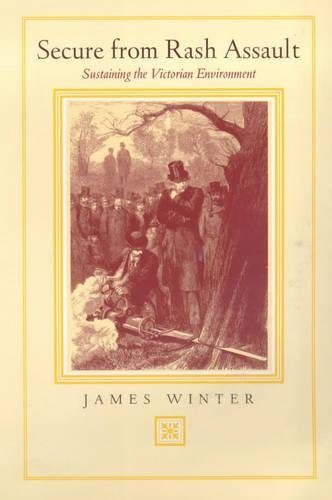
Nineteenth-century Britain led the world in technological innovation and urbanization, and unprecedented population growth contributed as well to the "rash assault," to quote Wordsworth, on Victorian countrysides. Yet James Winter finds that the British environment was generally spared widespread ecological damage.
Drawing from a remarkable variety of sources and disciplines, Winter focuses on human intervention as it not only destroyed but also preserved the physical environment. Industrial blight could be contained, he says, because of Britain's capacity to import resources from elsewhere, the conservative effect of the estate system, and certain intrinsic limitations of steam engines. The rash assault was further blunted by traditional agricultural practices, preservation of forests, and a growing recreation industry that favored beloved landscapes. Winter's illumination of Victorian attitudes toward the exploitation of natural resources offers a valuable preamble to ongoing discussions of human intervention in the environment.
Drawing from a remarkable variety of sources and disciplines, Winter focuses on human intervention as it not only destroyed but also preserved the physical environment. Industrial blight could be contained, he says, because of Britain's capacity to import resources from elsewhere, the conservative effect of the estate system, and certain intrinsic limitations of steam engines. The rash assault was further blunted by traditional agricultural practices, preservation of forests, and a growing recreation industry that favored beloved landscapes. Winter's illumination of Victorian attitudes toward the exploitation of natural resources offers a valuable preamble to ongoing discussions of human intervention in the environment.
Die Inhaltsangabe kann sich auf eine andere Ausgabe dieses Titels beziehen.
Über die Autorin bzw. den Autor
James Winter is Professor Emeritus of History at the University of British Columbia and author of London's Teeming Streets, 1830-1914 (1993).
Von der hinteren Coverseite
"This book is both learned and readable, at once an environmental, economic, and technological history. Actually about the whole length and breadth of Britain, it is never so technical that a lay reader gets lost and never so accommodating that it flattens the complexities of his subjects."—Michael Dintenfass, author of The Decline of Industrial Britain 1870-1980
Aus dem Klappentext
"This book is both learned and readable, at once an environmental, economic, and technological history. Actually about the whole length and breadth of Britain, it is never so technical that a lay reader gets lost and never so accommodating that it flattens the complexities of his subjects."Michael Dintenfass, author of The Decline of Industrial Britain 1870-1980
Auszug. © Genehmigter Nachdruck. Alle Rechte vorbehalten.
Secure from Rash Assault: Sustaining the Victorian Environment
By James WinterUniversity of California Press
Copyright © 1999 James WinterAll right reserved.
ISBN: 0520216091
Introduction
While workmen, entrepreneurs, inventors, and engineers were discovering new ways to apply the power of steam, a number of individuals began, at the beginning of the Victorian era, to voice alarm about the consequences of releasing so potent a force upon fragile nature. In 1848, when the second paroxysm of railway speculation was just beginning to subside, the noted geographer Mary Somerville confessed to having been astonished by the "successive convulsions" the "application of the powers of nature to locomotion" had caused. In her Physical Geography , she predicted that the new communication technology would radically shift the power balance toward man and away from nature, a shift that would force people to reconsider "the relationship between man and animate beings."1
This new relationship was the subject of Thomas Carlyle's "Signs of the Times," published some two decades earlier. Armed not only with steam but also with all manner of artifice, engineer mountain movers were, he announced, emerging everywhere victorious from their "war with rude nature." He announced that a new "Age of Machinery" had arrived and was consolidating its gains: "Nothing is now done directly, or by hand; all is by rule and calculated contrivance. For the simplest operation, some helps and accompaniments, some cunning abbreviating process is in readiness. Our old modes of exertion are all discredited and thrown aside." Increasingly calculated contrivances would, he thought, make sure that "nothing follows its spontaneous course."2
As we near the end of a millennium, pundits among us are similarly inclined toward prophecy; some of it hopeful, some angst-ridden. Either way, one notices that these predictions usually assume, as did those of Somerville and Carlyle, that technology, and the cast of mind that causes people to embrace it or at least accept it as inevitable, must transform society and its mechanisms as well as the material environment.
One example will suffice: an academic task force at one large North American university recently advised colleagues to recognize that "technological innovation is transforming education and exercising a significant influence on almost every aspect of daily life, including our leisure and cultural activities." This memorandum then expands on how computers are making jobs less office-centered; how they are reversing the long migration from the country to the city; how they, along with the use of automation, are undermining expectations of long-term employment and placing a premium on those skills that allow for occupational mobility; how they are rapidly constructing an electronic global village, a multicultural environment that will require that more attention be paid to cross-cultural studies and to foreign language training. Even in these post-Marxist times, it would seem, the proposition that the superstructure must eventually reflect changes in the material base can still be taken as a given.
The usual objections to this simplistic theory of causation will be raised in what follows. However, the focus will not be on a generalized future but on a particular past. Central to the enterprise will be a search for an answer to a question William Wordsworth posed in 1844 on hearing that engineers intended to build a railway line from Kendal to Windermere—into the heart of his beloved Lake District. Two lines of the sonnet he wrote on that occasion ask, "Is then no nook of English ground secure / From rash assault?"
Retrospect permits an answer but assures that it cannot be a straightforward yes or no. The sudden advent of new tools and methods for transforming and controlling nature, most of them worked out and applied first in Britain, did provide, directly or indirectly, the means and incentive to make large alterations and to do so almost everywhere. These mechanisms did not, of course, operate in a social, economic, or demographic vacuum. Intrusions into the fabric of landscapes and land surfaces happened when human beings were replicating at a dramatic pace relative to almost every other form of animate life, when the population scale shifted from rural to urban, when British entrepreneurs and manufacturers were leading the world in the process of industrialization, and
when British farmers were providing a model for those who wished to exploit land intensively. Under those circumstances, few nooks were likely to remain completely secure. There can also be no doubt that areas of English, Welsh, Scottish, and Irish ground were indeed rashly assaulted and left in ruins during the age of steam.
The forces of change were formidable enough. Almost everywhere in the island kingdom formerly self-contained ecological systems needed to react to the pull of urban centers and to those distant markets around the globe that had been opened by a revolution in communications technology. Localities responded by specializing their land uses, exporting water, minerals, and energy and adapting to the influx of artificial products from the outside world.
Nevertheless, what strikes us is the degree of continuity in the Victorian land and landscape—the continually shifting balances that were worked out—not the amount of change. As subsequent chapters will attempt to show, Victorian and Edwardian arable agriculture remained "ecologically benign," as did woodlands, which resisted large-scale coniferization and, as a consequence, retained much of their ecological complexity. Concentrations of industrial blight were confined and closely hemmed in with natural scenery, and experiments were made in restoring derelict sites. Popular tourism transformed areas of the seacoast without inflicting serious damage on the hinterland. The process of greening cityscapes advanced at the same time as the country was leaving the city. Overall, a distinctive and celebrated landscape retained its health and unique beauty.
No single, overarching, theoretical strategy will be employed to explain why these tensions could be balanced during a time when "steam" became a metaphor for artifice and innovation of every kind—cultural as well as technological. Offered instead will be a complex of factors that, coming together and interacting, created in Britain (to borrow a rotund phrase from Oliver MacDonagh) "a peculiar concatenation of circumstances in the nineteenth century."3
One of these circumstances was the capacity to lead the rest of Europe in draining resources from less industrially developed parts of the world. The fact of empire, "the empire of free trade," also allowed Britain to use steamships and steam locomotives to export at least some of its environmental damage. In that sense, the new technology acted as a domestic conservator. We see this clearly in the agricultural and forestry sectors. Yet, paradoxically, this technology also assisted in developing a sheep-grazing monoculture on rough upland pastures, thus adding to
the forces that were depleting a meager stock of soil nutrients on upland hillsides.
By way of balance, these new forms of transport helped to promote highly intensive and, at the same time, sustainable arable farming. This achievement, surely one of early and mid-Victorian Britain's most impressive, was brought about, not primarily by...
„Über diesen Titel“ kann sich auf eine andere Ausgabe dieses Titels beziehen.
Weitere beliebte Ausgaben desselben Titels

Suchergebnisse für Secure from Rash Assault: Sustaining the Victorian...

Beispielbild für diese ISBN
Secure from Rash Assault â" Sustaining the Victorian Environment
Verlag:
University of California Press, 1999
ISBN 10: 0520216091
ISBN 13: 9780520216099
Gebraucht
Hardcover
Anbieter: WorldofBooks, Goring-By-Sea, WS, Vereinigtes Königreich
Verkäuferbewertung 5 von 5 Sternen

Hardback. Zustand: Very Good. The book has been read, but is in excellent condition. Pages are intact and not marred by notes or highlighting. The spine remains undamaged. Artikel-Nr. GOR007295822
Gebraucht kaufen
EUR 3,32
EUR 6,46 Versand
Versand von Vereinigtes Königreich nach USA
Versand von Vereinigtes Königreich nach USA
Anzahl: 1 verfügbar
Beispielbild für diese ISBN
Secure from Rash Assault: Sustaining the Victorian Environment
Verlag:
University of California Press, 1999
ISBN 10: 0520216091
ISBN 13: 9780520216099
Gebraucht
Hardcover
Anbieter: Books From California, Simi Valley, CA, USA
Verkäuferbewertung 5 von 5 Sternen
Hardcover. Zustand: Very Good. Artikel-Nr. mon0003700798
Gebraucht kaufen
EUR 7,83
EUR 4,29 Versand
Versand innerhalb von USA
Versand innerhalb von USA
Anzahl: 1 verfügbar
Foto des Verkäufers
Secure from Rash Assault â" Sustaining the Victorian Environment
Verlag:
University of California Press, 1999
ISBN 10: 0520216091
ISBN 13: 9780520216099
Gebraucht
Hardcover
Anbieter: WeBuyBooks, Rossendale, LANCS, Vereinigtes Königreich
Verkäuferbewertung 5 von 5 Sternen
Zustand: Like New. Most items will be dispatched the same or the next working day. An apparently unread copy in perfect condition. Dust cover is intact with no nicks or tears. Spine has no signs of creasing. Pages are clean and not marred by notes or folds of any kind. Artikel-Nr. wbs7277828293
Gebraucht kaufen
EUR 5,20
EUR 8,61 Versand
Versand von Vereinigtes Königreich nach USA
Versand von Vereinigtes Königreich nach USA
Anzahl: 1 verfügbar
Beispielbild für diese ISBN
Secure from Rash Assault, Sustaining the Victorian Environment
Verlag:
University of California Press, 1999
ISBN 10: 0520216091
ISBN 13: 9780520216099
Gebraucht
Hardcover
Anbieter: N. Fagin Books, Chicago, IL, USA
Verkäuferbewertung 4 von 5 Sternen

Hardcover. Zustand: Near Fine. Dust Jacket Included. 1999. Conservation, Natural History, Europe. University of California Press. Very good - near fine brown cloth and dust jacket 342p. 10/25. Artikel-Nr. 1400926205
Gebraucht kaufen
EUR 8,85
EUR 5,15 Versand
Versand innerhalb von USA
Versand innerhalb von USA
Anzahl: 1 verfügbar
Foto des Verkäufers
Secure from Rash Assault; Sustaining the Victorian Environment.
Verlag:
University of California Press, (1999)., Berkeley:, 1999
ISBN 10: 0520216091
ISBN 13: 9780520216099
Gebraucht
Hardcover
Anbieter: Jeff Weber Rare Books, Neuchatel, NEUCH, Schweiz
Verkäuferbewertung 5 von 5 Sternen
8vo. xi, 342 pp. Illus., index. Gilt-stamped dark brown cloth, dust-jacket. Fine. ISBN: 0520216091 "Nineteenth-century Britain led the world in technological innovation and urbanization, and unprecedented population growth contributed as well to the "rash assault," to quote Wordsworth, on Victorian countrysides. Yet James Winter finds that the British environment was generally spared widespread ecological damage. / Drawing from a remarkable variety of sources and disciplines, Winter focuses on human intervention as it not only destroyed but also preserved the physical environment. Industrial blight could be contained, he says, because of Britain's capacity to import resources from elsewhere, the conservative effect of the estate system, and certain intrinsic limitations of steam engines. The rash assault was further blunted by traditional agricultural practices, preservation of forests, and a growing recreation industry that favored beloved landscapes. Winter's illumination of Victorian attitudes toward the exploitation of natural resources offers a valuable preamble to ongoing discussions of human intervention in the environment. " James Winter is Professor Emeritus of History at the University of British Columbia and author of London's Teeming Streets, 1830-1914 (1993). Artikel-Nr. SS12829
Gebraucht kaufen
EUR 3,99
EUR 25,00 Versand
Versand von Schweiz nach USA
Versand von Schweiz nach USA
Anzahl: 1 verfügbar