
Verwandte Artikel zu Random Violence: How We Talk about New Crimes and New...
Inhaltsangabe
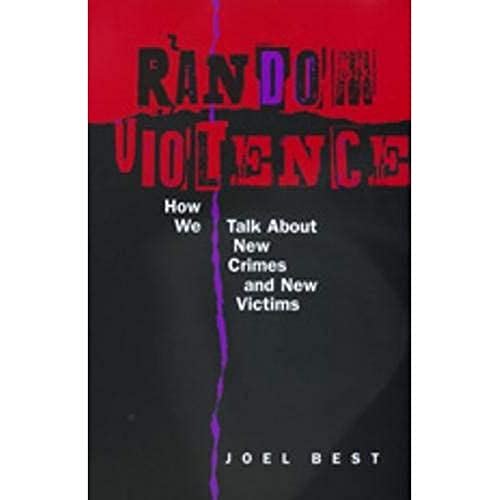
Random Violence is a deft and thought-provoking exploration of the ways we talk about--and why we worry about--new crimes and new forms of victimization. Focusing on so-called random crimes such as freeway shootings, gang violence, hate crimes, stalking, and wilding, Joel Best shows how new crime problems emerge and how some quickly fade from public attention while others spread and become enduring subjects of concern. Best's original and incisive argument illuminates the fact that while these crimes are in actuality neither new, nor epidemic, nor random, the language used to describe them nonetheless shapes both private fears and public policies.
Best scrutinizes the melodramatic quality of the American public's attitudes toward crime, exposing the cultural context for the popularity of "random violence" as a catch-all phrase to describe contemporary crime, and the fallacious belief that violence is steadily rising. He points out that the age, race, and sex of homicide victims reveal that violence is highly patterned.
Best also details the contemporary ideology of victimization, as well as the social arrangements that create and support a victim industry that can label large numbers of victims. He demonstrates why it has become commonplace to "declare war" on social problems, including drugs, crime, poverty, and cancer, and outlines the complementary influence of media, activists, officials, and experts in institutionalizing crime problems. Intrinsic to all these concerns is the way in which policy choices and outcomes are affected by the language used to describe social problems.
Die Inhaltsangabe kann sich auf eine andere Ausgabe dieses Titels beziehen.
Über die Autorin bzw. den Autor
Joel Best is Professor of Sociology at Southern Illinois University at Carbondale. He is the author of Threatened Children: Rhetoric and Concern about Child-Victims (1990).
Von der hinteren Coverseite
"A major contribution to the literature on social problems, crime, and social deviance, and a fine example of what is currently the best-established theoretical approach to this material. It is laudably interdisciplinary, draws admirably from 'high' and 'low' culture, and over all asks some very challenging questions."—Philip Jenkins, Pennsylvania State University
"Random Violence extends the growing scholarly literature on the social construction of social problems by showing us how currently trendy folk knowledge obscures the most perplexing problems in American society and how it serves to foster a climate of social distrust."—Donileen Loeske, University of South Florida
"Random Violence extends the growing scholarly literature on the social construction of social problems by showing us how currently trendy folk knowledge obscures the most perplexing problems in American society and how it serves to foster a climate of social distrust."—Donileen Loeske, University of South Florida
Aus dem Klappentext
"A major contribution to the literature on social problems, crime, and social deviance, and a fine example of what is currently the best-established theoretical approach to this material. It is laudably interdisciplinary, draws admirably from 'high' and 'low' culture, and over all asks some very challenging questions." Philip Jenkins, Pennsylvania State University
"Random Violence extends the growing scholarly literature on the social construction of social problems by showing us how currently trendy folk knowledge obscures the most perplexing problems in American society and how it serves to foster a climate of social distrust." Donileen Loeske, University of South Florida
"Random Violence extends the growing scholarly literature on the social construction of social problems by showing us how currently trendy folk knowledge obscures the most perplexing problems in American society and how it serves to foster a climate of social distrust." Donileen Loeske, University of South Florida
Auszug. © Genehmigter Nachdruck. Alle Rechte vorbehalten.
Random Violence
How We Talk about New Crimes & New VictimsBy Joel BestUniversity of California Press
Copyright © 1999 Joel BestAll right reserved.
ISBN: 9780520215726
Chapter 1
Random Violence
BEWARE!
There is a new GANG INITIATION!!
This new initiation of murder is brought about by Gang Members driving around at night with their car lights off. When you flash your car lights to signal them that their lights are out, the Gang Members take it literally as "LIGHTS OUT," so they follow you to your destination and kill you! That's their initiation.
Two families have already fallen victim to this initiation ritual. Be aware and inform your families and friends.
DO NOT FLASH YOUR CAR LIGHTS FOR ANYONE!!
flyer circulated in Chicago, 1993
Tales of gang members driving around, planning to kill whoever flashed headlights at them, spread from coast to coast during the fall of 1993 (Brunvand 1995; FOAFTale News 1993b, 1993c). Concerned citizens passed along the story via photocopies, faxes, and, of course, word of mouth. Employers warned their employees, law-enforcement agencies alerted one another, and the press cautioned the public. It seemed a plausible story: everybody knew that there were gang members out there; the notion that gang "initiation rites" required members to commit terrible crimes was well ingrained; and cars and guns seemed easy
to come by. It could happen , people told themselves. That's just the kind of thing gangs do.
The previous year's gang-initiation story had been about ankle grabbers at shopping malls (Brunvand 1993; FOAFTale News 1993a). It involved gang members who crawled beneath parked vehicles, waiting for the drivers to return. When a driver paused to open the car door, the gang member would reach out and grab the victim's ankles. There were different versions of what happened next: in one, when the victim reached down to pry the assailant's hands loose, the gang member chopped off a finger as a souvenir; in others, the gang member slashed the victim's Achilles tendon, dropping the victim to the groundthe first step in a robbery, rape, or murder. People believed the ankle-grabbing story, in spite of its imporbable elements (e.g., gang members positioning themselves for criminal attacks by crawling under cars, overpowering victims by grabbing their ankles, easily slicing through the tough Achilles tendon, etc.). After all, it was just the kind of thing gang members do.
There is no evidence that either gang-initiation tale was true. Neither seems especially plausible, yet both were widely believed. What explains this credulity? Concern about random, senseless violence has become a central theme in contemporary culture. In addition to gang initiation rites, we worry about serial murders, carjackings, freeway shootings, sexual predators, wilding, hate crimes, kids with guns, stalking, drive-by shootings, copycat criminals, workplace violence, shootings in schools, and other unpredictable threats. Why shouldn't we also worry about ankle-grabbing attacks and lights-out killings?
The notion that our society is plagued by random violence has surprisingly broad appeal. Consider two recent quotations invoking the concept:
Our greatest fear is of violence from a nameless, faceless stranger. . . . Citizens of all races who are fearful of random violence have good reason for their concern. Storekeepers, utility workers, police officers, and ordinary citizens out for a carton of milk or a family dinner are all increasingly at risk.
We are terrified by the prospect of innocent people being gunned down at random, without warning and almost without motive, by youngsters who afterward show us the blank, unremorseful faces of seemingly feral, presocial beings.
The first quotation is from the liberal attorney Adam Walinsky (1995:44, 47), the second from the conservative political scientist James Q. Wilson (1994:26). Although they bring different ideological assumptions to social analysis, and although they recommend different sorts of solutions for society's problems, both Walinsky and Wilson define random violence as a major social crisis.
Similar warnings abound. The Federal Bureau of Investigation (1994:237) warns: "Every American now has a realistic chance of murder victimization in view of the random nature the crime has assumed." Senator Daniel Patrick Moynihan (1993:27) charges: "Violent killings, often random, go on unabated. Peaks continue to attract some notice. But these are peaks above 'average' levels that thirty years ago would have been thought epidemic." The criminologist Jerome H. Skolnick (1994:3435) notes the intense media coverage given a few violent crimes:
The message seemed to be that random violence is everywhere and you are no longer safenot in your suburban home, commuter train, or automobileand the police and the courts cannot or will not help you. . . . It is random violent crime, like a shooting in a fast-food restaurant, that is driving fear.
A sociologist conducting focus groups of women talking about crime finds that they describe "predatory, extremely violent, criminals who attack at random" (Madriz 1997:112). A reader writes to Time magazine about "the latest episode in the drama of random violence that airs almost every day in America," calling it a "spiraling epidemic" (Gerol 1994). And a commentator for U.S. News & World Report reacts to President Clinton's suggestion that schools begin the day with a moment of silence:
Silence is a small, fragile thing. It cannot cure teen pregnancy or stop random violence. It cannot banish gangs or drugs. It cannot
rebuild families or restore faith. But it can, at times, replenish the spirit. (Roberts 1994)
In short, references to random violence have become commonplace, indicating a widespread sense that random violence is a significant problem.
In part, this concern with random violence seems grounded in a general sense that crime is both out of control and on the rise. But this generalized sense of dread is heightened by specific fears, fostered by what sociologists call "moral panics"exaggerated, heavily publicized reports of sudden increases in particular sorts of criminal violence, such as the stories that gangs had begun holding lights-out initiations.1 And, unlike the lights-out story, which was not true, there is at least some basis for many of the claims that bring new crime problems into the spotlight of public attention.
Consider, for example, the focus on freeway shootings in Los Angeles in the summer of 1987 (Best 1991). The story began when reporters juxtaposed stories of two shootings on L.A. freeways during the same June weekend. When a third shooting occurred a few weeks later, the press declared that they had spotted a trend, and, for three weeks in late July and early August, news stories about L.A.'s "road warriors" riding "hair-trigger highways" attracted national attention. These reports emphasized the randomness of freeway violence: anyone in a vehicle could become the target of an unprovoked attack. However, it soon became obvious that freeway violence was not spreading across the country or increasing in southern California; it was not even all that common in L.A. There simply weren't enough serious freeway shootings to justify continued media coverage, and the moral panic faded almost as quickly as it arose.
Concern over freeway violence was an intense but brief episode. In contrast, other crime problems prove to have greater staying power once they gain our attention. Serial murder,...
„Über diesen Titel“ kann sich auf eine andere Ausgabe dieses Titels beziehen.
Suchergebnisse für Random Violence: How We Talk about New Crimes and New...

Beispielbild für diese ISBN
Random Violence: How We Talk about New Crimes and New Victims
Verlag:
University of California Press (edition First Edition), 1999
ISBN 10: 0520215729
ISBN 13: 9780520215726
Gebraucht
Paperback
Erstausgabe
Anbieter: BooksRun, Philadelphia, PA, USA
Verkäuferbewertung 5 von 5 Sternen

Paperback. Zustand: Fair. First Edition. The item might be beaten up but readable. May contain markings or highlighting, as well as stains, bent corners, or any other major defect, but the text is not obscured in any way. Artikel-Nr. 0520215729-7-1-13
Gebraucht kaufen
EUR 4,86
Versand gratis
Versand innerhalb von USA
Versand innerhalb von USA
Anzahl: 1 verfügbar
Beispielbild für diese ISBN
Random Violence: How We Talk about New Crimes and New Victims
Verlag:
University of California Press (edition First Edition), 1999
ISBN 10: 0520215729
ISBN 13: 9780520215726
Gebraucht
Paperback
Erstausgabe
Anbieter: BooksRun, Philadelphia, PA, USA
Verkäuferbewertung 5 von 5 Sternen
Paperback. Zustand: Fair. First Edition. The item might be beaten up but readable. May contain markings or highlighting, as well as stains, bent corners, or any other major defect, but the text is not obscured in any way. Artikel-Nr. 0520215729-7-1
Gebraucht kaufen
EUR 5,07
Versand gratis
Versand innerhalb von USA
Versand innerhalb von USA
Anzahl: 1 verfügbar
Beispielbild für diese ISBN
Random Violence: How We Talk about New Crimes and New Victims
Verlag:
University of California Press, 1999
ISBN 10: 0520215729
ISBN 13: 9780520215726
Gebraucht
Paperback
Anbieter: ThriftBooks-Dallas, Dallas, TX, USA
Verkäuferbewertung 5 von 5 Sternen
Paperback. Zustand: Very Good. No Jacket. May have limited writing in cover pages. Pages are unmarked. ~ ThriftBooks: Read More, Spend Less. Artikel-Nr. G0520215729I4N00
Gebraucht kaufen
EUR 6,06
Versand gratis
Versand innerhalb von USA
Versand innerhalb von USA
Anzahl: 1 verfügbar
Beispielbild für diese ISBN
Random Violence: How We Talk about New Crimes and New Victims
Verlag:
University of California Press, 1999
ISBN 10: 0520215729
ISBN 13: 9780520215726
Gebraucht
Paperback
Anbieter: ThriftBooks-Atlanta, AUSTELL, GA, USA
Verkäuferbewertung 5 von 5 Sternen
Paperback. Zustand: Very Good. No Jacket. May have limited writing in cover pages. Pages are unmarked. ~ ThriftBooks: Read More, Spend Less. Artikel-Nr. G0520215729I4N00
Gebraucht kaufen
EUR 6,06
Versand gratis
Versand innerhalb von USA
Versand innerhalb von USA
Anzahl: 1 verfügbar
Beispielbild für diese ISBN
Random Violence : How We Talk about New Crimes and New Victims
Verlag:
University of California Press, 1999
ISBN 10: 0520215729
ISBN 13: 9780520215726
Gebraucht
Softcover
Erstausgabe
Anbieter: Better World Books: West, Reno, NV, USA
Verkäuferbewertung 5 von 5 Sternen
Zustand: Very Good. 1st Edition. Former library copy. Pages intact with possible writing/highlighting. Binding strong with minor wear. Dust jackets/supplements may not be included. Includes library markings. Stock photo provided. Product includes identifying sticker. Better World Books: Buy Books. Do Good. Artikel-Nr. GRP37521822
Gebraucht kaufen
EUR 6,19
Versand gratis
Versand innerhalb von USA
Versand innerhalb von USA
Anzahl: 1 verfügbar
Beispielbild für diese ISBN
Random Violence : How We Talk about New Crimes and New Victims
Verlag:
University of California Press, 1999
ISBN 10: 0520215729
ISBN 13: 9780520215726
Gebraucht
Softcover
Erstausgabe
Anbieter: Better World Books, Mishawaka, IN, USA
Verkäuferbewertung 5 von 5 Sternen
Zustand: Good. 1st Edition. Pages intact with minimal writing/highlighting. The binding may be loose and creased. Dust jackets/supplements are not included. Stock photo provided. Product includes identifying sticker. Better World Books: Buy Books. Do Good. Artikel-Nr. 7850537-6
Gebraucht kaufen
EUR 6,19
Versand gratis
Versand innerhalb von USA
Versand innerhalb von USA
Anzahl: 1 verfügbar
Beispielbild für diese ISBN
Random Violence : How We Talk about New Crimes and New Victims
Verlag:
University of California Press, 1999
ISBN 10: 0520215729
ISBN 13: 9780520215726
Gebraucht
Softcover
Erstausgabe
Anbieter: Better World Books, Mishawaka, IN, USA
Verkäuferbewertung 5 von 5 Sternen
Zustand: Good. 1st Edition. Former library copy. Pages intact with minimal writing/highlighting. The binding may be loose and creased. Dust jackets/supplements are not included. Includes library markings. Stock photo provided. Product includes identifying sticker. Better World Books: Buy Books. Do Good. Artikel-Nr. GRP88547953
Gebraucht kaufen
EUR 6,19
Versand gratis
Versand innerhalb von USA
Versand innerhalb von USA
Anzahl: 1 verfügbar
Beispielbild für diese ISBN
Random Violence : How We Talk about New Crimes and New Victims
Verlag:
University of California Press, 1999
ISBN 10: 0520215729
ISBN 13: 9780520215726
Gebraucht
Softcover
Erstausgabe
Anbieter: Better World Books Ltd, Dunfermline, Vereinigtes Königreich
Verkäuferbewertung 5 von 5 Sternen
Zustand: Good. 1st Edition. Former library copy. Pages intact with minimal writing/highlighting. The binding may be loose and creased. Dust jackets/supplements are not included. Includes library markings. Stock photo provided. Product includes identifying sticker. Better World Books: Buy Books. Do Good. Artikel-Nr. GRP88547953
Gebraucht kaufen
EUR 8,53
EUR 5,99 Versand
Versand von Vereinigtes Königreich nach USA
Versand von Vereinigtes Königreich nach USA
Anzahl: 1 verfügbar
Beispielbild für diese ISBN
Random Violence: How We Talk About New Crimes and New Victims
Verlag:
University of California Press, 1999
ISBN 10: 0520215729
ISBN 13: 9780520215726
Gebraucht
Softcover
Anbieter: Anybook.com, Lincoln, Vereinigtes Königreich
Verkäuferbewertung 5 von 5 Sternen
Zustand: Fair. This is an ex-library book and may have the usual library/used-book markings inside.This book has soft covers. Clean from markings. In fair condition, suitable as a study copy. Please note the Image in this listing is a stock photo and may not match the covers of the actual item,450grams, ISBN:9780520215726. Artikel-Nr. 9624009
Gebraucht kaufen
EUR 3,34
EUR 15,84 Versand
Versand von Vereinigtes Königreich nach USA
Versand von Vereinigtes Königreich nach USA
Anzahl: 1 verfügbar
Beispielbild für diese ISBN
Random Violence: How We Talk about New Crimes and New Victims
Verlag:
University of California Press, 1999
ISBN 10: 0520215729
ISBN 13: 9780520215726
Neu
Softcover
Anbieter: Kennys Bookstore, Olney, MD, USA
Verkäuferbewertung 5 von 5 Sternen
Zustand: New. An exploration of the ways we talk about - and why we worry about - new crimes and new forms of victimization. Focusing on so-called random crimes such as freeway shootings, gang violence, and wilding, it shows how new crime problems emerge and how some quickly fade from public attention while others spread and become enduring subjects of concern. Num Pages: 237 pages, 5 line drawings, 1 table. BIC Classification: 1KBB; JFC; JFFE; JKV; JPQB. Category: (P) Professional & Vocational. Dimension: 155 x 230 x 16. Weight in Grams: 63. . 1999. 1st Edition. Paperback. . . . . Books ship from the US and Ireland. Artikel-Nr. V9780520215726
Neu kaufen
EUR 35,76
EUR 9,38 Versand
Versand innerhalb von USA
Versand innerhalb von USA
Anzahl: 1 verfügbar