Inhaltsangabe
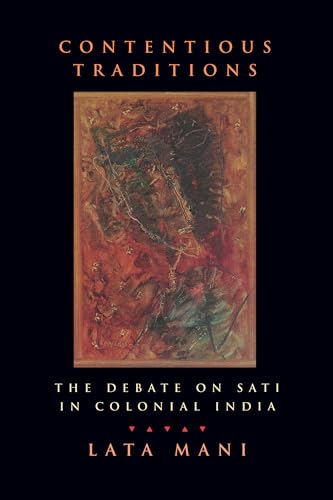
"Contentious Traditions" analyzes the debate on sati, or widow burning, in colonial India. Though the prohibition of widow burning in 1829 was heralded as a key step forward for women's emancipation in modern India, Lata Mani argues that the women who were burned were marginal to the debate and that the controversy was over definitions of Hindu tradition, the place of ritual in religious worship, the civilizing missions of colonialism and evangelism, and the proper role of the colonial state. Mani radically revises colonialist as well as nationalist historiography on the social reform of women's status in the colonial period and clarifies the complex and contradictory character of missionary writings on India. The history of widow burning is one of paradox. While the chief players in the debate argued over the religious basis of sati and the fine points of scriptural interpretation, the testimonials of women at the funeral pyres consistently addressed, the material hardships and societal expectations attached to widowhood. And although historiography has traditionally emphasized the colonial horror of sati, a fascinated ambivalence toward the practice suffused official discussions. The debate normalized the violence of sati and supported the misconception that it was a voluntary act of wifely devotion. Mani brilliantly illustrates how situated feminism and discourse analysis compel a rewriting of history, thus destabilizing the ways we are accustomed to look at women and men, at 'tradition', custom, and modernity.
Die Inhaltsangabe kann sich auf eine andere Ausgabe dieses Titels beziehen.
Über die Autorin bzw. den Autor
Lata Mani is an Indian feminist and historian who currently lives in California.
Von der hinteren Coverseite
"An important and disturbing book. Lata Mani has reopened the archives on widow burning in colonial India. Her meticulous reading of contemporary texts . . . is exemplary for its conceptual sophistication. Unsettling and illuminating, this is feminist scholarship at its best."—Ranajit Guha, founding editor Subaltern Studies
"Mani's argument that the terms 'tradition' and 'modernity' are inscribed and reinscribed in the bodies of colonized women has forever changed our understandings of patriarchy, nationalism, and colonialism, and indeed redefined the conditions for 'knowing' with respect to these contexts."—Lisa Lowe, author of Immigration Acts
"Lata Mani's brilliant and persuasive analysis of official, native and missionary writings on sati in colonial India makes for a new beginning in contemporary analysis of colonial discourse.This is the book that many have waited for. A landmark publication in several fields at once: modern South Asian history, feminist critiques of colonial discourse, and cultural studies."—Dipesh Chakrabarty, University of Chicago
"Mani's argument that the terms 'tradition' and 'modernity' are inscribed and reinscribed in the bodies of colonized women has forever changed our understandings of patriarchy, nationalism, and colonialism, and indeed redefined the conditions for 'knowing' with respect to these contexts."—Lisa Lowe, author of Immigration Acts
"Lata Mani's brilliant and persuasive analysis of official, native and missionary writings on sati in colonial India makes for a new beginning in contemporary analysis of colonial discourse.This is the book that many have waited for. A landmark publication in several fields at once: modern South Asian history, feminist critiques of colonial discourse, and cultural studies."—Dipesh Chakrabarty, University of Chicago
Aus dem Klappentext
"An important and disturbing book. Lata Mani has reopened the archives on widow burning in colonial India. Her meticulous reading of contemporary texts . . . is exemplary for its conceptual sophistication. Unsettling and illuminating, this is feminist scholarship at its best." Ranajit Guha, founding editor Subaltern Studies
"Mani's argument that the terms 'tradition' and 'modernity' are inscribed and reinscribed in the bodies of colonized women has forever changed our understandings of patriarchy, nationalism, and colonialism, and indeed redefined the conditions for 'knowing' with respect to these contexts." Lisa Lowe, author of Immigration Acts
"Lata Mani's brilliant and persuasive analysis of official, native and missionary writings on sati in colonial India makes for a new beginning in contemporary analysis of colonial discourse.This is the book that many have waited for. A landmark publication in several fields at once: modern South Asian history, feminist critiques of colonial discourse, and cultural studies." Dipesh Chakrabarty, University of Chicago
"Mani's argument that the terms 'tradition' and 'modernity' are inscribed and reinscribed in the bodies of colonized women has forever changed our understandings of patriarchy, nationalism, and colonialism, and indeed redefined the conditions for 'knowing' with respect to these contexts." Lisa Lowe, author of Immigration Acts
"Lata Mani's brilliant and persuasive analysis of official, native and missionary writings on sati in colonial India makes for a new beginning in contemporary analysis of colonial discourse.This is the book that many have waited for. A landmark publication in several fields at once: modern South Asian history, feminist critiques of colonial discourse, and cultural studies." Dipesh Chakrabarty, University of Chicago
Auszug. © Genehmigter Nachdruck. Alle Rechte vorbehalten.
Contentious Traditions
The Debate on Sati in Colonial IndiaBy Lata ManiUniversity of California Press
Copyright © 1998 Lata ManiAll right reserved.
ISBN: 9780520214071
Introduction
The prohibition of sati —widow burning—in 1829 has been canonized by colonialist and nationalist texts as a founding moment in the history of women's emancipation in modern India. Within the frames of a patriarchal ideology, sati , a predominantly upper-caste Hindu practice, is comprehended as the duty of a virtuous wife. By immolating herself, the widow purportedly enables herself as well as her deceased husband to enjoy "heavenly pleasures" and even, according to some scriptural texts, to escape thereafter the cycle of birth and death. The scriptural sanction for widow burning, as we shall see, is dubious and precisely part of what was under contest in the debate over its prohibition.
The ignominy of sati does not, however, lie only in the cruelty of the practice. It rests equally and inextricably in the place accorded to the outlawing of sati in the history of modern India. Historiography has constituted widow burning as the site upon which a charged battle was waged between colonial and countercolonial discourses. This was certainly the case. Yet equally salient, and neglected by this version, is the extent to which the suffering widow remained fundamentally marginal to a debate that was ostensibly about whether she should live or die.
This study sets out to critically investigate a particular discourse on women, culture, and Indian society that emerged at the turn of the nineteenth century and shaped discussions of widow burning. It does so by analyzing representations of sati and the debate over its legal prohibition among colonial officials, missionaries, and the indigenous male elite in Bengal in the period 1780–1833. My argument is that the debateon sati was shaped by a specifically colonial discourse, which simultaneously privileged brahmanic scriptures as the locus of authentic tradition and constituted woman as site for the contestation of tradition. I examine the institutional and noninstitutional contexts in which this configuration of ideas developed, the processes that shaped it, and the modes in which it was variously deployed.
It is my contention that although sati became an alibi for the colonial civilizing mission on the one hand, and on the other hand, a significant occasion for indigenous autocritique, the women who burned were neither subjects nor even the primary objects of concern in the debate on its prohibition. They were, rather, the ground for a complex and competing set of struggles over Indian society and definitions of Hindu tradition. The debate, in which public opinion was mobilized in India and Britain alike, inaugurated a process whereby an exceptional and caste-specific practice was to emerge in the West as a potent signifier of the oppression of all Indian women, and thereby of the degradation of India as a whole. The indigenous legacy of this charge, which the practice carries down to the present day, is the way widow burning was to assume the exemplary status newly accorded to it, not merely in countercolonial discourse, but also in nationalist historiography. The latter has represented the prohibition of widow burning as signaling a new concern with women's rights, thereby enshrining central elements of the colonial narrative even while rewriting others.
Colonialism and the Writing of Indian HistoryA major contradiction in our understanding of the entire Indian past is that this understanding derives largely from the interpretations of Indian history made in the last two hundred years. (emphasis mine)1
This observation was made by Romila Thapar in the mid-1970s in the context of an examination of the way Communalism has shaped the writing of Indian history.2 Romila Thapar's essay predated the publication of Edward Said's Orientalism, a groundbreaking study of British and French colonial discourses on West Asia.3 Said's text has inspired wide-ranging analyses of colonial discourses. While challenge to colonial forms of knowledge had been key to anticolonial struggle as well as analysis from the start, Orientalism inaugurated fresh, serious,and sustained consideration of the discursive dimensions of colonial expansion and rule.
Colonial discourse analysis is not so much a field as a critical reading strategy. "Discourse" signals a double focus: forms of knowledge and modes of description. Colonial discourses refer to the knowledges that developed alongside, mediated, and helped secure European conquest and domination, and to the rhetorical strategies that predominated in the representations of colonized peoples, societies, and cultures. Construed broadly, work within this rubric has examined the constitution of colonized society as an object of study essential to technologies of governance and state formation.4 It has also documented how particular conceptions of history, community, identity, labor, and sexuality emerged under colonial domination, how colonial policy was shaped by them, and the shifts they represented from precolonial forms.5 The relation of nationalist imaginings to colonial discourses has been an equally fertile field of analysis.6
The object of colonial discourse analysis has not, however, solely been the "Other" of the West. Part of what was at stake in the production of the colonized Other was the simultaneous construction of the Western Self, to whom the Other was variously an alter ego, underground self, and repository of irreducible cultural and/or racial difference. Insofar as the history of Western expansion is also the history of the European Enlightenment, such work has an implicitly comparative dimension and is an aspect of global history. Thus, even when such analysis has taken the West as its subject in both senses of that term, the West has been refracted through a different prism. Appearing in sharp relief is the importance of the Other to the Western sense of self, history, and culture: among other things the colony has served as a theater of social experimentation, an imaginary terrain in which to remap European social relations, and the place from which to mount a critique of metropolitan culture.7
As a reading strategy colonial discourse analysis has been deployed in a broad range of projects, though not always in the same way nor even to the same end. A number of conceptual difficulties have, however, been evident from the start, and some of these have become more pronounced as such work has proliferated. Among recurring weaknesses have been the limitations of conceiving of colonial relations in binary terms, the absence of attention to class and other differences among the colonized, the tendency to take the aggrandizing claims of colonial discourse at face value, and a frequent and astonishing marginalization ofthe Third World in the resoundingly Eurocentric ambit within which some of this criticism is grounded. These tendencies have led to a growing sense of frustration with, and concern regarding, the value and status of colonial discourse analysis.8 It thus becomes important to clarify the presumptions that guide my own use of this framework in the case of India. By colonial discourse I mean the emergence of an interpretive apparatus for apprehending India that acquired specific kinds of force with the shift of the East India Company in the latter half of the eighteenth century from a mercantilist to a territorial power. The increasing assumption by the East India Company of such state functions as revenue collection and the administration of law necessitated an intensification of its knowledge of its new subjects. The ethnographic requirements of the colonial state paralleled the late-eighteenth-century orientalist "discovery" of India, and although the two cannot be conflated, there was an abiding relation between their analyses of Indian society and culture. Indeed, many of the orientalists were themselves employed in the colonial bureaucracy in one capacity or another.
What makes these discourses colonial is the specific historical conjuncture in which they emerge and circulate: the socioeconomic and political relations of colonial domination. It was these relations that mediated the discourse of modernity in India. There is, in other words, nothing essentially colonial about them. Furthermore, late-eighteenth-century discourses do not arise out of nowhere (the relation of European precolonial to colonial discourses would of course vary depending on the object of study); neither is a grid of analytic and cultural prejudices imperiously laid upon some putatively uninscribed landscape. Although some work in the West implicitly reproduces the high imperialist fantasy, propagated primarily for metropolitan consumption, that the colonized subject was imaged and hence realized at will, the actual history of colonialism tells a rather different story. As we shall see, colonial discourses emerged and prevailed in complex, dispersed, and contested relations of intersection, complementarity, and disjunction with a range of indigenous discourses. Put another way, colonial discourses existed not in determining but in determinate though shifting relations with indigenous discourses. Furthermore, both colonial and indigenous discourses were internally differentiated. For example, early-nineteenth-century colonial discourses were not only inflected by class, gender, and race, but may in addition be disaggregated into several constitutive strands—orientalism, romanticism, utilitarianism, protestantism, evangelism, and so on. Indigenous discourses were similarly heterogeneous. They were distinguished by, among other things, class, caste, gender,philosophico-religious worldviews such as brahmanism, vaishnavism, and Islamic rationalism, degree of implication in the colonial apparatus, and competing visions of how to negotiate the logic of colonial modernity.
The complexity and heterogeneity of both colonial and indigenous discourses underscore the serious limitations of theorizing the colonial encounter solely in terms of a self/other binary. To begin with, there were more than two contenders involved in the proceedings. For instance, although not a homogeneous group, taken as a whole, the Bengali bhadralok, a class that was itself thrown up by colonialism, sought to define itself through a process that simultaneously distinguished it both from the British colonialists and the indigenous chottolok, or lower orders, in the caste /class hierarchy.9 Similarly, tensions between the discourses of colonial officials and missionaries, both in the metropole and in the colony, suggest that several factors determined the content and direction of missionary and official arguments. An analysis that privileges the self/other binary would perforce have to elide such complexities. It would err in converting a structuring element of colonial discourses, namely, the claim of a fundamental and constitutive difference between the European and the non-European, into a primary axis of analysis.
A binary analysis is, moreover, hardly up to the task to which it is being enlisted. It cannot fully grasp the implications of one of the fundamental conditions of the emergence of colonial discourse in the Indian context, namely, the colonial state's uneven penetration into indigenous society. As Ranajit Guha has argued, the colonial state in India achieved dominance not hegemony.10 The question confronted by any investigation of colonial representations, then, is in what ways, to what extent, and among which sectors of society such discourses became dominant. This returns us to an ongoing discussion within Indian historiography as to the kind of social, economic, and ideological restructuring facilitated or inaugurated by colonial domination. Did colonialism represent a total transformation, an abrupt caesura? Did it, by contrast, merely undertake the kind of minimal realignment of social forces necessary to enable colonial extraction, leaving most of society relatively undisturbed?11 Or did it entail decisive albeit differential shifts in socioeconomic and ideological relations, reconstellating in the process the mutually consolidating systems of caste, class, and patriarchy? Recent work has by and large tended toward this last position, and my own research supports such a conclusion.12
Critical attention to the discursive legacies of colonialism for nineteenth- and twentieth-century India has served to challenge and severelycompromise the modernization narrative which, in its liberal or Marxist variants, has hitherto dominated the historiography of India. This critique has pointed to the unquestioned acceptance by this literature of the content of such categories as tradition and modernity. The story of colonial modernity is accordingly being rewritten through a process of historical specification. Here, it no longer appears, as in the colonial purview, as a potentially liberating project though one doomed to failure by the intractability of a backward indigenous culture. Nor is it, as in the nationalist version, a heroic epic in which the nation is posited as a universally desired and fully realized telos. Colonial and postcolonial modernity emerge, rather, as contradictory forms of existence constituted by multiple paradoxes: hard-won gains and painful losses, fresh forms of individual and collective empowerment, and new principles of social division. It would seem that even as colonial modernity opened up a structure of opportunities, it simultaneously inaugurated its own logic of discrimination and submission.
Although there are several strands within the current revision of the historiography on colonialism and nationalism, signal contributions have been made by the distinct yet overlapping projects of subalternist and feminist historians. Taken as a whole, the new scholarship has equally contested the cherished fictions of colonialism and nationalism. In many cases, the latter has constituted the burden of such critique. This is perhaps not surprising, given the crises of the 1980s in which regional movements, upper-caste violence, and Hindu majoritarianism have unequivocally shattered the founding myths of India as a secular and democratic nation whose federal political structure is capable of orchestrating a unity out of diversity.
The simultaneous critique of both colonialism and nationalism makes it misleading to assimilate this scholarship into some generalized "post-colonial writing back against the West." Such a description, not uncommon in the Anglo-American academy, would only grasp part of what is at stake in these interrogations. At the same time, it is also important to challenge neo-nationalist certainty that colonial discourses can easily be sequestered within the nineteenth and early twentieth centuries. For one thing, nationalist ideology secularizes and domesticates the rationality of colonial modernity.13 A postcolonial critique of the former is, then, in part also a critique of the latter.
The project of historical specification also requires us to attend to the differential trajectories of colonial discourses in the Third World and in the First. For in the metropolis, where many of the chickens of empire have come home to roost, high-colonialist discourse can be found togive form and content to contemporary racist ideology, often with little or no rearticulation. Continuities between colonial and postcolonial discourses in the First World are thus of a different order than in the ex-colony. A genealogy of social and political discourses in contemporary Britain, for example, would involve analyzing the specific ambiguity in that context of the "post" in postcolonial. Additionally, it would require tracing the redeployment of colonial discourses in the effort to manage the crisis of a post-Empire, post-Cold War, multiracial Britain. It is within this conjuncture that British analysis of the discursive legacy of colonialism is grounded.14
The current crises of the national in both Britain and India are related in complex though different ways to the colonial pasts and recessionary presents of both societies. It is only by theorizing the specificities of their struggles with their respective pasts (the intersections as well as the disjunctions) that we can begin to grasp history in its proper dispersion. The questions of which pasts serve as resources for which presents, when, and why are key to such analysis. The issues that animate this book straddle Britain and India, the past as well as the present. Despite the multivalence of its concerns, however, this study is primarily a feminist investigation of early-nineteenth-century Bengal and an intervention in Indian historiography. It is in that sense an instance of postnationalist feminist historiography. At the same time, in its attention to the micropolitics of missionary and colonial accounts, it is equally an example of postcolonial or postorientalist feminist historiography. Though related, the designations—postcolonial and postnationalist—allude to different historical and semantic registers, and I will at various times be engaging one or the other more explicitly. As a result, aspects of this text will be more or less pertinent to the afterlives of colonial discourses in India and/or Britain and the West more generally. To cite one such contrast, missionary discourses will be found to resonate more strongly with current Western representations of India, while the contemporary legacy of bhadralok conceptions of gender and culture will be more readily apprehended in context of Indian political debates.
Overview of ChaptersMy analysis begins, in chapter 1, with the documents of the colonial bureaucracy. These include administrative and judicial proceedings, police records, official circulars, the legal opinions of punditsappointed to the court to interpret brahmanic scriptures, and the correspondence between the East India Company in Bengal and the Court of Directors to which it reported in London. After a brief discussion of the nature of the colonial state during the period under consideration, I examine the legislative history of sati, the process by which widow burning was constituted as an object of knowledge, and the understanding of Indian society that informed and shaped colonial policy. Officials, even when they agreed on the desirability of legislative prohibition, were divided on the political costs of intervening in what they construed as an inviolable aspect of Hindu tradition. This belief in the essentially religious character of sati persisted despite strong evidence to the contrary, as did a fundamental ambivalence toward the practice. Analyzing the interactions between colonial officials and the indigenous interpreters of scripture upon whom they relied exemplifies the power relations that structured the ethnographic project of the colonial state.
In chapter 2, I turn to an examination of the writings on sati of the indigenous male elite, the primary counterplayers in the debate on widow burning. Analysis of their discourse requires one to investigate the colonial context for the reconstellation of this class. Pamphlets, petitions to the East India Company, and newspaper reports addressed distinct though overlapping publics, and there is a specific cast to the primary focus of each. In general, pamphlets were more concerned with issues of scriptural interpretation, and petitions with questions of the legality or illegality of sati as it was actually practiced, while newspaper reports varied between matter-of-fact obituaries of the deceased males whose wives burned along with them, and contests over the details of specific incidents of sati . I read these sources in relation to each other, and in the context of official discourse, examining how they converged with, diverged from, and shaped each other. I also compare Rammohun Roy's post-1815 rhetoric in his publications on sati and related matters with his earlier published work. Rammohun's writing provides a rich template for tracing a set of critical shifts initiated by a specifically colonial discourse on India. This was to shape nineteenth-century elite consciousness in decisive ways, with particular consequences for women, and for the historiography of women, in modern India.
Chapters 3 and 4 are interlinked discussions of missionary discourse. Chapter 3 explores the functioning and reception of colonial discourse outside of an institutional apparatus and in a predominantly nonelite context. In it, I focus on analysis of the letters and diaries of the Baptist missionaries William Carey, Joshua Marshman, and William Ward. Inparticular, I examine their accounts of street preaching in and around the town of Serampore (Srirampur) where their mission was based. The fullest accounts of such itinerant preaching are available for the early years of missionary residence in India. They are thus invaluable sources for charting the development of missionary cognition of Indian society and culture. To the extent that they have recorded the responses of indigenous people to their sermons, these sources also provide a rich sense of subaltern engagement with and critique of their discourse.
Chapter 4 traces the consolidation of missionary discourse in the period after 1813, when evangelical activity was made legal in Bengal. In it, I move from the more "private" journals and letters to the texts written explicitly for publication, including scholarly monographs and evangelical fundraising literature. Comparative analysis of published with unpublished evangelical writings and of materials printed in India with those produced for a British audience shows how discursive elements were differently articulated and emphasized to serve varying objectives. Widow burning and the so-called degraded state of Hindu women were staples of evangelical literature in Britain, even though Carey, Marshman, and Ward had themselves paid little and infrequent attention to such matters in their journals and publications. Increasingly, however, in addressing British audiences, they also began to echo popular evangelical horror, while in India they eschewed such prose for arguments that continued to engage official and indigenous concerns.
Chapter 5 is a close reading of European eyewitness accounts of sati . I analyze how the narrative structure and focus of these descriptions is systematically shaped by a colonial discourse on sati and its participants. These narratives primarily represented sati as a religious ritual, evaded the physicality of the widow's suffering, and were most frequently structured around the twin poles of colonial horror of, and fascination with, widow burning. Reading these accounts against the grain and attending to the testimonials of widows they recorded, I challenge the notion of sati as a voluntary, religious practice of wifely devotion and clarify its material basis. I also foreground that which is marginalized in these descriptions: the agency of the widow and the materiality of her suffering.
Continues...
Excerpted from Contentious Traditionsby Lata Mani Copyright © 1998 by Lata Mani. Excerpted by permission.
All rights reserved. No part of this excerpt may be reproduced or reprinted without permission in writing from the publisher.
Excerpts are provided by Dial-A-Book Inc. solely for the personal use of visitors to this web site.
„Über diesen Titel“ kann sich auf eine andere Ausgabe dieses Titels beziehen.
Weitere beliebte Ausgaben desselben Titels

Suchergebnisse für Contentious Traditions: The Debate on Sati in Colonial...

Beispielbild für diese ISBN
Contentious Traditions : The Debate on Sati in Colonial India
Verlag:
University of California Press, 1998
ISBN 10: 0520214072
ISBN 13: 9780520214071
Gebraucht
Softcover
Anbieter: Better World Books, Mishawaka, IN, USA
Verkäuferbewertung 5 von 5 Sternen

Zustand: Good. Former library book; may include library markings. Used book that is in clean, average condition without any missing pages. Artikel-Nr. 10561478-20
Beispielbild für diese ISBN
Contentious Traditions: The Debate on Sati in Colonial India
Verlag:
University of California Press, 1998
ISBN 10: 0520214072
ISBN 13: 9780520214071
Gebraucht
Paperback
Anbieter: ThriftBooks-Dallas, Dallas, TX, USA
Verkäuferbewertung 5 von 5 Sternen
Paperback. Zustand: Good. No Jacket. Pages can have notes/highlighting. Spine may show signs of wear. ~ ThriftBooks: Read More, Spend Less. Artikel-Nr. G0520214072I3N00
Beispielbild für diese ISBN
Contentious Traditions: The Debate on Sati in Colonial India
Verlag:
University of California Press, 1998
ISBN 10: 0520214072
ISBN 13: 9780520214071
Gebraucht
Paperback
Anbieter: ThriftBooks-Atlanta, AUSTELL, GA, USA
Verkäuferbewertung 5 von 5 Sternen
Paperback. Zustand: Good. No Jacket. Pages can have notes/highlighting. Spine may show signs of wear. ~ ThriftBooks: Read More, Spend Less. Artikel-Nr. G0520214072I3N00
Beispielbild für diese ISBN
Contentious Traditions
Verlag:
University of California Press, 1998
ISBN 10: 0520214072
ISBN 13: 9780520214071
Gebraucht
Paperback
Anbieter: Books From California, Simi Valley, CA, USA
Verkäuferbewertung 5 von 5 Sternen
Paperback. Zustand: Very Good. Artikel-Nr. mon0003533693
Beispielbild für diese ISBN
Contentious Traditions : The Debate on Sati in Colonial India
Verlag:
University of California Press, 1998
ISBN 10: 0520214072
ISBN 13: 9780520214071
Gebraucht
Softcover
Anbieter: Better World Books Ltd, Dunfermline, Vereinigtes Königreich
Verkäuferbewertung 5 von 5 Sternen
Zustand: Very Good. Ships from the UK. Used book that is in excellent condition. May show signs of wear or have minor defects. Artikel-Nr. 17202769-6
Gebraucht kaufen
EUR 7,10
Versand:
EUR 9,09
Von Vereinigtes Königreich nach USA
Anzahl: 1 verfügbar
Beispielbild für diese ISBN
Contentious Traditions : The Debate on Sati in Colonial India
Verlag:
University of California Press, 1998
ISBN 10: 0520214072
ISBN 13: 9780520214071
Gebraucht
Softcover
Anbieter: Better World Books Ltd, Dunfermline, Vereinigtes Königreich
Verkäuferbewertung 5 von 5 Sternen
Zustand: Good. Ships from the UK. Former library book; may include library markings. Used book that is in clean, average condition without any missing pages. Artikel-Nr. 10561478-20
Gebraucht kaufen
EUR 7,10
Versand:
EUR 9,09
Von Vereinigtes Königreich nach USA
Anzahl: 1 verfügbar
Beispielbild für diese ISBN
Contentious Traditions: The Debate on Sati in Colonial India
Verlag:
University of California Press, 1998
ISBN 10: 0520214072
ISBN 13: 9780520214071
Gebraucht
Softcover
Anbieter: Anybook.com, Lincoln, Vereinigtes Königreich
Verkäuferbewertung 5 von 5 Sternen
Zustand: Good. This is an ex-library book and may have the usual library/used-book markings inside.This book has soft covers. In good all round condition. Please note the Image in this listing is a stock photo and may not match the covers of the actual item,500grams, ISBN:9780520214071. Artikel-Nr. 9222351
Gebraucht kaufen
EUR 12,26
Versand:
EUR 14,71
Von Vereinigtes Königreich nach USA
Anzahl: 1 verfügbar
Beispielbild für diese ISBN
Contentious Traditions
Anbieter: PBShop.store UK, Fairford, GLOS, Vereinigtes Königreich
Verkäuferbewertung 5 von 5 Sternen
PAP. Zustand: New. New Book. Shipped from UK. Established seller since 2000. Artikel-Nr. WF-9780520214071
Neu kaufen
EUR 32,25
Versand:
EUR 4,73
Von Vereinigtes Königreich nach USA
Anzahl: 1 verfügbar
Beispielbild für diese ISBN
Contentious Traditions - The Debate on Sati in Colonial India
Anbieter: PBShop.store US, Wood Dale, IL, USA
Verkäuferbewertung 5 von 5 Sternen
PAP. Zustand: New. New Book. Shipped from UK. Established seller since 2000. Artikel-Nr. WF-9780520214071
Beispielbild für diese ISBN
Contentious Traditions: The Debate on Sati in Colonial India
Verlag:
University of California Press, 1998
ISBN 10: 0520214072
ISBN 13: 9780520214071
Neu
Softcover
Anbieter: Kennys Bookstore, Olney, MD, USA
Verkäuferbewertung 5 von 5 Sternen
Zustand: New. Analyzes the debate on sati, or widow burning, in colonial India. This book argues that the women who were burned were marginal to the debate and that the controversy was over definitions of Hindu tradition, the place of ritual in religious worship, the civilizing missions of colonialism and evangelism, and the proper role of the colonial state. Num Pages: 246 pages, 5 b&w illustrations. BIC Classification: 1FKA; HRG; HRLF; JFSJ1; JHBT. Category: (P) Professional & Vocational. Dimension: 229 x 154 x 15. Weight in Grams: 368. . 1998. 1st Edition. Paperback. . . . . Books ship from the US and Ireland. Artikel-Nr. V9780520214071