
Verwandte Artikel zu From the Royal to the Republican Body: Incorporating...
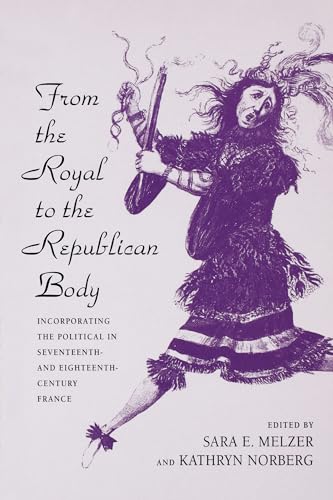
From the Royal to the Republican Body: Incorporating the Political in Seventeenth- and Eighteenth-Century France - Softcover
Inhaltsangabe
In this innovative volume, leading scholars examine the role of the body as a primary site of political signification in seventeenth- and eighteenth-century France. Some essays focus on the sacralization of the king's body through a gendered textual and visual rhetoric. Others show how the monarchy mastered subjects' minds by disciplining the body through dance, music, drama, art, and social rituals. The last essays in the volume focus on the unmaking of the king's body and the substitution of a new, republican body. Throughout, the authors explore how race and gender shaped the body politic under the Bourbons and during the Revolution. This compelling study expands our conception of state power and demonstrates that seemingly apolitical activities like the performing arts, dress and ritual, contribute to the state's hegemony. From the Royal to the Republican Body will be an essential resource for students and scholars of history, literature, music, dance and performance studies, gender studies, art history, and political theory.
Die Inhaltsangabe kann sich auf eine andere Ausgabe dieses Titels beziehen.
Über die Autorin bzw. den Autor
Sara E. Melzer is Associate Professor of French at the University of California, Los Angeles, author of Discourses of the Fall: A Study of Pascal's Pensées (California, 1986), and coeditor (with Leslie W. Rabine) of Rebel Daughters: Women and the French Revolution (1992). Kathryn Norberg is an Associate Professor at UCLA and former Director of the UCLA Center for the Study of Women. She has coedited (with Philip T. Hoffman) Fiscal Crises, Liberty, and Representative Government, 1450-1789 (1994) and is the author of Rich and Poor in Grenoble, 1600-1814 (California, 1985).
Auszug. © Genehmigter Nachdruck. Alle Rechte vorbehalten.
From the Royal to the Republican Body
Incorporating/PolBy Sara E. MelzerUniversity of California Press
Copyright © 1998 Sara E. MelzerAll right reserved.
ISBN: 9780520208070
Introduction
Sara E. Melzer and Kathryn Norberg
Few states were as body centered as seventeenth- and eighteenth-century France. The rhetoric, rites, and rhythm of political life derived from bodies. Political discourse abounded in body metaphors. Under the Bourbon monarchs, guildsmen spoke of their "corporation," and magistrates, of their "corps." Legal theorists talked about the "body politic," while royal apologists described the king as the "head" and his subjects as "members." The Jacobin republicans were no less body minded. Even though they rejected the king and replaced him with the nation, they still needed to embody authority (as either Hercules or Marianne), and they still talked about the "great body of the nation."
The most important rituals of the state also centered on bodies. At the coronation ceremony, the bishop of Reims anointed the king's body with the holy chrism. The king in turn touched, and supposedly cured, the bodies of scrofula sufferers.1 The royal entry allowed city dwellers to glimpse the king as he passed under triumphal arches that celebrated the corporal themes of Bourbon fertility and potency.2 Engagements, weddings,
Marc Bloch, The Royal Touch: Sacred Monarchy and Scrofula in England and France , trans. J. E. Anderson (London: Routledge, 1973); Richard Jackson, Vive le Roi! A History of the French Coronation from Charles V to Charles X (Chapel Hill: University of North Carolina Press, 1984); Le Sacre des rois: Actes du colloque international d'histoire sur les sacres et couronnements royaux (Paris: Les Belles Lettres, 1985).
See Lawrence Bryant, The King and the City in the Parisian Royal Entry Ceremony: Politics, Ritual, and Art in the Renaissance (Geneva: Librairie Droz, 1986). The ritual of the lit de justice also focused on the bodyb the king's body; see Sarah Hanley, The Lit de Justice of the Kings of France: Constitutional Ideology in Legend, Ritual, and Discourse (Princeton: Princeton University Press, 1983); Abby Zanger, Scenes from the Marriage of Louis XIV: Nuptial Fictions and the Making of Absolutist Power (Stanford: Stanford University Press, 1997); and Jean-Marie ApostolidC(s, Le Roi-machine: Spectacle et politique au temps de Louis XIV (Paris: Editions de Minuit, 1981).
and births of royal family members occasioned public festivals and regular celebration of Bourbon fecundity. Of course, the revolutionary republicans despised these monarchical rites and abolished them. But they created new rituals in which bodies played just as important a role. Bare-breasted statues embodied the state at the great Jacobin celebrations, and the nude portraits David did of Marat and Lepelletier de St. Fargeau became icons of the Jacobin regime.3
Under the monarchy, however, the body had a special resonance. Bourbon absolutism invested power not in anonymous institutions, as today, but in a body, that of the king. All authority flowed from the royal person, and proximity to the king equaled power. Consequently, at Versailles courtiers competed to be near his royal presence. They vied to participate in the ceremony of the levC)e, especially in the sixth entrC)e, during which they might have the enormous privilege of standing close enough to the king to hold his candle.4
Outside Versailles, French subjects had little hope of physical contact with the king, but his body was still a subject of speculation and concern. Was the king ill? Did he drink too much? Did he suffer from impotence, or was he too promiscuous?5 The monarch's appetites had political significance, for a sudden death or an interruption in the royal line could bring on civil disturbances or foreign war. Frenchmen believed that the king's health reflected on, perhaps even determined, the welfare of the realm. If the king were fertile, agriculture and commerce would prosper; if he were impotent, the kingdom too would be unproductive.6
Clearly, a special affinity existed between the king's body and his king-
Mona Ozouf, La FC*te rC)volutionnaire (Paris: Gallimard, 1976). On the paintings of Marat and Lepelletier de St. Fargeau, see Lynn Hunt, The Family Romance of the French Revolution (Berkeley: University of California Press, 1992), 74b 75. Marat's nude image also figured in revolutionary pageantry; see Marie-HC)lC(ne Huet, Rehearsing the Revolution: The Staging of Marat's Death , trans. Robert Hurley (Berkeley: University of California Press, 1982).
This ceremony is examined in Norbert Elias, The Court Society , trans. Edmund Jephcott (New York: Pantheon Books, 1983), 78b 85.
On speculation concerning the king's health, see Thomas Kaiser's essay "Louis le Bien-AlmC) and the Rhetoric of the Royal Body" in this volume.
In her forthcoming book on depopulationist delusions in eighteenth-century France, Carol Blum explores the connections believed to exist between the king's health and the material well-being of the country. On speculation regarding Louis XVI's potency, see Antoine de Baecque, Le Corps de l'histoire: MC)taphores et politique, 1770b 1800 (Paris: Calmann-LC)vy, 1993).
dom, an affinity promoted by the legal fiction of the king's "two bodies." According to medieval law, the king had a material or "natural" body and an invisible or "sacred" body. The material body died, but the sacred body lived on, for it consisted of all the king's subjects, united harmoniously in the fiction of an immaterial, figurative "body politic."7 The sacred body was the incarnation of the realm, just as the Host was the incarnation of Jesus Christ. The relationship between the king's two bodies was made visible at the king's funeral. When he died, not one but two bodiesb the second an effigyb were displayed before his mourners.8 They cried, "The king is dead; long live the king," seeing in the "natural" body being buried the immortality of the "sacred" body of the state.
Imaging the state in terms of the king's body made it difficult to conceive of the state as a separate entity. King Louis XIV articulated this fusion when he said, "In France, the nation is not a separate body but resides entirely in the person of the King"; and as Louis XV announced to the rebellious Parisian magistrates, "The rights and interests of the nation, which you dare to render as a body separate from the Monarch, are, of necessity, united with mine and remain uniquely in my hands."9 Small wonder, then, that the defining gesture of the Jacobin republic would be the beheading of the king, an act that signified the end not just of the monarchy but of a certain kind of society as well.10
If the king's body had great political significance, so too did the bodies of his subjects. As sites of signification and symbolization, subject bodies constituted a valuable "political resource," one that neither the old nor the new regime could afford to ignore.11 By disciplining the body, the monarchy mastered the mindb and nowhere did it do this more effectively than at Versailles. The noble who longed to hold the candle at the
See Ernst H. Kantorowicz, The King's Two Bodies: A Study in Mediaeval Political Theology (Princeton: Princeton University Press, 1957). For a very useful analysis of Kantorowicz's influence on French history, see Ralph E. Giesey, CC)rC)monial et puissance...
„Über diesen Titel“ kann sich auf eine andere Ausgabe dieses Titels beziehen.
Suchergebnisse für From the Royal to the Republican Body: Incorporating...

Beispielbild für diese ISBN
From the Royal to the Republican Body: Incorporating the Political in Seventeenth- And Eighteenth-Century France
Verlag:
University of California Press, 1998
ISBN 10: 0520208072
ISBN 13: 9780520208070
Gebraucht
Paperback
Anbieter: ThriftBooks-Dallas, Dallas, TX, USA
Verkäuferbewertung 5 von 5 Sternen

Paperback. Zustand: Fair. No Jacket. Readable copy. Pages may have considerable notes/highlighting. ~ ThriftBooks: Read More, Spend Less. Artikel-Nr. G0520208072I5N00
Gebraucht kaufen
EUR 13,05
Versand gratis
Versand innerhalb von USA
Versand innerhalb von USA
Anzahl: 1 verfügbar
Beispielbild für diese ISBN
From the Royal to the Republic Body: Incorporating the Political in Seventeenth- and Eighteenth- Century France
Verlag:
University of California Press, 1998
ISBN 10: 0520208072
ISBN 13: 9780520208070
Gebraucht
Softcover
Anbieter: Windows Booksellers, Eugene, OR, USA
Verkäuferbewertung 5 von 5 Sternen
Paperback. Wrappers are slightly edge worn and scuffed. 267 pages. 267 pp. Artikel-Nr. 570280
Gebraucht kaufen
EUR 8,87
EUR 6,59 Versand
Versand innerhalb von USA
Versand innerhalb von USA
Anzahl: 1 verfügbar
Foto des Verkäufers
From the Royal to the Republican Body: Incorporating the Political in Seventeenth- and Eighteenth-Century France
Verlag:
University of California Press, 1998
ISBN 10: 0520208072
ISBN 13: 9780520208070
Gebraucht
Paperback
Erstausgabe
Anbieter: Southampton Books, Sag Harbor, NY, USA
Verkäuferbewertung 5 von 5 Sternen
Paperback. Zustand: Like New. First Edition. First Edition, First Printing. Published by University of California Press, 1998. Octavo. Paperback. Book is like new. 100% positive feedback. 30 day money back guarantee. NEXT DAY SHIPPING! Excellent customer service. Please email with any questions. All books packed carefully and ship with free delivery confirmation/tracking. All books come with free bookmarks. Ships from Sag Harbor, New York. Artikel-Nr. 410243
Gebraucht kaufen
EUR 18,10
EUR 4,39 Versand
Versand innerhalb von USA
Versand innerhalb von USA
Anzahl: 1 verfügbar
Beispielbild für diese ISBN
From the Royal to the Republican Body: Incorporating the Political in Seventeenth- and Eighteenth-Century France
Verlag:
University of California Press, 1998
ISBN 10: 0520208072
ISBN 13: 9780520208070
Gebraucht
Softcover
Anbieter: Anybook.com, Lincoln, Vereinigtes Königreich
Verkäuferbewertung 5 von 5 Sternen
Zustand: Fair. This is an ex-library book and may have the usual library/used-book markings inside.This book has soft covers. In fair condition, suitable as a study copy. Please note the Image in this listing is a stock photo and may not match the covers of the actual item,550grams, ISBN:9780520208070. Artikel-Nr. 4329040
Gebraucht kaufen
EUR 21,61
EUR 15,81 Versand
Versand von Vereinigtes Königreich nach USA
Versand von Vereinigtes Königreich nach USA
Anzahl: 1 verfügbar
Beispielbild für diese ISBN
From the Royal to the Republican Body
Anbieter: PBShop.store US, Wood Dale, IL, USA
Verkäuferbewertung 5 von 5 Sternen
PAP. Zustand: New. New Book. Shipped from UK. Established seller since 2000. Artikel-Nr. L2-9780520208070
Neu kaufen
EUR 41,06
Versand gratis
Versand innerhalb von USA
Versand innerhalb von USA
Anzahl: Mehr als 20 verfügbar
Beispielbild für diese ISBN
From the Royal to the Republican Body
Anbieter: PBShop.store UK, Fairford, GLOS, Vereinigtes Königreich
Verkäuferbewertung 5 von 5 Sternen
PAP. Zustand: New. New Book. Shipped from UK. Established seller since 2000. Artikel-Nr. L2-9780520208070
Neu kaufen
EUR 38,08
EUR 4,84 Versand
Versand von Vereinigtes Königreich nach USA
Versand von Vereinigtes Königreich nach USA
Anzahl: Mehr als 20 verfügbar
Beispielbild für diese ISBN
From the Royal to the Republican Body: Incorporating the Political in Seventeenth- and Eighteenth-Century France
Verlag:
University of California Press, 1998
ISBN 10: 0520208072
ISBN 13: 9780520208070
Neu
Softcover
Anbieter: Ria Christie Collections, Uxbridge, Vereinigtes Königreich
Verkäuferbewertung 5 von 5 Sternen
Zustand: New. In English. Artikel-Nr. ria9780520208070_new
Neu kaufen
EUR 41,68
EUR 13,13 Versand
Versand von Vereinigtes Königreich nach USA
Versand von Vereinigtes Königreich nach USA
Anzahl: Mehr als 20 verfügbar
Beispielbild für diese ISBN
From the Royal to the Republican Body
Verlag:
University of California Press, 1998
ISBN 10: 0520208072
ISBN 13: 9780520208070
Neu
Softcover
Anbieter: Majestic Books, Hounslow, Vereinigtes Königreich
Verkäuferbewertung 4 von 5 Sternen

Zustand: New. pp. 286. Artikel-Nr. 4986666
Neu kaufen
EUR 56,06
EUR 7,56 Versand
Versand von Vereinigtes Königreich nach USA
Versand von Vereinigtes Königreich nach USA
Anzahl: 1 verfügbar
Foto des Verkäufers
From the Royal to the Republican Body _ Incorporating the Political in Seventeenth- and Eighteenth-Century France
Verlag:
University of California Press, Berkeley, 1998
ISBN 10: 0520208072
ISBN 13: 9780520208070
Gebraucht
Paperback
Anbieter: San Francisco Book Company, Paris, Frankreich
Verkäuferbewertung 5 von 5 Sternen
Paperback. Zustand: Very good. Paperback Octavo. illustrated wraps, 267 pp Standard shipping (no tracking) / Priority (with tracking) / Custom quote for large or heavy orders. Artikel-Nr. 78834
Gebraucht kaufen
EUR 20,00
EUR 45,00 Versand
Versand von Frankreich nach USA
Versand von Frankreich nach USA
Anzahl: 1 verfügbar
Beispielbild für diese ISBN
From the Royal to the Republican Body Incorporating the Political in the Seventeeth & Eighteenth Century France (Paper)
Anbieter: Revaluation Books, Exeter, Vereinigtes Königreich
Verkäuferbewertung 5 von 5 Sternen
Paperback. Zustand: Brand New. 1st edition. 286 pages. 9.25x6.25x0.75 inches. In Stock. Artikel-Nr. x-0520208072
Neu kaufen
EUR 58,84
EUR 11,63 Versand
Versand von Vereinigtes Königreich nach USA
Versand von Vereinigtes Königreich nach USA
Anzahl: 2 verfügbar