
Verwandte Artikel zu Unpacking Culture: Art and Commodity in Colonial and...
Inhaltsangabe
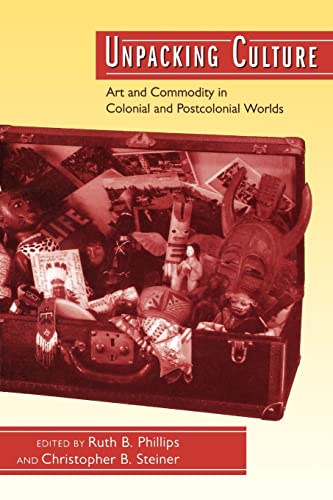
Tourist art production is a global phenomenon and is increasingly recognized as an important and authentic expression of indigenous visual traditions. These thoughtful, engaging essays provide a comparative perspective on the history, character, and impact of tourist art in colonized societies in three areas of the world: Africa, Oceania, and North America. Ranging broadly historically and geographically, Unpacking Culture is the first collection to bring together substantial case studies on this topic from around the world.
Die Inhaltsangabe kann sich auf eine andere Ausgabe dieses Titels beziehen.
Über die Autorin bzw. den Autor
Ruth B. Phillips is Director of the Museum of Anthropology and Professor of Art History and Anthropology at the University of British Columbia. She is the author of Representing Women: Sande Masquerade of the Mende of Sierra Leone (1990) and Trading Identities: Native Art and the Souvenir in Northeastern North America, 1700-1900 (1998). Christopher B. Steiner is Lucy C. McDannel '22 Associate Professor of Art History and Director of Museum Studies at Connecticut College. He is the author of African Art in Transit (1994) and coeditor of Perspectives on Africa: A Reader in Culture, History, and Representation (1997).
Von der hinteren Coverseite
"An outstanding set of studies that work well with each other to produce truly substantial and rich insights into the making and consuming of art in the colonial and post-colonial world."—Susan S. Bean, Curator, Peabody Essex Museum
Aus dem Klappentext
"An outstanding set of studies that work well with each other to produce truly substantial and rich insights into the making and consuming of art in the colonial and post-colonial world." Susan S. Bean, Curator, Peabody Essex Museum
Auszug. © Genehmigter Nachdruck. Alle Rechte vorbehalten.
Unpacking Culture
Art Commodity in Colonial PostcolonialBy Ruth B. PhillipsUniversity of California Press
Copyright © 1999 Ruth B. PhillipsAll right reserved.
ISBN: 9780520207974
1?
Art, Authenticity, and the Baggage of Cultural Encounter
Ruth B. Phillips and Christopher B. Steiner
Whereas in the Western ideal the artist is a fiercely independent, even rebellious, creator of art for art's sake, the African artist aims to please his public. This does not make all African artists crassly commercial, although that epithet can be justly applied to those who turn out knick-knacks for the tourist trade.
"AFRICAN ART BLACK MAGIC," ECONOMIST, DECEMBER 24, 1994
Throughout history, the evidence of objects has been central to the telling of cross-cultural encounters with distant worlds or remote Others. The materiality and physical presence of the object make it a uniquely persuasive witness to the existence of realities outside the compass of an individual's or a community's experience. The possession of an exotic object offers, too, an imagined access to a world of difference, often constituted as an enhancement of the new owner's knowledge, power, or wealth. Depending on the circumstances of their acquisition, such objects may evoke curiosity, awe, fear, admiration, contempt, or a combination of these responses. The exotic object may variously be labeled trophy or talisman, relic or specimen, rarity or trade sample, souvenir or kitsch, art or craft.
For the past century or so, the objects of cultural Others have been appropriated primarily into two of these categories: the artifact or ethnographic specimen and the work of art. They have, that is, been fitted into the scholarly domains defined in the late nineteenth century when anthropology and art history were formally established as academic disciplines. As a construction, however, this binary pair has almost always been unstable, for both classifications masked what had, by the late eighteenth century, become one of the most important features of objects: their operation as commodities circulating in the discursive space of an emergent capitalist economy. Although the growth of a consumer commodity culture in Europe and North America has undoubtedly been one of the most important organizing forces of social and economic life during the past two centuries, there has been a surprising silence about processes of commoditization in standard art histories and ethnographies.1 Scholars whose theories privileged this new reality?from Marx to Veblen, Baudrillard, and Bourdieu?were, until quite recently, marginalized within orthodox art history and anthropology.
The inscription of Western modes of commodity production has been one of the most important aspects of the global extension of Western colonial power. Moreover, the role of this process in transforming indigenous constructions of the object has intensified rather than diminished in many parts of the world since the formal demise of colonial rule. This volume explores instances of this inscription, together with other equally significant processes of mediation and negotiation engaged in by the inhabitants of colonial and postcolonial worlds. In every case, important consequences have flowed from innovations in the design, production, and marketing of objects, not only to those who consumed them but also to those who produced them. The makers of objects have frequently manipulated commodity production in order to serve economic needs as well as new demands for self-representation and self-identification made urgent by the establishment of colonial hegemonies.
The studies in this book range broadly both geographically and historically. The comparative perspective they offer reveals repeating patterns of imperialist encounter and capitalist exchange, as well as specific cultural and historical factors that give local productions their unique forms. Although the objects under discussion originated in such diverse times and places as mandarin China circa 1850, the American Plains circa 1880, and Kenya circa 1994, they are all equally difficult to contain within the binary schema of art and artifact. In some instances, where the fact of commoditization could be hidden, the objects have been accorded a place in one or the other category. In others, where their commoditized nature has been all too evident, they have most often fallen into the ontological abyss of the inauthentic, the fake, or the crassly commercial. A particularly dense aura of inauthenticity surrounds objects produced for the souvenir and tourist trades because they are most obviously located at the intersection of the discourses of art, artifact, and commodity. Many of the essays in this collection focus on "tourist arts" and offer particularly concentrated examples of the clash and resolution of culturally different ideas about the nature of authenticity.
Unpacking Culture is, in many ways, a successor to the groundbreaking anthology edited two decades ago by Nelson H. H. Graburn, Ethnic and Tourist Arts: Cultural Expressions from the Fourth World (1976). That volume was the first major publication to pay serious scholarly attention to the art commodities of marginalized and colonized peoples and to recognize their importance in the touristic production of ethnicity. In his introduction Graburn established a model that set the terms for the discussion of these arts. For the present volume, Graburn has provided a concluding essay, which discusses trends in the study of tourist art during the intervening years and therelationship of the individual essays in this volume to the current field of study.
Scholars today also build on recent discussions of primitivism and of the representation of non-Western arts, subjects that have achieved a new prominence in postcolonial art history and anthropology. For example, Arthur Danto et al. (1988), Sally Price (1989), Marianna Torgovnick (1990), Susan Hiller (1991), Thomas McEvilley (1992), Michael Hall and Eugene Metcalf (1994), Elazar Barkan and Ronald Bush (1995), George Marcus and Fred Myers (1995), and Deborah Root (1996) have investigated the appropriation of non-Western artists into Western aesthetic discourses. Graburn (1976a, 1984), Bennetta Jules-Rosette (1984), and more recently James Clifford (1985, 1988, 1997), Suzanne Blier (1989), Sidney Kasfir (1992), Shelly Errington (1994a), Barbara Babcock (1995), and Marta Weigle and Barbara Babcock (1996) have examined the circulation of objects among categories of scientific specimen, art, souvenir, and others. Arjun Appadurai (1986b) and Igor Kopytoff (1986) examine anthropological conceptualizations of commoditized exchange, and Nicholas Thomas (1991) and Ruth Phillips (1998) scrutinize specific historical negotiations of commoditization and art in the western Pacific and northeastern North America, respectively. Steiner's study of the contemporary West African art market (1994) focuses most closely on the mediation of knowledge that accompanies twentieth-century manifestations of art and artifact commerce, a complex network of cultural transactions similar to those addressed by many of the essays in this book.
Much of the literature on the reception of non-Western arts takes the dualistic art/artifact distinction as a given and focuses on its ambiguities and inadequacies. Confining the problem within these parameters, however, puts us in danger of validating the very terms that require deconstruction (see Faris 1988). Similar difficulties were articulated in the 1980s by Rozsika Parker and Griselda Pollock (1981) in relation to the feminist revision of...
„Über diesen Titel“ kann sich auf eine andere Ausgabe dieses Titels beziehen.
Suchergebnisse für Unpacking Culture: Art and Commodity in Colonial and...

Beispielbild für diese ISBN
Unpacking Culture: Art and Commodity in Colonial and Postcolonial Worlds
Verlag:
University of California Press, 1999
ISBN 10: 0520207971
ISBN 13: 9780520207974
Gebraucht
Softcover
Anbieter: World of Books (was SecondSale), Montgomery, IL, USA
Verkäuferbewertung 5 von 5 Sternen

Zustand: Good. Item in good condition. Textbooks may not include supplemental items i.e. CDs, access codes etc. Artikel-Nr. 00094485554
Gebraucht kaufen
EUR 4,83
Versand gratis
Versand innerhalb von USA
Versand innerhalb von USA
Anzahl: 2 verfügbar
Beispielbild für diese ISBN
Unpacking Culture: Art and Commodity in Colonial and Postcolonial Worlds
Verlag:
University of California Press, 1999
ISBN 10: 0520207971
ISBN 13: 9780520207974
Gebraucht
Paperback
Anbieter: ThriftBooks-Dallas, Dallas, TX, USA
Verkäuferbewertung 5 von 5 Sternen
Paperback. Zustand: Good. No Jacket. Pages can have notes/highlighting. Spine may show signs of wear. ~ ThriftBooks: Read More, Spend Less. Artikel-Nr. G0520207971I3N00
Gebraucht kaufen
EUR 8,00
Versand gratis
Versand innerhalb von USA
Versand innerhalb von USA
Anzahl: 1 verfügbar
Beispielbild für diese ISBN
Unpacking Culture: Art and Commodity in Colonial and Postcolonial Worlds
Verlag:
University of California Press, 1999
ISBN 10: 0520207971
ISBN 13: 9780520207974
Gebraucht
Paperback
Anbieter: ThriftBooks-Atlanta, AUSTELL, GA, USA
Verkäuferbewertung 5 von 5 Sternen
Paperback. Zustand: Very Good. No Jacket. May have limited writing in cover pages. Pages are unmarked. ~ ThriftBooks: Read More, Spend Less. Artikel-Nr. G0520207971I4N00
Gebraucht kaufen
EUR 8,02
Versand gratis
Versand innerhalb von USA
Versand innerhalb von USA
Anzahl: 1 verfügbar
Beispielbild für diese ISBN
Unpacking Culture : Art and Commodity in Colonial and Postcolonial Worlds
Verlag:
University of California Press, 1999
ISBN 10: 0520207971
ISBN 13: 9780520207974
Gebraucht
Softcover
Erstausgabe
Anbieter: Better World Books, Mishawaka, IN, USA
Verkäuferbewertung 5 von 5 Sternen
Zustand: Good. 1st Edition. Pages intact with minimal writing/highlighting. The binding may be loose and creased. Dust jackets/supplements are not included. Stock photo provided. Product includes identifying sticker. Better World Books: Buy Books. Do Good. Artikel-Nr. 9220434-6
Gebraucht kaufen
EUR 8,82
Versand gratis
Versand innerhalb von USA
Versand innerhalb von USA
Anzahl: 1 verfügbar
Beispielbild für diese ISBN
Unpacking Culture: Art and Commodity in Colonial and Postcolonial Worlds
Verlag:
University of California Press, 1999
ISBN 10: 0520207971
ISBN 13: 9780520207974
Gebraucht
Paperback
Anbieter: WorldofBooks, Goring-By-Sea, WS, Vereinigtes Königreich
Verkäuferbewertung 5 von 5 Sternen
Paperback. Zustand: Very Good. The book has been read, but is in excellent condition. Pages are intact and not marred by notes or highlighting. The spine remains undamaged. Artikel-Nr. GOR007517839
Gebraucht kaufen
EUR 3,44
EUR 6,69 Versand
Versand von Vereinigtes Königreich nach USA
Versand von Vereinigtes Königreich nach USA
Anzahl: 1 verfügbar
Beispielbild für diese ISBN
Unpacking Culture : Art and Commodity in Colonial and Postcolonial Worlds
Verlag:
University of California Press, 1999
ISBN 10: 0520207971
ISBN 13: 9780520207974
Gebraucht
Softcover
Erstausgabe
Anbieter: Better World Books Ltd, Dunfermline, Vereinigtes Königreich
Verkäuferbewertung 5 von 5 Sternen
Zustand: Good. 1st Edition. Former library copy. Pages intact with minimal writing/highlighting. The binding may be loose and creased. Dust jackets/supplements are not included. Includes library markings. Stock photo provided. Product includes identifying sticker. Better World Books: Buy Books. Do Good. Artikel-Nr. GRP70632841
Gebraucht kaufen
EUR 6,20
EUR 5,97 Versand
Versand von Vereinigtes Königreich nach USA
Versand von Vereinigtes Königreich nach USA
Anzahl: 1 verfügbar
Foto des Verkäufers
Unpacking Culture
Verlag:
University of California Press, 1999
ISBN 10: 0520207971
ISBN 13: 9780520207974
Gebraucht
Softcover
Anbieter: Hamelyn, Madrid, M, Spanien
Verkäuferbewertung 5 von 5 Sternen
Zustand: Good. : Unpacking Culture: Art and Commodity in Colonial and Postcolonial Worlds es un conjunto de estudios que ofrecen perspectivas ricas y sustanciales sobre la creación y el consumo de arte en el mundo colonial y postcolonial. Editado por Ruth B. Phillips y Christopher B. Steiner, este libro explora la intersección del arte y la cultura en diversos contextos geográficos, incluyendo Asia, África y América del Norte. Con 435 páginas, esta edición en tapa blanda profundiza en la antropología, los estudios culturales y la historia del arte, ofreciendo una visión general de los aspectos económicos y sociales del arte. EAN: 9780520207974 Tipo: Libros Categoría: Arte y Cultura|Historia Título: Unpacking Culture Autor: Ruth B. Phillips| Christopher B. Steiner Idioma: en Páginas: 435 Formato: tapa blanda. Artikel-Nr. Happ-2025-12-02-bf340bf8
Gebraucht kaufen
EUR 12,46
EUR 8,99 Versand
Versand von Spanien nach USA
Versand von Spanien nach USA
Anzahl: 1 verfügbar
Beispielbild für diese ISBN
Unpacking Culture; Art and Commodity in Colonial and Postcolonial Worlds
Verlag:
University of California, 1999
ISBN 10: 0520207971
ISBN 13: 9780520207974
Gebraucht
Soft cover
Erstausgabe
Anbieter: Ystwyth Books, Aberystwyth, Vereinigtes Königreich
Verkäuferbewertung 5 von 5 Sternen
Soft cover. Zustand: Good. 1st Edition. Good ex-library copy with the usual stamps and stickers. No further additions to text. In plastic overwrapper. Artikel-Nr. 037914
Gebraucht kaufen
EUR 16,53
EUR 9,55 Versand
Versand von Vereinigtes Königreich nach USA
Versand von Vereinigtes Königreich nach USA
Anzahl: 1 verfügbar
Beispielbild für diese ISBN
Unpacking Culture; Art and Commodity in Colonial and Postcolonial Worlds
Verlag:
University of California, 1999
ISBN 10: 0520207971
ISBN 13: 9780520207974
Gebraucht
Soft cover
Erstausgabe
Anbieter: Ystwyth Books, Aberystwyth, Vereinigtes Königreich
Verkäuferbewertung 5 von 5 Sternen
Soft cover. Zustand: Good. 1st Edition. Good reasing copy. No inscriptions. Corner of front cover a bit creased. Artikel-Nr. 038127
Gebraucht kaufen
EUR 16,53
EUR 9,55 Versand
Versand von Vereinigtes Königreich nach USA
Versand von Vereinigtes Königreich nach USA
Anzahl: 1 verfügbar
Beispielbild für diese ISBN
Unpacking Culture: Art and Commodity in Colonial and Postcolonial Worlds
Verlag:
University of California Press, 1999
ISBN 10: 0520207971
ISBN 13: 9780520207974
Neu
Softcover
Anbieter: Ria Christie Collections, Uxbridge, Vereinigtes Königreich
Verkäuferbewertung 5 von 5 Sternen
Zustand: New. In English. Artikel-Nr. ria9780520207974_new
Neu kaufen
EUR 43,97
EUR 13,48 Versand
Versand von Vereinigtes Königreich nach USA
Versand von Vereinigtes Königreich nach USA
Anzahl: Mehr als 20 verfügbar