
Verwandte Artikel zu Political Islam: Essays from Middle East Report (Merip...
Inhaltsangabe
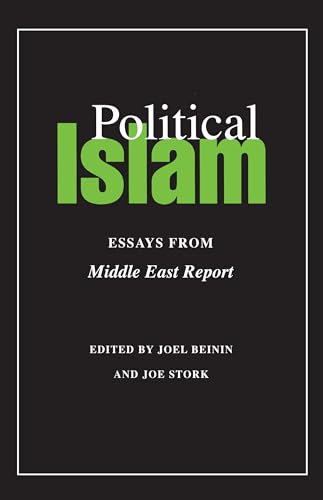
The essays and case studies collected here--featuring some of the best material from Middle East Report over the past decade as well as much original material--challenge the facile generalizations about what Western media and political establishments usually call "Islamic fundamentalism." The authors demonstrate the complexity of these movements and offer complementary and contrasting interpretations of their origins and significance. The material included covers a broad range of themes--including democracy and civil society, gender relations and popular culture--as they have emerged in countries throughout the Middle East and North Africa.
Die Inhaltsangabe kann sich auf eine andere Ausgabe dieses Titels beziehen.
Über die Autorin bzw. den Autor
Joel Beinin is Professor of History and Director of the Program in Modern Thought and Literature at Stanford University. He is an editor of Middle East Report. Joe Stork is a founder of the Middle East Research and Information Project and was Editor of Middle East Report for the first twenty-five years of its existence.
Auszug. © Genehmigter Nachdruck. Alle Rechte vorbehalten.
Political Islam
By Joel BeininUniversity of California Press
Copyright ©1996 Joel BeininAll right reserved.
ISBN: 9780520204485
1
On the Modernity, Historical Specificity, and International Context of Political Islam
Joel Beinin and Joe Stork
Let us begin with the matter of terminology. Why is this book entitled "Political Islam" and not "Islamic fundamentalism"? Certainly the phenomena and processes examined here can be and have been meaningfully compared to politically activist, socially conservative movements mobilized by revivalist Christian, Jewish, and Hindu identities.1 Nonetheless, "fundamentalism" is a problematic comparative term. It is inescapably rooted in a specific Protestant experience whose principal theological premise is that the Bible is the true word of God and should be understood literally. In this regard, it makes no sense to speak of fundamentalist Islam because one of the core elements of the creed of all believing Muslims is that the Qur'an is the literal (hence absolutely true) word of God as revealed to his Prophet Muhammad through the intermediacy of the angel Gabriel. The Islamic tradition has been very concerned with how Muslims should understand the Qur'an—which passages can be understood literally and which are so complex that they require allegorical or other forms of interpretation. But the divine origin of the text has never been a topic of legitimate debate.
There is another, more important, sense in which the term "fundamentalism" is inappropriate. "Fundamentalism" suggests the restoration of a pure, unsullied, and authentic form of the religion, cleansed of historical accretions, distortions, and modernist deviations. This is indeed how many Islamist leaders and ideologues present their ideas and the movements they lead. But it is a substantial error to conceptualize these movements as restoring an "original" form of Islam. Rather, they seek to revitalize and re-Islamize modern Muslim societies.
We term the movements examined in this volume "political Islam" because we regard their core concerns as temporal and political. They usethe Qur'an, the hadiths (reports about the words and deeds of Muhammad and his companions), and other canonical religious texts to justify their stances and actions. And they do so in all sincerity. But as many contributors to this volume suggest (especially the chapters of Sami Zubaida and Gudrun Krämer), today's Islamist thinkers and activists are creatively deploying selected elements of the Islamic tradition, combined with ideas, techniques, institutions, and commodities of the present and recent past, to cope with specifically modern predicaments: political, social, economic, and cultural issues that emerged in the Middle East as a result of the expansion of the world capitalist market, the colonization of important areas of the region by England and France, the formation of new territorial nation-states, the rise and decline of secular nationalist movements, the frustrations and failures of economic development, the reformation of gender relations, and the hybridization of culture and identity in the course of the wide range of contacts and interactions among Europeans and their cultures and the peoples of the Middle East.
Concepts like "Islamic republic" (in Iran), or the belief that post-1952 Egypt is a society of pre-Islamic ignorance (jahiliyya ), simultaneously critique and accept the institution of the modern national state. And as Karen Pfeifer makes clear, variant forms of Islamic economics do not oppose the technology of modern capitalism. Islamists do not uncritically reject modernity; they are trying to reformulate it and regulate it, using the discursive terms of the Islamic heritage.
Many of the solutions political Islam offers have no specific historical precedent in Islamic tradition. The organizational and mobilizational forms of political Islam—high-speed international communications using faxes, cassette tapes, and posters—rely on modern technology. Specific movements are often funded by businesspeople or regimes whose wealth depends on petroleum markets and other international circuits of capital. Women activists in Islamist movements respond and offer an alternative to an egalitarian model of gender relations perceived as specifically Western.
Islamist movements have posed sharp challenges to postcolonial, nationalist regimes—in Algeria (see the chapters of Meriem Vergès and Susan Slyomovics), Egypt (see the chapters of Alexander Flores and Carrie Rosefsky Wickham and the interviews with Tal 'at Fu' ad Qasim and Nasr Hamid Abu Zayd), Tunisia (see François Burgat's interview with Hamid al-Nayfar), Sudan (see the chapters of Khalid Medani and Sondra Hale), Turkey (see the chapter of Ronnie Margulies and Ergin Yildizoglu), and Iran (see the chapter of Sami Zubaida). But by and large they accept the territorial and political framework of the existing states and their economic foundations, which have been shaped by the legacy of European interests in the Middle East.
The Salafiyya Orientation
The current upsurge of political Islam, which can be said to date from the early 1970s, is not the first Islamic movement to emerge in the modern era. Historians of the modern Middle East have established a widely known canon of leaders and influential texts.2 This narrative, though misleadingly simple, usefully summarizes essential historical information, and we begin with it to lay the foundation for more complex alternatives.
In the Sunni tradition—the affiliation of the majority of Muslims who accept the legitimacy of the historical succession of the Caliphs who exercised political and military leadership of the Muslim community (umma ) after the death of the Prophet Muhammad—the conventional genealogy of modern Islamic thought begins with Sayyid Jamal al-Din al-Afghani (1839–97). Sayyid Jamal al-Din was most likely a Shi'a, but presented himself as a Sunni.3 His political career included activity in Egypt, Iran, and the Ottoman capital of Istanbul. The common theme linking his diverse activities was the need for all Muslims to unite to confront European, especially British, imperialism.
Muhammad 'Abduh (1849–1905) was a young associate of Sayyid Jamal al-Din in Egypt during the 1870s and 1880s. They spoke out against the foreign economic and political domination of Egypt that culminated in the British invasion and occupation in 1882. Exiled in Paris, they published a pan-Islamic journal (Al-'Urwa al-Wuthqa , The firmest link). When 'Abduh returned to Egypt, he partially reconciled himself to the British occupation and, with the approval of the British Consul General, Lord Cromer, eventually became chief mufti (jurisconsult) of Egypt. 'Abduh occupied himself with reforming the teaching of Arabic and the understanding of Islam, arguing that a proper understanding and implementation of the moral and ethical principles of Islam were compatible with the adoption of modern science and technology (noting, of course, that Muslims had inherited and developed Greek philosophy and science before transmitting it to the Western European Christians). 'Abduh argued that the early Muslims, the salaf (ancestors), practiced a pure and more correct form of Islam unsullied by medieval accretions and superstitions perpetuated by ignorance and unconsidered imitation.
Rashid Rida (1865–1935), who came to Egypt from Tripoli, Lebanon, was Muhammad 'Abduh's most influential...
„Über diesen Titel“ kann sich auf eine andere Ausgabe dieses Titels beziehen.
Suchergebnisse für Political Islam: Essays from Middle East Report (Merip...

Beispielbild für diese ISBN
Political Islam: Essays from "Middle East Report" (Merip Reader)
Verlag:
University of California Press (edition First Edition), 1996
ISBN 10: 0520204484
ISBN 13: 9780520204485
Gebraucht
Paperback
Erstausgabe
Anbieter: BooksRun, Philadelphia, PA, USA
Verkäuferbewertung 5 von 5 Sternen

Paperback. Zustand: Very Good. First Edition. It's a well-cared-for item that has seen limited use. The item may show minor signs of wear. All the text is legible, with all pages included. It may have slight markings and/or highlighting. Artikel-Nr. 0520204484-11-1
Gebraucht kaufen
EUR 5,02
Versand gratis
Versand innerhalb von USA
Versand innerhalb von USA
Anzahl: 1 verfügbar
Beispielbild für diese ISBN
Political Islam: Essays from Middle East Report
Verlag:
University of California Press, 1996
ISBN 10: 0520204484
ISBN 13: 9780520204485
Gebraucht
Paperback
Anbieter: ThriftBooks-Dallas, Dallas, TX, USA
Verkäuferbewertung 5 von 5 Sternen
Paperback. Zustand: Good. No Jacket. Pages can have notes/highlighting. Spine may show signs of wear. ~ ThriftBooks: Read More, Spend Less. Artikel-Nr. G0520204484I3N00
Gebraucht kaufen
EUR 6,41
Versand gratis
Versand innerhalb von USA
Versand innerhalb von USA
Anzahl: 1 verfügbar
Beispielbild für diese ISBN
Political Islam: Essays from Middle East Report
Verlag:
University of California Press, 1996
ISBN 10: 0520204484
ISBN 13: 9780520204485
Gebraucht
Paperback
Anbieter: ThriftBooks-Atlanta, AUSTELL, GA, USA
Verkäuferbewertung 5 von 5 Sternen
Paperback. Zustand: Very Good. No Jacket. May have limited writing in cover pages. Pages are unmarked. ~ ThriftBooks: Read More, Spend Less. Artikel-Nr. G0520204484I4N00
Gebraucht kaufen
EUR 6,41
Versand gratis
Versand innerhalb von USA
Versand innerhalb von USA
Anzahl: 1 verfügbar
Beispielbild für diese ISBN
Political Islam (Merip Reader)
Verlag:
University of California Press, 1996
ISBN 10: 0520204484
ISBN 13: 9780520204485
Gebraucht
Softcover
Anbieter: Wonder Book, Frederick, MD, USA
Verkäuferbewertung 5 von 5 Sternen
Zustand: Very Good. Very Good condition. With remainder mark. A copy that may have a few cosmetic defects. May also contain light spine creasing or a few markings such as an owner's name, short gifter's inscription or light stamp. Artikel-Nr. Y03K-00583
Gebraucht kaufen
EUR 6,42
Versand gratis
Versand innerhalb von USA
Versand innerhalb von USA
Anzahl: 1 verfügbar
Beispielbild für diese ISBN
Political Islam : Essays from "Middle East Report"
Verlag:
University of California Press, 1996
ISBN 10: 0520204484
ISBN 13: 9780520204485
Gebraucht
Softcover
Anbieter: Better World Books: West, Reno, NV, USA
Verkäuferbewertung 5 von 5 Sternen
Zustand: Good. Pages intact with minimal writing/highlighting. The binding may be loose and creased. Dust jackets/supplements are not included. Stock photo provided. Product includes identifying sticker. Better World Books: Buy Books. Do Good. Artikel-Nr. 11481581-75
Gebraucht kaufen
EUR 6,74
Versand gratis
Versand innerhalb von USA
Versand innerhalb von USA
Anzahl: 1 verfügbar
Beispielbild für diese ISBN
Political Islam : Essays from "Middle East Report"
Verlag:
University of California Press, 1996
ISBN 10: 0520204484
ISBN 13: 9780520204485
Gebraucht
Softcover
Anbieter: Better World Books, Mishawaka, IN, USA
Verkäuferbewertung 5 von 5 Sternen
Zustand: Good. Former library copy. Pages intact with minimal writing/highlighting. The binding may be loose and creased. Dust jackets/supplements are not included. Includes library markings. Stock photo provided. Product includes identifying sticker. Better World Books: Buy Books. Do Good. Artikel-Nr. 11632002-75
Gebraucht kaufen
EUR 6,74
Versand gratis
Versand innerhalb von USA
Versand innerhalb von USA
Anzahl: 1 verfügbar
Beispielbild für diese ISBN
Political Islam : Essays from "Middle East Report"
Verlag:
University of California Press, 1996
ISBN 10: 0520204484
ISBN 13: 9780520204485
Gebraucht
Softcover
Anbieter: Better World Books, Mishawaka, IN, USA
Verkäuferbewertung 5 von 5 Sternen
Zustand: Good. Pages intact with minimal writing/highlighting. The binding may be loose and creased. Dust jackets/supplements are not included. Stock photo provided. Product includes identifying sticker. Better World Books: Buy Books. Do Good. Artikel-Nr. 11481581-75
Gebraucht kaufen
EUR 6,74
Versand gratis
Versand innerhalb von USA
Versand innerhalb von USA
Anzahl: 1 verfügbar
Beispielbild für diese ISBN
Political Islam: Essays from Middle East Report
Verlag:
University of California Press, 1997
ISBN 10: 0520204484
ISBN 13: 9780520204485
Gebraucht
Softcover
Anbieter: Anybook.com, Lincoln, Vereinigtes Königreich
Verkäuferbewertung 5 von 5 Sternen
Zustand: Good. This is an ex-library book and may have the usual library/used-book markings inside.This book has soft covers. In good all round condition. Please note the Image in this listing is a stock photo and may not match the covers of the actual item,700grams, ISBN:9780520204485. Artikel-Nr. 7867202
Gebraucht kaufen
EUR 12,70
EUR 15,58 Versand
Versand von Vereinigtes Königreich nach USA
Versand von Vereinigtes Königreich nach USA
Anzahl: 1 verfügbar
Beispielbild für diese ISBN
Political Islam Essays from "Middle East Report"
Anbieter: Revaluation Books, Exeter, Vereinigtes Königreich
Verkäuferbewertung 5 von 5 Sternen
Paperback. Zustand: Brand New. revised ed. edition. 383 pages. 9.50x6.25x1.25 inches. In Stock. Artikel-Nr. x-0520204484
Neu kaufen
EUR 60,18
EUR 14,93 Versand
Versand von Vereinigtes Königreich nach USA
Versand von Vereinigtes Königreich nach USA
Anzahl: 2 verfügbar
Beispielbild für diese ISBN
Political Islam
Verlag:
University of California Press, 1996
ISBN 10: 0520204484
ISBN 13: 9780520204485
Neu
Softcover
Anbieter: Majestic Books, Hounslow, Vereinigtes Königreich
Verkäuferbewertung 4 von 5 Sternen

Zustand: New. pp. 383. Artikel-Nr. 4986558
Neu kaufen
EUR 84,07
EUR 7,76 Versand
Versand von Vereinigtes Königreich nach USA
Versand von Vereinigtes Königreich nach USA
Anzahl: 1 verfügbar