
Verwandte Artikel zu A Critic Writes: Essays
Inhaltsangabe
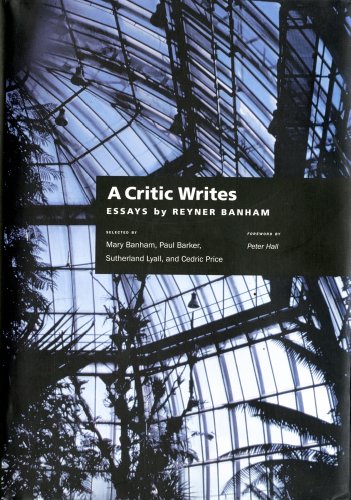
Few twentieth-century writers on architecture and design have enjoyed the renown of Reyner Banham. Born and trained in England and a U.S. resident starting in 1976, Banham wrote incisively about American and European buildings and culture. Now readers can enjoy a chronological cross-section of essays, polemics, and reviews drawn from more than three decades of Banham's writings.
The volume, which includes discussions of Italian Futurism, Adolf Loos, Paul Scheerbart, and the Bauhaus as well as explorations of contemporary architecture by Frank Gehry, James Stirling, and Norman Foster, conveys the full range of Banham's belief in industrial and technological development as the motor of architectural evolution. Banham's interests and passions ranged from architecture and the culture of pop art to urban and industrial design. In brilliant analyses of automobile styling, mobile homes, science fiction films, and the American predilection for gadgets, he anticipated many of the preoccupations of contemporary cultural studies. Los Angeles, the city that Banham commemorated in a book and a film, receives extensive attention in essays on the Santa Monica Pier, the Getty Museum, Forest Lawn cemetery, and the ubiquitous freeway system.
Eminently readable, provocative, and entertaining, this book is certain to consolidate Banham's reputation among architects and students of contemporary culture. For those acquainted with his writing, it offers welcome surprises as well as familiar delights. For those encountering Banham for the first time, it comprises the perfect introduction.
The volume, which includes discussions of Italian Futurism, Adolf Loos, Paul Scheerbart, and the Bauhaus as well as explorations of contemporary architecture by Frank Gehry, James Stirling, and Norman Foster, conveys the full range of Banham's belief in industrial and technological development as the motor of architectural evolution. Banham's interests and passions ranged from architecture and the culture of pop art to urban and industrial design. In brilliant analyses of automobile styling, mobile homes, science fiction films, and the American predilection for gadgets, he anticipated many of the preoccupations of contemporary cultural studies. Los Angeles, the city that Banham commemorated in a book and a film, receives extensive attention in essays on the Santa Monica Pier, the Getty Museum, Forest Lawn cemetery, and the ubiquitous freeway system.
Eminently readable, provocative, and entertaining, this book is certain to consolidate Banham's reputation among architects and students of contemporary culture. For those acquainted with his writing, it offers welcome surprises as well as familiar delights. For those encountering Banham for the first time, it comprises the perfect introduction.
Die Inhaltsangabe kann sich auf eine andere Ausgabe dieses Titels beziehen.
Über die Autorin bzw. den Autor
Reyner Banham (1922-1988) was Sheldon H. Solow Professor of the History of Architecture at the Institute of Fine Arts, New York University, and Professor of Art History at the University of California, Santa Cruz. His many books include Los Angeles: The Architecture of Four Ecologies (1973), Theory and Design in the First Machine Age (1980), and A Concrete Atlantis: U.S. Industrial Building and European Modern Architecture (1986). Mary Banham is an artist, editor, and curator who collaborated with her husband on his books and articles. Paul Barker, for many years editor of New Society, writes and broadcasts on social, environmental, and cultural issues. Sutherland Lyall, Literary Advisor to the Banham estate, has written seven books on architecture, design, and building. Cedric Price is an internationally acclaimed architect. The editors currently live in London.
Von der hinteren Coverseite
"Reyner Banham's special skill was to take objects that we otherwise might take for granted and to open our eyes and minds to their visual and cultural associates. Unlike many historians he had an 'eye' and this came through in his writings. He was also a popularizer—ahead of his time. These perspectives are every bit as relevant now as they were in the past."—Sir Norman Foster, Foster Associates
"Banham's stubborn insistence on the proper terms by which to measure the contemporary predicament reveals the depth and the breadth of his contribution to architectural history and theory. The modern, for Banham and for us, simply refuses to go away."—Anthony Vidler, author of The Architectural Uncanny
"Banham's stubborn insistence on the proper terms by which to measure the contemporary predicament reveals the depth and the breadth of his contribution to architectural history and theory. The modern, for Banham and for us, simply refuses to go away."—Anthony Vidler, author of The Architectural Uncanny
Aus dem Klappentext
"Reyner Banham's special skill was to take objects that we otherwise might take for granted and to open our eyes and minds to their visual and cultural associates. Unlike many historians he had an 'eye' and this came through in his writings. He was also a popularizerahead of his time. These perspectives are every bit as relevant now as they were in the past."Sir Norman Foster, Foster Associates
"Banham's stubborn insistence on the proper terms by which to measure the contemporary predicament reveals the depth and the breadth of his contribution to architectural history and theory. The modern, for Banham and for us, simply refuses to go away."Anthony Vidler, author of The Architectural Uncanny
"Banham's stubborn insistence on the proper terms by which to measure the contemporary predicament reveals the depth and the breadth of his contribution to architectural history and theory. The modern, for Banham and for us, simply refuses to go away."Anthony Vidler, author of The Architectural Uncanny
Auszug. © Genehmigter Nachdruck. Alle Rechte vorbehalten.
A Critic Writes: Selected Essays by Reyner Banham
By Reyner BanhamUniversity of California Press
Copyright 1997 Reyner BanhamAll right reserved.
ISBN: 0520088557
1
Vehicles of Desire
The New Brutalists, pace-makers and phrase-makers of the Anti-Academic line-up, having delivered a smart KO to the Land-Rover some months back, have now followed it with a pop-eyed OK for the Cadillac convertible, and automobile aesthetics are back on the table for the first time since the 'Twenties. The next time an open "Caddy" wambles past you, its front chrome-hung like a pearl-roped dowager, its long top level with the ground at a steady thirty inches save where the two tail-fins cock up to carry the rear lights, reflect what a change has been wrought since the last time any architect expressed himself forcibly on the subject of the automobile.
That was in the 'Twenties when Le Corbusier confronted the Parthenon and the Bignan-Sport, and from then to the New Brutalists the Greek Doric motor-car with its upright lines, square styling, mahogany fascia and yellowing nickel trim has remained the beau ideal of world aesthetes from Chicago to Chelsea Polytechnic. So great has been the aesthetic self-aggrandisement of architects, so great the public's Ruskin-powered terror of them that when Le Corbusier spoke, no-one dared to argue, and it has been placidly assumed ever since that all artefacts should be designed architect-
Originally appeared in Art, 1 September 1955, p. 3.
wise, and that later automobiles, which deviated from the Doric norm of the 'Twenties were badly designed. But what nonsense this is. Far from being uomini universali architects are by training, aesthetics and psychological predisposition narrowly committed to the design of big permanent single structures, and their efforts are directed merely to focussing big, permanent human values on unrepeatable works of unique art.
The automobile is not bigfew are even mantel-piece highit is not permanentthe average world scrapping period has lately risen, repeat risen, to fifteen yearsand they certainly are not unique. The effective time-base against which the impermanence of the automobile should be reckoned is less than even fifteen years, because the average re-sale periodthe measure of social obsolescenceis only three to six years, while technical obsolescence is already acute after eight to ten years. And as to uniqueness, even relatively unpopular cars have a bigger annual output than all but the most sought-after pre-fabricated, serially-produced buildings. This is a field where the architect is rarely qualified to work, or to pass judgment, and automobiles designed by architects are notoriously old-fashioned, even wherelike Walter Gropius's Adler coupsthey introduce marginal novelties such as reclining seats.
The technical history of the automobile in a free market is a rugged rat-race of detail modifications and improvements, many of them irrelevant, but any of the essential ones lethal enough to kill off a manufacturer who misses it by more than a couple of years. The "classic" automobiles whose "timeless" qualities are admired by aesthetes are nowadays the product of abnormal sales conditionsthe slump-crazy market on which Citroen's traction-avant was launched was as freakish as the commercially and ideologically protected one on which Dr. Porsche launched the Volkswagen . On the open market, where competition is real, it is the cunningly-programmed minor changes that give one manufacturer an edge over another, and the aesthetics of body-styling are an integral part of the battle for margins. Under these circumstances we should be neither surprised nor shocked to find that styling runs the same way as engineering development, and in any case there can be no norms of formal composition while the automobile remains an artefact in evolution, even though particular models are stabilised.
In fact it is a great deal more than an artefact in evolution as a concept while standardised in any passing type; it is also numerous as a possession while expendable as an individual example, a vehicle of popular desire and a dream that money can just about buy. This is a situation with which no pre-industrial aesthetic ever had to cope; even Plato's side-swipe at the ceramic trade in the Philebus falls a long way short of our current interpretative needs, for the Greek pot, though numerous and standardized, had long given up evolving and was not conspicuously expendable. But we are still making do with Plato because in aesthetics, as in most other things, we still have no formulated intellectual attitudes for living in a throwaway economy. We eagerly con-
sume noisy ephemeridae, here with a bang today, gone without a whimper tomorrowmovies, beach-wear, pulp magazines, this morning's headlines and tomorrow's TV programmesyet we insist on aesthetic and moral standards hitched to permanency, durability and perennity.
The repertoire of hooded headlamps, bumper-bombs, sporty nave-plates, ventilators, retakes, incipient tail-fins, speed-streaks and chromium spears, protruding exhaust-pipes, cineramic wind-screensthese give tone and social connotation to the body envelope; the profiling of wheel-arches, the humping of mudguards, the angling of roof-poststhese control the sense of speed; the grouping of the main masses, the quality of the main curves of the panelsthese balance the sense of masculine power and feminine luxury. It is a thick ripe stream of loaded symbolsthat are apt to go off in the face of those who don't know how to handle them.
The stylist knows how, because he is continually sampling the public response to dream-car prototypes, fantasy vehicles like Ford's fabulous Futura, but other people must be more careful. As the New York magazine Industrial Design said, when reviewing the 1954 cars, "The most successful company in the history of the world makes automobiles; in 1953 General Motors' sales totalled $10,028,000,000, an unheard of sum. Under the circumstances, passing judgment on a new crop of cars is like passing judgment on a Nation's soul."
But coupled with this admirable caution, Industrial Design also possesses a shame-faced, but invaluable, ability to write automobile-critique of almost Berensonian sensibility. In its pages, fenced about with routine kow-tows to the big permanent values, one will find passages like "the Buick . . . is perpetually floating on currents that are permanently built into the design. The designers put the greatest weight over the front wheels, where the engine is, which is natural enough. The heavy bumper helps to pull the weight forward; the dip in the body and the chrome spear express how the thrust is dissipated in turbulence toward the rear. Just behind the strong shoulder of the car a sturdy post lifts up the roof, which trails off like a banner in the air. The driver sits in the dead calm at the centre of all this motionhers is a lush situation."
This is the stuff of which the aesthetics of expendability will eventually be made. It carries the sense and the dynamism of that extraordinary continuum of emotional-engineering-by-public-consent which enables the automobile industry to create vehicles of palpably fulfilled desire. Can architecture or any other Twentieth Century art claim to have done as much? and, if not, have they any...
„Über diesen Titel“ kann sich auf eine andere Ausgabe dieses Titels beziehen.
Suchergebnisse für A Critic Writes: Essays

Beispielbild für diese ISBN
A Critic Writes : Selected Essays by Reyner Banham
Verlag:
University of California Press, 1997
ISBN 10: 0520088557
ISBN 13: 9780520088559
Gebraucht
Hardcover
Anbieter: Better World Books Ltd, Dunfermline, Vereinigtes Königreich
Verkäuferbewertung 5 von 5 Sternen

Zustand: Very Good. Former library copy. Pages intact with possible writing/highlighting. Binding strong with minor wear. Dust jackets/supplements may not be included. Includes library markings. Stock photo provided. Product includes identifying sticker. Better World Books: Buy Books. Do Good. Artikel-Nr. 4696325-6
Gebraucht kaufen
EUR 17,97
EUR 5,82 Versand
Versand von Vereinigtes Königreich nach USA
Versand von Vereinigtes Königreich nach USA
Anzahl: 1 verfügbar
Beispielbild für diese ISBN
A Critic Writes Essays by Reyner Banham: Selected Essays by Reyner Banham
Verlag:
University of California Press, 1996
ISBN 10: 0520088557
ISBN 13: 9780520088559
Gebraucht
Hardcover
Anbieter: Anybook.com, Lincoln, Vereinigtes Königreich
Verkäuferbewertung 5 von 5 Sternen
Zustand: Good. This is an ex-library book and may have the usual library/used-book markings inside.This book has hardback covers. In good all round condition. No dust jacket. Please note the Image in this listing is a stock photo and may not match the covers of the actual item,1150grams, ISBN:0520088557. Artikel-Nr. 5839423
Gebraucht kaufen
EUR 28,79
EUR 15,83 Versand
Versand von Vereinigtes Königreich nach USA
Versand von Vereinigtes Königreich nach USA
Anzahl: 1 verfügbar
Beispielbild für diese ISBN
A CRITIC WRITES: SELECTED ESSAYS BY REYNER BANHAM. (SIGNED)
Verlag:
University Of California Press, Berkeley,, 1997
ISBN 10: 0520088557
ISBN 13: 9780520088559
Gebraucht
Hardcover
Erstausgabe
Signiert
Anbieter: Burwood Books, Wickham Market, Vereinigtes Königreich
Verkäuferbewertung 5 von 5 Sternen
Hardcover. Zustand: Very Good. First Edition. Hardback. Dust Jacket. 4to. Original publishers blue cloth, lettered gilt at the spine. Signed presentation from Mary Banham on the front endpaper to Reyner Banham's brother, Paul Banham, "For Paul and family from Mary, April 1998." ISBN: 0520088557 Pages: 366 Very good indeed in very good indeed dust jacket. Signedes. Artikel-Nr. C89264
Gebraucht kaufen
EUR 59,94
EUR 26,19 Versand
Versand von Vereinigtes Königreich nach USA
Versand von Vereinigtes Königreich nach USA
Anzahl: 1 verfügbar